- 4280 views
The Civil War at Ocean Springs Chronology (1861 - 1865)
January 9, 1861 - Mississippi became the second state to leave the Union.
January 13, 1861 - Confederate forces occupy Ship Island.
March 4, 1861- Lincoln inaugurated at Washington D.C.
April 12, 1861 - Bombardment of Fort Sumter, Charleston, S.C. by Confederate forces of P.G.T. Beauregard.
July 21, 1861 - Battle First Bull Run fought in Virginia.
September 18, 1861 - The Live Oak Rifles, Company A, 3rd Regiment Mississippi Infantry, were sworn into State service. They had been organized in the spring of 1861 by A.E. Lewis, State Senator James B. McRae, and the Ramsay Family of west Jackson County. Originally 48 volunteers. Organized with the intent of protecting the coast between Ocean Springs and West Pascagoula. They fought in Kentucky, Mississippi, Georgia, Tennessee, and the Carolinas.
September 16, 1861 - Confederate forces abandon Fort Twiggs and burn the brick lighthouse at Ship Island.
December 4, 1861 - Vanguard of 18,000 Union troops lands at Ship Island under the command of Major-General Benjamin F. Butler for the assault of New Orleans.
March 1, 1862 - Ship launch from the USS Hartford anchored at Ship Island visits Biloxi and Ocean Springs. First Union soldiers to land at Ocean Springs. Did not see over ten people. Met John and Julia Egan, Irish immigrants. Egan was US Postmaster at Ocean Springs (1856-1861). Union soldiers took Egan's letter balance, fifty New Orleans newspapers, and a number of dilapidated guns, rifles, and muskets.
April 25, 1862 - Admiral David G. Farragut captured the City of New Orleans.
May 31, 1864 - After grounding off the extensive flats off Ocean Springs, the USS Cowslip and USS Narcissus, both gunboats, went about twenty-five miles up the Tchoutacabouffa River and destroyed salt works, boats and ferries. They also captured six pleasure yachts. Sawmills and logs were not destroyed. The USS Vincennes went up Fort Bayou to cut out a schooner. It had been scuttled, but two Confederate officers, Major Toby and Captain Wilkinson, were captured while they slept
August 5, 1864 - Battle of Mobile Bay fought between Union Navy under Farragut and Confederate force under Franklin Buchanan.
The Civil War Comes to Ocean Springs
by Ray L. Bellande
At the time of the Civil War (1861-1865), the population of Ocean Springs consisted of about one hundred people. They made their livelihoods by fishing and oystering, farming, logging, saw milling, and making charcoal. The tourist industry was in its infancy as the Ocean Springs Hotel had been built in 1853. Other hostelries operating north of the steamboat wharf on Jackson Avenue were the Seashore House, Morris House and Egan House. There may have been a structure near Marble Springs, situated on Old Fort Bayou and present day Iberville Drive.
As the Mississippi coast was not a commercial agricultural area, the slave population was small. The 1860 Federal Slave Census of Jackson County, Mississippi indicates that there were only about one thousand slaves at Jackson County in 1860. Very few families at Ocean Springs were affluent enough to possess slaves. On September 18, 1861 or about eight months after Mississippi seceded from the Union, the Live Oak Rifles, Company A, 3rd Regiment Mississippi Infantry, were sworn into state service. The company had been organized in the spring of 1861, by A.E. Lewis, State Senator James B. McRae, and the Ramsay family of West Jackson County. There were initially forty-eight volunteers mobilized with the intent of protecting the Mississippi coast between Ocean Springs and West Pascagoula. Instead the unit fought in Kentucky, Mississippi, Georgia, Tennessee, and the Carolinas. Of the two hundred ten men of the Live Oak Rifles who marched out of Ocean Springs in 1861, only seven returned in 1865.
During the late years of the Civil War, the defense of the Mississippi Gulf Coast was in the hands of Colonel Abner Clayton Steede (1828-1901) who commanded the 9th Mississippi Calvary known as Steede's Mounted Partisan Rangers. Steede was born at Uniontown, Alabama and moved to Jackson County in 1850. His forces were small and relied on guerilla tactics. Steede is believed to have owned land at Ocean Springs after the war. With the Union blockade in the Mississippi Sound and many local farmer mustered into various military units, food supplies, especially corn, were scarce. Mrs. Josephine Bowen Kettler (1845-1933+), daughter of Reverend Philip P. Bowen, lived at Ocean Springs until starvation drove her family to Eucatta, Mississippi in 1862. In an interview with Schuyler Poitevent (1875-1936) in 1933, she related the following: "We had no bread. We had to eat sweet potatoes all the time; and once we sent a nigger slave seventy-five miles for a bushel of corn meal and he could get only a part of it, and after we sifted the meal for bread we parched the husks and used them for coffee. We would roll a fish in a paper and green leaves and cover it with hot ashes and bake it that way, for we had neither lard nor tallow to fry with".
Mrs. Kettler also told of a telegraph operator named Steel. The last time she saw him the Yankees were shooting at him as he fled down the branch. Later in the conflict local conditions ameliorated as indicated by a letter dated June 27, 1864, from Fred Wing (1814-1895) of Ocean Springs to Moses Greenwood at Mobile concerning conditions at Ocean Springs stated:
"We are well and get along pretty smoothly. Breadstuffs are high, corn $12 to $14 per bushel, but then contra, we have fish and oysters for the trouble of catching and fruit in abundance. Chickens and eggs we raise and if hard pressed go out and shoot a rabbit".
In a letter to Governor Pettus, W.A. Champlin, a War Tax Collector from Handsboro, who constantly moved through Jackson County to avoid capture by the Yankees wrote the following about Ocean Springs:
On last Monday a number (of Yankees) from Ship Island landed at Ocean Springs and staid till Tuesday at the house of one John H. Brown, who resides there, and claims to be a British subject, though he has made a large fortune in New Orleans. Many women, some calling themselves Ladies entertain these Yankee officers, and walk with them on the streets, and load them with Bouquets, etc. when they depart. They threaten to arrest me, and Stop my collection of the War Tax, and I do not know when it may be done, as I am constantly moving about. I am sorry to say among traitors on shore, who would sell any one for a small consideration. Since New Orleans has fallen (April 25, 1862) a large number of small vessels some say one hundred are trading with the coast by license of Lincoln's commander, buying wood, charcoal, lumber, etc. and much of this is doubtless for the Enemy's use. This will if continued greatly demoralize the people on the Coast, who are very poor and needy and in my opinion ought at once to be stopped.
In December 1861, the Union forces of General Benjamin F. Butler began arriving at Ship Island. They were massing for the invasion of New Orleans. A contingent of sailors and marines associated with this force landed at Ocean Springs on March 1, 1862. They came from a launch assigned to the USS Hartford, which was Admiral David G. Farragut's flagship. The New York Herald of March 25, 1862, reported the incident as follows:
We now steered for Ocean Springs, and on landing we found we were on Eagan's Wharf, which is well built and is several hundred yards in length. On it is a railroad track used for transporting goods from the boats, which land there. We seated ourselves on the car and the marines were our steam, or rather motive power.
Here we met but one sore-faces Creole. Of course, we let him go, but he followed us. On leaving "the cars", we passed through a dilapidated building (This could have been the Seashore Hotel), by another, and we were in Ocean Springs, and were the first landing party of Union men who have been here since the war. Our footsteps were directed to the Post Office, where we found Mrs. J. Eagan in charge. Mrs. E. is a good looking lady from the Emerald Isle, of a fiery temper, and with finger nails ling enough to do some tall scratching with. Her better half, John, arrived soon after we entered the domains of the Confederate States of America Post Office Department. He wore an angry look and a seedy coat; was tall in stature and in his speech; had a contemptuous air and an air of onions; was not a Northerner or Southerner but was born in Ireland; was a postmaster under Buck (President Buchanan) who illthrated him, and now he was one of Mr. Davis' postmasters. He had returned all his stamps, but kept his letter balance to balance his accounts. Colonel Jones could not see his balance in that light, and after weighing the thing in his mind came to the conclusion not to be found wanting in the scales of duty, and carried off Eagan's balance because it bore these significant characters---P.O.D.U.S. (Post Office Department United States). Eagan was mad, but Mrs. Eagan was madder, and she gave us a little bit of Irish advice. Ocean Springs is a beautiful place and well adapted for a watering place. It is smaller than Biloxi, which place was built up under the influence of the Southern land excitements. Ocean Springs is almost entirely deserted and we did not see over ten persons there. The object of our visit being eminently successful, and having taken about fifty New Orleans papers, we prepared to return. Bidding Eagan & Co. goodbye, we "took the cars" for the end of the wharf were we found that the Hartford's launch crew had made a seizure of quite as number of guns, rifles, and muskets, all of them in dilapidated condition. They were probably brought there for the purpose of complying with an order to the citizens to send their old arms to New Orleans to be repaired. We put them in the boat and started for the New London.
The city of New Orleans fell to Union forces on April 25, 1862. In desperation, many coast people began a contraband trade with the enemy at Ship Island and New Orleans. Tar, pitch, turpentine, lumber, charcoal, wood, and livestock were exchanged for coffee, flour, shoes, clothing, and medicine. Early in the war, coast residents had bartered salt with inland farmers who provided corn, potatoes, vegetables, and fresh or smoked meat.
In August 1949, Joseph Lewis "Dode" Schrieber (1873- 1951) related the following tale of his step-father, German immigrant, Joseph Letzler (1832-1908), to Ellis Handy (1891-1963), creator of "Know Your Neighbor", in The Gulf Coast Times.
Joseph Letzler was trying to make his way overland from New Orleans to Ocean Springs sometimes during the fall of 1863. He was without food and traveled through the Honey Island swamp area and was either just crossing or had crossed the Rigolets when he was arrested by Negro Federal troops. He was three days without food and had no particular reason for any sectional loyalty in a foreign country. He asked for food but was told he must either enlist with the federal forces or be confined. He served for some eighteen months with Company E Louisiana Infantry and later received a federal pension. After the close of the war Letzler came to Ocean Springs.
The Union Navy Western Gulf blockading squadron, which patrolled the Mississippi Sound occasionally made forays up the local bayous and rivers. One such incident reported by a correspondent for The New Orleans Weekly Times on June 18, 1864, follows: On Tuesday, May 31st, the gunboat, USS Narcissus, Wm. G. Jones, commanding, and the USS Cowslip, Robert Canfield commanding, went on an expedition up the Back Bay of Biloxi in command of Lieutenant Commander W.F. Fitzhugh of the US steamer Sebago. At 10 o'clock A.M., we grounded on the extensive flats off Ocean Springs, not having sufficient water to cross. After hard labor for twenty-four hours, by heaving at anchors and lightening the vessels of their iron platings, we succeeded in crossing the flats. There have been several attempts since the war to penetrate into the rivers on the Back Bay of Biloxi but they have always failed. But through the perseverance and energy of Lt. Commander Fitzhugh and the commanders of the Cowslip and Narcissus, we have succeeded in getting over the difficult shoals. The Cowslip and Narcissus went twenty-five miles further up the Chucatabuff (Tchoutacabuffa) River than any steamer previous to or since the war. They destroyed all the salt works and boats and ferries on the way, and also brought down six very fine pleasure yachts. In addition, the Federal raiders captured two very important officers, Major Toby and Lieutenant Wilkinson, of the Rebel army. The launch of the USS Vincennes, with acting Master Billings in charge was also on the expedition and rendered very efficient service. Also, the 3rd cutter, in charge of Boatswain Smith of the Vincennes, who volunteered to go to Fort Bayou at midnight to cut out a schooner, which was in the bayou was apart of the flotilla. When Smith arrived there he found the schooner scuttled by the rebels. He went up to a house and surrounded it and demanded admittance, and captured the Major and Lieutenant in their beds. This has been a bad blow to the rebels as they never expected that our gunboats could cross the shoals. We also captured a new boiler shaft and everything complete suitable for a small propeller. The inhabitants on the river banks received us with joy and at some places the ladies serenaded us. The country through which we passed is one of the most beautiful I ever saw. Fruits in abundance, and cattle by hundreds were to be seen. We passed several very extensive saw-mills and the creeks were full of pine and cypress logs. We did not destroy the saw-mills, as they will be useful to Uncle Sam some future day. All the boats we could not bring off, we destroyed. Everyone did his duty. The commanders and officers of the Cowslip and Narcissus were up night and day, wet to the skin for three days, as it rained steadily the whole time. The rebels must bless the Yankees for bringing them rain. We also brought off one deserter and several refugees. Since my last report, the Narcissus has captured two more boats from Mobile and the Cowslip one.
Many families from the Ocean Springs area fought in the Civil War. Among them were: Bellande, Bellman, Bosarge, Bowen, Carco, Carroll, Catchot, Cox, Cruthirds, Davis, Fayard, Fountain, Fournier, Gill, King, Krohn, Lecand, Letzler, Mon, Noble, O'Keefe, Pons, Quave, Ramsay, Ryan, Scarborough, Seymour, Van Cleave, Vaughn, Westbrook, Woodcock, and Zirlott.
When those who survived the conflict returned home, one can only surmise that they were heavily scarred from the ordeal. The shrimp, oysters, and fish were still in the bay. The Ocean Springs Hotel reopened. Life would go on. By 1870, the railroad reached town and the economy would get better.
Camp of Confederate Veterans
In early April 1903, a temporary camp of Confederate Veterans was organized at Ocean Springs. E.N. Ramsay was elected captain and Dr. H. Shannon, secretary. Attendees were: Enoch N. Ramsay, W.D. Bullock, W.G. Bullock, Julian Fayard, etc. (The Pascagoula Democrat-Star, April 10, 1903, p. 3)
REFERENCES:
Cyril E. Cain, Four Centuries of the Pascagoula, Volume II, (Cain: State College, Mississippi-1962), p. 66-67.
H. Grady Howell, Jr., To Live and Die in Dixie, (Chickasaw Bayou Press: Jackson, Mississippi-1991), p. 135 and 311.
Schuyler Poitevent, Broken Pot, (unpublished manuscript in the Department of Archives and History at Jackson, Mississippi), Chaper 7 (Biloxi Bay), pp. 3-4.
Charles Sullivan, The Mississippi Gulf Coast: Portrait of a People, (Windsor Publications: Northridge, California-1985), pp. 89, and 97.
M. James Stevens Collection, Biloxi Public Library, Biloxi, Mississippi-Book No. 25.
The Daily Herald, "Biloxi’s Hardships During Civil War’, May 28, 1930.
The Daily Herald, "A Bit Of Civil War History", May 31, 1930.
The Historian of Hancock County, "Civil War Days", October 1994, p. 3.
The Pascagoula Democrat-Star, "Death of Col. A.C. Steede", November 15,
1901, p. 3.
The Pascagoula Democrat-Star, "Ocean Springs Locals", April 10, 1903.
1860 Federal Slave Census of Jackson County, Mississippi
___________________________________________________________________________
The Spanish-American War Comes
to Ocean Springs: 1898
by Ray L. Bellande

Probably members of Company B 5th US Volunteers
(courtesy of Norton Haviland)
Slightly over one hundred years ago, the United States and Spain fought a short-term global war. Although the causes for this bellicose action is complex possibly being a combination of Spain’s long internal strife with the Cuban people, the aggressive nature of American capitalism, and yellow journalism by the American press, this conflict had its immediate cause at Havana, Cuba, where the USS Maine, a 318-foot long, American battleship, commanded by Captain Sigsbee, was mysteriously destroyed on February 15, 1898. Several hundred American service men, aboard the Brooklyn Navy Yard built vessel, were killed by a large internal explosion, possibly caused by spontaneous combustion of her coal bunkers. (The Pascagoula Democrat-Star, February 18, 1898, p. 2, c. 2)
Republican President William McKinley (1843-1901) and the US Congress declared war on Spain on April 21, 1898. The Spanish-American War had several impacts on Mississippi and the South. The economy in the region improved, but the conflict was also the catalyst, which returned Southern people to the mainstream of American cultural life. The pangs of the Civil War defeat and Reconstruction were still felt in the South. The Spanish-American War united former enemies and a new sense of nationalism was reborn. As one former Confederate soldiers said, "if we couldn’t whip Uncle Sam in four years we shouldn’t allow someone else to come here and do what we couldn’t do ourselves". (McLemore-1973, p. 492)
In late May 1898, by a special act of Congress, ten regiments of Immunes from the South were authorized for the Spanish American War. Five regiments were colored and five white. They were selected for garrison duty in Cuba and other tropical environments.(The Biloxi Daily Herald, May 28, 1898, p. 7)
Like many small American towns, Ocean Springs was affected by the Spanish American War. As we shall see, many of our young men volunteered for action in this short duration conflict. Two naval heroes of this war, Admirals Dewey and Schley, were honored locally. Dewey Avenue was named for Commodore George Dewey (1837-1917) who defeated the Spanish fleet at Manila Bay in the Philippines in May 1898. Joseph Bellande (1819-1907) sold the city a thirty-five foot strip of land south of Porter to the A.G. Tebo property for $100 in May 1898, from which the thoroughfare was created. (Minute Book 1, Town of Ocean Springs, Mississippi)
An award winning paper shell pecan was named for Rear Admiral Winfield Scott Schley (1839-1911), who was credited with the destruction of the Spanish fleet fleeing the Cuban port of Santiago de Cuba. This decisive naval engagement in July 1898, virtually ended the conflict. Albert Grant Delmas of Pascagoula developed the Schley (pronounced Sly) Pecan. In 1900, it won a bronze medal at the International Exposition in Paris. The silver medal was awarded the nut in 1904, at the St. Louis Exposition. A.G. Delmas served the people of Jackson County as Chancery Clerk from 1876-1884. (The History of Jackson County, Mississippi-1989, p. 21)
Another bit of local trivia concerning the Spanish American War was that probably the first shot fired in the conflict was directed at the Spanish merchantman, Buenaventura. This vessel took on a cargo of lumber at Pascagoula and was bound for Rotterdam when it was fired upon a captured by the USS Nashville on April 22, 1898, near Key West, Florida. (O’Toole, 1984, pp. 200-201)
Mississippi’s initial quota for the Spanish-American War was two regiments. The Federal Government funded the conflict. In late April 1898, Governor Anselm J. McLaurin (1848-1909) called for volunteers. By early May, Camp Port Henry was set up near Jackson to receive volunteer troopers. The Mississippi National Guard supplied over half the men who enlisted to fight the Spanish in Cuba and the Philippines. (Rowland-1978, p. 558)
About twenty-five young men volunteered from Ocean Springs for military duty in the Spanish-American War. They were represented for the most part in the 1st Mississippi InfantryRegiment, 2nd Mississippi Infantry Regiment, and the 5th US Volunteer Infantry (Immunes). The Immunes were composed of men who were considered immune to yellow fever.
In Cuba, the US Army lost about 2600 men in this conflict. Only 346 were killed or died from wounds. Disease accounted for over 2200 American lives. Although many were inflicted with malarial fever and other tropical ailments, the Ocean Springs contingent of servicemen returned safely. The Spanish-American War cost the country about $900,000,000. (The Pascagoula Democrat-Star, October 7, 1898, p. 1, c. 7 and August 26, 1898, p. 1, c. 4)
The hostilities of the Spanish-American War ended on August 12,1898. The Pascagoula Democrat-Star facetiously wrote on August 26, 1889, "All mines having been removed from Biloxi Bay, Mr. Narcisse Seymour (1849-1931) treated the guests of the Shanahan House to a delightful boat ride on his sloop, Leonie". At this time, Mr. Seymour was associated in the oyster business with Phil McCabe of Biloxi. (The Pascagoula Democrat-Star, November 18, 1898)
The peace treaty ending the Spanish-American War was signed at Paris on December 10, 1898. By virtue of this treaty and an earlier agreement reached at the cessation of fighting in August 1898, Spain gave Cuba her freedom, ceded the Philippines, Puerto Rico, and Guam to the United States. Spain received $20,000,000 from the US and agreed to be responsible for its Cuban debt. (Encyclopedia Americana, 1995, p. 449).
Following is a chronological synopsis from local journals of the months of 1898-1899, as relating to the effects of the Spanish-American War at Ocean Springs:
In March 1898, rumors of war with Spain were ubiquitous about Ocean Springs. Colonel Loren H. Whitney of Chicago, who had recently built a cottage on Porter (now the domicile ofMike Smith at 619 Porter) expected to tender his services as Brigadier General in case of war Whitney was writing the history of the three principal world religions. (The Pascagoula Democrat-Star, March 18, 1898 and January 24, 1902)
Ocean Springs became directly involved in this war on April 13, 1898, when Colonel Edward Webb Morrill (1839-1910), a Confederate veteran, of Biloxi, commander of the 1stRegiment of the State National Guard, mustered Battery D, 1st Regiment, Mississippi National Guard into service. Twenty-seven men led by Captain Sam T. Haviland (1845-1911), 1st Lt. Joseph B. Garrard (1871-1915), and 2nd Lt. Joe March (1876-1939), met at Firemen’s Hall on Washington Avenue. Their quota was forty men, which was expected to be met by the end of the week. (The Biloxi Herald, April 16, 1898, p. 8)
Battery D boarded the naptha launch, Odette, and sloop, Creole, owned by Captain Marsh, in late April 1898, and embarked for a drill called by Colonel E.W. Morrill at Biloxi. (The Pascagoula Democrat-Star, April 29, 1898)
In early May, local physician, Dr. Edward Reneau Bragg (1862-1916), was appointed surgeon for the 3rd Alabama Regiment-US Army and expected to go to Cuba. He left Mobile for the West Indies in early June 1898. (The Pascagoula Democrat-Star, June 10, 1898) Dr. Bragg was sent to New York to recover from the effects of Cuba in August 1898. (The Pascagoula Democrat-Star, September 2, 1898). He reported to Washington D.C. in early October. (The Pascagoula Democrat-Star, October 7, 1898) Bragg returned to Cuba and held a position at Santiago de Cuba in November 1898. (The Pascagoula Democrat-Star, November 18, 1898)
Lt. Garrard and orderly Sergeant Clark of the J.B. Rose Light Artillery secured a number of recruits from the Fort Bayou community. They were sworn into service. (The Pascagoula Democrat-Star, May 6, 1898).
In mid-May, Will Casey (1875-1960), Henry Gottsche (1875-1905), Phil Bellman (1872-1927), John Cullinan, and Frank Jackson joined the Scranton Battery. (The Pascagoula Democrat-Star, May13,1898).
On May 30, 1898, Teddy Roosevelt’s Rough Riders passed rapidly through Ocean Springs on a troop train. Perhaps the most unique and colorful unit in the US Army, the Rough Riders were en route to Tampa, Florida, their embarkation port, for Cuba. (The Biloxi Herald, June 4, 1898)
Roosevelt’s troops, the First United States Volunteer Cavalry, were mustered in New Mexico, Arizona, Oklahoma, and Indian Territory. They met in San Antonio, Texas to prepare for the conflict with Spain. (Roosevelt-1971, p. 7 and p. 14)
In early June 1898, Lt. J.B. Garrard left Ocean Springs with ten men for Jackson, Mississippi to enlist with Captain Wood’s Company of the 2nd Infantry Regiment of the Mississippi Volunteers. Among his cohorts were: Sergeant V.L. Beyer, W.V. Shannon, Charles Bellman, P.H. Champlin, F.A. Schrieber, John Catchot, and Jack Richards. About the same time,Anton P. Kotzum (1871-1916) was appointed Band Master of the 2nd Texas Volunteers stationed at Camp Coppinger. (The Pascagoula Democrat-Star, June 10, 1898)
In late June 1898, Edwin A. Clark (1853-1936) gave a dinner in honor of his son, Charles Clark (1879-1945), and his soldier friends, Thornton Vaughan (1868-1898+) Joseph Marsh, and Silas Boyd (1876-1950). These young men were leaving Ocean Springs for a military camp at Columbus, Mississippi. They reported to Colonel Sargeant. (The Pascagoula Democrat-Star, June 24, 1898)
With Martin Rooney, these men left for Columbus. Miss Jessie Boyd sang the Star Spangled Banner when they departed. Martin Rooney was rejected for military duty because of his low body weight. (The Pascagoula Democrat-Star, July 1, 1898 and July 8, 1898)
Three Ocean Springs soldiers are ill at Jacksonville, Florida. Corporal Joe Garrard and Charlie Bellman of the 2nd Mississippi Volunteers have been sick, but are much improved. (The Pascagoula Democrat-Star, August 12. 1898)
Garrard returned to Ocean Springs to recover from malarial fever. (The Pascagoula Democrat-Star, August 19, 1898)
Will Shannon also of the 2nd Volunteers returned to Ocean Springs with his father, Dr. Harry Shannon (1831-pre 1909), who went for him. (The Pascagoula Democrat-Star, August 26, 1898).
With the combat phase of the conflict over, men began to return to Ocean Springs. Private Henry Gottsche returned on furlough in the first week of September. (The Pascagoula Democrat-Star, September 16, 1898)
Other personnel of the 1st and 2nd Regiments of the Mississippi Volunteers were also home on furlough. The 1st Mississippi was represented by: Sergeant Frank Jackson, Corporal Will Casey, and Bugler Phil Bellman. Also, Sergeant Vincent Beyer, Corporal J.B. Garrard, Will Shannon, Dolph Schrieber, Porter Champlain, Len Hopkins, and John Catchot were enjoying furlough from the 2nd Regiment-Mississippi Volunteers. (The Pascagoula Democrat-Star, September 23, 1898).
Ab Jackson of the 2nd Alabama regiment arrived home last week and was warmly greeted. (The Pascagoula Democrat-Star, September 30, 1898).
Ab Jackson left for Montgomery, Alabama to rejoin his regiment, the 2nd Alabama and expects to be mustered out. (The Pascagoula Democrat-Star, October 28, 1898)
Ab Jackson returned to Ocean Springs as his unit was mustered out. (The Pascagoula Democrat-Star, November 11, 1898)
Our boys of the 1st and 2nd Infantry regiments left Sunday for Columbia, Tennessee where they will be mustered out of service. (The Pascagoula Democrat-Star, December 2, 1898)
Sergeant Frank Jackson and Will Casey were mustered out and went to work on the Shaffer Sugar Plantation at Terrebonne Parish, Louisiana. (The Pascagoula Democrat-Star,December 12, 1898)
Master Horace Culver, son of Lieutenant George Culver of the 5th Immunes US Volunteers Santiago de Cuba is home again. (The Pascagoula Democrat-Star, January 13, 1899).
Bugler Manny Clark of the 5th US Volunteers, Immunes, returned to Ocean Springs. He was expected to recover quickly from the effects of the Cuban climate. (The Pascagoula Democrat-Star, March 17, 1899)
Dr. E.R. Bragg is home and will rent from Herman Nill (1863-1904) an office building north of Nill’s Drugstore on Washington Avenue. (The Pascagoula Democrat-Star, April 21, 1899)
Apparently, Dr. Bragg quickly changed his plans as he made a decision to relocate to Biloxi. His Illinois born, sister-in-law, L.W. Hyatt (1866-1900+), was living with them there in 1900. (The Pascagoula-Democrat-Star, April 28, 1899)
Dr. Edward Reneau Bragg (1862-1916) studied medicine at Tulane. He was licensed to practice medicine in Jackson County in April 1889. His father, Dr. William D. Bragg (1833-1891) of Moss Point, supervised his post-graduate medical training. Dr. Bragg was situated in the Nill Building at Ocean Springs as early as April 1891. He ran this advertisement in The Biloxi Daily Herald on October 9, 1900:
Dr. E.R. Bragg-Biloxi, Mississippi
Office 2nd Floor of Dukate’s Theater-Telephone 11
Dr. Bragg expired at Biloxi on May 16, 1916. His remains and those of his wife, Emma Hyatt (1868-1968), and son, Edward H. Bragg (1900-1927), are interred in the Bragg-Hyatt family plot at the Biloxi City Cemetery.
US VOLUNTEERS -5th Immune Regiment

Colonel H.H. Sargent, Commander USV 5th Infantry
This unit, composed of men from Alabama, Mississippi, and Louisiana, was mustered at Columbus, Mississippi, in late July 1898. Colonel H. H. Sargent was in command. The 5th Immune Regiment was sent to Cuba to relieve the troops of General Shafter at Santiago de Cuba, after the fighting there had subsided. They performed garrison duty here from August 1898 until March 1899. Their chief enemy was malaria and yellow fever and the other pestilence which pervaded this tropical island. (Rowland-1978, p. 560).
The 5th Immune Regiment left Columbus, Mississippi on August 6, 1898, for Savannah, Georgia, their embarkation point for southeastern Cuba. The troop transports left Savannah on the 8th of August, and arrived at Santiago de Cuba on the morning of August 12, 1898. Major James K. Vardaman (1861-1930), who resigned from the editorship of The Greenwood Commonwealth to lead a battalion of soldiers of the 5th Immunes, wrote a series of letters to his wife, Anna Burleson Robinson Vardaman. They give a detailed picture of a soldier’s life and living conditions in the tropics. The Vardaman letters were published in The Journal of Mississippi History, in April 1947. Before the Spanish-American War, Texas native, J.K. Vardaman, was a lawyer-newspaper editor. He practiced law at Winona and was editor of The Winona Advance (1882). Vardaman relocated to the Delta and edited The Greenwood Enterprise-Greenwood Commonwealth from 1890-1903. Returning from Cuba, he entered politics and was elected as a populist Democratic Governor serving the State from 1904-1908, in that capacity. Vardaman was Mississippi’s U.S. Senator from 1913-1919. He became known as "the great white father". (Biographical Directory of the American Congress-1961, p. 1751).
Major James K. Vardaman led about 82 enlisted men from Mississippi to Cuba. These young men left home robust and healthy. At Cuba, seven died, twenty-five were sent home, and for the most part the remainder "looked more like half-animated cadavers than the stalwart men they were when the regiment first landed on Cuban soil". (The Pascagoula Democrat-Star, April 14, 1899)
In May 1899, the 5th US Volunteer Infantry was sent to Camp Meade at Middleton, Pennsylvania. They were mustered out in June 1899. (The Pascagoula Democrat-Star, May 19, 1899)
On June 23, 1899, "Anchorage", the Shearwater neighborhood home of Mrs. Jessie Boyd, was the site of a soiree for the comrades of her son, Sgt. Silas Boyd, who had fought with the 5thUS Volunteers in Cuba. Invitees were: Lt. George Culver, Sgt. Charles Clark, Sgt. Joe Marsh, Corp. Thornton Vaughan, Corp. Will Ryan, and Bugler Manny Clark. (The Pascagoula Democrat-Star, June 30, 1899)
5th Immune Men from Ocean Springs

Company B, 5th US Volunteer Infantry
Camp Walthall, Mississippi-Spring 1898
(courtesy of Norton Haviland)
Sergeant Silas Weeks Boyd (1876-1950)-Silas W. Boyd was the son of Texan William Boyd and Jessie M. Weeks (1855-1932). He was born at Summitt, Mississippi. Silas Boyd made his livelihood as a salesman in a grocery store at Ocean Springs, when he returned from the Spanish-American War. In 1910, at New Orleans he commenced in the lumber business as Enterprise Lumber and Commission Company. (The Ocean Springs News, October 15, 1910)
Silas Boyd was married to Daisy Davis. Their children were: Mrs. Ralph Hurst, Mrs. Marlin Rains, Robert Weeks Boyd, and Beverly Boyd. The Silas W. Boyd family settled at Jackson, Mississippi. (The Daily Herald, February 23, 1950, p. 8, c. 1)
Sergeant Charles E. Clark (1879-1945)-Charles E. Clark was the son of Massachusetts born, Edwin A. Clark (1853-1936), and Katherine T. Glasscock (1853-1930). He was born at Concordia Parish, Louisiana. The Clark family came to Ocean Springs in 1897. Here, Charles married LuLu Haviland (1880-1972). They were childless. Returning from Cuba, Clark became a college student and studied medicine. He was educated at LSU and Cumberland University. At Ocean Springs, he worked for the railway mail service and five years as rural mail carrier at Ocean Springs. Clark was also an attorney. In 1936, he was officed on the 2nd floor of the Farmers & Merchants State Bank Building. (The Daily Herald, April 6, 1945, p. 8, c. 3)
Bugler Alexander M. "Manny" Clark (1880-1950)-Manny Clark was the son of James Lundy Clark (1850-1914) and Charlotte Virginia Richards (1859-1939). He was born at Ocean Springs. Manny Clark was married to Donna Hilton. Their children were: Grace Clark, Mary Clark, Dr. Lamar S. Clark (1911-1996), and A.M. Clark Jr. Dr. Lamar S. Clark received a Doctor of Divinity degree from SMU. During WW II, he was a highly decorated chaplain with the 24th Infantry Division in the South Pacific theater. Dr. Clark ministered to the Methodist faithful in east and southeast Texas, during his long ministerial career. Mr. Manny Clark was a merchant at Gulfport and later moved to Houston, Texas. In retirement, he returned to Ocean Springs and lived with Joe L. "Dode" Schrieber’s family on East Porter Avenue. Manny Clark expired in July 1950, at the Biloxi VA Center. His remains were interred in the Clark Family plot in the Evergreen Cemetery at Ocean Springs. (The Daily Herald, July 22, 1950, p. 2, c. 3 and Lurline S. Hall, 1998).
Lieutenant George Culver (d. 1906) was married to Virginia 'Vina' Norwood Jones (1855-1906) of Chicago. They married on June 6, 1899 in Jackson County, Mississippi. She was the daughter of Mr. and Mrs. Frederick W. Norwood of Chicago and East Beach. The Norwoods acquired the Charnely Cottage on East Beach at Ocean Springs in June 1896.
In January 1900, Lieutenant Culver, a staff member of General Wood, was sent to Santiago de Cuba to supervise construction work for the government. Mrs. Culver joined her husband in Cuba in March 1900. She took passage aboard the steamer, Transit, out of the port of Mobile. (The Pascagoula Democrat-Star, January 5, 1900, p. 3 and March 9, 1900, p. 3)
When George Culver returned from Cuba to Ocean Springs, he was the manager for Southern Lands, a real estate company owned by W.R. Snyder (1846-1919).
The Culvers were killed in the great storm of September 1906. He had taken a post as custodian of the Emily C. Lyon estate oyster planting grounds on the coast of Alabama, south of Grand Bay. In March 1908, Mrs. Culver’s corporal remains were exhumed by J.Y. Morgan, an undertaker, and brought from Bayou Herron, probably a small settlement on Mon Louis Island, to the Evergreen Cemetery at Ocean Springs. (The Pascagoula Chronicle Star, March 14, 1908, p. 3)
Their son, Horace Culver, was living at Hattiesburg in April 1903, and in Mobile in July 1914, where he was circulation manager of The Mobile Item. Young Culver had come to Ocean Springs in July 1914, to visit friends here in his racing sloop while attending the Biloxi regatta. (The Pascagoula Democrat-Star, April 10, 1903, p. 3 and The Ocean Springs News,July 18, 1914, p. 5)
Sergeant Joseph B. Marsh (1876-1939). Sergeant Marsh was born in Fitzpatrick, Alabama in December 1876. His parents were from Georgia and Alabama respectively. He was the nephew of S.T. Haviland (1845-1911). (Federal Census 1900-Jackson County, Mississippi)
Before the war, Joseph B. Marsh was the skipper of the sloop, Creole. He with Thornton Vaughan and Bob Jones ran an oyster dredging operation in the Louisiana marshes. When they returned from an oystering expedition in January 1898, Mr. Jones left the trio to find employment elsewhere. (The Pascagoula Democrat-Star, January 21, 1898, p. 3)
J.B. Marsh was elected to be regimental color bearer of the 5th Immune Regiment of Colonel H.H. Sargent. (The Pascagoula Democrat-Star, July 29, 1898).
Joseph B. Marsh expired on December 23, 1939, at the Biloxi Veterans Facility. He had been here for a month. Mrs. Marsh resided in Jackson, Mississippi. J.B. Marsh’s corporal remains were sent to Brookhaven, Mississippi for internment. (The Daily Herald, December 26, 1939)
Major Hernando Deveaux. Money (1869-1936)-H.D. Money served in Cuba as a battalion commander. He was charged with the Barracoa District, under the overall command of General Leonard Wood. H.D. Money resided north of Fort Bayou on a large farm (formerly the Rose Farm) where he raised citrus and pecans. He was married to Lucretia Eggleston (1876-1929) and was a cousin of Captain James K. Vardaman. The Money children were: Deveaux Money Ackley (1900-1986) and Lucretia Money Parlin (b. 1900). After the conflict, the H.D. Money Camp of Spanish-American War Veterans at Gulfport, were named in his honor. H.D. Money ran an unsuccessful campaign for the 6th Congressional seat in 1928 election. He passed December 15, 1936 at the Wanalaw Plantation in Holmes County, Mississippi. Money’s remains were interred in the Evergreen Cemetery at North Carrollton, Mississippi. (The Daily Herald, December 16, 1936, p. 1, c. 3 and The Ocean Springs Record, January 6-20-1994, p. 14)
Corporal William Edward "Will" Ryan (1877-1925)-William E. Ryan was the son of Antoine Ryan (1846-1908) and Marie Ryan (1846-1886+). He worked on a steamboat in 1900, and moved to Biloxi circa 1907, where he worked for the Biloxi police force. Ryan later made his livelihood as keeper of the Biloxi Yacht Club. He married Theodora Vuyovich (1886-1944) of Biloxi. Their children were: Oliver Ryan (1907-1930+), Marshall J. Ryan (1910-1930), Theodora Ryan (c. 1914), Rayoal Ryan (c. 1917), and William Ryan. The family resided at 804 Reynoir Street. Will Ryan’s corporal remains were interred in the Biloxi City Cemetery. (The Daily Herald, December 2, 1925, p. 2, c. 5 and Krohn,1995, p. 16).
A son, Marshall J. Ryan (1910-1930), died of pneumonia in March 1930. He worked for the Mississippi Ice and Utilities Company. (The Daily Herald, March 15, 1930, p. 2, c. 2)
Corporal Thornton A. Vaughan (1868-1933)-Thornton A. Vaughan was the son of Dr. Milton Clay Vaughan (1832-1903) and Fanny Thornton (1840-1875). His father was a dentist at Ocean Springs and served as mayor in 1895-1896. Vaughan’s siblings were: Susie Willis Vaughan (1869-1962), Milton Clay Vaughan Jr. (1873-1923), and Fannie Thornton Vaughan(1873-1965). Thornton Vaughn made his livelihood here after the conflict as a carpenter. He died in late December 1933. Vaughan’s remains like the remainder of the M.C. Vaughan family are interred in the Evergreen Cemetery at Ocean Springs. (The Daily Herald, January 1, 1934, p. 2, c. 2)
The following is a letter written from Cuba by Thornton A. Vaughan (1868-1933) to his aunt, Susan W. Price:(The Pascagoula Democrat-Star, September 1898)
Ocean Springs, Mississippi
Dear Aunt:
One week in camp and everything in fair shape. The colonel, sergeant, and all officers in our regiment are the equals of any officers in the United States service. Our boys are doing well and would enjoy a skirmish, even with natives; anything to break the monotony of garrison life. The climate resembles that of our coast, but must be a few degrees warmer, as this island is so much nearer the equator.
We are encamped on an eminence overlooking the Bay of Santiago, and surrounded by high hills or low-lying mountains, whose sides are ornamented with graceful palm trees. Bamboo grows in the ravines or valleys to a height of probably forty feet and as large around as a quart cup.
At present we drill one hour each day and have other work to occupy two or three hours, morning and evening. We lounge around in tents and smoke, talk, and spin yarns. We do not know what our future will be. Some say we will be discharged in a few weeks, while others think we will be retained for garrison duty for months. I do not care about going into the city often, but would like to feel free, and to be able to explore the country about me.
Yours,
Santiago de Cuba
MISSISSIPPI VOLUNTEERS-1st Infantry Regiment
This military unit was commanded by Colonel George M. Govan. They were mustered in at Jackson, Mississippi on May 26, 1898, but soon left for the US Army camp at Chickamauga Park, Tennessee. The 1st Mississippi Infantry regiment was mustered out at Columbia, Tennessee on December 20, 1898. (Rowland-1978, pp. 558-559)
The men from Ocean Springs, who volunteered for the 1st Regiment, US Volunteers, served in Company D led by Edgar R, DuMont of Scranton (Pascagoula). They were as follows:
Miss. Volunteers, 1std Infantry Regiment-Men from
Ocean Springs Company D
Bugler Phillip Bellman (1872-1927). Phillip Bellman was enrolled as a private by Captain DuMont at Scranton on April 27, 1898. He was appointed company musician on July 5, 1898. Bugler Bellman was mustered out at Columbia, Tennessee on December 20, 1898, by Captain W.B. Homer, 6th Artillery. (Spanish-American War Service Record Extracts 1898-1899, No. 204).
Phillip Bellman was the son of Charles W. Bellman (1841-1885) and Elmina Brown (1843-1880+). After the war, he returned to Ocean Springs and worked as a butcher. Bellman married Alice Seymour (1880-1957), the daughter of local seafood shipper, Narcisse Seymour (1849-1931), and Caroline V. Krohn (1847-1895) in May 1899. They reared a large family at Ocean Springs. By 1910, Phil Bellman made his livelihood as an oysterman. He started in the seafood business for himself in March 1916. His packing house, The Ocean Springs Fish and Oyster Company, was located on the beach between Washington and Jackson Avenue. Bellman made a specialty of the Eagle Point Oyster. (The Ocean Springs News, March 23, 1916, p. 6, c. 7). He passed on at Biloxi on March 3, 1927, and his remains were interred in the Bellande Cemetery at Ocean Springs.
.jpg)
Corporal Will H. Casey (1875-1960)
image made by A.W. Judd, Chattanooga, Tennessee
Courtesy of Joseph B. Garrard II from the Verta Lee Bradford Van Cleave family collection.
Corporal Will H. Casey (1875-1960). Corporal Will Casey was born at Clinton, Louisiana, the son of John F. Casey (1844-1907) and Mary Emma Casey (1851-1928). His sister, Eudora Casey Van Cleave (1876-1950), was the wife of William S. Van Cleave (1871-1938). The Van Cleaves operated a store on the northwest corner of Washington and Porter for several decades. Casey became a railroad engineer for the Illinois Central Railroad in 1903. He lived at Gulfport and was active in Spanish-American War Veterans causes on the national, state, and local level. Casey served as commander of the H.D. Money Camp No. 12 at Gulfport, for many years. His remains like those of most of his family are interred in the Evergreen Cemetery at Ocean Springs. (The Daily Herald, August 13, 1960, p. 2)
Will Casey joined Company D of the 1st Mississippi Volunteer Infantry Regiment on April 27, 1898, at Scranton. He was mustered into service at Camp Port Henry on May 9, 1898, by Lt. Lockwood. Casey was discharged on December 1,1898, at Columbia, Tennessee. (Spanish-American War Service Record Extracts 1898-1899- No. 486).
Henry B. Gottsche-(1875-1905)-Henry B. Gottsche was the son of German immigrants, Hans Heinrich Gottsche and Christiana Switzer? The family came to Ocean Springs from New Orleans circa 1870. The Gottsche family owned a homestead on Washington Avenue in Block 27-Lot 14 (Culseig Map of 1854). After the Spanish-American War, Henry B. Gottshce was a laborer on the bridge gang of the L&N Railroad. His brother, Albert C. Gottsche (1873-1949), who had worked for the Davis Brothers general merchandising store, commenced an enterprise of his own in October 1910, which developed into the legendary Gottshe’s Thrifty-Nifty. It was located on the Gottsche family lot at the southwest corner of Washington and Desoto. Henry B. Gottsche expired on February 2, 1905. His remains were interred in the Evergreen Cemetery. (The Biloxi Herald, February 3, 1905, p. 6, c. 2)
Sergeant Frank T. Jackson-In November 1897, Frank Jackson was associated with the US Marine Hospital Service. He mustered into the military at Scranton on April 27, 1898. No further information. (The Pascagoula Democrat-Star, November 19, 1898)
Some Biloxians who served in Company D, under Captain duMont were: Gus Henzelena (1869-1953), A.V. Foretich, Tom McCabe, W. Smith, John Fayard, and Emile Tremmel. Private Tremmel (1869-1898), a native of New Orleans, died of sickness at Camp Chickamauga, Tennessee, in late August 1898 His remains were accompanied to Biloxi by Gus Henzelena. (The Biloxi Daily Herald, December 22, 1898, p. 8, c. 1 and August 27, 1898, p. 8, c. 3)
Also, Albert Irish Hann, son of Gelon Hann. (see DH, 12-4-1933, p. 1)
The 2nd Infantry Regiment led by Colonel William A. Montgomery was mustered at Camp Port Henry near Jackson, Mississippi in early June 1898. The unit was discharged on December 20, 1898, at Columbia, Tennessee. Company B of the 2nd Infantry Regiment-Mississippi Volunteers was commanded by Edgar H. Woods of Rosedale, Mississippi.(Rowlands, 1978 p. 559)
The men from Ocean Springs who served in Company B were as follows:
Miss. Volunteers, 2nd Infantry Regiment-Men from
Ocean Springs Company B
Private Charles M. Bellman (1876-1956). Bellman was enrolled for military service by Captain Woods at Ocean Springs on June 4, 1898. He was mustered in by Lt. Lockwood at Jackson, Mississippi on June 7, 1898. Private Bellman was mustered out of the volunteer army on December 20, 1898 at Columbia, Tennessee by Captain W.B. Homer. (Spanish-American War Service Record Extracts 1898-1899-No. 204).
Charles M. Bellman was the son of Charles W. Bellman (1841-1885) and Elmina Brown (1843-1880+). He made his livelihood as a conductor for the GM&O RR and resided at Mobile. No further information. (The Daily Herald, September 26, 1956, p. 2, c. 1)
Quartermaster Sergeant Vincent L. Beyer (1874-1920+). V.L. Beyer was born in Texas. He mustered in at Jackson on June 4, 1898. Beyer was promoted to Quartermaster Sergeant on August 1, 1898. He mustered out at Columbia, Tennessee on December 20, 1898. (Spanish-American War Service Record Extracts 1898-1899-No. 225)
V.L. Beyer was married to Effie Beyer, a Mississippi native. Her father was German and mother from the Magnolia State. His parents were from New York and Louisiana. In 1920, V.L. Beyer was a nurseryman at Ocean Springs and the father of eleven children. No further information. (Federal Census 1920-Jackson County, Mississippi).
Cook John J. Catchot (1863-1910)-John J. Catchot was the son of Spanish immigrant, Arnaud Catchot (1834-1910), and Adele Ryan (1844-1880). He married Bessie Robbins circa 1900. Their children were: Maggie Catchot (1901-1910+), Albertine Catchot (1903-1903), Frazine Catchot (1904-1910+), William Jerome Catchot (1906-1910+), and Frank Catchot (1909-1910+). Catchot made his livelihood as a railroad laborer. (Federal Census 1910-Jackson County, Mississippi) He was mustered into the Army at Jackson on June 4, 1898, by Lt. Lockwood, and mustered out at Columbia, Tennessee by Capt. W.B. Homer, 6th Artillery. (Spanish-American War Service Record Extracts 1898-1899-No. 490).
John J. Catchot’s corporal remains were interred in the Bellande Cemetery on Dewey Avenue.
Porter Hand Champlin (1870-1933)-Porter H. Champlin was the son of Dr. Anthony P. Champlin (1839-1897) and Margaret Smith. Dr. Champlin was a physician at Biloxi. He was born and educated at New Orleans and was a quarantine physician for several years at Ship Island. At the time of his demise, Dr. Champlin was in charge of the Cat Island Quarantine Station. (The Biloxi Herald, May 15, 1897, p. 8, c. 3) His niece, Lee B. Champlin (1884-1964), the daughter of Judge Zachary T. Champlin (1847-1924), married Daniel Judson Gay (1870-1949). Their son, John Champlin Gay (1909-1975), was Mayor of Ocean Springs from 1953-1961 and from 1965-1969. (The Ocean Springs Record, June 29, 1995, p. 20)
Porter Hand Champlin was named for his uncle, Porter B. Hand. Porter B. Hand (1834-1914) was born at New York, the son of Miles B. Hand (1804-1880+), the founder of Handsboro. Porter Hand married Margaret Champlin (1835-1880+), the sister of Dr. A.P. Champlin, in May 1855. The Hands were childless. Porter Hand was a merchant at Biloxi until early 1888, when he returned to Handsboro. Here he built the schooner, Winnie Davis, in April 1888. (The Biloxi Herald, May 12, 1888, p. 8, c. 2)
In 1905, Mr. Hand also operated a bucket factory at Ocean Springs with George L. Friar (1870-1924).
After the demise of his wife, Porter Hand married Marie Anna Adams (1846-1935). At the time of his demise, the Hands resided at the foot of Oak Street in Biloxi. Hands’s remains were interred in the Biloxi Cemetery. (The Daily Herald, August 13, 1914, p. 5, cc. 4-6)
Private Porter H. Champlin was born at Bay St. Louis, Mississippi on July 3, 1870. He resigned his position under Captain Dana, lighthouse inspector, in April 1898, and visited friends at Ocean Springs. He mustered in at Jackson on June 4, 1898, and discharged after the muster rolls were completed. (The Pascagoula Democrat-Star, April 15, 1898 and Spanish-American War Service Record Extracts 1898-1899, No. 506).
P.H. Champlin married Leonie Dufrechon (1880-1929), a native of New Orleans, at Biloxi on January 8, 1900. She was the daughter of Baptiste Dufrechon and Laura Bosarge. They were the parents of three children: Louis Champlin, Laura Rousseau, and Mrs. Julius Strong. (The Daily Herald, January 18, 1929, p. 2).
After the Spanish-American War, Porter Hand Champlin resided at 1301 Bradford Street in the East Back Bay section of Biloxi where he made his livelihood as a fisherman. Porter H. Champlin expired on January 30,1933. His final respects were given by members of the Admiral Thomas P. Magruder Camp, Spanish-American War Veterans of Biloxi. Internment was at the Biloxi Cemetery. (The Daily Herald, January 30, 1933, p. 6, c. 2 and January 31, 1933, p. 2, c. 2)
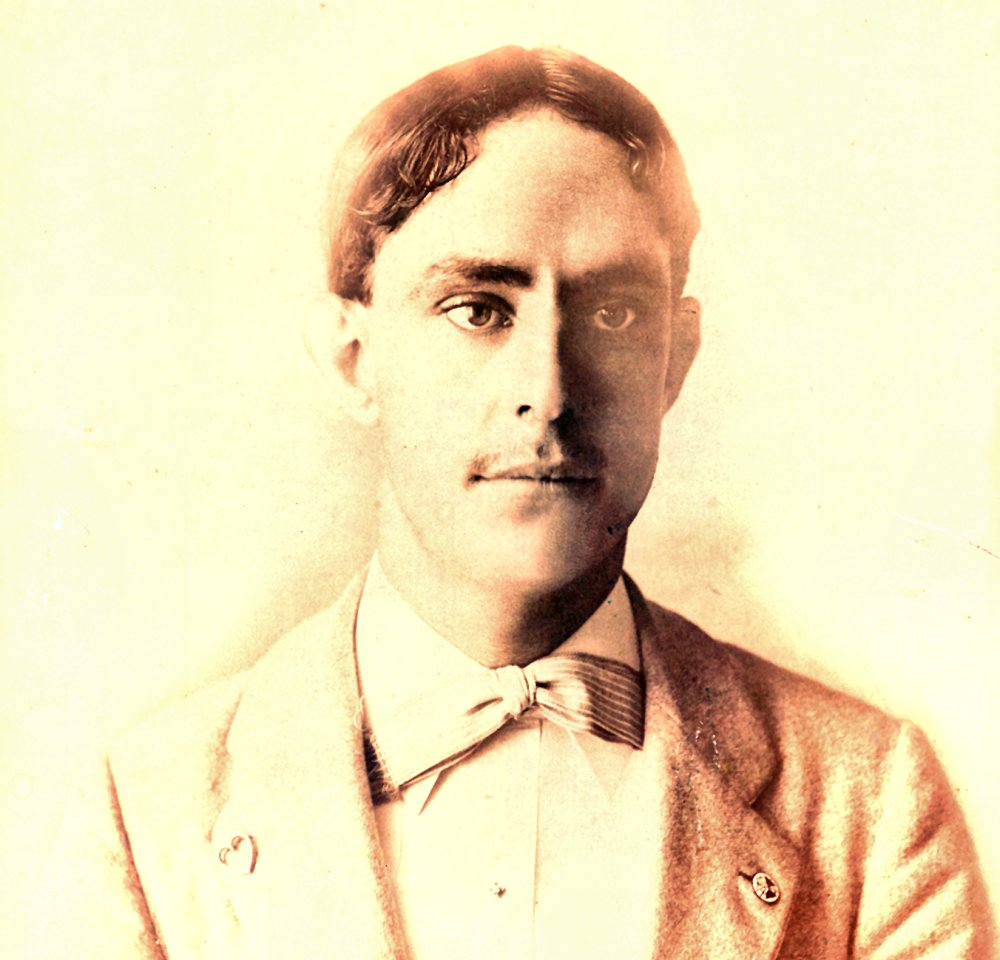
Joseph B. Garrard
[Courtesy of Jack K. Garrard and Mary Lee Williams Garrard]
Corporal Joseph B. Garrard (1871-1915). Joseph B. Garrard was born at New Orleans the son of James J. Garrard (1828-1902) and Francesca V. Marks (1839-1907). Joseph B. Garrard was mustered in at Jackson on June 4, 1898. Mustered out at Columbia, Tennessee on December 20, 1898. Corporal Garrard was seriously wounded on the march to Santiago de Cuba when he fell into a pit of poisoned spears. One of the stakes penetrated his abdomen, but prompt action by the company surgeon saved his life. (Spanish-American War Service Record Extracts 1898-1899. No. 997 and WPA, 1936-1938, p. 178)
In October 1899, Joseph B. Garrard was with the 29th Regiment, U.S. Volunteers and sent to the Philippine Islands. His mother was the recipient of one of his missives sent from Honolulu in the Sandwich Islands, now the Hawaiian Islands. (The Pascagoula Democrat-Star, November 3, 1899, p. 3)
Joseph B. Garrard married Carrie Ann Johnson (1886-1968) of Algiers, Louisiana in January 1906. Their children were: James F. Garrard (1906-1972) and Frank Benson Garrard (1908-1919). Mr. Garrard made his livelihood in Ocean Springs as a brick manufacturer and hardware merchant. Ward I Alderman, Joseph B. Garrard II, and his brother, Jack Garrard, who resides in the J.B.Garrard family home on Iberville Drive, are grandsons.
Private Leonard Hopkins (1871-1900+)-Leonard Hopkins was the son of Mississippi native, the widow, Marancy Hopkins (1853-1909+). Leonard Hopkins was born in Texas, the son of a Canadian father. He had eight siblings in 1900. No further information. (Federal Census 1900-Jackson County, Mississippi)
Private Jack D. Richards-Private Jack Daniel Richards [1879-1948] was born at Ocean Springs, Mississippi in 7 June 1879. He married Virginia Ryan [1885-1974] and they reared a large family at New Orleans where Jack made his livelihood as a carpenter. Children: Ethel Richards; Estelle Lillian Richards [1905-1985] m. Henry J. Scoggins [1904-1943] and Daniel H. Lathrop [1914-1988]; Ester Richards; Etta Richards; John Richards; Daniel Richards; Inez Richards; Wallace Richards; James D. Richards; and Eunice Richards. Jack Dan Richards expired at NOLA6 August 1948. His corporal remains were interred in Saint Joseph No. 1 Cemetery at NOLA. Richards was mustered in at Jackson, Mississippi on June 4, 1898, by Lt. Lockwood. He was mustered out at Columbia, Tennessee on December 20, 1898, by Captain W.B. Homer, 6th Artillery. No further information. (Spanish-American War Service Record Extracts 1898-1899, No. 2585)
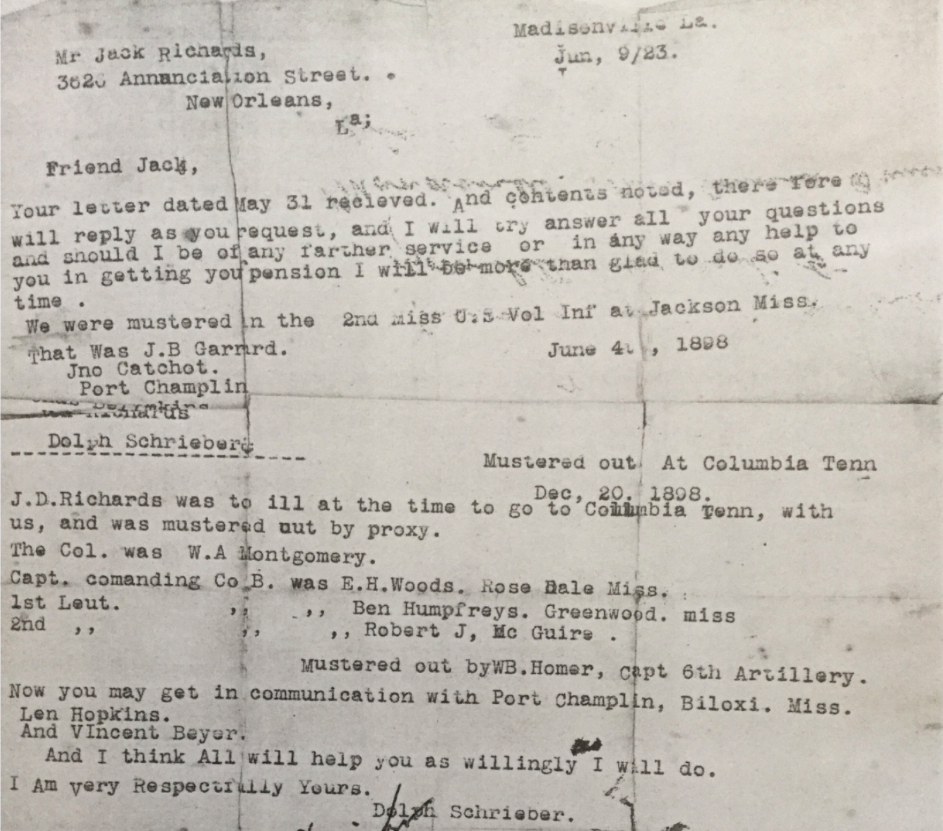
[courtesy of
Private Will V. Shannon (1878-1910)-Will V. Shannon was the son of Dr. Harry Shannon (1831-1900+) and Lucy Irwin (1838-1910+). He was mustered into military service at Jackson on June 4, 1898. Private Shannon was mustered out at Columbia, Tennessee on December 20, 1898. Dr. Shannon owned a large citrus orchard called "Shannondale". The Fort Bayou Estates occupies this site today. (Spanish-American Was Service Record Extracts 1898-1899, No. 2764)
Will Shannon died suddenly from heat prostration at El Centro, California in July 1910. He had recently located here. His remains were interred at El Centro. (The Ocean Springs News, July 30, 1910)
Other men from Ocean Springs who served in the Spanish-American War were as follows:
29th US Volunteers

F.A. Schrieber
[courtesy of Lowell F. Ford-Torrance, California]
F.A. Schrieber (1871-1944)-Frederich Adolph Schrieber, called Dolph, was the son of German immigrants, Adolph Josef Schrieber (1835-1875) and Rosina Christian (1834-1920). Dolph Schrieber married Lily Alice Rupp (1889-1972). Their children were: Rachel S. Wright (1911-1968), Robert F. Schrieber (1915-1973), Leah S. Thayer (1917-1992), Joseph W. Schrieber (1921-1953), E.M. Ashley Schrieber (1919-2001), Mildred S. Ford (1923-1978), and Allen Schrieber (1925-1985).
In August 1899, Dolph Schrieber re-enlisted with the 29th US Volunteers and was assigned to CO G and sent to the Philippine Islands to fight in the Philippine Insurrection. He was discharged in May 1901 with the rank of corporal.(Lowell F. Ford, January 3, 2007)
After returning from military duty in the Philippine Islands, Mr. Schrieber secured land at Marsh Point and planted rich oyster beds in the waters of Davis Bayou. He later joined the US Lighthouse Service and spent his career at light stations on the Louisiana and Mississippi coastlines(The Jackson County Times, March 18, 1944, p. 1, c. 2).
In 1929, Dolph and Lily Schrieber bought the Hamilton Conner (1855-1929) cottage on Ward Avenue adjoining the home of her parents, Robert Rupp (1857-1930) and Pauline Thieme (1857-1945). They retired here in 1937, after his career in the US Lighthouse Service was completed. Mr. Schrieber’s last duty station was at Biloxi. (Schrieber, August 10, 1998)
US VOLUNTEERS-2nd Alabama Infantry
Albert Beyer-No further information.
George Beyer-No further information.
Albert Jackson (1920+)-Albert Jackson was the son of Dr. Albert Jackson (1841-1925) and Laura Scott (1844-1922). Dr. Jackson served in the Civil War with Company E of the 5thAlabama Infantry. He was the lessee-manager of the Ocean Springs Hotel from 1895 to about 1898. Dr. Jackson relocated to the Mobile area where he ran the Spring Hotel. Albert Jackson later resided in Biloxi at 124 West Beach where he cared for his parents in their old age. (Bellande,1994, p.13 )
1st Louisiana Volunteer Infantry-Company B
H. Peter Madsen (1879-1918)-was the son of Henry Peter Madsen (1854-1892), a Danish immigrant shoemaker, and Margaret Jennett Friar (1857-1932), the daughter of Hiram Heath Friar (b. 1825) and Elizabeth A. Baxter (1823-1900+). H.P. Madsen and Margaret Friar married in 1876. Their children were: George L. Madsen (1877-1877), Amelia A. Madsen(1878-1878), H. Peter Madsen (1879-1918), and Nathaniel C. Madsen (1881-1948). Hall Peter Madsen married Elizabeth Toche (1882-1978) on January 31, 1900. Their family consisted of: Hal P. Madsen (1901-1971), Helen M. Belton (1907-1988), Ruth M. Mullins (b. 1912), and Vera Madsen (b. 1916). He expired on November 3, 1918, from the influenza during the pandemic episode of 1918. Mr. Madsen worked at the Dierks-Blodgett shipyard in Pascagoula at the time of his demise. (The Jackson County Times, November 9, 1918, p. 5. c. 3)
Mrs. Elizabeth T. Madsen married Harry Struchen of Fairview, Pennsylvania in February 1928. (The Jackson County Times, February 18, 1928)
US VOLUNTEERS-2nd Texas Infantry
Charles Blount-No further information.
A.P. Kotzum (1871-1916). Anton P. Kotzum was the son of local blacksmith-real estate mogul, Joseph Kotzum (1842-1915), and housewife, Josephine Kotzum (1845-1920). During the 1898 conflict with Spain, he was appointed Band Master of the 2nd Texas Volunteers at Camp Coppinger. Tony Kotzum left Ocean Springs for Alameda, California after the Spanish-American War. He returned home in September 1915 and soon founded the Eagle Point Oyster Company with Spanish-American war veteran, Phil Bellman (1872-1927). In October 1895, Kotzum was married to Julia C. North. Their children were Joseph Kotzum and Alice Kotzum. After his demise in September 1916, the family returned to California. (The Ocean Springs Record, March 7, 1996, p. 14)
John D. Collins Jr. (1889-1900+) John D. Collins Jr. was the son of John D. Collins (1848-1900+) and McCall? Collins (1854-1900+). He served aboard the USS Texas, a light battleship. (The Pascagoula Democrat-Star, July 29,1898). The USS Texas was built at the Norfolk Navy Yard in the late 1880s. The vessel was of English design and was lighter, but faster than the other American battlewagons. USS Texas saw action at the bombardment of Caimanera in June 1898, and the Battle of Santiago de Cuba in July 1898. When Admiral Cervera (1833-1898+) aboard his flagship, Infanta Maria Teresa, and the Spanish fleet attempted to run the American naval blockade at Santiago de Cuba on July 3, 1898, they were intercepted by the USS Texas and other US naval forces and destroyed. No further information. (Photographic History of the Spanish-American War, 1898, pp. 19-20 and p. 275)
On December 25, 1898, Chief Bugler Alexander Merrian "Manny" Clark (1880-1950) composed a poem, "The Fifth Immunes", which was the infantry unit in which he served at Santiago de Cuba from August 1898 until May 1899. Clark’s last verse of this ballad appropriately follows:
Now my story is ended,
I will bring it to a close,
How I wish I was in Mississippi,
Where the watter mellons grow.
Once again we would all be happy,
And fill up on beer and prunes,
And we’d say the devil with Cuba,
And three cheers for the Fifth Immunes.
REFERENCES:
BOOKS
Ray L. Bellande, Ocean Springs Hotel and Tourist Homes, (Bellande: Ocean Springs-1994).
Darlene J. Krohn, The Descendants of Jerome Ryan, (Krohn: Latimer, Mississippi-1995), p. 16.
Richard A. McLemore, A History of Mississippi, Volume II, (University and College Press of Mississippi: Hattiesburg, Mississippi-1973).
Minute Book Volume One of the Town of Ocean Springs, Mississippi.
G.J.A. O’Toole, The Spanish War: An American Epic 1898, (W.W. Norton & Company: New York-1984).
Theodore Roosevelt, The Rough Riders, (reprinted by Corner House Publishers: Williamstown, Massachusettts-1971),
Dunbar Rowland, Military History of Mississippi, (reprinted by The Reprint Company: Spartanburg, South Carolina-1978)
Biographical Directory of the American Congress 1774-1961, (U.S. Government Printing Office-Washington, D.C.-1961).
Encyclopedia Americana, Volume 25, (Grolier Inc.: Danbury, Connecticut-1995).
The History of Jackson County, Mississippi, "Pecans", (Jackson County Genealogical Society: Pascagoula, Mississippi-1989).
--------------------------------------------------------, "James J. Garrard", (Jackson County Genealogical Society: Pascagoula-1989).
Photographic History of the Spanish-American War, (The Pearson Publishing Company: New York-1898).
MICROFILM
Spanish-American War Service Record Extracts 1898-1899. (Microfilm at Mississippi Department of Archives and History-Jackson, Mississippi).
JOURNALS
The Journal of Mississippi History, "The Spanish-American War As Revealed Through The Letters of Major James K. Vardaman", Volume 9, No. 2, April 1947.
VFW, "‘Mock’ Battle for Manila", August 1998.
NEWSPAPERS
The Biloxi Herald, "Death of Dr. A.P. Champlin", May 15, 1897.
--------------------, "Battery D Mustered Into Service", April 16, 1898.
The Biloxi Herald, "War Echoes", April 30, 1898.
The Biloxi Herald, " ", , May 28, 1898.
---------------------, June 4, 1898.
---------------------, "Biloxi’s Dead Soldier", August 27, 1898.
The Biloxi Herald, "Local and Personal", September 10, 1898.
---------------------, "Local and Personal", December 22, 1898.
The Biloxi Herald, "Took The Suicide Route", February 3, 1905.
The Daily Herald, "Former Biloxian (E.W. Morrill) Dead in Florida", February 24, 1910.
---------------------, "Admiral W.S. Schley Drops Dead in Street", October 3, 1911.
---------------------, "Porter B. Hand Passes at Home", August 13, 1914.
---------------------, "Corporal William E. Ryan", December 2, 1925.
---------------------, "Mrs. Porter Champlin Dead", January 18, 1929.
---------------------, "Marshall Ryan Dies", March 15, 1930.
---------------------, "P.H. Champlin Dies", January 30, 1933.
---------------------, "T.A. Vaughan Buried", January 1, 1934.
---------------------, "H.D. Money Dies At Lexington", December 16, 1936.
---------------------, "Veteran Dies (Joseph B. Marsh)", December 26, 1939.
---------------------, "Charles Clark Dies", April 6, 1945.
---------------------, "Silas Weeks Boyd", February 23, 1950.
---------------------, "Alex M. Clark Dies", July 22, 1950.
---------------------, "Charles W. Bellman", September 26, 1956.
---------------------, "William Casey, Retired Railroad Engineer, Dies", August 13, 1960.
The Jackson County Times, "Death of H.P. Madsen", November 9, 1918
--------------------------------, "Local and Personal", February 18, 1928.
--------------------------------, "F.A. Schrieber, Succumbs After Long And Lingering Illness", March 18, 1944.
The Ocean Springs News, "Local News", July 30, 1910.
------------------------------, "Local News", October 15, 1910.
------------------------------, July 18, 1914.
------------------------------, "Local News", March 23, 1916.
The Ocean Springs Record, "Sous Les Chenes", January 6, 1994.
--------------------------------, "Sous Les Chenes", January 13, 1994.
--------------------------------, "Sous Les Chenes", January 20, 1994.
--------------------------------, "Sous Les Chenes", June 29, 1995.
--------------------------------, "Sous Les Chenes", March 7, 1996.
The Pascagoula Chronicle Star, "Local News", March 14, 1908, p. 3.
The Pascagoula Democrat-Star, "Ocean Springs Locals", November 19, 1897.
The Pascagoula Democrat-Star, "Ocean Springs Locals", January 21, 1898.
The Pascagoula Democrat-Star, "An Awful Disaster", February 18, 1898.
-------------------------------------, "Ocean Springs Locals", June 10, 1898.
-------------------------------------, "Ocean Springs Locals", June 24, 1898.
-------------------------------------, "Ocean Springs Locals", July 1, 1898.
-------------------------------------, "Ocean Springs Locals", July 8, 1898.
-------------------------------------, "Ocean Springs Locals", July 15, 1898.
-------------------------------------, "Ocean Springs Locals", July 29, 1898.
-------------------------------------, "A Souvenir of Cervera’s Fleet", July 29, 1898.
-------------------------------------, "Ocean Springs Locals", August 26, 1898.
-------------------------------------, "Cost of the War with Spain. Men and Money", August 26, 1898.
-------------------------------------, "Ocean Springs Locals", September 16, 1898.
-------------------------------------, "Ocean Springs Locals", September 30, 1898.
-------------------------------------, "Ocean Springs Locals", October 7, 1898.
-------------------------------------, "Ocean Springs Locals", October 28, 1898.
-------------------------------------, "Ocean Springs Locals", November 11, 1898.
-------------------------------------, "Ocean Springs Locals", November 18, 1898.
-------------------------------------, "Ocean Springs Locals", November 25, 1898.
-------------------------------------, "Ocean Springs Locals", January 13, 1899.
-------------------------------------, "Ocean Springs Locals", March 17, 1899.
-------------------------------------, "Ocean Springs Locals", April 14, 1899.
-------------------------------------, "Ocean Springs Locals", April 21, 1899.
-------------------------------------, "Ocean Springs Locals", April 28, 1899.
-------------------------------------, "Ocean Springs Locals", May 19, 1899.
-------------------------------------, "Ocean Springs Locals", June 30, 1899.
The Pascagoula Democrat-Star, "Ocean Springs Locals", January 5, 1900.
The Pascagoula Democrat-Star, "Ocean Springs Locals", November 3, 1900.
The Pascagoula Democrat-Star, "Ocean Springs Locals", March 9, 1900.
The Pascagoula Democrat-Star, "Ocean Springs Locals", April 10, 1903.
PERSONAL COMMUNICATION
Charles Fayard at Ocean Springs, Mississippi on May 27, 1998.
Lurline Schrieber Hall at Letohatchie, Alabama on June 4, 1998, and July 27, 1998.
Barbara and Norton Haviland at Ocean Springs, Mississippi on August 3, 1998.
Ashley Schrieber at Ocean Springs, Mississippi on August 10, 1998.