- 20484 views
Ocean Springs Families
Contents
Alves Family
Ames Family
Blossman Family
Calongne Family
Camba Family
Colligan Family
Dale Family
Dalgo Family
Davis-Maxwell Family
Egan Family
Gormly Family
Hamill Family
Jakins Family
A.E. Lee Family
Lundy-McClure Family
McEwen Family
Morris-Maxwell
O'Keefe Family
Seymour Family
Soden Family
Steelman Family
Swedish Families [Ackander, Hakanson, Lindholm, Lindstrom, Nelson, Nilsson, and Strahle]
Taltavull Family
Tillinghast
Toche Family
Van Cleave
Ward Family
Westbrook Family
__________________________________________________________________________________________
ALVES FAMILY
Peter Alves (1863-1939) was born in Louisiana on December 11, 1863, the son of Peter Alves and Elizabeth Supass. He married Angelina Trasierra (1876-1957), the daughter of Manuel Trasierra and Emily Numberg (1848-1924). Angelina was born at New Orleans and her parents were from Mexico and Texas respectively. Their children were: August George Alves (1893-1959), Charles Alves (1896-1971), Jennie Alves Tillman (1898-1980), Bertha Alves Gerosa Churchill Thomas (1901?-1980+), Joseph Alves (1903-1953), Alma Alves Olier (1907-1987), and Wilhemina Alves West (1910-2005).
The Peter Alves family arrived at Biloxi circa 1910, probably from New Orleans. In 1920, Peter Alves was sick and not working. Angelina was an oyster shucker in a canning plant. They lived on Myrtle Street at Point Cadet in a domicile adjacent to the Joseph A. Toche (1872-1960) family.
BERTHA ALVES
Betha Alves married a Mr. Gerosa. On December 21, 1921, she married Henry T. Churchill (1897 or 1900-1931), the son of Henry Frank Churchill and Mary Collins. Henry was born at Redmonville, Mississippi. He expired at Breton Island, Louisiana on May 15, 1931, while at crewman on the Willomena, a Biloxi fishing boat owned by Marco Skrmetta (1889-1959). Henry was buried in the Alves family plot in the Biloxi City Cemetery. He was survived by a son, Henry Churchill.(The Daily Herald, May 16, 1931, p. 2)
CHILDREN
AUGUST GEORGE ALVES (1893-1959)
August George Alves was born December 23, 1893. He married Lola Daniels (1898-1940). Children: August G. Alves II (1915-1979), Lola Claire Alves (1918-1919), Joyce Alves Nocora, and Rita Alves Oliver. He died on March 15, 1959 while she expired on November 11, 1940. Buried Biloxi City Cemetery.
August G. Alves II (1915-1979)
August G. “Ducky” Alves II married Phala Louise Vierling (1921-1978). Their children: August G. Alves III, Kay A. Braun DeSilvey, and Kevin Alves. In 1958, August G. Alves is making his livelihood as a ship captain and living at 120 West End Homes in Biloxi.
August G. Alves III
Kay Claire Alves (b. 1939) married Robert E. Braun (b. 1942), the son of Russell Braun and Louise Ruiz, at Pascagoula in April 1963. He was a water ski instructor and bartender.(JXCO, Ms. MRB 103, p. 204)
Kevin Vincent Alves (b. 1948) the son of August G. Alves II (1915-1979) and Phala Louise Vierling (1921-1978). Grew up at 27 Holcomb Boulevard. Joined USAF and while a serviceman, he married Lynn Belle Speed (b. 1950), the daughter of Alfred Speed and Irene Martin, at Ocean Springs in August 1968.(JXCO, Ms, Circuit Court MRB 111, p. 157) Appointed police chief in 1983 and served in this capacity until 1989. Elected Mayor of Ocean Springs in 1989 and 1993.
Kevin Vincent Alves married Lynn Belle Speed (b. 1950), the daughter of Alfred Speed and Irene Martin, in August 1968.(JXCO, Ms. MRB 111, p. 157)
Children: Kevin V. Alves II (b. 1975) and Shannon Lyn Alves (b. 1972?) married Mark Andrew Williams (b. 1969?), the son of Albert L. Williams (1927-2000) and Norma Williams of Ocean Springs, on November 27, 2004 in Biloxi.(The Ocean Springs Record, October 28, 2004, p. A6)
Joyce Alves Nocora
Rita Alves Oliver
Rita married William Oliver. They had a daughter, Chi Chi Joyce Oliver (1940-1940) who expired as an infant on May 23, 1940. Buried Biloxi City Cemetery.
CHARLES PETER ALVES (1896-1971)
Charles Peter Alves was born at New Orleans on November 17, 1896. He married Adele Marie Primeaux (1903-1975) a native of Erath, Louisiana. She was the daughter of Dupre Primeaux and Octavia Duplantis. They resided at 302 Rose Street in Biloxi where he worked as a fisherman. They had a son, Henry G. Alves (1920-1992), and four daughters: Vivian A. Cellucci, Donna A. Flores, June A. Palumbo, Gloria A. Landry, and Mary A. Williamson. Charles Alves expired in July 1971. His remains were interred at the Biloxi City Cemetery.(The Daily Herald, August 1, 1971, p. 2)
Gloria A. Landry, d. 1-29-1991, 5-24-1991, 9-22-2000.
Henry G. Alves (1920-1992)
Henry G. Alves, called Bubba” was born at Biloxi on November 22, 1920. He made his livelihood as a marine salesman. Henry never married. During WW II, he served in the U.S. Navy. Henry G. Alves expired at Gulfport, Mississippi on November 12, 1992. His remains were interred in the Biloxi City Cemetery.(The Daily Herald, November 14, 1992, p. A-2)
JENNIE ALVES TILLMAN (1898-1980)
Jennie “Honey” Alves Tillman was born on November 22, 1898, at New Orleans. She married John William Tillman. Member of the Sacred Heart Catholic Church in North Biloxi. Her family was: Lionel Pete Tillman, Frank Tillman, Norma T. Rhodes, Rita T. McMillan, June T. Cannette, Shirley T. Mallette, and Joyce T. Merritt. She expired on January 26, 1980. Buried Biloxi Cemetery.(The Daily Herald, January 28, 1980, p. A-2)
JOSEPH ALVES (1903-1953)
Joseph “Joe” Alves was born at New Orleans. He married Mable Marie Tauzin (1907-2004), a native of New Iberia, Louisiana, and the daughter of Emile Tauzin and Angela Borrell. (HARCO, Ms. MRB 36, p. 35).
Joseph Alves passed on October 19, 1953, and was buried in the Biloxi Cemetery. They were the parents of Raphael “Ray” P. Alves (1926-1988), Edmonia “Mona” Alves Sorci, Daniel Alves, and Helen Alves Wadja.
Sometime before 1918, young Joe Alves was injured while working for the Sea Food Company on Point Cadet in Biloxi, Mississippi. While unloading an oyster schooner at the factory, Alves fell through a hole in the wharf and suffered bodily harm for which litigation was brought against the Sea Food Company. In February 1918, the Mississippi Supreme Court upheld the lower courts decision in favor of Alves against the defendant.(The Daily Herald, February 26, 1918, p. 1)
Mable T. Alves worked at the Dejean Packing Company in 1958, while residing at 260 Miramar Avenue in Biloxi. She expired at Ocean Springs on May 27, 2004. Buried in the Biloxi City Cemetery.(The Sun Herald, May 29, 2004, p. A-8)
Raphael P. Alves
Raphael “Ray and Ralph” P. Alves (1926-1988), called Ralph, was born at Biloxi on October 25, 1926. He married Willine Wright. They were the parents of Joyce Alves Von Heeder of Sealy, Texas. In 1958, he was a fisherman employed with the Moore Seafood Company and residing with his mother. At the time of his demise on August 30, 1988, in Houston, Texas, Raphael P. Alves was a maintenance technician for a food equipment company. His corporal remains were sent to the Biloxi City Cemetery for burial.(The Daily Herald, September 2, 1988, p. A-4)
Daniel J. Alves
Daniel “Buddy” J. Alves [1928-1992] was a long time resident of Houston, Texas and expired there January 4, 1992.. Children: John Alves, Raphael "Ray" Alves, and Gail Alves Morris.[The Sun Herald, January 31, 1992, p. A-2]
Edmonia “Mona” Alves
Edmonia “Mona” Alves married John B. Sorci, the son of Mr. and Mrs. Salvdore Sorci, of San Jose, California on July 1, 1950, at St. Michael’s Roman Catholic Church in Biloxi, Mississippi. At the time of her mother’s death in 2004, she was residing at San Jose, California. No children?(The Daily Herald, June 29, 1950, p. 2]
Helen M. Alves
Helen Marie Alves married Eugene A. Wadja [1934-1983], native of Jamaica, New York at Biloxi on August 14, 1953 .Children: Anthony, John, Eugene, Jeanne W. Dykraff.
ALMA ALVES OLIER (1907-1987)
Born July 8, 1907. Married Voorhis Louis Olier. They had a son, Voorhis L. Olier II (1928-1948), who died on April 25, 1948. She expired in September 1987.
WILHEMINA ALVES WEST (1910-2005).
Wilhemina Alves was born April 8, 1910. She was married to Houston West (1908-1997). He expired September 12, 1997. They were the parents of: Phyllis W. Spataro; Ralph West; and Hollis West. Mrs. West expired at Biloxi, Mississippi on September 30, 2005. Her corporal remains were interred in the Biloxi City Cemetery.(The Sun Herald, October 4, 2005, p. A6)
REFERENCES:
The Daily Herald, “Biloxi Youth Wins His Suit”, February 26, 1918.
The Daily Herald, “Churchill-Gerosa”, December 21, 1921.
The Daily Herald, “Fisherman Dies Suddenly”, May 16, 1931.
The Daily Herald, “Miss Mona Alves”, June 29, 1950.
The Daily Herald, “Charles Pete Alves”, August 1, 1971.
The Daily Herald, “Raphael P. Alves”, September 2, 1988.
The Daily Herald, “Mrs. Jennie A. Tillman”, January 28, 1980.
The Sun Herald, "Daniel J. Alves", January 31, 1992.
The Daily Herald, “Henry G. ‘Bubba’ Alves”, November 14, 1992.
The Ocean Springs News, “Jennie Alves Tillman”, January 1980.
The Ocean Springs Record, “Williams and Alves honored by VFW", May 6, 1976, p. 14.
The Ocean Springs Record, “Alves Named Ocean Springs Chief of Police”, February 10, 1983.
The Ocean Springs Record, “New chief assumes duties”, February 17, 1983.
The Ocean Springs Record, “First Family”, June 22, 1989.
The Ocean Springs Record, “Alves-Williams", October 28, 2004, p. A6.
The Sun Herald, “Mabel Marie Tauzin”, May 29, 2004.
The Sun Herald, "Mrs. Wilhemina West", October 4, 2005, p. A6.
__________________________________________________________________________________________
AMES FAMILY
The forefather of the Ames family at Ocean Springs was John Ames (1797-1852+). Ames settled originally at New York (1843) and came to Ocean Springs circa 1845 where he made his livelihood as a collier (charcoal maker). Ames secured land patents in 1847 and 1848 from the United States Government on one hundred-twenty acres of land in the SE/4 of Section 19, T7S-R8W.
This parcel of land, known in the past as the "Ames Tract", was bounded on the north by the south line of the SW/4 of the NE/4 of Section 19 (which strikes east-west through the southern one-third of the Evergreen Cemetery) and a line south of Iberville through the Spring Plaza Shopping Center, west by a line projecting from Government through Blount to Fort Bayou, south by Government, and east by a line from Government to the east side of the Spring Plaza Shopping Center. Oddly, Ames Avenue is just west of the original Ames Tract.
Probably, the first baseball park at Ocean Springs, called the "Baseball Green" was located on a part of the Ames Tract. It was 763 feet by 363 feet (6.36 acres) and located west of present day Germaine's Restaurant. Captain Antoine Bellande (1829-1918) purchased the tract from James Stranby of New Orleans in November 1873. It later became known as Veillon's Ball Diamond after Mrs. Henrietta Hyde Veillon (d. 1920) bought it from Bellande in May 1913.(JXCO, Ms. Land Deed Bk. 39, pp. 208-210 and Bk. 39, pp. 328-329)
Dr. Henry Bradford Powell (1867-1949), a Canadian physician and inn keeper, operated a four hole golf course here in 1910. The links were short lived as Powell with A.E. Lee (1874-1936) and George E. Arndt (1857-1945) developed the Ocean Springs Country Club on the Rose-Money Farm north of Fort Bayou in 1914.
John Ames and his wife, Helen (1814-1874) reared four children at Ocean Springs: Thomas Ames (1843-1906), Elizabeth Ames (1845-1917), William Ames (1848-1922), and Jeremiah Ames (1852-pre 1922).
Thomas Ames (1843-1906), the eldest child, was born at New York. He made his livelihood as a carpenter. At the time of his demise on June 30, 1906, he was employed by the Dantzler Lumber Company at its Cedar Lake Camp in Harrison County. It is believed that Thomas Ames never married.
Elizabeth Ames (1845-1917) called Eliza was the first Ames child born at Ocean Springs. Her younger days were filled with acts of heroism and works of charity which entitle her to a prominent niche in the history of Ocean Springs. In October 1878, the dreaded "yellow jack" struck the Mississippi Gulf Coast. Miss Eliza Ames and her brothers led the small brave corps who nursed the sick and buried the dead. They often worked day and night without pay or hope of reward.
In 1884, Miss Eliza Ames sold the lot adjacent to the Public Cemetery to Bishop Francis Janssens, the Roman Catholic Bishop of Natchez. At this time, this burial ground was known as the Catholic Cemetery. Later, the Public and Catholic Cemetery were called collectively the Evergreen Cemetery.
In 1900, Eliza Ames was the proprietress of a hotel or boarding house probably the ancestral Ames home located on the east side of Cemetery Road (now Sunset). By 1910, she had retired from the business world. Miss Eliza Ames died in January 1917.
After the Augustus von Rosambeau Store and home on Jackson at Calhoun were destroyed by fire on November 13, 1917, Leo von Rosambeau (1883-1931) and a group of workmen tore down Miss Ames's residence. The lumber from that ancient structure was utilized to build the new von Rosambeau home at 420 Jackson Avenue. Thomas Gautier and his family reside here today.
William Ames (1848-1922) married Mary Lux. They had at least two children: Giordina Beatrice Ames (b. 1885) and Thomas Alexander Ames (b. 1888). They left Ocean Springs to reside at Bay St. Louis where he may have worked for the railroad. William Ames died there in September 1922.
Jeremiah M. Ames (1852-pre 1922) married Louisa Monti (1856-1925), the daughter of Giacomo Monti (1820-1891) and Rosa Lendre Bacchi. They married on January 15, 1876 in Bay St. Louis at Our Lady of the Gulf. He made his livelihood initially as a merchant (1880) and later with the L&N Railroad as a bridge builder (1900). Jerry and Louisa Ames reared a large family at Ocean Springs. Their children were: Theodore J. Ames (1876-1927), Helen Rose Ames (b. 1878), William Thomas Ames (1880-1969), Emma Louise Williams Ames (b. 1882), Floyd Ames (1885-1969+), Allen Monti Ames (1888-1963), Westley Ames (b. 1890), and Mabel Veronica Ames (b. 1896). (Lepre, 1995, p. 263)
Children of Jeremiah M. Ames
Theodore J. Ames (1876-1927), known as Ted, married Carrie Seymour (1889-1979), the daughter of Narcisse Seymour (1849-1931) and Caroline Virginia Krohn (1847-1895). In 1904, Ames operated a livery stable behind the Commercial Hotel on Robinson. He later moved into a metal building further east nearer Cash Alley.
In the early part of this Century, Ted Ames functioned as the director of the Ocean Springs Brass Band. In 1918, During WW I, he served with U.S. Army at Camp Wheeler, Georgia where he was a member of the 123rd Infantry Band. When Ted Ames returned from his military service, he worked as a railroad carpenter (1920). Later Ames was the caretaker of Captain Alex L. Bisso's home (Terrace Hill) at 414 Martin. He and Miss Carrie lived at present day 1108 Calhoun (the Centennial House) where their only child, a son, Kenneth Ames (1923-1987), was born. Kenneth Ames appears to have been the last male Ames left at Ocean Springs.
William Thomas Ames (1880-1969) was born at Ocean Springs, Mississippi on September 4, 1880. His father, Jeremiah Ames (1852- circa 1920) was a first generation American of Irish parentage, and his mother Louisa Monti (1856-1925) from Bay St. Louis was the daughter of Giacomo Monti (1820-1891) and Rosa Lendre Bacchi. Jerry Ames made his livelihood initially as a merchant (1880) and later with the L&N Railroad as a bridge builder (1900). Mrs. Ames had eight children of which six were living in 1900. They were: Theodore J. Ames (1876- 1927), Helen Rose Ames (b. 1878), William T. Ames (1880-1969), Emma Louise Ames (b. 1882), Floyd Ames (1885-1969+), Allen Ames (b. 1888), Westley Ames (b. 1890), and Mabel Veronica Ames (b. 1896). Mr. Jeremiah Ames died at Ocean Springs prior to 1922. One daughter married Will Sigerson of Bay St. Louis.
Career
Young William T. Ames worked as a typesetter for The Progress, an Ocean Springs journal, from 1900 to 1903. He listed his occupation as manager of an electric company, probably the Mississippi Coast Traction Company, in 1910.
It is known that he went to Nashville, Tennessee and took a course in telephone work and was appointed manager of the Cumberland Telephone and Telegraph Company at Ocean Springs in 1904. In April 1909, Manager Ames announced that the phone company was going to rebuild the local phone exchange because the company was unable to supply the demand for telephones at Ocean Springs.
Ames was frequently transferred temporarily by the telephone company and was sent to Hattiesburg in 1917. He returned to Ocean Springs and resigned his position as local manager of the Cumberland Telephone Company, and head of the Gulf Coast Traction Company. Eugene W. Illing succeeded Ames of the affairs of the Gulfport & Mississippi Coast Traction Company, which furnished electric lights to Ocean Springs.
In January 1918, Ames accepted a government job with the sanitation department at Hattiesburg. He was in charge of the sanitary works and garbage collection of that city.
Evidently this opportunity was short-lived as The Jackson County Times reported Ames back with the phone company. In March 1918, W.T. Ames went to New Orleans. In July 1918,
he was made manager of Cumberland Telephone Company at Crowley, Louisiana. In October 1918, at Covington, Louisiana in charge of the telephone exchange.(The Jackson County Times, October 26, 1918, P. 5, c. 2) It is believed that Mrs. Ames and the children remained at Ocean Springs during these times.
William T. Ames officiated as Mayor of Ocean Springs (1913-1916), and alderman of Ward One 1905-1910. He was known for his faithful attention to his duties both as mayor and alderman. This was reflected by his almost perfect attendance at all public meetings.
Marriage
In 1910, W.T. Ames married a widow, H. May Bertolotti of Mobile on September 11, 1909. Her first husband, E.A. Bertolotti, was the local manager of the Biloxi Railway & Power Company. He was a first class electrician. His company specialized in wiring buildings, burglar alarms, desk fans, ceiling fans, and electric door bells. The Bertolottis lived at Ocean Springs in 1904, and had a daughter, Mary L. Bertolotti Baehler (1904-1984).
In May 1915, a daughter, Elizabeth Ames Estalote (1915-1995), was born to the Ames at Ocean Springs. It is believed that the Ames had another child, probably a son. Ames was a musician in the famous turn of the century Ocean Springs Brass Band.
After leaving Louisiana circa December 1918, Ames relocated to Pascagoula where he was the manager of the Pascagoula telephone exchange. He joined the Mississippi Bottling Works at Pascagoula as manager in March 1919. The company made pop, ginger ale, and other soft drinks. In Pascagoula as late as September 1919.
The Ames relocated to Selma, Alabama where he was employed by the L&N Railroad as an electrician. They resided at 519 Lamar Street until Mrs. Ames death on May 26, 1926. Her body was sent to Mobile for burial. She was survived by three children.
When his mother, Louisa Ames, died in August 1925, she was living with Dr. Allen Ames in Pensacola. Her other surviving children were: Mrs. Will Sigerson of Bay St.Louis, Floyd and Wesley Ames of Hattiesburg, and W.T. Ames of Selma, Alabama.
W.T. Ames moved to 226 Franklin Street at Selma and remained here until his retirement in 1964. He probably moved to Algiers, Louisiana to be near his daughter ?
Mayor Ames died on September 27, 1969 at Algiers. He is buried at Westlawn Memorial Park.
Floyd Ames (1885-1963+) married Martha Elizabeth Cragin of Purvis at Hattiesburg in February 1909. They resided at Hattiesburg where Ames was a partner in the Century Drug Company. No further information.
Allen Monti Ames (1888-1963) would go to Hattiesburg in the summer months to assist his brother, Floyd, at his drug store there. He began his medical education at Vanderbilt University and in 1912, graduated from the Tulane Medical School at New Orleans. In 1914, Dr. Ames opened his medical practice at Pensacola, Florida. He was a veteran of WW I and returned to Pensacola where he served the community for nearly fifty years. Dr. Ames expired at Pensacola in mid-June 1963. His corporal remains were interred in the Holy Cross Cemetery at Pensacola. He was of the Roman Catholic faith.(The Pensacola Journal, June 19, 1963, p. 8-A)
REFERENCES:
Jerome Lepre, Catholic Church Records Diocese of Biloxi, Mississippi, Volume 1, "Ames", (Catholic Diocese of Biloxi: Biloxi, Mississippi-1991), p. 4.
The Daily Herald, "W.T. Ames Goes to Hattiesburg", January 14, 1918, p. 4.
The Daily Herald, "Mrs. Willie Ames Obit", May 26, 1926, p. 1.
The Jackson County Times, "W.T. Ames Goes to Hattiesburg", January 12, 1918, p. 5.
The Jackson County Time, "Local News Interest", March 16, 1918.
The Jackson County Times, "Local News Interest", July 6, 1918.
The Jackson County Times, "Local News Items", October 26, 1918.
The Jackson County Times, "Local News Interest", March 29, 1919.
Jackson County Times, "Mrs. Louisa Ames Buried Here", August 15, 1925, p. 4.
Jackson County Times, "Local News Items", October 1, 1927.
Ocean Springs News, "The Weekly Roundup", April 17, 1909.
The Ocean Springs News, "W.E. Wilson in the Race for Mayor", September 26, 1914, p. 1.
The Ocean Springs News, "Mayor Ames a Candidate for Reelection", October 24, 1914, p. 5.
The Ocean Springs Record, "Obituary", October 9, 1969, p. 8.
The Progress, "Local News", July 2, 1904, p. 4.
The Selma Times-Journal, "Ames Remains Carried To Mobile For Burial", May 27, 1926.
US CENSUS - Jackson County, Mississippi (1880, 1900, 1910)
__________________________________________________________________________________________________
.jpg)
BLOSSMAN FAMILY
This portrait of Edward 'Woody' W. Blossman (1913-1990), founder of Blossman Gas in Ocean Springs and many other local enterprises, was painted by William Robert Steene (1887-1965), Syracuse, New York native. Steene was a fine portrait painter and had many commissions from industrialists and educators. Mr. Blossman had William R. Steene paint several historical and maritime scenes which hang today in the Blossman Building at 809 Washington Avenue.
The Blossman family at Ocean Springs began with Edward ‘Woody’ Woodrow Blossman (1913-1990). Woody was born at Covington, Louisiana on October 10, 1913, the son of Richard Samuel Blossman (1878-1952) and Edna Sarah Rhody (1881-1979), the daughter of Alfred Rhody (1837-1921), an 1853 English immigrant, and Hattie Ellis Rhody (1855-1929).
In 1920, Richard S. Blossman made his livelihood as a clerk in the tax assessor’s office at St. Tammany Parish, Louisiana. At this time, he and Edna Rhody Blossman were the parents of Dorothy Ellis Blossman Hollander (1903-1991); Alfred Rhody Blossman (1904-1990); Grace Blossman Hollister (1906-2000); Richard S. Blossman Jr. (1908-2000); Edna Blossman Buquoi (1909-1999); Edward Woodrow Blossman (1913-1990); and David C. Blossman (1919-1979).(1920 St. Tammany Parish, Louisiana T625_
With the exception of Woody Blossman, whose corporal remains were interred in the Evergreen Cemetery at Ocean Springs, Mississippi, Richard S. Blossman his spouse and children were after their demise, interred in the Burns Cemetery at Folsom, Louisiana.
New Orleans
Circa 1941, Woody Blossman married a New Orleans lady, Miss Arthemise Ann Alsina, the daughter of John Alsina Jr. (1887-1954) and Jeanne Ader Alsina (1888-1974), both natives of New Orleans. Their only child was John Richard Blossman (1943-2009). Mr. Blossman arrived in Ocean Springs from Louisiana in 1952, with an engineering degree from Tulane University and the experience of a Marine Corps veteran of WWII. He opened an office for Blossman Gas Incorporated, his butane gas company, in the Moran Building on Washington Avenue. As the Blossman Gas company grew, the organization acquired the A.C. Gottsche building in November 1962. It remains here today as the corporate headquarters for the regional butane distributor, which was led his son, John Richard Blossman (1943-2009) until his death. In addition to his gas company, Woody Blossman was active at Ocean Springs in banking, the restaurant business, and philanthropic ventures. He founded the Gulf Coast YMCA and was known for his generosity in the community.
The mid-20th Century arrival of the Edward ‘Woody’ W. Blossman at Ocean Springs from his native Louisiana brought an energy and community enthusiasm reminiscent of that initiated by earlier Ocean Springs’ “mover and shakers” such as: George Allen Cox (1811-1887), Robert A. Van Cleave (1840-1908); Hiram F. Russell (1858-1940); Louis A. Lundy (1876-1941); A.P. ‘Fred’ Moran (1897-1967); J.K. Lemon Jr. (1914-1998); and today’s A.R. ‘Fred’ Moran Jr.
In the 1940s, Woody Blossman, a USMC veteran, armed with his degree from Tulane worked as an engineer with Brown and Root and other firms in various parts of America before joining Blossman Inc., a Covington, Louisiana based company, vending Hydratane Gas, the trade name for their butane-propane gas mixture used in home heating and cooking. In 1951, Woody Blossman (1913-1990) was vice president of the company, which was led by his brother, Alfred R. ‘Red’ Blossman (1904-1990), and staffed by brothers, Sam Blossman (1908-2000), secretary, and Dave Blossman (1919-1979), treasurer. In 1950, the company had 80 salesmen and 150 vehicles and was distributing gas to 35,000 customers in Louisiana and Mississippi. They were the second largest butane dealer in the South.(The Gulf Coast Times, February 8, 1951, p. 2)
Amos N. Tims (1888-1960), a native of Vaiden, Mississippi and resident of East Beach at Ocean Springs, had been the local propane distributor from 1938 until he sold to Blossman, Inc. in 1948. He also sold Tappan gas ranges.(The Gulf Coast Times, July 31, 1952, p. 1)
Natural Gas
It is interesting to note that in 1948, the year that Blossman Inc. began its butane-propane gas business in Ocean Springs, Mayor Albert S. Westbrook (1900-1980) was on June 22, 1948, turning on the valve situated on West Porter Street, which allowed the flow on natural gas [methane] into the local United Gas distribution system which had just been finished. At this time, United Gas was providing natural gas service to about 450 residential and 90 commercial and industrial clients at Ocean Springs. The residents of Gulf Hills did not receive natural gas service until 1953.(The Daily Herald, June 18, 1948, p. 1 and June 23, 1948, p. 1)
Ocean Springs
In the summer of 1952, Woody Blossman opened an office at Ocean Springs for Improved Hydratane Gas Service of which he company president. Amos N. Tims, the former propane salesman and distributor and local representative of Blossman Inc. since he had sold to them in 1948, was named vice president and local manager. Woody Blossman chose a space in the Moran Building on Washington Avenue, which had formerly been occupied by the Carson Ice Cream Parlor. The fledgling operation had one truck to provide service to their customers.
Shearwater Drive
Initially, the Blossman family rented a house on the southwest corner of General Pershing and Hellmer’s Lane. Woody Blossman began acquiring his residence tracts at Ocean Springs in January 1953 when he purchased a lot with 200 feet on Shearwater Drive from Stanley P. Ruddiman (1890-1986) and Camille M. Ruddiman (1891-1982). In December 1947, the Ruddimans had bought a large parcel of land between Davis Bayou and Shearwater Drive from Sarah M. Taylor. They sold contiguous southern tracts to Blossman in 1958 and 1964 until his lot now about 4 acres extended from Shearwater Drive to Davis Bayou with excess to Davis Bayou and the Bay of Biloxi by virtue of a dredged canal into the marshy area on the southern end of the tract.(Jackson Co., Mississippi Land Deed Bk. 131, p. 209; Bk. 98, p. 307; Bk. 130, p. 315; and Bk. 252, p. 204)
In January 1971, the Ruddimans conveyed an .87 acres lot with 106 feet on Shearwater Drive to the Blossmans. This lot was juxtaposed to his original Ruddiman purchase giving them over 300 feet on Shearwater Drive. (Jackson Co., Mississippi Land Deed Bk. 394, p. 237)
201 Shearwater Drive
A guest cottage at 201 Shearwater Drive in Lot 14-Block 1 of the Point-O-Pines Subdivision was acquired by E.W. Blossman in April 1979 from Mary Anderson Stebly. It was sold to Alpha Investments, a Blossman company, in July 1982. The Blossman cottage was destroyed by a fire in October 1999 and the derelict structure removed in January 2000. The lot on the northeast corner of Pine Drive and Shearwater Drive remains vacant today. (Jackson Co., Mississippi Land Deed Bk. 648, p. 613)
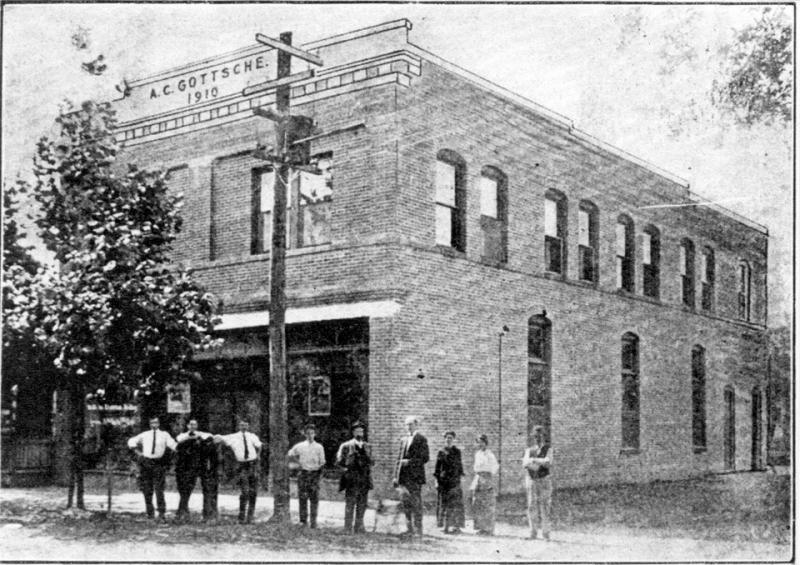
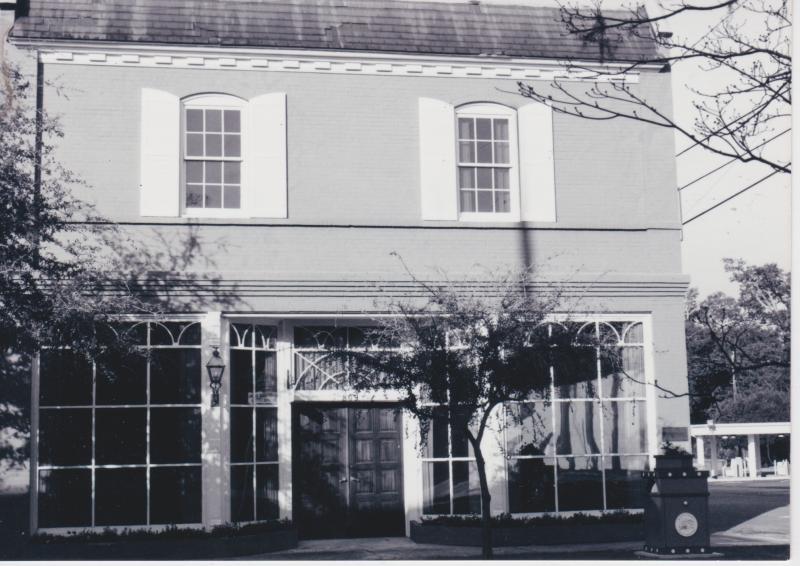
Circa 1915 809 Washington Avneue-February 1993
Gottsche-Blossman Building
The Blossman Building at 809 Washington Avenue in Ocean Springs was erected in 1912-1913 for Albert Cecil Gottsche (1873-1949), the son of Hans H. “Henry” Gottsche (1844-pre 1883) and Christina Switzer Gottsche (ca 1852-pre 1896), both German immigrants. Albert C. Gottsche was born on September 23, 1873, at Ocean Springs. On September 30, 1896, he married Cynthia “Cinnie” Davis Maxwell (1869-1951), the daughter of George Washington Davis (1842-1914) and Margaret Bradford (1846-1920). At this time, Mr. Gottsche was a salesman in the Davis Brothers Store, a mercantile business on Washington Avenue, owned jointly by George W. Davis (1842 -1914), Cinnie’s father, and her uncle, Elias Samuel Davis (1859-1925). Albert and Cinnie Davis Gottsche had one son, Albert Lynd Gottsche Sr. (1902-1974), who was the father of John ‘Jack’ H. Gottsche (b. 1941). Jack, a Georgia Tech engineering graduate, was employed by Blossman’s Ready Mix Concrete in 1971 and later managed Trilby’s Restaurant, another E.W. Blossman enterprise.
In late 1910, Albert C. Gottsche resigned from the Davis Brothers Store operation and began selling animal feed on southeast corner of Washington Avenue and Desoto in the present day Catchot-Lemon Building. He erected the Gottsche Store building across the street in 1912-1913, and ran a first class grocery and market here until his death in March 1949.
After the demise of A.C. Gottsche, his stepson, Karl Case Maxwell (1893-1958), managed the Gottsche Store. In the early 1920s, Mr. Maxwell and spouse, Nellie Myrtle Morris (1893-1970), had returned from New Orleans to work in the Gottsche Store. Unfortunately, Mr. Maxwell met death accidentally on June 29, 1958, in an automobile car crash on US Highway 80, near Clinton, Mississippi. Mrs. Dena Atkinson Talbott (1886-1958) of Ocean Springs, the mother of Mrs. Gerald Noble, of Fontainebleau, was also killed in the accident.(The Ocean Springs News, July 3, 1958, p. 1 and The Daily Herald, July 5, 1958, p. 2)
After Karl C. Maxwell’s death, the Gottsche Store remained open under the supervision of A. Lynd Gottsche. In January 1959, Lynd Gottsche incorporated the business and became its first president. He hired several managers, among them Jack Bosarge (1931-1999) and Claude Trahan (1920-1984). In 1961, when the Gottsche store ceased operations, the fixtures in the building were sold to Curmis Broome (1928-2006), a former butcher in the Gottsche’s meat market, for his Broome’s new store, called Foodland, on Vermont, now M.L. King Jr. Avenue, and Government Street.(Jack Gottsche, December 17, 2002 and The Gulf Coast Times, January 15, 1959, p. 1)
The old Gottsche Store building now corporate headquarters for Blossman Gas, Inc. was acquired from Albert L. Gottsche in November 1962. The lot had 35 feet on Washington Avenue and ran 200 feet west on Desoto.(Jackson County, Mississippi Land Deed Book 232, p. 382)
After acquiring the Gottsche Store building, Mr. E.W. Blossman hired architects, Slaughter & Smith, of Pascagoula and relied on the advice and suggestions of his wife, the distinguished American artist, William Robert Steene (1887-1965), who was retired and lived in Gulf Hills, and others to create an edifice for Blossman Gas and its management and employees that would reflect the French cultural history of the area.
It is interesting to note that E.W. Blossman and William R. Steene became friends and Mr. Blossman commissioned several large paintings that hang today in the Blossman Building at 809 Washington Avenue. A short biographical sketch of Mr. Steene follows:
William R. Steene
William Robert Steene (1887-1965) was born at Syracuse, New York on August 18, 1887. He was a nationally known portrait painter and muralist. Steene studied under Colarossi and Julian in Paris, after his initial art education at the Art Students’ League and National Academy of Design in New York City. Among his portraitures possibly familiar to local residents are: President Franklin D. Roosevelt; Senator Theodore Bilbo of Mississippi; Governor Henry Whitfield of Mississippi; Dr. Karl Meyer, head of Cook County Hospital at Chicago; E.V Richards, president of the Navy League of America and Paramount Richards Theatres; and golfing legend, Robert Trent “Bobby” Jones.(Who’s Who in America, Vol. 31, 1960-1961 and Bradford-O’Keefe Burial Book 48, p. 245)
Probably William R. Steene's first visit to the Mississippi Gulf Coast was in April 1931, when he was a guest of the Buena Vista Hotel at Biloxi. He had painted in Mississippi earlier in his distinguished art career. Mr. Steene had come to Biloxi after completing two portraits. They were of Frank G. Logan (1851-1937), philanthropist and honorary president of the Chicago Art Institute, and Dr. Harry Woodburn Chase (1883-1955), president of the University of Illinois. Mr. Logan's portrait was hung in the Grand Central art gallery at NYC.(The Daily Herald, April 18, 1931, p 2)
Gulf Hills
In November 1950, the William R. Steene home and studio in Gulf Hills was under construction. During its building, the Steenes were domiciled in the Edward Brou residence on Washington (sic) Avenue.(The Gulf Coast Times, November 3, 1950, p. 8)
In 1956, from his Gulf Hills studio, W.R. Steene completed a large mural depicting the 1953 Louisiana Sesquicentennial Celebration, a remembrance of the Louisiana Purchase of 1803, at New Orleans. President Eisenhower is at the center of this 50-foot long, ten-foot tall, triptych mural, which took a year to complete. The painting hangs in the Presbytery of the Louisiana State Museum at New Orleans.(The Daily Herald, “Know Your Coast”, November 15, 1957)
Locally, the Blossman Gas office at 809 Washington Avenue has a fine collection of Mr. Steene’s oil paintings. In 1963, E.W. “Woody“ Blossman commissioned "Landing of Iberville" from Steene to hang in his refurbished Gottsche Building, which was acquired in 1962. The architectural firm of Slaughter & Smith of Pascagoula directed the buildings restoration and W.R. Steene served as art consultant for the project.(Down South, March 4, 1964)
William Steene also painted a portrait of E.W Blossman and several other works, primarily shrimp boats of the Mississippi Gulf Coast. The City of Biloxi has a Steene painting in its City Hall on Lameuse Street appropriately titled, “Blessing of the Fleet” and the Ohr-O’Keefe Museum of Art [OOMA] has a Steene in its business office on the Biloxi campus.(The Ocean Springs News, June 3, 1965, p. 7)
William Steene and his wife Eula Mae Jackson Steene (1888-1969) resided in Gulf Hills north of Ocean Springs from 1950, until his death at Biloxi on March 24, 1965. They married in 1914, and had two daughters, Betty S. Painter and Marianne S. Ware (1919-2001). Mrs. Steene’s sister, Miss O. Jackson, a native of Lexington, Kentucky, was once the manager of the Town And Country Restaurant on Park Avenue in New York City.(The Daily Herald, March 24, 1965, p. 1 and The Gulf Coast Times, January 22, 1953)
Blossman Companies
Trilby's Restaurant-1963
After successfully establishing Blossman Gas at Ocean Springs and surrounding territories, E.W. ‘Woody’ Blossman and his family built a conglomerate through several investment entities in the fields of food service, real estate, banking, construction, printing, and retail flower sales. Probably the most visible and relished gem in the E.W. Blossman empire was Trilby’s Restaurant.
In June 1963, after the demise of Trilby G. Steimer (1896-1960), Trilby's Restaurant was acquired from her daughter and widower, Elise ‘Happy’ Welton Gabrielson Thomas (1920-1989) and Edward ‘Ted’ C. Steimer, by Alpha Investment Corporation, an E.W. Blossman (1913-1990) family enterprise. The name "Trilby's" was sold with the restaurant.(Jackson Co., Mississippi Land Deed Bk. 241, p. 483)
Harold M. Mayfield Jr. (1932-2011) and Jocelyn Seymour Mayfield, who had worked for Trilby G. Steimer, managed the eating affair for Mr. Blossman, until 1982, when they opened Jocelyn's, their own fine restaurant, also on Bienville Boulevard. Jocelyn’s, closed in late December 2013, after 31 years of excellent food and fine patronage. Jack Gottsche became manager of Trilby’s in 1983. In May 1987, Craig Claiborne (1920-2000), native Mississippian and food critic for the New York Times, ate at Trilby’s.(Jack Gottsche, February 1, 2008 and The Ocean Springs Record, May 21, 1987, p. 7)
_0.jpg)
Lillian Grenet Steimer
Lillian “Trilby” Grenet Welton Steimer (1896-1960)-Trilby was a restaurateur at Ocean Springs from 1946 until her demise in 1960. Her Trilby’s Restaurant on US Highway No. 90 became synonymous with fine dining at Ocean Springs and on the Coast. Jocelyn Seymour Mayfield and Harold M. Mayfield Jr. (1932-2011) worked for Mrs. Steimer until 1982, before commencing Jocelyn’s Restaurant, which closed in December 2013
By January 1952, Willy Dale had a new proprietor in his Porter Street edifice. She was ‘Trilby’ Grenet Steimer (1896-1960). Trilby had already made a name for herself at Ocean Springs in the fine dining and restaurant business. She ran the Big Pine Inn on West Porter Street until February 1946, when it was sold to Paul Lewis. In 1947, Trilby and Ted Steimer with Ray and Juanita Taylor, opened the Alibi, formerly the Clear View Café, on Highway 90 (Government Street) east of Ocean Springs. Another site for the ubiquitous Trilby was the Bayou Chateau, now Aunt Jenny's Catfish Restaurant. She opened here on September 4, 1948. This was the first time that the name “Trilby’s” was used for her business.(The Jackson County Times, August 27, 1948, p. 9)
Lillian “Trilby” G. Welton Steimer (1896-1960) was born at New York City on April 1, 1896, the daughter of Auguste J. Grenet (1863-1920+) and Lillian Day (1865-1947). Honore Grenet, Trilby’s grandfather, was born in France and had a background in the restaurant business. He immigrated to Mexico with his Majorcan born wife between 1864 and 1867, when Ferdinand Maximilian (1832-1867), the Austrian archduke, was being enthroned as Emperor of Mexico* by Napoleon III, Louis Napoleon Bonaparte (1808-1873), who ruled France from 1852-1870. Opposition to the French invasion of Mexico led to anarchy, which swept the country and led Honore Grenet to remove his family to the safe environs of San Antonio, Texas. Here Monsieur Grenet founded a successful merchandiser. He owned the Alamo, which he purchased from the Roman Catholic Church for $20,000, and utilized it as a warehouse for his expanding business. Trilby’s father, Auguste J. Grenet, was sent to Manhattan College in New York City. Here he became engaged in the chemical business, but was enamored with horse racing. Auguste, a competent mathematician, devised a system for handicapping race horses and became the first professional handicapper.(Down South,Vol. 9, No. 4, July-August 1959)
*Cinco de Mayo is the celebration of a Mexican military victory over invading French forces at Puebla, Mexico on 5 May 1862. It is not Mexican Independence Day!
Walter F. Welton
In New York circa 1917, Trilby Grenet married Walter F. Welton (1894-1981), the son of Frances Welton, a Manhattan butcher and later hotelier, and Elise Welton, a French immigrant. Trilby and Walter F. Welton had two children: Francis Welton (1918-pre-1930) and Elise ‘Happy’ W. Fulwiler Mendez Thomas (1920-1989). In 1920, Walter F. Welton was in the hotel business with Frances Welton (1867-1918+), his father. Their resort was called Moheghan Lake and situated in Westchester County, New York. Adele Grenet Stevenson (1888-1990), Trilby’s sister, was also married to a hotelier and resided in Palm Beach, Florida.(1920 New York Co., New York Federal Census T625_1226, p. 3A, ED 1)
Ted Steimer
In March 1930, Trilby Grenet Welton, then divorced from Walter F. Welton, married Edward C. "Ted" Steimer (1884-1967) in south Florida. He was an associate of her father's in the horse race handicapping business. Ted Steimer began visiting Ocean Springs circa 1916, as a fishing destination. He continued this routine for years, as he would arrive here in the fall to hunt and fish before the racing season began at New Orleans. Ted and Trilby relocated to Ocean Springs after their wedding.(The Daily Herald, March 14, 1930, p. 9
Willy Dale’s Place
By January 1952, Trilby G. Steimer had relocated to the William ‘Willy’ F. Dale (1899-1990) building, formerly the Jeremiah J. O’Keefe home at 911 Porter Street. The Steimer’s lived upstairs in the old O’Keefe mansion. Burglars broke into their restaurant on New Year’s Day 1952 and stole $4 in pennies from the cash register.(The Gulf Coast Times, January 3, 1952, p. 1)
Willy Dale had taken possession of the Jeremiah J. O’Keefe home in December 1939 for $3850. It had been repossessed in December 1938, by the Home Owners Loan Corporation, a Federal corporation. A balance of $5612.17 was owed by the O’Keefe family on the mortgaged property.(Jackson Co., Mississippi Land Deed Bk. 71, pp. 580-581 and Bk. 74, pp. 158-160)
One of the great success stories of Ocean Springs is the return of the J. J. O’Keefe family residence on Porter Street to the family. When they lost it in 1938, the Jeremiah J. ‘Ben’ O’Keefe II family relocated to Biloxi and resided on Fayard Street behind the Bradford-O’Keefe Funeral parlor at 601 West Howard Avenue. A young Jeremiah J. “Jerry” O’Keefe III (b. 1923) and his sister, Alice O’Keefe Sebastian (1922-2011), vowed that someday, they would reclaim their former home in Ocean Springs.(Alice O’Keefe Sebastian, September 13, 1999 and The Ocean Springs Record, July 3, 1986, p. 2 and July 10, 1986, p. 2
This was accomplished in July 1986, when the Willy Dale family sold the former O’Keefe mansion to Gulf National Life, an O’Keefe corporation. A ceremony was held on the grounds and after signing the warranty deed to the O’Keefe family, Willy Dale said, “Folks, the first day [of owning this building] was fun and the last day is fun too.” In December 1987, Jeremiah J. ‘Jerry’ O’Keefe III with the competent architectural advice and service of Bruce Tolar completed its restoration. The refurbished edifice has been used as the Bradford-O’Keefe Funeral Home since this time.(JXCO Land Deed Bk. 863, p. 159 and The Ocean Springs Record, July 3, 1886, p. 2 and December 3, 1987, p. 1)
The Gehl Place
In July 1955, Trilby G. Steimer acquired the former Gehl place on "new" US Highway 90, today known as 1203 Bienville Boulevard. This is the Trilby's that many older residents of Ocean Springs are familiar and had fond culinary memories. Here such gourmet dishes as Rock Cornish game hen au parto and creamed ham and sweetbreads with ripe olives, macaroni loaf, carrot casserole, and rum pie were concocted. (Jackson Co., Mississippi Land Deed Bk.
Blossman Flower Shop-1965
The Blossman Flower shop was situated just south of the Blossman Building at 809 Washington Avenue. It was a small property with just 19 feet on the street but ran west for 200 feet. This tract had been in the Westbrook family for many years and had served as the barbershop of Edwin Westbrook and his son, Albert Westbrook.
Eula Quave Noyes sold the business to Alpha Investments, a Blossman company, in May 1963. It had belonged to Tone and Eleanor Herman and Louise Westbrook before Mrs. Noyes took possession.(Jackson Co., Mississippi Land Deed Bk. 239, p. 76)
Banking
First National Bank of Ocean Springs
The First National Bank of Ocean Springs was organized in June 1967 after the Comptroller of Currency in the Capitol approved their charter. The principals in the bank were: E.W. Blossman (1913-1990), W.C. Gryder III (1928-1999), Anthony van Ryan (1899-1980), J.C. “Champ” Gay (1909-1975), Samuel L. Zanca (1919-1991), William T. Dunn (1919-1990), Naif Jordan (1907-1993), G.E. Egeditch (1907-1987), J.K. Lemon Jr. (1914-1998), Dr. Frank O. Smith (1902-1975), Richard M. Davis, Oscar Jordan, Frank T. Pickel (1912-1982), and Thomas L. Stennis (b. 1935). A lot was acquired on the northwest corner of Washington Avenue and Desoto to erect a bank building.(The Ocean Springs Record, June 29, 1967, p. 1)
Earl Jones
In March 1968, Earl Jones was named president of the First National Bank of Ocean Springs. Earl was a native of Columbus, Mississippi and graduate of Mississippi State University with a degree in finance. In 1953, he joined the National bank of Commerce at Columbus and was named vice-president of this organization in 1961. Earl Jones had married Fay West and they were the parents of: West Jones (b. 1960), Judi Jones (b. 1963), and Jane Jones (b. 1965). The Jones family resided in the Fort Bayou Estate subdivision.(The Ocean Springs Record, March 14, 1968, p. 3)
Opening day
After E.W. Blossman, chairman of the board delivered a welcome address and Don Green, president of the Ocean Springs Chamber of Commerce, cut the ribbon, the doors of the The First National Bank of Ocean Springs opened for business in late November 1968 in a Claude H. Lindsley (1894-1969) designed building. Over 3000 people entered the bank and 700 accounts were opened. $1,200,000 in business was transacted.(The Ocean Springs Record, November 28, 1968, p. 1)
First National Bank of Jackson County-Pascagoula
In December 1970, the bank opened an office in Pascagoula on the corner of US Highway 90 and Telephone Road. The bank was housed in a small structure, which was already on the property. The First National Bank of Ocean Springs became the First National Bank of Jackson County in 1971. A new building was erected on the Pascagoula property and the bank moved into it in September 1972.(The Ocean Springs Record, September 14, 1972, p. 2)
In July 1972, Jolly McCarty of Pascagoula became a vice-president of the bank. He was hired primarily as the Public Relations Officer for the organization.(The Ocean Springs Record, July 27, 1972, p. 1)
First National Bank of the South
In late 1971, when Harroll Dean Castle (b. 1937), a native of Laurel, Mississippi became president of the First National Bank of Jackson County, it had assets of about $8 million. In late 1977, the bank acquired the Biloxi branch of the Southern National Bank and the name of the Ocean Springs based bank became the First National Bank of the South. In 1980, Harroll D. Castle acquired controlling interest in the First National Bank of the South, which by 1984 had assets of $88 million. Mr. Castle also possessed a majority interest in the Pine Belt Capital Corporation, which owned the Hattiesburg based Pine Belt Federal Savings and Loan.(The Ocean Springs Record, October 4, 1984, p. 1)
Bank mergers-Metropolitan National Bank and Hancock
In November 1984, one of the largest bank mergers ever contracted on the Mississippi Gulf Coast occurred when the First South National Corporation, Harroll D. Castle, president; the First National Bank of the South, Kenneth D. Ross, chairman and CEO; the First State Bank of Gulfport, William A. Wiltshire, chairman; and the Metropolitan National Bank of Biloxi, John R. Conry, president, merged to form the Metropolitan National Bank. The new bank had assets of $138 million and eleven branches.(The Ocean Springs Record, November 29, 1984, p. 1)
In February 1990, an agreement in principal was reached between the Metropolitan Bank and Hancock Bank, which allowed Hancock to acquire the Metropolitan National Bank, a subsidiary of the Metropolitan Corporation. G.H. English, CEO of Metropolitan, said, "this combination will add to the quality and convenience of our banking services to the people of the Mississippi Gulf Coast". The merger took place in June 1990, after all Federal banking agencies approved the Hancock acquisition which cost them $6,750,000.(The Ocean Springs Record, February 15, 1990, p. 1 and June 14, 1990, p. 6)
The clock
The clock on the old Ocean Springs State Bank, which had been installed in its 1955 remodeling, was removed on December 11, 1990, for refurbishing and cleaning before installation on the new Hancock Bank quarters in the former Metropolitan Bank building. This action by the Hancock Bank created a small furor as members of Main Street and the Historic Ocean Springs Association (HOSA) protested the action. These local civic organizations felt that the clock would be out of character on the former Metropolitan Bank building, which was to become the site of the Hancock Bank at Washington and Desoto.(The Ocean Springs Record, December 13, 1990, p. 1)
The superstitious might say that Hancock Bank was punished by the ‘gods’ for removing the iconic Ocean Springs State Bank clock in December 1990, from its primal location on the now Cornerstone Group edifice on the NE/C of Washington Avenue and Government Street, when a truck hit the old clock in June 1995. It was removed and repaired and later re-installed where it hangs today on Washington and Desoto Avenues.(The Ocean Springs Record, June 29, 1995, p. 3)
Blossman ‘Airforce’
Among his many skills and talents, E.W. ‘Woody’ Blossman could also fly an airplane. Initially, he owned a Cesna 172 Skyhawk and then acquired a Piper Comanche, both single engine aircraft. As his propane gas business grew in the southeast United States and his desire to relax and fish in south Florida increased, Mr. Blossman in the summer of 1965 commenced Airplane Services Incorporated.(Robert Bowers-June 2014)
Gulf Park Estates Airport
In 1962, H. Vaughn Watkins, a Jackson attorney, Forrest Jackson and their investors from Jackson, Mississippi acquired Gulf Park Estates and hired Harry Del Reeks of Ocean Springs as general manager and sales agent. Immediately, the Watkins-Jackson group built a 2500-foot landing strip in the E/2 of Section 35, T7S-R8W. The small airport was vastly improved in February 1964 when a contract was signed with Space Age Structures of Gulfport to erect a 15,000 square-ft. hangar to house 25 aircraft. The new airport was dedicated in June 27, 1965. At the celebration, Richard ‘Dick’ M. Davis, president of the Ocean Springs Chamber of Commerce, introduced the Reverend Merlin F. Usner of the 1st Presbyterian Church who gave the invocation. Notable dignitaries present were: Mayor C. Ernest Schmidt; J.J. Hayden, president of Perkinston JC; Miss Rosie Ray, Miss Hospitality; A.V. Ragusin from the Biloxi Chamber of Commerce; H. Vaughan Watkins, Jackson attorney; and Colonel Rex G. Fryer, representing KAFB (Down South, July-August 1962, p. 11 and The Ocean Springs News, June 4, 1962, p. 1 and July 1, 1965, p. 2)
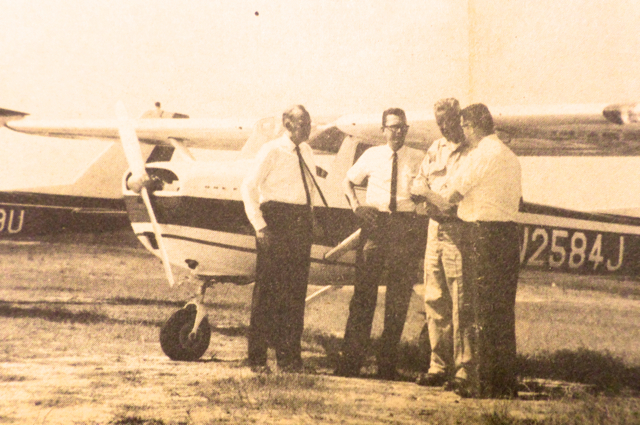
Gulf Park Estates Airport-1965
This June 1965 image was made at the dedication of the Gulf Park Estates Airport. Built in 1962 with a 2500-foot landing strip located in the E/2 of Section 35, T7S-R8W. The small airport was vastly improved in 1964 when a contract was signed with Space Age Structures of Gulfport to erect a 15,000 square-ft. hangar to house 25 aircraft. The new airport was dedicated in June 27, 1965. [L-R: E.W. Blossman; James Wood; Captain Tom Dansby; and Jay Nelson with J.D. Hair Company of Baton Rouge, Louisiana]
Airplane Services Incorporated
In 1965, Blossman’s Airplane Services Inc. took a lease on the Gulf Park Estates Airport. The company was staffed by Captain Tom Dansby, a retired USAF veteran with 26 years flying and administrative experience; Max Lamptenfeld, vice-president, was a licensed pilot and instructor; and James Wood of Blossman Incorporated served as the secretary-treasurer.(The Ocean Springs News, June 24, 1965, p. 1)
By 1966, E.W. Blossman had hired Frank Fleming to assist his Airplane Services Inc. Among other duties, Mr. Fleming taught flying lessons. One of his students, Joan Ferguson, became the first women to make her solo flight from the Gulf Park Airport.(The Ocean Springs Record, June 23, 1966, p. 6)
The Blossman Gas Company owned three twin-engine aircraft while flying Woody Blossman, company executives, family and friends in the Gulf South. According to Robert ‘Bob’ Bowers (b. 1936), former and last of the Blossman pilots, these aircraft were: Piper Aztec, a twin-engine, six-seat aircraft; Cessna 414; and Beechcraft King Air C-90. The last two aircraft had pressurized cabins. After the Blossman Company bought their Beechcraft King Air C-90 circa 1985, they relocated to Gulfport Field.(Robert Bowers-June 2014)
Lt. Colonel [ret] Bob Bowers, a native Virginian, joined E.W. Blossman’s Marine Electronics as a technician working with William ‘Bill’ Cox. Bob had been a navigator in the USAF, but learned to fly in his private life. Bowers became the Blossman company pilot circa 1981 when Walter Brown retired. Bowers retired in 1994 from his flying duties after the Beechcraft King Air C-90 was sold. Bob remembers Woody Blossman as a kind, gregarious man who enjoyed life. Although he had turned the gas company executorship to John R. Blossman, his son, Woody would occasional remind the troops that he was still their ‘Boss’!
Marathon
Another of the Blossman family love was blue water with sailing and fishing at the top of the chart. The Florida Keys, especially Marathon, Florida became a Blossman treasured sanctuary. Marathonis a city of about 12,000 people in Monroe County situated on Knight’s Key, Boot Key, Key Vaca, Fat Deer Key, Long Point Key, Crawl Key, and Grassy Key, all small islands in the middle Florida Keys. Initially, E.W. Blossman either acquired or built a small house on a canal with access to the Florida Strait. As his fortunes improved a larger home was erected at Marathon called Copa de Oro. The Blossman flotilla consisted of two sailboats and two yachts. Mrs. Artemise Blossman gave their boats Spanish names.[Bob and MaBelle S. Bowers-June 2014)
When a Blossman boat was moved from the Mississippi coast to the Florida Keys, Woody Blossman, Bill Cox and crew, which occasionally included MaBelle Snyder Bowers (b. 1942), Bob’s wife, and certainly one of Ocean Springs great characters, was aboard. Mabelle was galley chef and sergeant-at-arms while at sea. The Blossman family general modus operandi was to leave Ocean Springs on a Friday and sail until late Sunday. Bob Bowers would then fly from Gulf Park Estates Airport to an airfield near where the Blossman vessel had moored and return its crew to Ocean Springs for work on Monday. In this way, the boat eventually reached Marathon, Florida.(MaBelle S. Bowers-June 2014)
Blossman Printing-1969
With his businesses become more successful, Woody Blossman realized that he could reduce operating expenses by owning his own printing company. In late June 1969, the Blossman Printing Company held its formal opening in what might have been in the old Engbarth garage building on Washington Avenue. The new Blossman enterprise commenced with a Kors Heidelberg press and a Robertson 580 color process camera.(The Ocean Springs Record, June 26, 1969, p. 3 and Jack Gottsche-April 2014)
Claude Engbarth
In May 1922, Claude Engbarth (1893-1967) had bought a lot fronting 30 feet on the west side of Washington Avenue, from his uncle, George E. Arndt (1857-1945). The Engbarth garage was south and contiguous with the Farmer’s and Merchants’ State Bank building. The grocery store of Judge Orin D. Davidson (1872-1938) was south of the new Engbarth enterprise. Before the Farmer’s and Merchant’s Bank had been erected in 1913, the infamous Paragon Saloon of Mr. Arndt had sat there on the southwest corner of Washington and Robinson.
Claude Engbarth was probably born at Rodney, Jefferson County, Mississippi, the son of Emile Engbarth (1855-probably 1905) and Magalene, called Lena, Jeanette Arndt (1856-1938). Both his paternal and maternal grandparents were German immigrants who settled in southwest Mississippi.Emile Engbarth was the postmaster at Ocean Springs from 1882 to 1885. As Emile and Lena Engbarth were again residents of Rodney in 1900, it appears that they moved back to Jefferson County after April 1889, when Emile’s position as postmaster terminated. The Pascagoula Democrat-Star of August 31, 1900, announced that well-known Republican, Emile Engbarth, is in Ocean Springs and rumored to be the new postmaster. This did not come to fruition as Thomas I. Keys (1861-1931), a local Black merchant and ardent Republican, remained at this post until March 1911. In September 1900, Emile Engbarth applied for the position of postmaster at Pascagoula. It appears that he was unsuccessful in attaining this opportunity, as the local journal reported that "Mr. E. Engbarth… returned to Rodney, Miss".(The Pascagoula Democrat-Star, October 5, 1900, p. 3)
Marie Arndt Alexander (1905-1994) writing in The History of Jackson County, Mississippi (1989) states that her father, George E. Arndt, came to Ocean Springs on May 17, 1881, from Rodney, Mississippi to be with his sister, Lena Engbarth.
At Ocean Springs, Claude Engbarth had been in the auto repair business with Philip J. Weider (1887-1985), whose parents were also both German immigrants. The Jackson County Times of July 12, 1919, which related that the partners, who called their recent venture, The Ocean Springs Garage, were going to erect a new garage on County Road [Government Street] on the lot that they recently purchased from George L. Friar. Actual construction on the Wieder-Engbarth structure did not start until January 1920. When construction was completed by Wieder and Engbarth, who were surely assisted by some of their brothers, talented carpenters and plumbers themselves, it had a wooden floor and accommodations for fifteen motorcars.
Herrs Wieder & Engbarth announced in The Jackson County Times in January 1921:
We have been appointed by the Adams Motor Co. Inc., authorized Ford dealers at Pascagoula, Mississippi as their sub-agent to sell Ford cars for immediate delivery. Get Yours Today. Wieder & Engbarth-Ocean Springs Garage.
The Ocean Springs Garage on County Road operated by the Wieder-Engbarth combine was dissolved on April 1, 1922. In late March, Mr. Engbarth had sold his interest in the business to P.J. Wieder for $500 and acquired the Arndt lot on Washington Avenue to start his own automobile repair business.(The Daily Herald, April 15, 1922, p. 8)
Restaurateur
Claude Engbarth later started a cafe and bar on Government Street, which after several later proprietors, including The Medora Cafe of Mrs. Wallace of Biloxi, and Cyril Hopkins, eventually evolved into the legendary, Henrietta's Cafe. This local, eatery, landmark closed its portals on May 20, 1995. Engbarth bought two old homes and moved them together for his enterprises. One structure was a shot-gun house which Emile Fayard (1872-1931) once occupied. The present day Henrietta's building, now an amalgamation of small shops, is the original Claude Engbarth structure except for a different roofline. It is believed that the present day, front gable, facade of the structure was established by Aden S. Bellew (1907-1981) in the early 1940s, when he was married to Henrietta Beaorvich Cvitanovich Savage (1911-1999), the daughter of Marco Beaorvich (1883-1966) and Jacobina Sekul (1882-1956), both immigrants from the Isle of Brac, Split-Dalmatia County, Croatia. Henrietta was reared at 429 Pine Street at Biloxi where her parents toiled in Biloxi’s growing seafood industry on Point Cadet.(J.K. Lemon-March 1996)
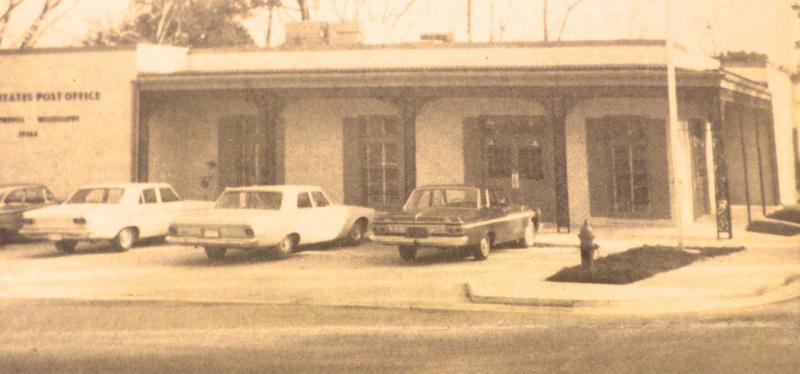
1966 U.S. Post Office [June 1966]
In 1987, E.W. Blossman, through Alpha Investments, acquired the former US Post Office building at Desoto Avenue from . John Blossman announced that the building would serve temporarily as storage for Toys For Tots. In the spring of 1988, Blossman planned to moved their printing operation here, as well as statement and cusomer mailing operations.(Jackson Co., Mississippi Land Deek Bk. 899, p. 13 and The Ocean Springs Record, October 15, 1987, p. 1)
By 1965, it had become apparent that Ocean Springs had outgrown its post office. A site was selected on the southeast corner of Desoto and Jackson Avenue and on July 26, 1965 McCorkle & Stuart of Montgomery, Alabama construction was commenced on the 5800 square-foot building, which cost $76, 381. In February 1966, Mose W. Stuart III and Frank McCorkle leased their new building to the United States Post Office. In March 1966, moving from the old post office on Washington Avenue began to Desoto and Jackson.
In June 1966, Postmaster Orwin J. Scharr and his staff of twenty postal employees relocated from the Palfrey building [Salmagundi here until 2013] on the southeast corner of Washington Avenue and Robinson for their new quarters at present day 900 Desoto. The new structure almost tripled the area of the former one on Washington Avenue.(The Gulf Coast Times, December 10, 1953, p. 1 and January 13, 1954, p. 14, and The Ocean Springs Record, June 23, 1966, p. 1)
Dedication
On June 19, 1966, Max Jordan, postal service officer for South Mississippi of the Memphis Region, one of fifteen regions in the Post Office Department, served as the master of ceremonies for the dedication of the new post office. A flag that had flown over the Lyndon B. Johnson (1908-1973) White House was presented to Postmaster Scharr by Congressmen James O. Eastland (1904-1986) and William M. Colmer (1890-1980). An open house was held at the Ocean Springs Chamber of Commerce immediately post-ceremonies. Lee Jordan, Chamber president and J.K. Lemon (1914-1998) welcomed guests and visitors at the Chamber office in the old L&N depot. David McFalls and spouse of the Whistle Stop assisted at the reception.(The Ocean Springs News, June 23, 1966, p. 1)
Concrete Ready-Mix Inc.
Blossman Real Estate Holdings
The Doll House
The Doll House was a project of Artemise Blossman. A building was erected west of Trilby's Restaurant at Bienville Boulevard and opened in July 1987 to house her immense doll collection. It was in essence a 'doll museum' and opened to the public.(The Ocean Springs Record, July 2, 1987, p. 1)
Blossman Mardi Gras Royalty
1963
E.W. Blossman was King Iberville in 1963. Following his reign, he was elected president of the Gulf Coast Carnival Association in January 1964.
1974
John Richard Blossman
-1974 King_0.jpg)
John R. Blossman (1943-2009)
John R. Blossman (1943-2009), King d'Iberville, and Laurie James Turnbough, Queen Ixolib, ruled the Gulf Coast Carnival Association Mardi Gras at Biloxi on February 26, 1974. The theme was the 250th Anniversary of the Biloxi Bay Colony.(The Ocean Springs Record, February 28, 1974, p. 1)
1994
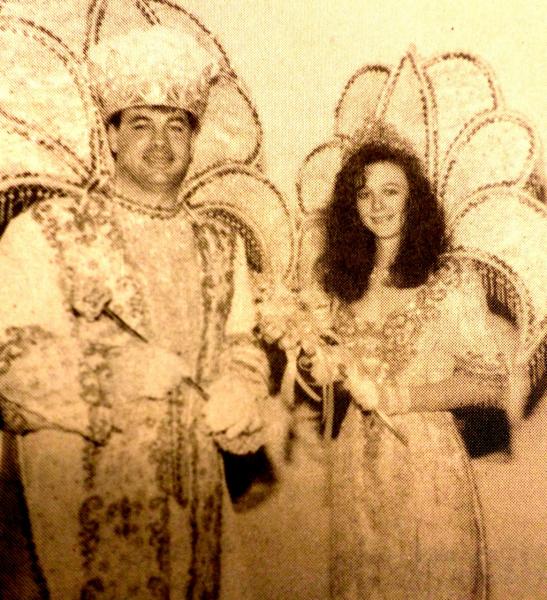
Frank Bertucci and Lorrie C. Blossman
Lorrie Catherine Blossman (b. 1971), daughter of John R. Blossman (1943-2009) and Catherine L. Brulet Blossman, was Queen Ixolib in February 1994 Gulf Coast Carnival Association celebration of Mardi Gras. Her King Was Frank D. Bertucci.(The Sun Herald, February 24, 1994, p. 10)
Child
_0.jpg)
John R. Blossman (1943-2009)
John Richard Blossman (1943-2009) was born July 26, 1943 in New Orleans, Orleans Parish, Louisiana. He attended public school at New Orleans until his sophomore year when he transferred to Phillips Academy at Andover, Massachusetts. John matriculated to Yale University where his interests were in Philosophy. John graduated from Yale in 1966 and then pursued a law degree at Vanderbilt University. He completed his legal studies at Nashville and passed the Mississippi Bar examination in 1970.
Family
On January 22, 1969 in the First Presbyterian Church at Ocean Springs, Mississippi, John Richard Blossman married Catherine Lynn Brulet (b. 1945), a native of Corpus Christi, Texas and the daughter of Hoffman Gregory Brulet and Gloria Marie Carambat, both natives of New Orleans. John and Catherine were the parents of Lorrie Catherine Blossman Brodowicz (b. 1971). Lorie Blossman was Queen Ixolib of the 1994 Gulf Coast Carnival Association. She ruled on Mardi Gras Day February 23, 1994 with Frank D. Bertucci as King Iberville.(The Ocean Springs Record, February 24, 1994, p. 10)
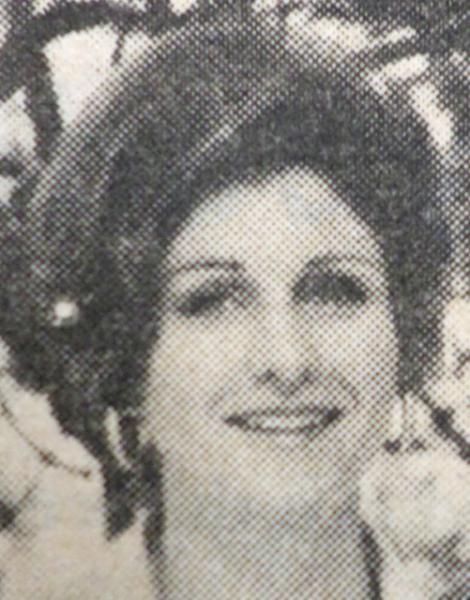
Courtney Cook Weidie Blossman [image made 1974)
After his marital dissolution, John R. Blossman on January 15, 1977, married Courtney Cook Weidie (b. 1941), former wife of Wayne Weidie, one time editor-publisher of the Ocean Springs Record and chief of staff for Gary Eugene ‘Gene’ Taylor, US Congressman. Courtney was born May 25, 1941 at Greenville, Mississippi to Stuart McAnally Cook and Mary Bethal McNeil. She is the mother of Stuart Weidie and Courtney Lee Weidie.
REFERENCES:
Down South, ‘Preserving the Past’-Volume 14, No. 2-March-April 1964.
Down South, ‘In the Business of Living’, Vol. 26, No. 1-January-February 1976.
Coast Lines, ‘Blossman Inc. “To Fill A Need”, December 1971.
The Daily Herald, ‘Blossman head Coast Carnival organization’, January 3, 1964.
The Daily Herald, ‘Celebration begins with formal coronation’, February 24, 1974.
The Daily Herald, ‘Jaycees name [John] Blossman outstanding young man’, February 21, 1979.
The Daily Times-News, ‘History of the Blossman office building has interesting background’, January 13, 1964.
The Gulf Coast Times, ‘Blossman success built on quality and good service’, February 8, 1951.
The Gulf Coast Times, ‘New Hydratane Gas Company to open here’, July 31, 1952.
The Ocean Springs News, ‘Blossman Gas buys Flower Shop’, November 18, 1965.
The Ocean Springs Record, “Ocean Springs First National Bank approved by comptroller”, June 29, 1967, p. 1.
The Ocean Springs Record, “First National Organizers, July 20, 1967, p. 1.
The Ocean Springs Record, “Architect sketch of proposed 1st National Bank of Ocean Springs”, November 23, 1967, p. 1.
The Ocean Springs Record, “Sell one half million in new bank stock”, January 25, 1968, p. 1.
The Ocean Springs Record, “Earl Jones President of new national bank”, March 14,1968, p. 3.
The Ocean Springs Record, “Grand opening First National Bank”, November 28, 1968, p. 1.
The Ocean Springs Record, “First National Bank celebrates first year”, December 4, 1969, p. 1.
The Ocean Springs Record, ‘John Blossman heads group enterprise’, June 19, 1969.
The Ocean Springs Record, ‘Blossman Printing Company holds formal opening’, June 26, 1969.
The Ocean Springs Record, ‘[John] Blossman inducted [into US Army] today’, April 23, 1970.
The Ocean Springs Record, “First National Reveals Pascagoula branch design”, February 11, 1971.
The Ocean Springs Record, “First National Names Public Relations Officer”, July 27, 1972.
The Ocean Springs Record, “First National in New Building”, September 14, 1972.
The Ocean Springs Record, ‘Springs artist [Courtney Cook Blossman] exhibit at 1st Mississippi Bank', January 10, 1974.
The Ocean Springs Record, ‘Blossman named to committee for Ford’, October 21, 1976.
The Ocean Springs Record, ‘Mrs. Sarah Rodi Blossman’, January 18, 1979.
The Ocean Springs Record, ‘[John] Blossman named one of the outstanding men in State’, February 22, 1979.
The Ocean Springs Record, “A nice business”, November 12, 1981, p. 9.
The Ocean Springs Record, “King D’Iberville”, February 17, 1983, p. 1.
The Ocean Springs Record, “Harroll Castle acquires bank stock option”, October 4, 1984, p. 1.
The Ocean Springs Record, “Two Ocean Springs directors mum on bank merger”, October 25, 1984, p. 1.
The Ocean Springs Record, “Doll House opened”, July 2, 1987, p. 1.
The Ocean Springs Record, “Old PO sold”, October 15, 1987, p. 1.
The Ocean Springs Record, "Hancock, Metropolitan National Agree To Merge", February 15, 1990, p. 1.
The Ocean Springs Record, "Hancock Bank, Metropolitan Bank Merge", June 14, 1990, p. 6.
The Ocean Springs Record, "Hancock Bank Clock Removed", December 13, 1990, p. 1.
The Ocean Springs Record, ‘[John] Blossman named NPGA president-elect’, July 1, 1993.
The Ocean Springs Record, ‘[Lorie Blossman] Queen Gulf Coast Carnival Association’, February 24, 1994.
The Ocean Springs Record, ‘[Arthemise] Blossman honored by YMCA’, May 11, 2000.
‘Blossman legacy lives on’, December 14, 2000.
The Sun Herald, ‘Arthemise Alsina Blossman’, December 8, 2000.
The Sun Herald, ‘John R. Blossman’, , 2009.
_______________________________________________________________
CALONGNE FAMILY
This family name may have originally been Fauconne de Calongne. Calongne is a small village or estate in France. Progenitors of the American family were Francois Calongne and Emilie Adelaide Henry of New Orleans. Their son, Sidney Auguste Calongne (1855-1911), built the American Sugar Refinery in St. Bernard, Parish and other buildings in New Orleans. In 1881, he married Sally A. Forschee (1853-1942), the daughter of J.H. Forshee and Sarah Knight. Sidney A. Calongne and Sally Forschee Calongne had five children: Sidney E. Calongne (b. 1883), Wilford F. Calongne (1885-1967), Emily C. Mead (b. 1887), Ashely Calongne (1890-1953), Mildred Calongne (1891-1892), and Evelyn Leah C. Smith (1896-1973).(Bill Calongne, April 1997)
The Calongnes were fond of Ocean Springs and began coming here in the early 1900s. They rented a cottage behind Glengariff, the beach front home of Captain Francis O' Neill (1849-1936), the retired Superintendent of Chicago police. It was here that a young Wilford F. Calongne met Mary Haggarty, the daughter of John J. Haggarty. The Haggartys were also residents of the Crescent City and enjoyed the breezy, warm summers of the Mississippi coast. Wilford married Miss Haggarty in September 1920 at New Orleans.(Bill Calongne, April 1997)
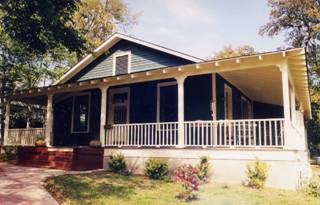
Calongne-Reeves House [destroyed by Katrina, August 2005]
204 Washington Avenue
Hillside
The Calongne family built a home in the fall of 1909 at present day 204 Washington Avenue. It was called, Hillside, and cost $3000. The contractors were Wieder & Friar. Hillside burned in the 1930s, and was rebuilt. Muriel Cousins, wife of Mayor George Barrow Cousins (b. 1883), once lived here.(The Ocean Springs News, November 27, 1909, p. 1 and Bill Calongne, April 1997)
The Calongne home on lower Washington Avenue had been possessed since December 1978 by Louise “Lit” VanCourt (1914-2004). In the late 1990s, Miss VanCourt sold it to James D. Reeves and Nell Webb Reeves. In the summer of 1999, the Reeves family renovated their home with consultations from Carl D. Germany, AIA, and under the auspices of the Ocean Springs Historic Preservation Commission. They restored the L-shaped gallery of the original structure, replaced windows, and installed a balustrade around the perimeter of the porch. New colors, Tarrytown Green with Windham Cream trim, were selected to replace the faded dark green and white trim.(JXCO, Ms. Land Deed Bk. 636, p. 449 and City of Ocean Springs-Historical District Application for Certificate of Appropriateness-March 1999)
Paving company
The three sons of Sidney A. Calongne formed a paving company called Calongne Brothers. They came to Ocean Springs in May 1915, to remove the defective schellinger paving and laid over one mile of cement walks and driveways at the Benjamin Estate, the large, well-landscaped property of Anna Louise Fitz Benjamin (1848-1938), the widow of David M. Benjamin (1834-1892) of Milwaukee, Wisconsin.(The Ocean Springs News, June 3, 1915, p. 1)
Calongne Children
Sidney E. Calongne
Sidney Edward Calongne (b. 1883) received a Civil Engineering degree from Tulane. Married Ethel Calongne. Died at Baton Rouge. Four children: Dorothy Calongne, Ethel Calongne, Calongne, and Sidney Calongne married J. Arthur Smith. No further information.(Bill Calongne, April 1997 and Philo Hooper DuVal, April 2001)
Wilford F. Calongne
Wilford F. Calongne (1883-1967) was born November 30, 1883 at New Orleans. He received a Civil Engineering degree from Tulane. Married Mary Haggarty at New Orleans, in September 1920. She was the eldest of sixteen children (only eight survived). Only child, a son, Wilford F. Calongne Jr. was born a New Orleans in 1921. The family resided on Webster Street near Audubon Park. They later relocated to the Broadmoor section of New Orleans, which is now predominantly Black. W.F. Calongne for WPA during the Depression and assisted in the construction of the Lake Pontchartrain seawall. He expired in May 1967.(Bill Calongne, April 1997)
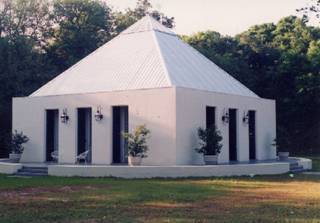
W.F. “Bill” Calongne House (built 1996)
11001 Pointe-aux-Chenes Road
Professor Wilford F. Calongne Jr.
Wilford “Bill” F. Calongne (1921-2012) was born at New Orleans in September 1921, the son of Wilford F. Calongne and Mary Haggarty. He was reared on Webster Street near Audubon Park. The Calongne family came to Ocean Springs for their summer holiday. They stayed in their grandmother's cottage, Hillside, at present day 204 Washington Avenue. Hillside was built in October 1909, by Wieder & Friar, local building firm.
These were days when Johnny Seymour operated his fish and oyster house at the foot of Washington Avenue, the Anchor Inn of Mark Seymour was in full swing, and the "natives" were more prominent than they are today. Ocean Springs still reeked with atmosphere and ambience of the small village, which it had been since the first tourist had discovered it during the steam packet days of the middle 19th Century.
In the summer of 1938, young Bill Calongne met Nathaniel Curtis, the Dean of the Tulane School of Architecture. Dean Curtis and family were at Hillside for the summer. Calongne's aunt, Emily C. Mead?, was letting the Connor Cottage on Lovers Lane. They met at the Connors and the two became fishing companions often taking a boat into Back Bay to fish for white trout. During their fishing ventures, Professor Curtis influenced young Calongne into studying architecture.
Professor Calongne retired from teaching at Tulane in 1984. In November 1973, he bought four acres of land at Pointe aux Chenes described as the W/2 of Lot 5 from William B. Rudolf and his wife, Hayne Rudolph. Ruth Carr was sales the agent. Bill Calongne planned to build his dream home here upon retirement. When construction costs soared beyond his budget, he scaled down the project.(JXCO, Ms. Land Deed Bk. 482, p. 296)
Capital for the Calongne home was raised by selling the land to William Seaman and Wynn Seaman in March 1994. Seaman rents the land to Calongne for $1 per year. The home will naturally belong to Seaman upon the demise of Calongne. (JXCO, Ms. Land Deed Bk. 1049, p. 329 and JXCO, Ms. Chancery Court Plat Book 1, p. 120)
Professor Calongne started a house on the bluff facing the Gulf of Mexico. Foundation completed and framing commenced, when Seaman discovered the location and didn't want the house there. In 1996, the Calongne project was restarted at a location farther from the water. Ken Snyder of Ocean Springs was the general contractor. The Calongne home has an area of 1500 square feet.(Bill Calongne, April 1997)
Wilford Francis Calongne Jr. [September 20, 1921 - August 4, 2012 Ocean Springs, Mississippi]
Wilford "Bill" Calongne, age 90 years, of Ocean Springs, MS died on Saturday, August 4, 2012. Mr. Calongne was a resident of Ocean Springs since 1984.
He retired from Tulane University where he was a Professor in Architecture. His urbane and gentle manner was as influential as his considerable skill as an architect. What set him apart was his interest in music, particularly that of modern composers and his passion for the well-designed object. Unlike most of his University colleagues, he was almost universally admired as a non dogmatic but highly principled teacher and architect.
Some of his noteworthy students were Albert Ledner, Milton Scheuermann and Errol Barron. In the scope of his career, he designed many notable buildings in New Orleans and on the gulf coast to include several homes in Biloxi, Ocean Springs and Pascagoula.
Mr. Calongne retired from teaching at Tulane in 1984. In November of 1973 he bought four acres of land at Pointe aux Chenes, where he planned to build his dream home. His home was eventually built as an architectural experiment of his own design. The home was geometrically pure, spatially concise and sturdy surviving Hurricane Katrina in 2005.
His father, Wilford F. Calongne, was born in 1883 in New Orleans. He married Mary Haggarty in New Orleans in 1920. Wilford, Jr. was their only son and the family resided on Webster Street near Audubon Park. Mr. Calongne is survived by extended families to include the Luckey, Smith and Calongne family that mourn his passing and celebrate his unique life.
Funeral services will be held on Saturday, August 11, 2012 at 1:30 p.m. at the Ocean Springs Chapel of Bradford-O'Keefe Funeral Home. Friends may visit from 1:00 p.m. until service time. Interment will follow in Evergreen Cemetery, Ocean Springs.(from The Sun Herald (Biloxi, MS) - Thursday, August 9, 2012)
Ashley Calongne
Ashley Calongne (1890-1953) married Carol Burns. For twenty years, Ashley was the chief sanitation engineer for the New Orleans District for the U.S. River Commission. He died June 23, 1953, at his Waveland, Mississippi home. Three children: Mrs. Frank London (Baltimore), Claire Calongne (Waveland), and Ashley Calongne (New Orleans).(The Gulf Coast Times, July 2, 1953, p. 1)
Emily Calongne
Emily Calongne (b. 1887) married Walter R. Mead of Mobile at New Orleans in November 1913. He worked at New Orleans for the U.S. Post Office commuting from Ocean Springs. Three children: Elaine Mead, Muriel M. Cousins married George Barrow Cousins, and Audrey Mead.
Evelyn Leah Calongne
Evelyn Leah Calongne (1896-1973) married Alwyn Smith Sr. (1892-1987) at New Orleans on June 30, 1917.. Al Smith was a 1912 graduate of the Tulane School of Dentistry. Naval commander. Came to Mississippi coast to reside in 1945. He was a retired oral surgeon. The Smiths had four children: Captain Alwyn Smith II (Poway, California), married Mary Lou Dixon; Jr.; Dr. Stanley T. Smith (Beaumont, Texas) married Betty Grant; Dr. Roland C. Smith (Novato, California) married Elizabeth Leach; and Joy Evelyn S. Luckey (1932-2003?) married Toxie Hall Luckey (1927-1984) and Philo Hooper DuVal (b. 1930). (The Sun Herald, April 20, 1987, p. A-4 and Philo Hooper DuVal, April 2001)
Dr. Smith was a member of the New Orleans Country Club, the Louisiana Dental Association, New Orleans Kiwanis Club, and Tulane Alumni Association. He died April 18, 1987. Mrs. Smith passed on July 1, 1973.(The Sun Herald, April 20, 1987, p. A-4)
REFERENCES:
The Daily Herald, "Calongne Death", July 25, 1953, p. 12.
The Gulf Coast Times, “Funeral Services Held For Late Ashley Colongne (sic)”, July 2, 1953, p. 1.
The Jackson County Times, “Mrs. Calogne Dies”, July 25, 1942.
The Ocean Springs News, "Local News", August 28, 1909.
The Ocean Springs News, "Local News", October 23, 1909.
The Ocean Springs News, “Ocean Springs is Growing”, November 27, 1909.
The Ocean Springs News, "Local News", December 24, 1910.
The Ocean Springs News, “Death of Sidney A. Calongne”, March 4, 1911.
The Ocean Springs News, "One Mile of Cement Roads", June 3, 1915, p. 1.
The Sun Herald, "Dr. Alwyn Smith", April 20, 1987.
The Sun Herald, "Wilford Francis Calogne Jr.", August 9 , 2012.
Personal Communication:
W.F. “Bill” Calongne Jr.-April 1997.
Philo Hooper DuVal- April 2001.
__________________________________________________________________________________________________
CAMBA FAMILY
Francis H. Camba
Francis “Frank” Henry Camba (1853-1885) may have been the son of Frank Camba and Rosalia Oser. He and Elizabeth Catchot (1854-1927) were the progenitors of this local family. They were married at Jackson County, Mississippi on September 22, 1877. At this time Mr. Camba was employed as a teller in a New Orleans bank.(The Pascagoula Democrat-Star, May 21, 1880, p. 3)
Their only child, Walter F. Camba (1878-1960), was born on July 4, 1878, at Ocean Springs, Mississippi, the home of his mother. Mrs. Camba was the daughter of two European immigrants, Antonio Catchot (1826-1885) of Menorca in the Balearic Islands, and Elizabeth Hoffen (1832-1916), a native of Bremen, Germany. Birth records from archivist of the Diocese of Menorca at Ciudadela, Menorca indicate that the Catchot family migrated to that Mediterranean Island from Malta in the late 18th Century. Antonio Catchot appears to have immigrated to the United States circa 1850, while his wife arrived in 1853 from Germany. Their children were: Elizabeth C. Camba Dunn (1854-1927), Joseph S. “Joe Tony” Catchot (1858-1919), Mary C. Bellande (1861-1931), and Antonio “Toy” Catchot Jr. (1868-1948).
The Camba family left Ocean Springs for New Orleans circa 1885. Shortly thereafter, Frank H. Camba died at the Louisiana Insane Asylum at Jackson, Louisiana. His remains were interred in the Girard Street Cemetery at New Orleans. When the Louisiana Superdome was erected in the 1970s, the cemetery had to be removed. Camba’s remains were probably sent to the Greenwood Cemetery for internment.(Walter F. Camba Jr., March 1997)
John M. Dunn
Frank H. Camba’s widow, Mrs. Elizabeth C. Camba married John M. Dunn (1853-1932) at the St. Alphonsus Church in Ocean Springs in October 1887. Mr. Dunn was from Bay St. Louis, Mississippi. They had no children. Both are interred at the Evergreen Cemetery at Ocean Springs.
Walter F. Camba (1878-1960)
(Courtesy of Walter F. Camba Jr. (1912-1999)-south elevation of the cottage of Captain A.V. Bellande (1829-1918) and spouse, Mary Catchot Bellande (1861-1931), on Jackson Avenue north of Cleveland)
Walter F. Camba
Walter F. Camba grew up in New Orleans. He married Grace Hunt at Fort Philip, Louisiana on April 22, 1903. Miss Eva Catchot was a bridesmaid in his wedding. Walter Camba later married Mary Ellen Glaven (1880-1957). They had three children: Mercedes Camba Schmid (1909-1987) m. Dewey I. Schmid (1898-1979), Walter F. Camba Jr. (1912-1999), and Mrs. Paul Schriber. Most of the Camba family members were interred in the Metairie Cemetery-Glavin-Section 26. Mr. Walter Camba made his livelihood with the Illinois Central Railroad. He worked for that organization for forty-six years retiring in August 1940. Walter F. Camba passed on June 14, 1960. His remains were placed in the family mausoleum at the Metairie Cemetery. Walter F. Camba Jr. expired on January 29, 1999 at Metairie, Louisiana.( Walter F. Camba Jr., March 1997)
Eva Louisa Camba
Eva Louisa Camba (1880-1914), sometimes called Eva Catchot, was the illegitimate half-sister of Walter F. Camba. Her parents were Frank H. Camba (1853-1885) and Mary Catchot (1860-1931), the sister of Mrs. Frank H. Camba. Eva was born at New Orleans, and carried her mother's maiden name, Catchot, until her marriage. She married Issac Clayton Chance, a protestant, of Rome, Georgia on March 8, 1911, at the St. Alphonsus Catholic Church in Ocean Springs, Mississippi. His parents were Isaac Chance and Etheline Hobbs. While growing up in Rome, Georgia, Issac Chance knew Ellen Axson (1860-1914), who married Woodrow Wilson (1856-1924), the 28th President of the United States.(The Pascagoula Democrat-Star, May 21, 1880, p. 3 and The Ocean Springs News, August 15, 1914)
Issac and Eva Camba Chance had a daughter, Mary Etheline Chance, who was born in October 1911. The Chances lived at No. 68 Church Street in Ashville, North Carolina. Eva Catchot Chance died on November 4, 1914. Her remains were sent to Ocean Springs for burial in the Evergreen Cemetery.(The Ocean Springs News, November 14, 1914, p. 2)
Camba Cottage- 520 Rayburn Avenue
In June 1924, Mary Catchot Bellande (1861-1931) conveyed for $1200 a Queen Anne cottage on the east side of Rayburn Avenue at Ocean Springs to Walter F. Camba. The small, cottage at present day 502 Rayburn Avenue was utilized by the Cambas as a retreat from New Orleans. (JXCO, Ms. Land Deed Bk. 76, pp. 431-432).
The small, one-story, wood framed, structure was built circa 1880. It has a front gabled roof with imbricated shingles in the gable. The projecting wrap-around gallery has turned posts and sawn brackets. There are shed and gabled-roofed additions on the north and east elevations.
Mr. Camba sold his sanctuary to Roland Lovelace (1889-1967) and spouse, Valera Pickel (1910-1977), in April 1951. The conveyance included all furniture and equipment, excepting the Camba’s lawn furniture.(JXCO, Ms. Land Deed Bk. 117, p. 362)
In April 1958, the Lovelace family conveyed their Rayburn cottage to Ralph P. Aiken and Charlotte B. Aiken (JXCO, Ms. Land Deed Bk. 176, p. 522)
Ralph P. Aiken and Charlotte B. Aiken. No information.
In October 1966, Special Warranty Deed issued by Everette E. Cook to get Mrs. Aiken on the title.(JXCO, Ms. Land Deed Bk. 301, p. 436 and Bk. 301, p. 437)
In September 1967, Ralph P. Aiken and wife conveyed to Zella Ward Walker (1918-2000).(JXCO, Ms. Land Deed Bk. 318, p. 545)
In June 1998, several years before her demise, Kitty Walker conveyed her home to herself and her brother, Guy M. Walker, as joint tenants in common.(JXCO, Ms. Land Deed Bk. 1145, p. 298)
The Camba Cottage is presently owned by Guy M. Walker. Guy is married to the former Betty Goodwin.
REFERENCES:
Books
Brother Jerome Lepre, Catholic Church Records Diocese of Biloxi, Mississippi, Volume I, (Diocese of Biloxi: Biloxi, Mississippi-1991), p. 54.
Journals
The Gulf Coast Times, “Roland Lovelaces Purchase New Home”, January 26, 1951.
The Gulf Coast Times, “Lovelaces Purchase Walter Camba Home”, April 19, 1951.
The Jackson County Times, August 17, 1940, p. 1, c. 3.
The Ocean Springs News, “Local News”, August 15, 1914.
The Ocean Springs News, “Mrs. I.C. Chance”, November 14, 1914.
The Pascagoula Democrat-Star, “Local News Paragraphs”, May 21, 1880.
The Pascagoula Democrat-Star, April 24, 1903.
Personal Communication:
Walter F. Camba Jr.-March 23,1997.
__________________________________________________________________________________________________
COLLIGAN
Irish immigrant, Henry Colligan (1823-1887) and Louisiana born, Mary Colligan (1832-1904), arrived at Ocean Springs circa 1848. Mary Colligan was first generation Irish probably born at New Orleans.
Henry Colligan made his livelihood as a gardener and farmer. He patented several forty acre tracts of land from the U.S. Government in March 1854. These were the SW/4 of the NW/4 and the NW/4 of the SW/4 of Section 20, T7S-R8W. This land later became the property of J.C. Wright (1879-1941) and his brother-in-law, Texas oilman, Haroldson Lafayette Hunt (1889-1974). Here Wright operated the Fort Bayou Dairy, raised cattle, and cultivated pecans.(JXCO, Ms. Land Deed Bk. 12, pp. 545-547)
Henry and Mary Colligan had three children: James Robert (1855-1905), May (1856-pre 1870), and John (1859-1893).
James Robert Colligan (1855-1905) married Ellen E. Birdrow (1860-1926), a native of Louisiana. Her father may have been from France, while her mother, Theresa Birdrow Bird (1843-1920), was a native of the Magnolia State. Mrs. Birdrow appears to have been widowed circa 1870. She then married a Bird (died pre-1900) who was a native of Pennsylvania. Their children were: James (1876-1918), Jesse Galle (1880-1942), William (1883-1956), and Samuel (1886-1925). Theresa Bird acquired lands in the Cox Avenue area from Sarah A. VanCleave in 1887.
James R. Colligan made his living initially working as a farmer with his father and then later as a carpenter. In 1900, he was employed on the bridge gang for the L&N Railroad. James and Ellen Colligan's children were: James H. Colligan (1888-1951), Hattie V. Hoffman (1889-1958), Mae C. Ryan (1892-1966), Nancy C. Bertuccini (1894-1984), Ellen C. McKay (1896-1951+), Jasper Colligan (1899-1951+), and Jessie C. Illing (1903-1972). The Colligans resided on the west side of Cox Avenue.
James Henry Colligan (1888-1951) was a plumber and electrician commencing that profession before 1910. He may have apprenticed under George W. Dale (1872-1953) who was probably the senior plumber at Ocean Springs at this time. When Colligan had his own plumbing business, Mayor Albert S. Westbrook (1900-1980) worked with him before joining the L&N Railroad.
Ellen Colligan's brother, George Birdrow (1865-1923), was a carpenter and building contractor at Ocean Springs. In the 1920s, James H. Colligan left Ocean Springs for Texas. By 1929, he had settled his young family at Kenner, Louisiana. At Louisiana, Colligan was employed during the Great Depression helping to construct the Bonne Carre Spillway near Norco. He later worked for the East Jefferson Parish Waterworks and did carpentry work.
James H. Colligan married Catherine Cunningham (1900-1955). She was a native of New Orleans and met Colligan when she came to Ocean Springs on a vacation. At the time, Catherine Cunningham was employed by the D.H. Holmes Company. This organization provided the opportunity for its female employees to spend a week at Ocean Springs each summer for $7.00. They stayed at "Haven on the Hill", the F.J. Lundy home located at LaFontaine and Washington. Mrs. Hilda chaperoned the young ladies when they were visited by the young men of Ocean Springs. The Colligans met in this manner.
James and Catherine Colligan had three children born at Louisiana: Louise Wilbert (1921), James H. Colligan, Jr. (1926-1926), and Ellen Catherine Colligan (1928-1928).
Jasper Colligan (1899-1951+) was a plumber for the L&N Railroad. He left Ocean Springs in the 1920s and lived briefly at New Orleans where he met his wife, Lillian. The Colligans spent the remainder of their years at Mobile. They had a daughter, Claire Danks (1926), who was born at New Orleans.
__________________________________________________________________________________________________
DALE FAMILY
William F. 'Willy' Dale (1899-1990)
Willy Dale has been described as a “hard working, good businessman and mechanical wizard”. He was a passionate fisherman and motorboater as well. Here circa 1927, Willy he shown with two drum that he caught in Biloxi Bay near Gulf Hills. Courtesy of H. Randy Randazzo-Arlington, Virginia.
Hattie Rose Seymour Dale (1876-1956)
[L-R: William F. Dale (1899-1990), Hattie S. Dale, and George Dale (1901-1953+)
William ‘Willy’ Frederic Dale was born March 4, 1899, at Ocean Springs. He was known in the community as Willy Dale. His parents were George William Dale (1872-1953) and Harriet ‘Hattie’ Rose Seymour (1876-1956), the daughter of Narcisse Seymour (1849-1931) and Carolyn V. Krohn (1847-1895). They were married on December 9, 1897 at the St. Alphonsus CatholicChurch. George W. Dale was baptized into the Roman Catholic Church on June 27, 1897, several months before his marriage to Miss Seymour.(Lepre, 1991, p. 78)
Catherine Dana Dale (1852-1934)
[Courtesy of Dr. Judy Bassham-Niceville, Florida]
George W. Dale was a native of Hayward, California. His parents were William Dale and Catherine Dana (1852-1934). William Dale made his livelihood as a plumber and taught the trade to his sons at Hayward, California. Catherine Dana Dale was a native of Sacramento and had lived at Hayward since 1869. George W. Dale settled at Ocean Springs in the 1890s and made his livelihood as an L&N Railroad employee, tinsmith and plumber. In 1909, he went into the hardware and plumbing business with Joseph B. Garrard (1871-1915). They erected a building on the west side of Washington Avenue between Desoto and Robinson. Dale’s father-in-law, Narcisse Seymour, was a pioneer in the seafood industry at Ocean Springs operating at the foot of Washington Avenue. He was especially known for his fine raw oysters.(The Jackson County Times, November 10,1934, p. 3 and The Daily Herald, July 23, 1953, p. 13)
In the fall of 1916, George W. Dale retired from plumbing when he transferred his business to James H. Colligan (1881-1951), an employee.(The Daily Herald, September 27,1916, p. 6)
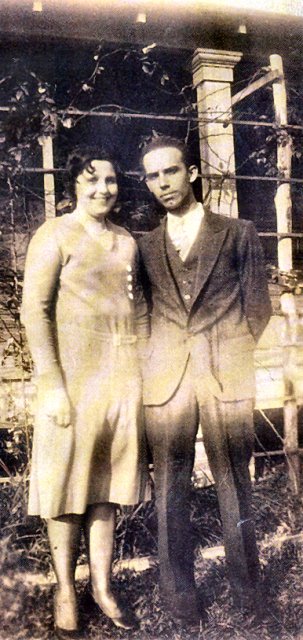
.jpg)
Alforetta Newcomb Dale (1905-1932) and Leo B. Dale (1904-1954) and John A. Dale (1914-1975)
[Courtesy of Dr. Judy Bassham-Niceville, Florida]
Willy Dale was the eldest of the eight children born to George and Harriet Seymour Dale. His siblings were: George E. Dale (1901-1953+), Leo B. Dale (1904-1954), Lillian Dale Jefferis (1906-1998), Louise Dale Scott (1909-1979+), Milledge Dale Whitworth Allen (1912-1998), John A. (1914-1975), and Gerrard W. Dale (1917-1957). The Dale family was reared at present day 1203 Calhoun Avenue near the homestead of Mrs. W.F. Dales father, Narcisse Seymour, at present day 1108 Calhoun Avenue.
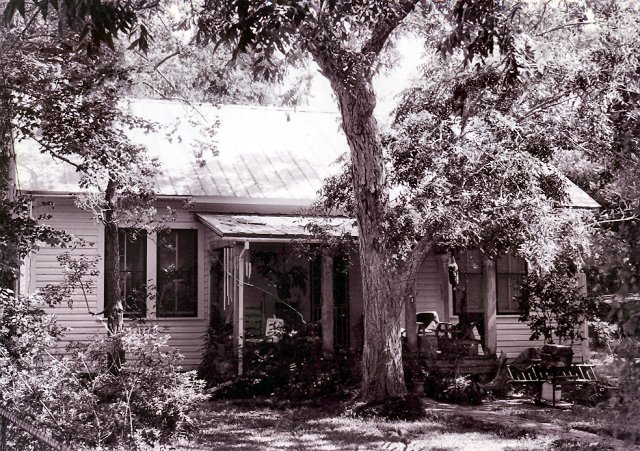
1203 Calhoun
[image made August 1997 by Ray L. Bellande]
Dale family cottage
In May 1913, Narcisse Seymour conveyed Lot 9-Block 35 (Culmseig Map of Ocean Springs 1854) to Hattie Seymour Dale, his daughter. Shortly thereafter, George W. Dale erected at No. 19 Calhoun Avenue, present day 1203 Calhoun, a 1600 square-foot, vernacular, side-gabled roof cottage with a small, shed-roof porch.(Jackson Co., Ms. Land Deed Bk. 39, p. 241)
In July 1936, during the Great Depression, George and Hattie Seymour Dale sold their home to Eugenia Zeolide “Gallie” Eglin (1877-1962), the wife of Henry L. Armstrong (1874-1945). The Armstrongs resided at 1112 Bowen with their two children: Rollin “Polly” Stanley Armstrong (1907-1979), and Bernadette Armstrong Cavanah (1909-1962+). Mrs. Armstrong returned the Dale cottage to them in a sale in November 1942.(Jackson Co., Ms. Land Deed Bk. 69, p. 173 and Bk. 82, p. 282)
In July 1953, George W. Dale expired in his home at No. 19 Calhoun Avenue. His corporal remains were passed through St. Alphonsus Catholic Church and interred in the Bellande Cemetery on Dewey Avenue.(The Daily Herald, July 23, 1953, p. 13)
In her later years and post-demise of George W. Dale, Hattie Seymour Dale was domiciled in a personal care home at Mobile for two years before she expired on August 7, 1956 in Mt. Pleasant, Maury County, Tennessee, at the home of Milledge Dale Allen, her daughter and spouse of Clarence S. Allen (1906-1987). Mrs. Dale’s corporal remains were returned to Ocean Springs and interred in the Bellande Cemetery.(The Daily Herald, August 9, 1956, p. 2)
Milledge Dale Allen was appointed executrix of her mother’s estate, which consisted solely of her residence at No. 19 Calhoun. Hattie Seymour Dale’s heirs conveyed the George W. Dale cottage to Conrad and Mildred von Salzen in May 1959 for $4500.(Jackson Co., Ms. Chancery Court Cause No. 14007-December 1957 and Jackson Co., Ms. Land Deed Bk. 187, p. 512, Bk. 187, p. 514, and Bk. 187, p. 516)
The von Salzen family lived here until J.Y. Christmas III acquired the Dale cottage from them in October 1976. Mr. Christmas remains here today.(Jackson Co., Ms. Land Deed Bk. 575, p. 451)
Early Life
Willy Dale attended local schools and graduated with the Ocean Springs High School Class of 1916, which was headed by Professor Benjamin H. Ashman (1892-1983) and spouse, Mildred D. Ashman (1890-1975). Among his classmates who would also find success in their chosen careers were: Edward A. Bellande (1897-1978), A. Lynd Gottsche (1902-1974), and Walter B. Holloway (1900-1965).
On January 20, 1920, Willy Dale married Ethel Sophia Endt (1900-1978), the daughter of Anthony J. “Tony” Endt (1870-1948) and Johanna Friedericka Wendel (1873-1931). Their nuptial ceremony took place at St. Alphonsus Catholic Church and was presided over by the Reverend Joseph H. Chauvin (1867-1959). Shortly after the wedding, Willy Dale moved to Oklahoma. His wife joined him later.(The Jackson County Times, January 17,1920, p. 5 and Jackson Co., Ms. MRB 13, p. 274)
The parents of Ethel Endt Dale were natives of New Orleans and the children of German immigrants. Ethel’s parents had married October 29, 1896 at St. Alphonsus Catholic Church.
(Lepre, 1991, p. 103 and JXCO, Ms. MRB 6, p. 70)
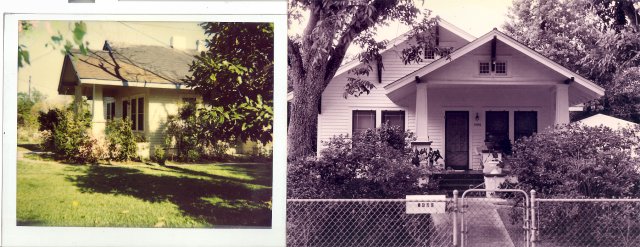
1406 Porter
[L-R: images made April 1990 and August 1997 by Ray L. Bellande]
Dale-Marion home
In March 1920, Ethel Endt Dale acquired Lot 5-Block 33 (Culmseig Map 1854), from Elijah Brown of Washington D.C. Here the Dales built their familial home at 1406 Porter Street and reared their two children: Thelma Dale Bradford Christopherson (b. 1921) and William F. Dale Jr. (1926-1979). In November 1989, before his demise, Willy Dale sold his Porter Street home to Thelma Dale Christopherson, his daughter, and Gary W. Christopherson, his grandson, who reside in South San Francisco, Lake Co., California.(Jackson Co., Ms. Land Deed Bk. 48, p. 3 and Bk. 949, p. 31)
In June 1990, shortly after Willy Dales’s death, Thelma and Gary W. Christopherson vended the structure to Andrew A. Marion Jr. and Melissa Schloegel Marion, his wife. They relocated to Seapointe in 1996 and conveyed the Dale cottage to Andrew’s parents, Andrew A. Marion and Martha B. Marion, who remain here on Porter Street today adjacent to Freedom Field..(Jackson Co., Ms. Land Deed Bk. 959, p. 656 and Bk. 1084, p. 660)
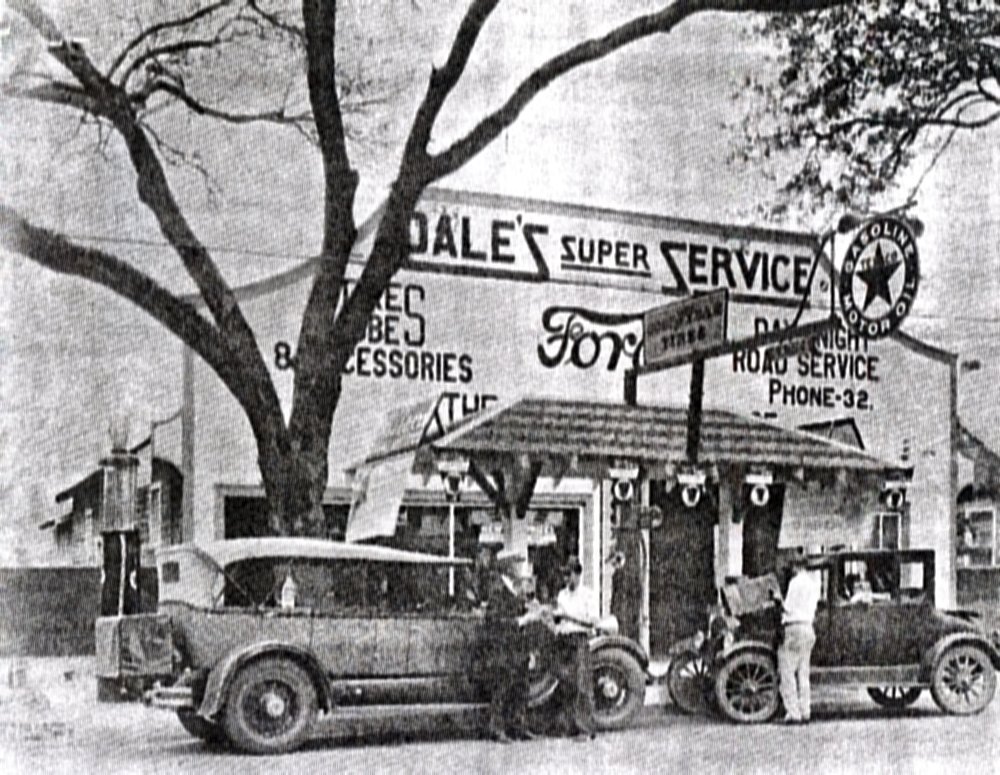
Dale Motor Company [circa 1927]
9 Porter Street
[from The Ocean Springs Record, June 22, 1972, p. 1]
Mechanical genius
As a young man Dale learned to repair automobiles. In May 1926, he went into business as the Dale Motor Company. He opened a 3500 square-foot garage on West Porter, in a structure which was once the locus of the J.J. O’Keefe Livery Stable. It was of the most modern on the entire coast. Dale's machines and tools were mostly electrically powered, state of the art for the period. Among his inventory of apparatuses were: the electrical valve resurfacing and reseating tool; electrical riveting; counter-sinking machine for relining brakes; cylinder hones; aligning gauges for front wheels; acetylene welding and cutting torch; weaver wrecker for hauling in disabled vehicles; air pump; Weaver tire change stand; Humpy-Cooper re-babbitting machines and other appurtenances applicable to automobile repair. At this time Willy Dale was the local Chevrolet dealer. He also sold gasoline, oil, and greases and his Porter Street auto service business.(The Jackson County Times, June 12, 1926)
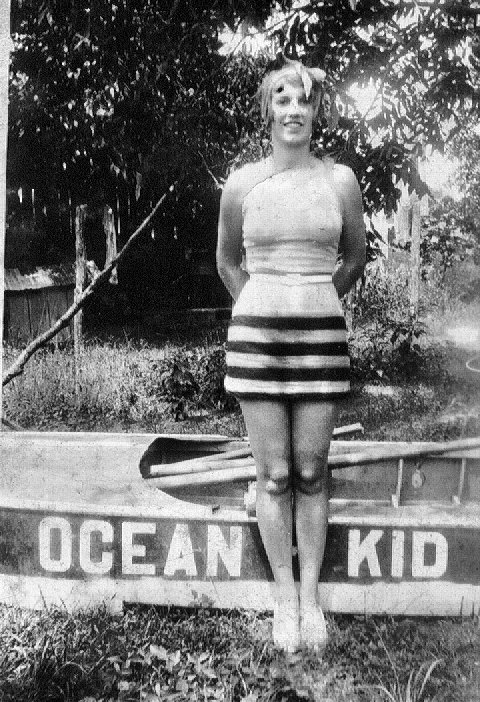
Milledge Dale Whitworth Allen (1912-1998)
[Milledge Dale standing in front of Willy Dale's Ocean Kid, circa 1928. Courtesy of Dr. Judy Bassham-Niceville, Florida]
Motorboat Racing
Willy Dale was a passionate man and motorboat racing and fishing were his salient avocations. His Ocean Wave was the only competitive speed boat at Ocean Springs. The watercraft was powered by a Lockwood Motor. Willy’s Dale Motor Company was the agent for Johnson and Lockwood outboard motors.
On May 10, 1928, Willy Dale participated in a motorboat regatta in conjunction with the dedication of the Harrison County seawall. Dale in his Ocean Wave, won three trophies. He piloted his light craft to victory in the Class B races. Willy also captured second place in two other class events. He was a contender in a fourth event, but his craft was damaged.(The Jackson County Times, May 12, 1928, p. 2)
On June 10, 1928, Dale participated in the Pass Christian Motor Boat Regatta. This time he was in a small light craft called the Ocean Kid. This boat developed great speed from its Johnson outboard motor. Willy Dale expertly drove his craft to first place in its class, and finished second in a race against all competitors piloting craft of all sizes and horsepower. (The Jackson County Times, June 16, 1928, p. 3)
Two weeks later, Willy Dale ran the Ocean Kid in Back Bay at a race course off Bay Terrace. He had recently been experimenting with the small craft and the June 24th race was a ‘test race’ for him. Willy’s experimentations proved deleterious to his watercraft. The Ocean Kid ran well in the first contest finishing second in a hotly contested race with The Last Flea of Biloxi. Dale was not able to race again that day.(The Jackson County Times, June 23, 1928, p. 3 and June 30, 1928, p. 3 )
Willy Dale made a successful appearance at the Biloxi Yacht Club Regatta held in July 1928, piloting the Red Gold, built by a Biloxi party with one of Dale’s ten and one-half, horsepower, Lockwood engine. The Red Gold averaged thirty-five miles per hour and swept every class race.(The Jackson County Times, July 14, 1928, p. 3)
In August 1928, Dale drove his Lightning to first place finishes in the Class B and Class C outboard motor races at Bay St. Louis. Competitors were from New Orleans and other Mississippi coast towns.(The Jackson County Times, August 25, 1928, p. 1)
Entrepreurial years
As previously mentioned, Willy Dale commenced his long career as a local entrepreneur in 1926 with the opening of Dale Motor Company on West Porter Street. Mr. Dale had leased the “O’Keefe Livery Stable Lot”, east of the mansion in August 1927, from the J.J. O’Keefe family. Here he operated a garage and initially sold Texaco products. Mr. Dale later vended Shell gasoline here.(JXCO Land Deed Bk. 70, pp. 196-200)
In September 1929, he Dale began Dale Motor Sales, Inc. with two partners, Arthur W. Hersey and Arthur .T. ‘Ted’ Hersey. This enterprise was an agency that represented and vended Chrysler and Plymouth motorcars . It also was located on West Porter Street at the site of the Dale Motor Company and garage. Willy Dale continued here with his auto repairs and the vending of auto accessories, tires, tubes, and outboard motors. Willy and Ted Hersey managed the motorcar sales of their Chrysler-Plymouth enterprise.(The Jackson County Times, September , 1929, p. )
Hersey family
Arthur W. Hersey (1879-1971), a native of Boston, Massachusetts, was a consulting Civil Engineer who came to Ocean Springs from Harvey, Cook County, Illinois. He was reared in Bean Town where his family was in the grocery business. A.W. Hersey was the City Engineer for Harvey, Illinois, a south Chicago suburb, before becoming a consultant engineer.(1900 Suffolk Co., Massachusetts; 1910 Cook Co., Illinois; and 1920 Cook Co., Illinois Federal Census T9_560, p. 17, ED 749; T624_241, p. 13B, ED 120; and T625-363, p. 14B, ED 216)
A.W. Hersey and A.M. McElrath, also from Cook County, Illinois supervised the dredging and road construction at Gulf Hills for the Branigar Brothers in 1925 and 1926. At this time, a thirty-six ton dredge was utilized to dig a six to eight-foot depth channel to residential sites at the Gulf Hills development. Mr. Hersey oversaw the construction of Shore Drive and Ridge Road, as well as, connecting roads and an eight mile bridal path through the wooded region.(The Jackson County Times, January 23, 1926, pp.1 and 3)
Circa 1906, Arthur W. Hersey married Emma B. Hersey (1887-1930+), a native of Pennsylvania. They had one child, Arthur T. “Ted” Hersey (1907-1991), who was born in Illinois, probably Harvey. In May 1930, A.W. Hersey was a resident of Gulf Hills and employed as a real estate manager. In 1927, he and Emma had built one of the original Gulf Hills homes, a Spanish Colonial Revival structure at present day 13720 Windlo Circle, now the residence of Maria Mavar. The Hersey-Mavar domicile will be one of four Gulf Hills habitats on tour for the 2007 Gulf Coast Symphony Orchestra Guild Kaleidoscope of Homes, which will occur on December 2nd.(1930 Federal Census-Jackson Co., Ms., T626-1150, p. 83)
A.T. “Ted” Hersey married Helen Wertz (or Werts) of Champaign-Urbana, Illinois on June 24, 1929. She was the daughter of A.E. Werts and the sister of Mrs. Paul Beam. The newly weds honeymooned in the Midwest and then took a steamer from New York to New Orleans. They planned to be in Ocean Springs on July 10, 1929.(1930 Federal Census of JXCO, Ms., T626-1150, p. and The Jackson County Times, June 15, 1929, p. 2)
In 1930, Ted and Helen Hersey were living in Cherokee Glen. As mentioned, he made his livelihood in automobile sales with Willy Dale. The Herseys were members of the “Monday Night Club”. They were hosts of a meeting of the club in May 1930 and their guests included his parents.(The Daily Herald, May 28, 1930, p. 2)
The Dolphin
The Dolphin-was built for Willy Dale on Porter Street in 1938 by Henry F. Fountain (1899-1964), a Biloxi boat builder and hull superintendent at the Westergard Boat Works on the Back Bay in Biloxi during WW II. Westergard’s vessels were wooden, minesweepers, which were 110 feet in length and saw service in the North Atlantic. They were dubbed the ‘Splinter Fleet’ and the ‘Donald Duck Navy’. Willy Dale’s Dolphin was used in the Mississippi Sound for commercial fishing charters and pleasure cruising to the barrier island.
The Babendriers or Babendreers
In March 1936, Willy Dale formed another local corporation, Dale Inc., to manufacture, sell, and build oil dispensing devices. His partners were Dr. Albert Babendrier and spouse, Dr. Estelle Turner Babendrier (1871-1958). Capital stock for the new company was $26,000.(The Jackson County Times, March 28, 1936)
Dr. Charles Albert Irving Babendrier (1867-1938) called Albert, was born in Baltimore, Maryland on November 13, 1867 of German parentage while Estelle Turner Babendreir was a native of Mobile, Alabama. She was born July 28, 1871. Her father was a native of North Carolina, and her mother was a French speaking Swiss national. Estelle Babendrier attended Plute Medical College probably located at Kentucky. She graduated in March 1896, after completing four courses in allopathic medicine. Her experience as a physician was with Dr. J.E. Million of Kentucky where she practiced for thirteen years.(JXCO, Ms. Physician’s License Bk. 2, p. 199)
The Babendriers may have arrived at Ocean Springs in late 1906. They probably came here from Kentucky where their two children, Eleanor Sophia Babendrier Moore (1900-1986) and Eric Turner Babendrier (1902-1975) were born. Both Babendrier children practiced law. Eleanor was the first woman attorney at Ocean Springs and possible in South Mississippi. She was admitted to the bar in August 1922 with Judge D.M. Graham administering the oath at Pascagoula.(The Jackson County Times, August 12, 1922, p. 1)
It is generally believed that the Babendriers chose Ocean Springs to retire from their respective medical practices. Later Estelle did develop her medicinal skills at Ocean Springs after being granted a license to practice medicine in Jackson County on July 18, 1922.(JXCO, Ms. Physician’s License Bk. 2, p. 199)
On January 3, 1907, Albert Babendrier purchased thirty acres of land in the SE/4 of the NW/4 of Section 28, T7S-R8W from Mayor F.M. Weed (1852-1917) and merchant, Elias S. Davis (1859-1925), for $840. This tract is south of Government Street and west of Pine Hills Road. After building a unique, 3000 square-foot, concrete home at present day 601 Pine Hills Road in the northeast corner of his estate, the Babendriers planted pecans and citrus trees.(JXCO, Ms. Land Deed Bk. 32, pp. 143-144)
Circa 1916, Albert Babendrier came out of semi-retirement to become an entrepreneur. By May 1917, he and E.S. Davis were active in cereal making with their Whole Grain Wheat Company at Monence, Illinois. Albert Babendrier acquired the Biloxi Canning Company in October 1919 for $4000. Willie C. Rose Humphreys (1877-1921+), the wife of John Brown Humphrey (1861-1921), was the vendor of this seafood factory, which is now the site of the Imperial Palace Casino on Bay View Avenue in Biloxi.(The Jackson County Times, May 12, 1917 and HARCO, Ms. Land Deed Bk.125, p. 73)
In 1920, at Biloxi, Albert Babendrier entered into the machine and foundry business, which was complimentary to his cannery. The enterprise called the Biloxi Machine Works & Foundry Company was located on the northeast corner of Railroad Street and Magnolia. The organization manufactured the Gulf Standard Gasoline engine, gray iron, and made brass and aluminum fittings. Louis Braun served as vice president and J.R. McElroy was the treasurer of the organization.
When Dr. Albert Babendrier died on June 19, 1938, he was buried in a mausoleum like structure located southwest of his home. This feature may have been used originally as a cyclone cellar. Paul bearers at Dr. Babendrier's funeral were: W.G. Wilkes, E.C. Tonsmeire, Willie Dale, W.A. Vierling, F.B. Royster, and Dr. Carl Lindstrom. Dr. Estelle Turner Babendrier lived until March 12, 1958. She was a member of the Gulf Coast Medical Society and American Medical Association. She specialized in skin disorders and allergies. Her treatment of patients at Ocean Springs is legendary as it is generally believed she prepared her own formulae from herbs and plants grown in her garden. George E. Arndt (1910-1994), remembered that Dr. Babendrier gave him some "little pink pills" for a respiratory ailment. He believed also that some of her medicine was manufactured by a pharmaceutical house in St. Louis. Many other people at Ocean Springs can relate to having been treated for poison ivy and sumac by Dr. Babendrier. Her treatments for these irritating skin ailments were oral liquids, salves, and lotions. It appears the good lady doctor took her apothecarial secrets to the grave.(The Daily Herald, June 20, 1938, p. 1 and June 21, 1938, p. 3; and March 12, 1958, p. 2; and J.K. Lemon)
The Dolphin
In April 1938, Willy Dale contracted with Henry Fountain (1899-1964), a Biloxi boat builder, to construct a cabin cruiser. It was built on Porter Street at his boathouse adjoining the Dale automobile garage. When completed, the $7500 vessel was launched in Old Fort Bayou and christened, Dolphin. The Dolphin was about forty feet in length with a twelve-foot beam and hold depth of six feet. She was built of clear cypress with the cabin and interior made of mahogany. Willy Dale and William Walter Hearther (1892-1981), the spouse of Mildred Peacock (1896-1968), the granddaughter of Charles D. Peacock, founder of C.D. Peacock Jewelers and E.J. Lehmann, founder of the Fair Store, which merged with Montgomery Ward & Company, had just returned from Detroit, Michigan where they went to select a 165 horse power GM diesel engine for the new vessel. W.W. Hearther was a Chicago stockbroker and part time, Gulf Hills resident. The 1050 mile return trip to Ocean Springs was made in 17 ½ hours. When completed, the Dolphin was used by Sportsman’s Services, Inc. out of Biloxi for sports fishing and pleasure cruising to the nearby barrier islands. Willy Dale managed the operations.(The Daily Herald, April 22, 1938, p. 6 and May 25, 1938, p. 8 and The Chicago Tribune, February 14, 1968)
Willy Dale and the O’Keefe Mansion
The O'Keefe family began its long and illustrious history at Ocean Springs when Irish immigrant Edward "Ned" O'Keefe (1815-1874), came here from New Orleans in the mid-1850s. O'Keefe married Mary Tracy (1832-1895) in 1859, the same year he purchased Lot 5 of Block 26 (Culmseig Map) from A.F. Ramsay on the northeast corner of Porter and Rayburn.(JXCO, Ms. Land Deed Bk. 7, p. 272)
After returning from the Civil War (1861-1865) with the Live Oak Rifles, Company A, 3rd Mississippi Regiment, Ned O'Keefe became a teamster and started a livery business. He supplied transportation service to the multitude of visitors who arrived at Ocean Springs by steam packet and later train. When people passed on, his carriages were used to transport their corporal remains to the local cemeteries, primarily Evergreen and Bellande. Before his death in 1874, Ned O'Keefe and his wife had two children: Jeremiah Joseph “Jerry” O’Keefe (1860-1911) and Mary Helen O’ Keefe (1863-1878), a victim of the 1878 Yellow Fever epidemic.
In February 1881, Mary Tracy O'Keefe commenced her boarding house and store operations on the northeast corner of Jackson and Porter. The property was purchased by her husband, Ned O'Keefe in two parcels. The first lot was bought from Enoch N. Ramsay (1832-1916), in April 1867, and described as Lot 6 of Block 27 (Culmseig Map-1854) and comprised 52 feet on Jackson and 200 feet on Porter. In August of the same year, Ned Keith purchased Lot 5 of Block 27 (Culseig Map-1854) from George A. Cox (1811-1878). This tract became the site of the O’Keefe livery stable and later the Willy Dale garage.(The Pascagoula Democrat-Star, February 4, 1881, p. 3 and JXCO, Ms. Land Deed Bk. 62, p. 475 and Bk. 62, p. 476)
In 1909, Jerry O'Keefe built a large family home behind the old family boarding house at present day 911 Porter Street. This 2 1/2 story mansion of Beaux-Arts "polite" design, Corinthian columns, and wide porches has become a symbol of O'Keefe prosperity and financial calamity. The edifice was completed with cost approaching $10,000. The Jerry O’Keefe mansion was lauded in 1909, as a handsome addition to the numerous beautiful edifices situated in Ocean Springs.(The Ocean Springs News, November 27, 1909, p. 1)
An adjunct to this tale is that of the fabulous cut-glass portals on the 1909 O’Keefe home. They were constructed by Jefferson Davis Egan (1864-1907), the son of Irish immigrants John J. Egan (1827-1875) and Julia Egan (1833-1907), as a wedding gift for his childhood friend, Jerry O’Keefe.(1860-1911). From 1938 until 1971, the O’Keefe cut-glass doors remained at Ocean Springs in Miss Mary C. O’Keefe’s cottage, which was located on West Porter between Dale’s Garage and the W.S. Van Cleave Store. After Miss O’Keefe’s domicile was demolished to erect the Villa Maria in the early 1970s, the doors were stored in Biloxi. They were mounted on the O’Keefe mansion during its restoration by Jeremiah J. O'Keefe III, which was completed in December 1987.(Ellison, 1991, p. 67, Alice O’Keefe Sebastian, September 13, 1999, and The Ocean Springs Record, December 3, 1987, p. 1)
It is believed that the 1909 O’Keefe home at present day 911 Porter was modeled on that of the Dr. Don Carlos Case-H.F. Russell edifice, which stood on the southwest corner of Washington and Porter until it was demolished in the1930s after being damaged by a fire in 1934. (The Jackson County Times, September 29, 1934 and J.K. Lemon, 1993)
Boarding house
In July 1910, the antiquated, wooden O’Keefe boarding house was sold to Samuel Backous (1855-1921), a farmer from Indiana, who had recently returned to Ocean Springs from Texarkana, Texas. Mr. Backous and his wife had sold their Texas farm, and planned to reside at Ocean Springs permanently. In September 1907, they had purchased the NW/4, NW/4 of Section 29, T7S-R8W from E.E. Clements of Buncombe County, North Carolina.(JXCO, Ms. Land Deed Bk. 32, pp. 616-617)
The old O’Keefe boarding house was moved to the Backous place, now the Ted Clark place at 2122 Government Street, in 1910. The upper story was removed. It is speculated that the O’keefe home was transported over the shell roads of Ocean Springs using a method popular at this time i.e., oxen pulling the house, which had been jacked off its foundation and supported by poles or logs which were chained to a pair of wagon wheels.
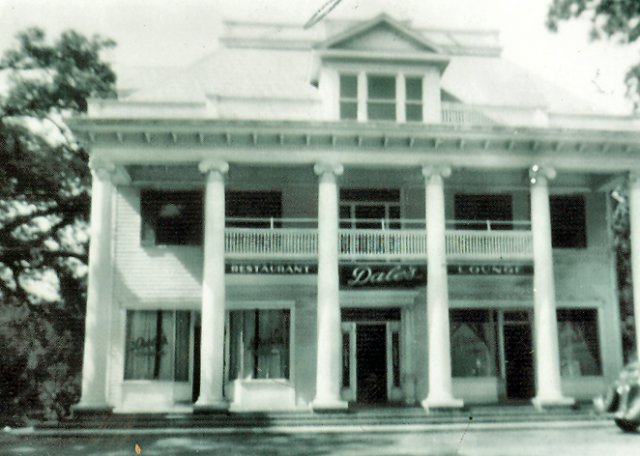
Dale’s Restaurant and Lounge
From the early 1940s until the early 1980s, Willy Dale was the proprietor or lessor of this magnificent edifice which had been built in 1909 by Jeremiah J. O’Keefe (1890-1911) as his family residence. During Dale’s long ownership, this building was often the social center of town with food, music, and libations to enjoy. In addition to Dale’s, it was also known as Trilby’s, the White Oaks Restaurant, and the White Oaks Inn. During WW II, the Greyhound bus line stopped here as well. Courtesy of Robert W. Potter (1918-2008).
Unfortunately, the 1909 Jeremiah J. O’Keefe architectural, gem at present day 911 Porter Street was lost by the O’Keefe family during the Depression, when it was repossessed in December 1938, by the Home Owners Loan Corporation, a Federal corporation. A balance of $5612.17 was owed by the O’Keefe family on the mortgaged property. It was vended by this Federal government agency to William F. ‘Willy’ Dale (1899-1990) in December 1939, for $3850.(JXCO, Ms. Land Deed JXCO Land Deed Bk. 71, pp. 580-581 and Bk. 74, pp. 158-160)
One of the great success stories of Ocean Springs, is the return of the J.J. O’Keefe family residence on Porter Street to the family. When they lost it in 1938, the Jeremiah J. ‘Ben’ O’Keefe II family relocated to Biloxi and resided on Fayard Street behind the Bradford-O’Keefe Funeral parlor at 601 West Howard Avenue. A young Jeremiah J. “Jerry” O’Keefe III (b. 1923) and his sister, Alice O’Keefe Sebastian (b. 1922), vowed that someday, they would reclaim their former home in Ocean Springs.(Alice O’Keefe Sebastian, September 13, 1999 and The Ocean Springs Record, July 3, 1986, p. 2 and July 10, 1986, p. 2
This was accomplished in July 1986, when the Willy Dale family sold the former O’Keefe mansion to Gulf National Life, an O’Keefe corporation. A ceremony was held on the grounds and after signing the warranty deed to the O’Keefe family, Willy Dale said, “Folks, the first day [of owning this building] was fun and the last day is fun too.” In December 1987, Jeremiah J. ‘Jerry’ O’Keefe III with the competent architectural advice and service of Bruce Tolar completed its restoration. The refurbished edifice has been used as the Bradford O’Keefe Funeral Home since this time.(JXCO Land Deed Bk. 863, p. 159 and The Ocean Springs Record, July 3, 1886, p. 2 and December 3, 1987, p. 1)
Dale’s Restaurant and Lounge
After Willy Dale took possession of the O’Keefe home, at present day 911 Porter Street, he converted it into a restaurant and lounge. Its chronology is varied and interesting as for the next forty plus odd years, the Dale building, formerly O’Keefe residence, was leased by many individuals who attempted to make their livelihood from the food and beverage business within its hallowed halls and expansive rooms. During some of this time, Willy Dale continued his interest in the vending of gasoline and oil and the selling and repairing of automobiles. An example of this interest was demonstrated in October 1941, when he opened a new Shell filling station and in January 1946, when Willy Dale reopened his auto repair service in Ocean Springs.(The Jackson County Times, October 25, 1941, p. 1 and January 26, 1946, p. 4)
World War II
World War II introduced mass changes on the Mississippi Gulf Coast. Ocean Springs was highly influenced by the establishment of Keesler Field at Biloxi in 1941 and our own Army Air Corps Crash Boast Base set up in early 1944 on the Inner Harbor. The overflow of military personnel and their dependents from Biloxi for housing and entertainment was surely excellent for local business and rentals. Dales’s on Porter Street was the social center of town during these trying times. Several local gals found husbands whom they met at Dale’s during WW II.
Willy Dale also was the local agent for the Greyhound Lines at his Porter Street establishment during WW II. He advertised this enterprise as follows:
GREYHOUND
BUS STATION
Now located at Dale’s
Ocean Springs, Mississippi
24-HOUR RESTAURANT SERVICE
Will appreciate your business and patronage
(The Jackson County Times, April 15, 1944, p. 4)
Ancel D. Thompson
Shortly after the termination of WW II., in January 1946, Willy Dale leased his restaurant and lounge on Porter to Ancel David Thompson (1907-1977), a native of Alabama, and Mildred Elizabeth Izard Thompson (1905-1998) of Biloxi. Mr. Thompson had been an assistant manager of a wholesale grocery in Gulfport and a traveling salesman prior to joining the military in 1943. He expected to improve the restaurant in several areas. Miss Nora Ladnier continued tending bar for the Thompsons.(The Jackson County Times, January 26, 1946, p. 1)
Ancel D. Thompson opened in early February 1946, with the following advertisement in The Jackson County Times of February 8, 1946, p. 4:
ANNOUNCEMENT
DALE'S
Restaurant
REOPENS
Saturday, Feb. 9, 1946
We will specialize in Sea Food Dinners,
Steaks and Chicken
Dances Continue on Wednesday and
Saturday as Usual with C.F. Gollote's (sic)
Orchestra
Restaurant Hours 12 Noon to 9 P.M.
The Thompson’a tenure at Dale’s was short-lived as by the summer of 1946, a new tenant had taken over the property.
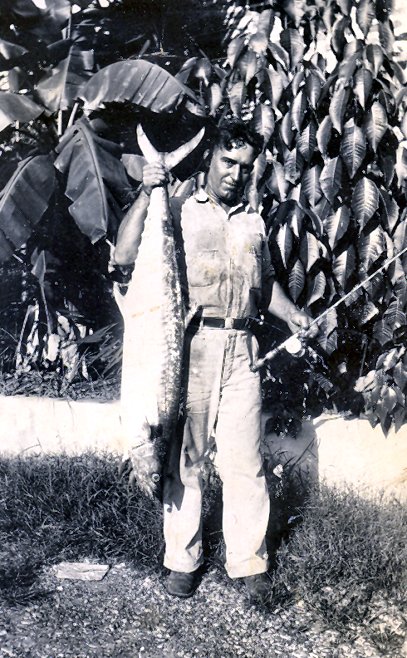
Willy Dale (1899-1990) was an avid fisherman and boater. He is depicted here with a large Spanish mackerel. After the Dolphin, Mr. Dale acquired the Hubba Hubba, a twenty-four foot, mahogany, cabin cruiser. It was kept in his boathouse on West Porter between the restaurant-lounge and the former service station, which had been converted to offices.
Nosery M. Abraham
In August 1946, Nosery Mark Abraham (1898-1969), a 1909 Syrian immigrant, undertook the management of the Dale property. Nosery M. Abraham had been reared at Ocean Springs, as William Abraham (1865-1941), his father, had operated a fruit stand, general store, and residence, probably on Washington Avenue. In September 1911, Joseph A. Wieder (1877-1960) was contracted to erect another story onto the structure occupied by the Abraham family. The family planned to reside on the second floor and enlarge their business on the bottom story.(The Ocean Springs News, September 9, 1911 and September 30, 1911
On June 1, 1918, Mrs. William Abraham moved to Pascagoula and leased a store building near the post office to take advantage of the booming economy there reacting to America’s entry into WW I. Nosery M. Abraham showed the patriotism often evoked by recent immigrants and enlisted in July 1918 in the U.S. Marine Corps. He finished basic training at Parris Island, South Carolina and was mustered out of the Marine Corps at the Marine Barracks, Quantico, Virginia in January 1919.(The Jackson County Times, June 1, 1918, p. 5)
Nosery M. Abraham returned to Mississippi after his military service and opened an ice cream manufacturing business at Columbia, Mississippi. His father closed his shoe repair business at Ocean Springs in August 1920 and joined him in Marion County.(The Jackson County Times, August 21, 1920)
At Biloxi in April 1926, Nosery married Loretta Sablich (1901-1992), the daughter of Julius Sablich (1873-1947) Alphonsine Ruex (1874-1960). After their nuptials, the newly weds were domiciled at Gulfport, but by 1930 had returned to Hopkins Boulevard at Biloxi where Nosery was employed selling sea food. At this time, they had two sons, Nosery M. Abraham Jr. (1927-2003+) and Joseph E. Abraham (1929-1976).(The Jackson County Times, April 10, 1926, p. 3 and 1930 Harrison Co., Ms. Federal Census R 1146, p. 14A, Ed 5)
The Silver Gull and Dale’s
Prior to commencing his food and beverage services in the Dale place on Porter Street, Nosery Abraham had been the proprietor of The Silver Gull, a restaurant and lounge, situated on U.S. Highway 90, now the Old Spanish Trail or Government Street, two miles east of Ocean Springs. He opened The Silver Gull in February 1940.(The Jackson County Times, February 24, 1940, p. 4)
On August 3, 1946, Nosery M. Abraham, the new manager, opened as:
DALE’S
Restaurant and Lounge
Dining Room
Specializing
Fine steaks, fresh well-prepared seafood, fried chicken, and poor boy sandwiches
Curb service No cover or admission charge
Mr. Abraham also offered C.F. Gollott (1911-1987) of Biloxi and his orchestra with Miss Mae Morgan on vocals. C.F. Gollott played Dixieland Jazz and was associated with name bands of his era: Ace Cannon, George Brunies (1902-1974), Dan Glasser, and Chuck Foster.(The Daily Herald, August 2, 1946, p. 3 and The Ocean Springs Record, December 2, 1982, p. 2)
Pete Lowery
In the spring of 1947, Leland ‘Pete’ Lowery (1914-1955) took over the management of Dale's Place, a cafe and lounge, on the northeast corner of Porter and Jackson Avenue. Pete Lowery was a native of Grenada, Mississippi. He came to Ocean Springs with his family from Gulfport after WW II. They had earlier resided in the Delta region of northwest Mississippi.(Donnie L. Beaugez, August 1998 and The Jackson County Times, July 26, 1947)
|
DINE and DANCE At DALE’S UNDER NEW MANAGEMENT Open 8: A.M. to 12: 00 P.M. The Coolest Place In Town The Coldest Drinks In Town We are equipped to handle Special Partities Mr. and Mrs. Pete Lowery, Proprietors
(The Jackson County Times, May 24, 1947, p. 8) |
It appears that Pete Lowery left Dale’s Place in the spring of 1949, and relocated across the street to the Neville Byrd property situated on the northwest corner of Porter and Jackson. Here he commenced a business called Pete’s Lounge. Mr. Lowery’s place featured nightly dining and dancing with music by Toby Gunn on the Hammond organ and the Dixie Land Band. Adam “Frenchie” Bourgeois (1914-1987), the bar tender, later opened his own West Porter establishment called, Frenchie’s Fine Foods. Pete Lowery also had a drive-inn restaurant with curb service. A barbecue pit was located near the Cosper Courts, now Dale Cottages. The Lowery family also resided here as there were two apartments on the site.(The Jackson County Times, June 10, 1949 and July 1, 1949, p. 10 and Donnie L. Beaugez, August 1998)
In late September 1950, Leland “Pete” Lowery left this location and opened a Pete’s Lounge on Highway 90 on the west side of the War Memorial Bridge in the former Kersanac’s Snug Harbor building of J.J. Kersanac. Pete Lowery made significant improvements to the property. The exterior and interior of the structure was repainted, the rear of the building was excavated to create a circular driveway and space for patron curb service, and adequate rest room facilities were installed. Local artist, Charles Kuper, painted jungle scenes in the Cocktail Lounge. Jo Selzer of New Orleans was hostess. In relocating to Highway 90, Pete Lowery had taken a four-year lease from Mrs. May W. Lundy (1885-1951+).(The Gulf Coast Times, September 22, 1950, p. 1 and JXCO, Ms. Land Deed Bk. 124, pp. 394-396)
In January 1951, Pete Lowery suffered a heart attack, and spent several months recovering. It appears that he may have decided to retire from the restaurant business as in October 1951, Pete Lowery sub-leased the property known as Pete’s Lounge to Edwin L. Matheny (1920-1987). Mr. Matheny took an option to buy Lowery’s equipment and fixtures in Mrs. Lundy’s building.(The Gulf Coast Times, January 19, 1951, p. 1 and JXCO, Ms. Land Deed Bk. 124, pp. 397-400)
It is known that Pete Lowery went back into the lounge business as he was operating Pete’s Lounge in West Biloxi in December 1953.(The Gulf Coast Times, December 10, 1953, p. 1)
Bingo
Bingo has long been that game of chance used so ubiquitously to raise money for good causes. Dale’s was also the venue for Bingo as advertised in 1947 and 1948.
|
|
BINGO Every Wednesday At 8 p.m. DALE’S RESTAURANT First Game Free 21 Games JACKPOTS THIS WEEK $135------$55 BENEFIT BUILDING FUND OCEAN SPRINGS VOLUNTEER FIRE STATION “Help build a modern FIRE STATION. A big step towards reducing your fire insurance rates!!” If you are unable to attend Bingos, we will appreciate your contributions. Mail or give them to Arthur Marx, Secretary P.O. Box 427. (The Jackson County Times, December 31, 1948)
|
On March 25, 1949, The Gulf Coast Times announced that Dale's Restaurant and Lounge, a local landmark, will open on March 28, 1949. It had been operated by others last year. As previously mentioned Pete Lowery had moved across the street and opened Pete's Lounge circa June 1949.(The Gulf Coast Times, June 10, 1949).
Willy Dale returns
It’s fun to done by candlelight at
DALE’S
HIGHWAY 90, OCEAN SPRINGS
Enjoy superb food, at this new and attractive restaurant, always
Reasonable prices
Open 11:00 a.m. to 2:30 p.m. 4:30 to 10:30 p.m.
Managed by Wm. F. Dale
(The Gulf Coast Times, April 8, 1949, p. 10)
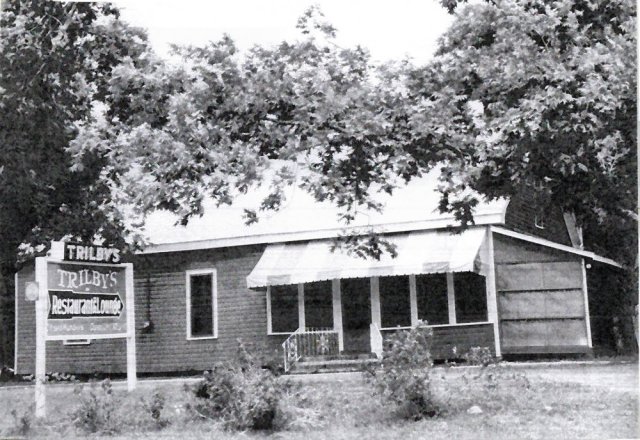
After closing her Porter Street restaurant in Willy Dale’s building, Trilby G. Steimer (1896-1960) relocated in 1955 to the old Gehl place on "new" US 90, today called Bienville Boulevard. The ‘new’ U.S. Highway 90 by passed down town Ocean Springs. E.W. ‘Woody’ Blossman (1913-1990) acquired the property and Trilby name in 1963. Harold and Jocelyn Seymour Mayfield, who had worked for Trilby, managed the eating affair for Mr. Blossman, until 1982, when they opened Jocelyn's, their own fine restaurant, also on Bienville Boulevard. Jack Gottsche became manager of Trilby’s in 1983. In 1993, he changed the name to Germaine’s. The restaurant became Chandler’s in 2004 and after Katrina (2005), Alberti’s, formerly of Biloxi has operated in the former Trilby’s.
Trilby’s
By January 1952, Willy Dale had a new proprietor in his Porter Street edifice. She was‘Trilby’ Grenet Steimer (1896-1960). Trilby had already made a name for herself at Ocean Springs in the fine dining and restaurant business. She ran the Big Pine Inn on West Porter Street until February 1946, when it was sold to Paul Lewis. In 1947, Trilby and Ted Steimer with Ray and Juanita Taylor, opened the Alibi, formerly the Clear View Café, on Highway 90 (Government Street) east of Ocean Springs. Another site for the ubiquitous Trilby was the Bayou Chateau, now Aunt Jenny's Catfish Restaurant. She opened here on September 4, 1948. This was the first time that the name “Trilby’s” was used for her business.(The Jackson County Times, August 27, 1948, p. 9)
Lillian “Trilby” G. Welton Steimer (1896-1960) was born at New York City on April 1, 1896, the daughter of Auguste J. Grenet and Lillian Day. Honore Grenet, Trilby’s grandfather, was born in France and had a background in the restaurant business. He immigrated to Mexico with his Majorcan born wife between 1864 and 1867, when Ferdinand Maximilian (1832-1867), the Austrian archduke, was being enthroned as Emperor of Mexico by Napoleon III, Louis Napoleon Bonaparte (1808-1873), who ruled France from 1852-1870. Opposition to the French invasion of Mexico led to anarchy, which swept the country and led Honore Grenet to remove his family to the safe environs of San Antonio, Texas. Here Monsieur Grenet founded a successful merchandiser. He owned the Alamo, which he purchased from the Roman Catholic Church for $20,000, and utilized it as a warehouse for his expanding business. Trilby’s father, Auguste J. Grenet, was sent to Manhattan College in New York City. Here he became engaged in the chemical business, but was enamored with horse racing. Auguste, a competent mathematician, devised a system for handicapping race horses and became the first professional handicapper.(Down South, Vol. 9, No. 4, July-August 1959)
Walter F. Welton
In New York circa 1917, Trilby Grenet married Walter F. Welton (1894-1981), the son of Frances Welton, a Manhattan butcher and later hotelier, and Elise Welton, a French immigrant. Trilby and Walter F. Welton had two children: Francis Welton (1918-pre-1930) and Elise ‘Happy’ W. Fulwiler MendezThomas (1920-1989). In 1920, Walter F. Welton was in the hotel business with Frances Welton (1867-1918+), his father. Their resort was called Moheghan Lake and situated in Westchester County, New York. Adele Grenet Stevenson (1888-1990), Trilby’s sister, was also married to a hotelier and resided in Palm Beach, Florida.(1920 New York Co., New York Federal Census T625_1226, p. 3A, ED 1494)
Ted Steimer
In March 1930, Trilby G. Welton, then divorced from Walter F. Welton married Edward C. "Ted" Steimer (1884-1967) in south Florida. He was an associate of her father's in the horse race handicapping business. Ted Steimer began visiting Ocean Springs circa 1916, as a fishing destination. He continued this routine for years, as he would arrive here in the fall to hunt and fish before the racing season began at New Orleans. Ted and Trilby relocated to Ocean Springs after their wedding.(The Daily Herald, March 14, 1930, p. 9)
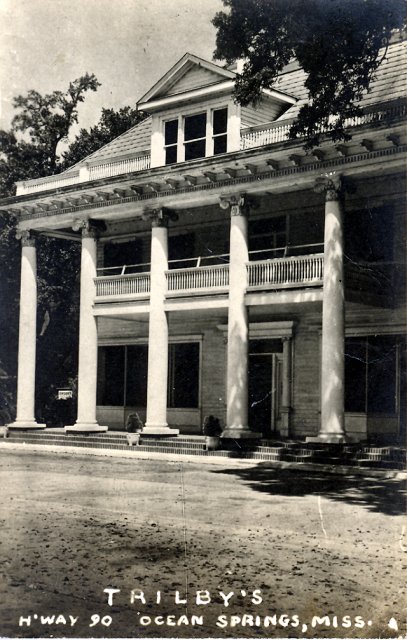
TRILBY’S [circa 1953]
911 Porter Street
Trilby's, an Ocean Springs culinary experience and tradition was commenced by Lillian ‘Trilby’ Grenet Welton Steimer (1896-1960) at Ocean Springs in 1948, when she opened in the Bayou Chateau, now Aunt Jenny’s, on Old Fort Bayou. In 1955, after a several years in the O’Keefe-Dale place on West Porter, she and E.C. ‘Ted” Steimer (1884-1967) opened Trilby’s at present day 1203 Bienville Boulevard. With Trilby’s demise in Mr. Steimer vended the business to E.W. ‘Woody’ Blossman (1913-1990). The former Trilby’s has been operated in recent years as: Germaine’s, Chandler’s, and today is called Alberti’s.
Dale’s Place
By January 1952, Trilby G. Steimer had relocated to the W.F. Dale building, formerly the J.J. O’Keefe home on Porter Street. The Steimer’s lived upstairs in the old O’Keefe mansion. Burglars broke into their restaurant on New Year’s Day 1952 and stole $4 in pennies from the cash register.(The Gulf Coast Times, January 3, 1952, p. 1)
In July 1955, Trilby G. Steimer acquired the old Gehl place on "new" US 90, today called Bienville Boulevard. This is the Trilby's that most residents of Ocean Springs are familiar and have fond culinary memories. Here such gourmet dishes as Rock Cornish game hen au parto and creamed ham and sweetbreads with ripe olives, macaroni loaf, carrot casserole, and rum pie were concocted.
E.W. Blossman
In June 1963, after the demise of Trilby G. Steimer, Trilby's Restaurant was acquired from her daughter and widower, Elise G. Thomas and E.C. Steimer, by the Alpha Investment Corporation, an E.W. Blossman (1913-1990) family enterprise. The name "Trilby's" was sold with the restaurant. Harold and Jocelyn Seymour Mayfield, who had worked for Trilby, managed the eating affair for Mr. Blossman, until 1982, when they opened Jocelyn's, their own fine restaurant, also on Bienville Boulevard. Jack Gottsche became manager of Trilby’s in 1983. In May 1987, Craig Claiborne (1920-2000), food critic for the New York Times, ate at Trilby’s.(Jack Gottsche, February 1, 2008 and The Ocean Springs Record, May 21, 1987, p. 7)
Germaine’s-Chandler’s-Alberti’s
In September 1988, title to the Trilby restaurant property at 1203 Bienville Boulevard was transferred to the Blossman Company. From 1993 until 2004, the restaurant was called Germaine's for Germaine Gottsche, now Dr. Germaine Gottsche, DDS, and the lovely daughter of the former proprietors, Jack and Jane Dees Gottsche. In January 2004, Jack Gottsche sold his interest in Germaine’s to Vikki Harlan McElhose and spouse, Wayne McElhose. The McElhose family changed the name of their eatery from Germaine’s to Chandler’s. Chandler was Mrs. McElhose’s father, Howard Chandler Harlan. The McElhose family came to the Mississippi Gulf Coast in 1997. Vikki had thirty years of restaurant experience and promised to continue with many of Trilby’s original recipes. She did add Prime Rib, Lobster, Black & Bleu Soup, and Fried Green Tomatoes. An Express lunch menu was also commenced with meals ranging from $8-$10. Chandler’s also offered off site catering and private parties. There was a Champagne brunch on Sunday.(The Ocean Springs Record, January 15, 2004, p. A1 and The Mississippi Press, April 21, 2004, p. 4)
Chandler’s was short lived as a local culinary venue. By the time Hurricane Katrina struck in late August 2005, the restaurant was in decline. After Hurricane Katrina, Alberti’s, an old Biloxi eating tradition which was destroyed by the August 2005 tempest, relocated to the Blossman building on Bienville and continues to operate here today with their specialties of creative Italian cuisine and prime steaks.(Jack Gottsche, February 1, 2008)
1959-Perkinston classes
On August 31, 1959, Perkinston Junior College, commenced classes in the former O’Keefe home and Dale’s Restaurant at 911 Porter Street. The regional junior college offered seventeen evening classes and one morning class in practical nursing, which included a simulated twelve-bed hospital. Subjects available for prospective scholars to enroll in the evening curriculum were: English, English literature, algebra, trigonometry; general business, accounting; shorthand, general psychology; sociology, American government, world history, personal health, speech, music appreciation and introduction to teaching. Admission to the Perkinston classes was open to high school graduates or mature individuals demonstrating the ability to utilize the material offered by the lecturer.(The Ocean Springs News, May 27, 1959, p. 1 and August 27, 1959, p. 1)
The fire
On the eve of January 3, 1960, a fire started in the Perkinston Junior College nurses training center in the W.F. Dale building on West Porter. Firemen from Biloxi were summoned to the conflagration and assisted the OSFD in quickly extinguished the blaze. Mr. Dale's losses were estimated initially to total about $10,000. President J.J. Hayden Jr. of the Junior College planned to announce a new location for the nurses training program soon. The students in Ocean Springs class were to graduate in a month and were sent to the Singing River Hospital to complete their nurse's training.(The Daily Herald, January 4, 1960, p. 8)
1966 liquor petition
By June 1966, Willy Dale was back in business at 911 Porter operating as Dale’s Lounge. At this time, the State of Mississippi was planning to charge a fee for an initial liquor license and an additional assessment after a business had reached $5000 in liquor sales. To demonstrate his ire with this proposal, Mr. Dale began collecting signatures on a petition opposing the proposed liquor taxation.(The Ocean Springs Record, June 30, 1966, p. )
1970-White Oaks Inn
In May 1970, the Dale Restaurant and Lounge property on West Porter was renovated extensively. The main dining room was still situated downstairs, but an upstairs dining area to seat and additional one hundred-seventy patrons was created. The upstairs dining area of the edifice also featured an additional bar, a piano bar, as well as dining on the balcony.(The Ocean Springs Record, May 21, 1970, p. 7)
The refurbished building opened for business on October 9, 1970 with Lee Niblo, as proprietor and manager. Mr. Niblo called his enterprise the “White Oaks Inn”.(The Ocean Springs Record, October 8, 1970, p. 2)
WHITE OAKS INN
Formerly Dale’s Restaurant
Under new management by Lee Niblo
Lounge 2 P.M. til 2 A.M.
Dinner 5-11 P.M.
Head Chef L.W. Sampson, formerly Head Chef, Robert E. Lee Hotel, Jackson, Mississippi
CLOSED SUNDAY
(The Ocean Springs Record, October 8, 1970, p. 2)
1982-White Oaks Restaurant
By 1982, Willy Dale was operating the White Oaks Restaurant with son, W.F. Dale Jr. They featured ‘down home cooking’. Frieda Russell was manager; the chef was Bill Brooks, and Willy Dale greeted customers. The restaurant had eight-foot tables with five-foot lazy-susans centered in them. Teddy A. Belesky (1922-1996) of TAD Cabinets and Millwork at Biloxi built the unique serving tables. They were modeled after those at the Mendenhall Hotel Restaurant at Mendenhall, Mississippi. Every day at noon, Mr. Dale served: salad; two meats-southern fired chicken or chopped steak; rice, potatoes, corn muffins; biscuits; tea; coffee; and Bundt cake. Cost for this meal was $3.95. In the evening, one could get the following for $6.00: shrimp spaghetti; spinach quiche; fruit cobbler; and bread pudding. Children were fed for ½ price.(The Ocean Springs Record, July 22, 1982, p. 3)
Dale children
Willy and Ethel E. Dale’s were the parents of two children. Their daughter, Thelma Agnes Dale (1921-2008), married Ensign Standish James Bradford (1914-1992), the son of James S. Bradford (1884-1963) and Sara Bardsley (1891-1973) on August 2, 1942 at St. Michael’s Catholic Church in Biloxi. Father Edmund Mullin officiated at the double ring ceremony held in the parish rectory with immediate members of both clans present. Thelma A. Dale had graduated from Ocean Springs High School with the Class of 1939. She attended Perkinston Junior College and worked at Keesler AFB. Standish J. Bradford also received is education at Ocean Springs High School finishing with the Class of 1933. Before his enlistment in the U.S. Navy, he was employed at the Bradford Wayside Nursery, his father’s business in Ocean Springs. (The Jackson County Times, August 1942)
After Thelma Dale and Standish J. Bradford divorced, she married Henry Christopherson in California. Thelma was a talented accountant and was employed by the IRS at San Francisco in the late 1940s. She later was comptroller and co-proprietor of Trans Bay Electronics, Inc. at Richmond, California. Thelma Dale Christopherson expired in South San Francisco on January 26, 2008. Her survivors include Henry ‘Hank’ Christopherson, her spouse; Gary W. Christopherson and Stephanie Christopherson, her son and daughter-in-law; and Rachel and Blake Christopherson, her grandchildren. A memorial service was held for Mrs. Christopherson at Ocean Springs, Mississippi on February 16, 2008 at the Bradford-O'Keefe Funeral Parlor on West Porter Street in the same edifice that Willy Dale, her father, had owned for many years.(The San Francisco Chronicle, February 1, 2008 and The Sun Herald, February 14, 2008, p. A6)
William F. Dale Jr.
William F. ‘Bud’ Dale Jr. (1926-1979) was the son of William "Willy" F. Dale Sr. (1899-1990) and Ethel S. Endt (1900- 1978). He was known in the community by his familial name, Bud or Buddy. William Dale Jr. matriculated to Ole Miss after finishing Ocean Springs High School in 1944. He left Oxford shortly thereafter and enlisted in the U.S. Navy. Buddy Dale completed his education at the University of Pennsylvania earning degrees in Business Administration at the Bachelor’s and Master’s level. He became a Certified Public Accountant. The lure of the Far East enticed Buddy Dale to Central Sumatra, Republic of Indonesia where he oversaw the accounting department of CalTex, a U.S. affiliate owned jointly by Chevron and Texaco. Mr. Dale also was employed by accounting firms in New Orleans and New York. He joined Ingalls Shipbuilding at Pascagoula in 1967, as a facilities planner. Buddy Dale was active in politics. He was elected alderman of Ward Two in 1973. Mr. Dale was a member of the American Institute of Certified Public Accountants and the 1699 Historical Committee. He expired at Ocean Springs on December 20, 1979. His corporal remains were interred in the Evergreen Cemetery on Old Fort Bayou.(The Ocean Springs Record, December 27, 1979, p. 3 and March 6, 1980, p. 7)
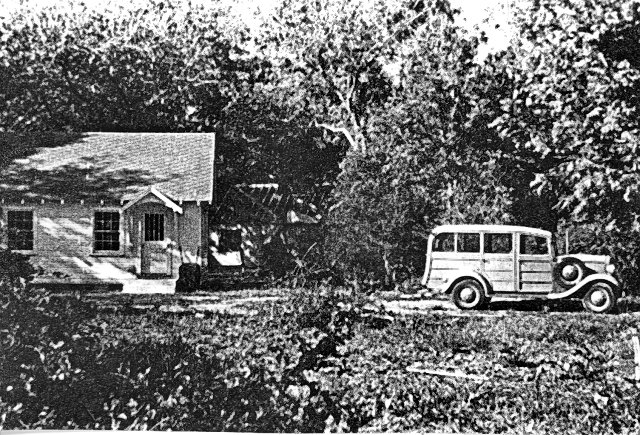
Heffner-Cosper-Dale Cottages
811 Porter
Situated at 811 Porter Street, these pre-WW II structures were erected in 1941 by Oscar E. Heffner (1893-1988), as rentals for travelers plying U.S. Highway 90, then Porter Street. Keesler AFB at Biloxi was also under construction at this time and its exponential growth after WW II commenced for America in December 1941would create a serious housing shortage on the Mississippi Gulf Coast. The W.F. Dale family acquired this 2.27 acres parcel and improvements in October 1945. The Estate of Thelma Dale Christopherson (1921-2008) possesses this valuable property today. Courtesy of Marshall Heffner and Brian Heffner.
Heffner-Cosper-Dale Cottages
The Dale Cottages at 811 Porter Street were erected in the fall of 1941 by Oscar E. Heffner (1893-1988), a native of Chesapeake, Ohio, and his wife Ruth H. Brewster (1894-1972) of Howell County, Missouri. In August 1941, Oscar E. Heffner acquired 2.37 acres at the northeast corner of Rayburn and Porter from Theo Bechtel Jr. (1909-2003) and Jessica White Bechtel (1869-1946), his mother. This tract had been the site of ‘Hollywood’, the exquisite home of Thomas A.E. Holcomb and Holcomb of Chicago.(JXCO, Ms. Land Deed Bk. 78, pp. 24-26.)
Here, Oscar E. Heffner built a home and six rental cottages, which stand today. The cottages range from about 700 to 900 square feet in area. The Heffner Courts were built as a family affair with Frank “Kiddo” Galle Jr. (1900-1986), as the local contractor. Heffner's brothers, Ira Heffner, and nephew, Chester Heffner, of Deer Park, Ohio assisted in the construction. George Basly did the electrical wiring, while Joe Weider (1877-1960) and Charles Van Court (1877-1984) plumbed the cottages. Mr. Hefner initially rented his units to military personnel who were pouring into Keesler Field, the new military training base at Biloxi. Rents ranged from $50-$55 per month. There may have been some daily rentals.(The Jackson County Times, April 9, 1941, p. 1 and Oscar Heffner, June 1995)
Louis Henry Cosper (1884-1963) a native of Monroe, Louisiana acquired the Hefner property in October 1945. He was a pioneer in the oil and gas industry in North Louisiana and served as vice-president of the Progressive Oil Company, which drilled the No. 1 Spyker, the discovery well for the Bastrop gas field. Mr. Cosper was honored in late August 1959, when a monument to Bastrop's pioneer industrialists was unveiled on the courthouse square.(Ms. Land Deed Bk. 89, p. 382-383 and Bk. 91, pp. 392-393 and The Ocean Springs News, September 3, 1959, p. 1)
Upon Louis H. Cosper's death in March 1963, his wife and daughter inherited the Porter Street property. At this time, the Cosper Courts were managed by B. Nowlin Keener Jr. In July 1964, Martha S. Cosper and her daughter, Mrs. Eldredge L. Carroll, conveyed the Cosper Courts to William F. Dale Jr. (JXCO, Ms. Chancery Court Cause No. 16991-December 1963 and JXCO, Ms. Land Deed Bk. 259, p. 366)
Before his demise in 1979, William Dale Jr. legated his estate to his father, W.F. Dale Sr., Thelma Dale Christopherson, and Gary W. Christopherson, his sister and nephew, respectively. When Willy Dale expired in May 1990, his daughter, Thelma Dale Christopherson, inherited his interest in the Dale Cottages.(JXCO, Ms. Chancery Court Cause No. 37,792-October 1986 and JXCO, Ms. Chancery Court Cause No. P-2711-Ocotber 1990)
During her nearly two decade ownership of the Dale Cottages, Thelma Dale Christopherson and her local management team during this period, Lee Adams and Jane Frammersburger, has excellently maintained the buildings and grounds of her Porter Street property. They are a show piece of the city and blend well with the historic homes and buildings in the Old Ocean Springs Historic District which they are an integral part.
The Bud and Willy Dale Oaks
On February 29, 1980, the Ocean Springs Garden Club planted two Live Oak trees at the White Oaks Inn on West Porter in the memory of W.F. ‘Buddy’ Dale Jr. (1926-1979) and to recognize W.F. Dale Sr. who was still active in the community. At this time, Miss Florence Morrow (1868-1934), a pioneer teacher in the local public school system, was remembered with a Live Oak placed in the earth at the N.E. Taconi School on Magnolia Street.(The Ocean Springs Record, March 6, 1980, p. 7)
Gulfport
In addition to his entrepreneurial activities at Ocean Springs, Willy Dale commenced in April 1945 an automobile agency at neighboring Gulfport. Here he entered into a two-year lease with Juanita D. Stuard and Ignatius D. Alfonso (1909-1977) on Lot 14 of Block 158. The rental fee was $150 per month. Here on the northeast corner of 23rd Avenue at 15th Street, Mr. Dale opened Dale's Motor, Inc., a general auto sales and service agency, with Jules Galle Jr. (1903-1987). They vended Chrysler-Plymouth motor cars. Dale Motors also performed body and fender work as well as automobile painting. (Harrison Co., Mississippi Land Deed Bk. 276, pp. 163-165)
In April 1946, Willy Dale and James Turan (1917-1986) of Gulfport drove to Detroit stopping at boat and automobile factories on route. Mr. Dale was enthusiastic about the performance and road handling of his new Plymouth sedan, which carried them through the Midwest.(The Jackson County Times, April 23, 1946, p. 6).
In March 1947, W.F. dale advertised his Gulfport operation as follows:
DALE’S
Motor Company
General Auto Repair
Repairs, Tires, Accessories
USE OUR BUDGET PLAN
10 per cent down
Phone 1508, Gulfport
(The Jackson County Times, March 1, 1947, p. 4)
Home and Auto Supply StoreWith his automobile sales business at Gulfport going well, Willy Dale rented his former Dale’s Garage on West Porter to Henry Burkle (b. 1921) in May 1947. Mr. Burkle had resided at Pittsburgh, Kansas before entering the U.S. Army in June 1942. Upon discharge, he joined the Biloxi Firestone Store. Henry Burkle’s store on West Porter was equipped to sell Firestone tires and tubes, electrical appliances, bicycles, automobile accessories including batteries and radios. He also repaired radios and sold Shell gasoline.(The Jackson Co. Times, May 24, 1947, p. 5)
Rescue in the Chandeleurs
While on a day outing to the Chandeleurs in early September 1947, Willy Dale and Dr. R.N. Cahill (1907-1961) of Gulfport, his fishing companion and pilot, had to be rescued by the U.S. Coast Guard. While landing on the littoral at Coster Island, one of their landing gear broke disabling Dr. Cahill’s converted U.S. Army Air Corps Aeronca L-3 trainer aircraft. Unperturbed by the situation the two gentlemen adventurers proceeded to catch eight red fish and twelve, large, speckled sea trout. Naturally, when they didn’t return in the evening their families became concerned and reported them overdue. The following morning the two men were observed by a U.S. Coast Guard PBY aircraft and soon rescued and flown to U.S. Army Field at Gulfport. Their only discomfort was the mosquitoes, which forced them to spend five hours in the water during the night to avoid their unrelenting attacks.(The Jackson County Times, September 6, 1947, p.1)
Oil and gas exploration
In his late fifties, Willy Dale began another career in what had been a somewhat diverse life. The lust for travel and adventure enticed him into the oil exploration business. One of Willy’s first overseas tours took him to Nicaragua with a seismic crew from Lafayette, Louisiana. He later spent time in the Middle East with other oil exploration survey teams.(The Ocean Springs News, January 24, 1957, p. 1 and May 31, 1990, p. 3)
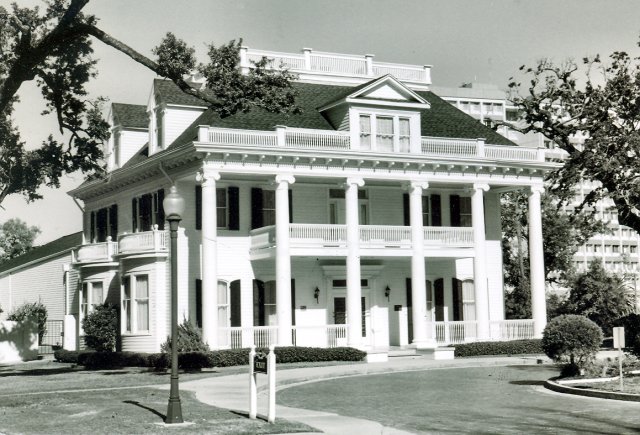
911 Porter
Bradford-O’Keefe Funeral Home-Built in 1909 by Jeremiah J. O’Keefe (1859-1911) as his residence, the O’Keefe family lost it during the Depression. It was acquired by W.F. ‘Willy’ Dale (1899-1990) in December 1939. Mr. Dale utilized the structure primarily as a restaurant and lounge for about forty-five years. Jeremiah J. ‘Jerry’ O’Keefe III (b. 1923), the grandson of the builder, bought the property in July 1986 and had it restored to serve as a funeral parlor for Bradford-O’Keefe Funeral Homes, Inc. It has served this purpose for the last twenty years. Image by Ray L. Bellande.
Bradford-O’Keefe
After the White Oak Inn closed in the early 1980s, Willy Dale retired to his home at East Porter Street. In July 1986, the Willy Dale family sold the White Oaks Inn, formerly the Jeremiah J. O’Keefe mansion to Gulf National Life, an O’Keefe corporation. A ceremony was held on the grounds and after signing the warranty deed giving title to the O’Keefe family, Willy Dale said, “Folks, the first day [of owning this building] was fun and the last day is fun too.” (JXCO Land Deed Bk. 863, p. 159 and The Ocean Springs Record, July 3, 1986, p. 2 and July 10, 1986, p. 2)
The O’Keefe Funeral Service began in 1892 evolving from the family business of drayage and undertaking. J.J. ‘Ben’ O’Keefe II (1894-1954) opened a funeral parlor in Biloxi in March 1923, when he acquired the Frank Voivedich (1861-1930) property at 601 Howard Avenue. Ben’s sibling bought a ¼ undivided interest in the business in October 1924 O’Keefe paid her $6800 for the lot and improvements.(HARCO Land Deed Bk. 135, pp. 351-352 and Bk. 143, p. 212)
This commercial venture was related to the public as follows: Ben O’Keefe, local undertaker and funeral director, has purchased property in Biloxi opposite the Catholic Church (Nativity BVM) and expects to enter into the business in that city about June 1st. He is fitting up a modern funeral parlor and will be equipped to do a general undertaking business conducting funerals, etc. Mr. O’Keefe will of course continue his large business interest in Ocean Springs, having his brother, Joseph O’Keefe to assist him.(The Jackson County Times, on May 19, 1923, p. 5)
To check Ben O’Keefe’s undertaking enterprises at Biloxi, the Bradford Company at 119 East Howard Avenue, lead by Lyman Bradford (1863-1944) and his sons, James Floyd Bradford (1890-1963) and Paul S. Bradford (1894-1983) countered almost immediately and opened their own funeral parlor in Ocean Springs. In June, they leased the McFarland bungalow at present day 317 Washington Avenue. The Bradfords opened for business in mid-July 1923.(The Daily Herald, June 18, 1923, p. 3 and The Jackson County Times, July 14, 1923, p. 5)
Upon Ben O’Keefe demise in November 1954, Jeremiah J. ‘Jerry’ O’Keefe III (b. 1923) continued the family funeral and burial insurance company at Biloxi. In May 1957, Jerry O'Keefe acquired the Bradford Funeral Home at Biloxi with all property, ambulances, etc. and merged the two entities into Bradford-O'Keefe. In 1962, he built the Ben O'Keefe funeral parlor at present day 1904 Government Street, which formerly housed the New Hope Center dedicated August 3, 1997, and supported by the O’Keefe Foundation, which Jerry O’Keefe and Rose Annette Saxon O’Keefe (1924-1998), his lovely spouse, created in 1996.(The Ocean Springs News, August 6, 1964, p. 3 and The Ocean Springs Record, May 21, 1998, p. 5)
In December 1987, Jerry’ O’Keefe with the competent architectural advice and services of Bruce Tolar completed the restoration of Dale’s White Oaks Inn at 911 Porter. The refurbished edifice has been used as the Bradford O’Keefe Funeral Home since this time. Today, Jeffrey H. O'Keefe (b. 1956), Rose and Jerry O'Keefe's son, is the proprietor of Bradford-O'Keefe Funeral Homes, Inc.(The Ocean Springs Record, December 3, 1987, p. 1)
Final days
After the White Oak Inn closed in the early 1980s, Willy Dale retired to his home at East Porter Street. Thelma Dale Christopherson (1921-2008), his daughter, came from California in early March 1987 and gave him a family birthday fete to celebrate Willy’s eighty-eighth natal anniversary.(The Ocean Springs Record, March 12, 1987, p. 5)
William Frederick Dale (1899-1990) passed at Ocean Springs, Mississippi on May 25, 1990. During his ninety-one years at Ocean Springs, Willy Dale witnessed his town grow from a boutique, tourist village on the Bay of Biloxi to a thriving pecan and citrus, agricultural center. Surviving the Depression, he utilized his boundless energy, mechanical wizardry, and entrepreneurial skills to create wealth. As a true Pisces, Willy found joy on the water with his boats and the lure of salt water fishing was in his veins. His corporal ashes were appropriately dispersed on the littoral at Horn Island after cremation.(The Ocean Springs Record, May 31, 1990, p. 3)
REFERENCES:
1947 Gulfport City Directory, (Mullins-Kille Co.: Parsons, Kansas-1947), p. 26.
Jackson Co., Mississippi Chancery Court Cause No. 37,792,"Estate of W.F. Dale Jr.”, October-1986
Jackson Co., Mississippi Chancery Court Cause No. P-2711, "Estate of W.F. Dale, Sr.", October-1990.
Journals
The Chicago Tribune, Woman [Mildred Peacock Hearther] leaves an estate of 2.1 Million”, February 4, 1968.
The Daily Herald, “Ocean Springs man retires”, September 27, 1916.
The Daily Herald?, “Boat Races Thrill Hundreds at Ocean Springs Yesterday”, ??
The Daily Herald, “Ocean Springs”, June 23, 1923.
The Daily Herald, “Building New Boat For Pleasure Service”, April 22, 1938, p. 6.
The Daily Herald, “New excursion boat being completed”, May 25, 1938, p. 8.
The Daily Herald, "Dr. Babendreer Dies at Ocean Springs", June 20, 1938, p. 1.
The Daily Herald, "Dr. Babendreer Buried", June 21, 1938, p. 3.
The Daily Herald, “Dale’s Restaurant and Lounge”, August 2, 1946.
The Daily Herald, “Dale Death”, July 23, 1953.
The Daily Herald, “Harriet Rose Dale”, August 9, 1956.
The Daily Herald, "Dr. Estelle Babendrier", March 12, 1958, p. 2.
The Daily Herald, "Examine Cause of O.S. Fire", August 28, 1960, p. 8.
The Daily Herald, "Mrs. Ethel Sophie Dale", August 28, 1978, p. A-2.
The Gulf Coast Times, March 25, 1949, p. 6.
The Gulf Coast Times, "George W. Dale”, 81, Dies Wednesday", July 30, 1953, p. 1.
The Jackson County Times, “Local News Interest”, May 12, 1917.
The Jackson County Times, “Local News Interest”, January 5, 1918.
The Jackson County Times, “Local News Interest”, June 1, 1918.
The Jackson County Times, "Local News Interest", January 17, 1920.
The Jackson County Times, “Ocean Springs has first woman lawyer”, August 12, 1922.
The Jackson County Times, "local and Personal", May 19, 1923.
The Jackson County Times, "Abraham-Sablich", April 10, 1926.
The Jackson County Times, "Dale Motor Has Modern Garage", June 12, 1926.
The Jackson County Times, "Local Outboard Racer Wins Three Cups", May 12, 1928, p. 2.
The Jackson County Times, "Ocean Springs Speed Boat Wins at Pass Christian", June 16, 1928, p. 3.
The Jackson County Times, "Local boat to enter in outboard races Sunday”, June 23, 1928, p. 3.
The Jackson County Times, "Many attend outboard motor races at Biloxi”, June 30, 1928, p. 3.
The Jackson County Times, "Local and Personal”, July 14, 1928, p. 3.
The Jackson County Times, “Ocean Springs Boat Wins Outboard Motor Race In Two Events”, August 25, 1928.
The Jackson County Times, "Local and Personal", September 22, 1928.
The Jackson County Times, "George Dale's Mother Dies in California", November 10, 1934, p. 3.
The Jackson County Times, "Local and Personal", March 28, 1936.
The Jackson County Times, "William Abraham”, September 13, 1941.
The Jackson County Times, "Bill Dale Opens New Filling Station", October 25, 1941, p. 1.
The Jackson County Times, "Greyhound Bus Station”, April 15, 1944, p. 4.
The Jackson County Times, "Dale’s restaurant And Lounge Leased to Mr. and Mrs. Ancel Thompson”, January 26, 1946.
The Jackson County Times, "Firestone Store in Ocean Springs", May 24, 1947.
The Ocean Springs News, "Local News", January 24, 1957.
The Ocean Springs News, Perk classes beginning here in O’Keefe home”, May 27, 1959.
The Ocean Springs News, “Now a college center”, August 27, 1959.
The Ocean Springs News, "Fire injures city landmark on Porter", January 7, 1960.
The Ocean Springs News, "J. O'Keefe", August 6, 1964.
The Ocean Springs Record, "W.F. Dale and Dr. R.N. Cahill rescued on island”, September 6, 1947.
The Ocean Springs News, “Dale returns from Nicaragua”, January 24, 1957.
The Ocean Springs Record, "Petitions on the way’, June 30, 1966.
The Ocean Springs Record, "Dales Restaurant and Lounge", May 21, 1970, p. 7.
The Ocean Springs Record, “White Oaks Inn”, October 8, 1970, p. 2.
The Ocean Springs Record, "Former Alderman Dies after Illness", December 27, 1979, p. 3.
The Ocean Springs Record, “Oak planted in memory of ‘Bud’ Dale”, March 6, 1980, p. 7.
The Ocean Springs Record, "Down home cooking featured at new White Oaks Restaurant", July 22, 1982, p. 3.
The Ocean Springs Record, "C.F. Gollott celebrates 50 years”, December 2, 1982.
The Ocean Springs News, “Ocean Spring family celebrate home coming”, July 3, 1986, p. 2.
The Ocean Springs News, “O’Keefes come home to Ocean Springs”, July 10, 1986, p. 2.
The Ocean Springs Record, “Birthday”, March 12, 1987, p. 5.
The Ocean Springs Record, “O’Keefes come home”, December 3, 1987, p. 1.
The Ocean Springs Record, "William F. Dale Sr.", May 31, 1990, p. 3.
The Ocean Springs Record, "Rose Annette Saxon O'Keefe", May 21, 1998.
The San Francisco Chronicle, "Thelma Dale Christopherson", February 1, 2008.
The Sun Herald, "Thelma Dale Christopherson", February 14, 2008, p. A6.
__________________________________________________________________________________________________
FOR IMAGES AND NEW INFORMATION ON THE DALGO FAMILY see ['Biloxi Families' at www. biloxihistoricalsociety.org]
DALGO [HIDALGO] FAMILY
The progenitor of the Dalgo Family, formerly Hidalgo, of the Mississippi Gulf Coast was Antoine Hidalgo (b. 1866), called Anthony, the son of Felix Hidalgo (1837-1922)and Emelie Marie Domingue (1846-1910+), the daughter of Manuel Domingue (b. 1808) and Armaline ? Domingue (b. 1820). Felix and Emelie married March 10, 1864 in St. Landry Parish, Louisiana. Felix and Emelsie were the parents of seven children: Anthony Hidalgo (1866-1903+) ; Luc Hidalgo (1868-1930+); Neome Hidalgo; W. Saul Hidalgo (1877-1900+); Emanuel Hidalgo (1879-1880+); Mozard Hidalgo (1884-1910+). By 1900 six Hidalgo children were living and by 1910 only four of them were alive.
It appears that when the Anthony Hidalgo family migrated from Southwest Louisiana to the Mississippi Gulf Coast circa 1910. In Mississippi, the family changed their name to ‘Dalgo’ from Hidalgo.
ANTHONY HIDALGO [DALGO]
Anthony Dalgo(1866-1903+) was born about September 17, 1866, probably near Youngsville, Lafayette Parish, Louisiana. He was baptized in the Lafayette, Louisiana Roman Catholic Church on February 2, 1867. (Hebert, 1977, p. 251)
Anthony Hidalgo married Editha Comeaux on October 20, 1890 in Lafayette Parish, Louisiana. A few days later their marriage was solemnized in the Roman Catholic Church at Youngsville, Lafayette, Parish, Louisiana. (Hebert, Vol. 21, 1980, p. 208)
A son, Laurent Hidalgo (1893-1937), later called Lawrence Dalgo, was born at Youngsville, Lafayette Parish, Louisiana on June 5, 1893.(Hebert, Vol. 24, 1980, p. )
Lawrence Dalgo
Circa 1915, in Jackson County, Mississippi, Lawrence Dalgo married Ethel Tillman (1896-1978), the daughter of Gideon N. Tillman (1872-1925) and Laura Toche (1882-1940). Initially at Ocean Springs, Lawrence Dalgo made his livelihood in the employ of Anna Louise Benjamin (1848-1938), a wealthy widow from Milwaukee, Wisconsin. Mrs. Benjamin owned Shore Acres, a large estate situated on the Fort Point Peninsula at Ocean Springs, Mississippi.(WWI Draft Registration Card-Jackson Co., Mississippi)
By 1920, Lawrence Dalgo had found employment as a laborer in a shipyard, probably at Pascagoula, Mississippi. At this time they had two children: Merlin Beverly Dalgo (1916- 2003) married Sarah Fuller (1917-1990) and Beryl Dalgo Woodruff (1919-2010) married Hubert C. Woodruff (1921-1995).(1920 Jackson Co., Mississippi Federal Census T625_879, p. 14B, ED 66)
M. Beverly Dalgo
Merlin Beverly Dalgo was born in 1916 at Ocean Springs, Mississippi. He married Sarah Fuller, who was born October 31, 1917 at Gautier, Mississippi, the daughter of Fuller and . They were the parents of Linda Dalgo Bradford and Lawrence Fuller Dalgo.
Sarah F. Dalgo expired at Mobile, Alabama in October 1990. M. Beverly Dalgo died at Gulfport, Mississippi on December 3, 2003.
After the demise of Lawrence Dalgo, Ethel T. Dalgo married Theodore D. Manuel (1878-1960), a building contractor. Mr. Manuel had lived at New Orleans for many years. They resided at 710 West Porter in Ocean Springs. Mrs. Manuel was the organist at St. Paul's Methodist Church for twenty-five years. T. D. Manuel died in October 1960. His corporal remains were interred in the Biloxi City Cemetery. Ethel passed on March 12, 1978. Her remains were buried in the Evergreen Cemetery on Old Fort Bayou.(The Daily Herald, October 4, 1960, p. 2 and March 14, 1978, p. A-2)
Beryl Dalgo Woodruff
Beryl Dalgo was born December 18, 1919 at Ocean Springs, Mississippi. She married Hubert C. Woodruff (1921-1995) who was born January 10, 1921. H.C. Woodruff expired on September 25, 1995, while Beverly D. Woodruff died on May 28, 2010 at Ocean Springs, Mississippi. Their corporal remains were interred at Southern Memorial Park cemetery at Biloxi, Mississippi. They had no children.
Clarice Marie Leblanc
There is a high degree of certitude that Editha Comeaux Dalgo expired in childbirth of shortly thereafter as Anthony Hidalgo married Clarice Marie Leblanc (1873-1942) on September 2, 1895 at the Lafayette Parish, Louisiana Courthouse. Their marriage was designated Cause No. 5445.(Hebert, Vol. , p. )
The children of Anthony Hidalgo and Clarice Marie Leblanc were: Leon Dalgo (1896-1953), Felix J. Dalgo (1898-1953); Isaac Dalgo (1900-1967); and Angelo Dalgo (1903-1975). Clarice Marie Leblanc Dalgo expired at Biloxi, Mississippi expired on March 22, 1942.
Leon Dalgo(1896-1953) was born June 23, 1896. He married Celestine A. ? (1898-1988). Known children: Harold L. Dalgo (1918-1990) and a son born February 13, 1921.(The Daily Herald, February 17, 1921, p. 3)
In 1920, Leon Dalgo was a corker [caulker] in a shipyard at Pascagoula, Mississippi. The family lived on Foote Street.(1920 Jackson Co., Mississippi Federal Census, T625_879, p. 16A, ED 65)
Harold L. Dalgo married Ila Mae Manuel on January 20, 1937. Leon Dalgo expired on March 6, 1953.(The Daily Herald, January 29, 1937, p. 5)
Felix J. Dalgo(1898-1939) was born April 26, 1898 in Louisiana. He married Anna G. Lusk (1898-1992), the daughter of Richard Lusk (1875-1954) and Anna E. McCaleb (1875-1954)-children: Roland Andrew Dalgo (1920-1922) and Felix J. Dalgo Jr. (1925-1989).
Roland Andrew Dalgo expired at Biloxi on March 27, 1922.(The Daily Herald, March 29, 1922, p. 3)
In 1920, Felix J. Dalgo made his livelihood as a tow boat engineer. His family lived on East Beach Street at Biloxi, Mississippi with Richard Lusk, a ship carpenter.(1920 Harrison Co., Mississippi Federal Census, T625_876, p. 25B, ED 39)
Felix J. Dalgo expired on Christmas Day 1939.
Isaac Dalgo (1900-1967?) was born March 18, 1900 in Louisiana. In 1917, when Isaac Dalgo registered for the WW I draft, he was living with his mother at 1026 Pearl Street at Biloxi, Mississippi. He was employed as a ship caulker at the Diersks-Blodgett shipyard in Pascagoula.
In September 1920, he married Irma Anna Hebber or Heffler (1906-1930+), a native of Louisiana. They were the parents of: a baby boy (1921-1921); George Almer Dalgo (1922-1922); Donald Earl Dalgo (1923-1923); Rita Dalgo was born May 29, 1925; and Shirley Florence Dalgo (1931-1931).(The Daily Herald, September 16, 1920, p. 4 and June 30, 1925, p. 3 and Bradford-O’Keefe Burial Bk. 11, p. 149, Bk. 12, p. 29, Bk. 12, p. 232, and Bk. 19, p. 255)
By 1930, Isaac Dalgo was working as a boatman in the Biloxi seafood industry and domiciled on Maple Street with his wife and daughter, Rita Dalgo.(1930 Harrison Co., Mississippi Federal Census R 1146, p. 31B, ED 2)
Isaac Dalgo may have moved to Louisiana and expired there in November 1967??
Angelo J. Dalgo(1903-1975) was born October 10, 1903 in Louisiana. In January 1924, he married Grace Canaan (1907-1929), the daughter of Israel Henry Canaan (1876-1958), a native of Michigan, and Catherine Caldwell (1873-1943), the daughter of Madison ‘Matt’ Caldwell (1843-1900) and Olina ‘Ollie’ Ramsay Caldwell (1847-1903), the daughter of Daniel Huey Ramsay (1814-1867) and Mahala Holder Ramsay (1814-1885). The nuptials of Angelo Dalgo and Grace Canaan were held in Biloxi at the home of Judge Z.T. Champlin.(The Daily Herald, January 18, 1924, p. 2)
Angelo and Grace C. Dalgo were the parents of: George Dalgo (b. 1925), who was born January 10, 1925 and Jerry A. Dalgo (1927-2008) who was born January 18, 1927.(The Daily Herald, January 10, 1925, p. 3)
Jerry A. Dalgo
Jerry A. Dalgo (1927-2008) married Mattie Louise Sumrall of Perkinston, Mississippi in Harrison County, Mississippi on December 13, 1953.(Harrison Co., Mississippi MRB 96, p. 146)
Jerry A. Dalgo and Mattie L. Sumrall were the parents of three sons: Angelo Lance Dalgo married Loree Lee Noble on November 1, 1975. Jerry A. Dalgo II married Judy Detoney; and Robert Dalgo married ?.
Grace C. Dalgo expired at her home on Heidenheim Avenue on January 12, 1929, from blood poisoning. Her corporal remains were passed through the Lutheran Church with the Reverend Stock officiating. Burial followed in the Biloxi City Cemetery.(Bradford-O’Keefe Burial Bk. 15, p. 242 and The Daily Herald, January 14, 1929, p. 2)
After the death of Grace Canaan Dalgo, Angelo J. Dalgo married Gladys Stanley (b. 1913), the daughter of Frank Stanley (1875-1931) and Mary Stanley (b. 1893). They had two daughters,Betty Louise Dalgo (1931-1932) and Helen Dalgo Foretich, the spouse of Alvin Foretich. In 1930, Angelo Dalgo was working as an oyster fisherman. He and his two sons were living with the Henry Canaan family on Heidenheim Avenue at Biloxi, Mississippi. In 1918, Henry Canaan was a boatmen for the Foster-Fountain Packing Company.(1930 Harrison Co., Mississippi Federal Census, R1146, p. 9A, ED 1 and Jerry Dalgo, November 19, 2006)
Angelo J. Dalgo expired on June 28, 1975.
LUC [Luke] HIDALGO
Luc Hidalgo (1868-1930+) was born November 20, 1868. He was baptized in the Church Point Roman Catholic in St. Landry Parish, Louisiana. Luc married Idea Prejean (1870-1910+) on November 11, 1887.(Hebert, Vol. 8, 1977, p. 251)
In 1900, Luke and Idea Hidalgo were farming in the 4th Ward, Lafayette Parish, Louisiana. Their children were: Nila Hidalgo (1891-1900+); Felix Hidalgo (1891-1900+); Alcide Hidalgo (1894-1900+); Willie Hidalgo (1896-1900+); Ulysse Hidalgo (1898-1900+); and Pierre Dalgo (1899-1900+).(1900 Lafayette Parish, Louisiana Federal Census T623 567, p. 9A, ED 44)
In 1910, Luke and Idea Prejean Hidalgo were farming in the Youngsville, Lafayette Parish, Louisiana section. They had had twelve children by this time, but only eight were alive in 1910. Six sons were living at home: Felix Hidalgo (1891-1910+); Willie Hidalgo (1896-1910+); Ulysse Hidalgo (1897-1981); Cyrus Hidalgo (1900-1910+); Saul (1903-1930+); Ellis Hidalgo (1906-1977), and Lucien Hidalgo (1908-1930+).(1910 Lafayette Parish, Louisiana Federal Census T624_516, p. 7B, ED 71)
In 1930, Luke Hidalgo was widowed and retired and a resident of Beaumont, Texas. In his household were five children: Saul, Lucien, Essy (1912-1930+), Rene (1913-1930+), and Annie Mae Hidalgo Carre (1915-2005). It appears that Idea Prejean Hidalgo expired before 1920.(1930 Jefferson County, Texas R 2362, p. 6B, ED 32)
NEOME HIDALGO
Neome Hidalgo (1871-pre-1910) married Beauregard David (1862-1932) on February 14, 1890 in Lafayette Parish, Louisiana. They had two daughters: Lydia Davis (1891-1910+) and Odeide David (1898-1910+). The daughter were living with their grandparents, Felix and Emelie Hidalgo and widowed Uncle Mozard Hidalgo at Youngsville in 1910.(1910 Lafayette Parish, Louisiana Federal Census T624_516, p. 1A, Ed 71)
Beauregard David expired on September 21, 1932.
W. SAUL HIDALGO
W. Saul Hidalgo (1876-1900+) was born October 1876. Circa 1898, he married Hallie A. ? (1877-1900+). A daughter, Virgil M. Hidalgo was born in December 1898. In 1900, the family were residents of Ward 6 in Acadia Parish, Louisiana where W. Saul Hidalgo made his livelihood as a farm laborer.(1900 Acadia Parish, Louisiana Federal Census T623 556, p. 9B, ED 8)
EMANUEL HIDALGO
Emanuel Hidalgo was born circa
MOZARD HIDALGO
Mozard Hidalgo was born circa
REFERENCES:
Reverend Donald J. Hebert, Southwest LouisianaRecords, Volume 8, (1866-1868)-(Hebert Publications: Cecelia, Louisiana-1977).
Reverend Donald J. Hebert, Southwest LouisianaRecords, Volume 21, (1890)-(Hebert Publications: Cecelia, Louisiana-1980).
Reverend Donald J. Hebert, Southwest LouisianaRecords, Volume 24, (1893)-(Hebert Publications: Eunice, Louisiana-1980).
Journals
The Daily Herald, “Biloxi News Paragraphs”, September 16, 1920.
The Daily Herald, “[birth-son of Mr. and Mrs. Leon Dalgo], February 17, 1921.
The Daily Herald, “Infant Buried Yesterday [Roland Andrew Dalgo]”, March 29, 1922.
The Daily Herald, “Child Dead [Herbert Dalgo]”, September 23, 1923, p. 3.
The Daily Herald, “Dalgo-Canaan”, January 18, 1924.
The Daily Herald, “Biloxi News Items”, June 30, 1925.
The Daily Herald, “Mrs. Grace Dalgo Dies”, January 14, 1929.
The Daily Herald, "Lawrence Dalgo Dies", December 13, 1937.
The Daily Herald, "[Joseph Dalgo and Ella Mae Saujon marriage], September 24, 1938, p. 3.
The Daily Herald, “[Anna Constance Dalgo death]”, April 20, 1940, p. 7.
The Daily Herald, "Theodore D. Manuel", October 4, 1960, p. 2.
The Daily Herald, “Mrs. Ethel Dalgo Manuel”, March 14, 1978.
The Jackson County Times, "Lawrence Dalgo", December 18, 1937.
The Ocean Springs News, “Bradford-Dalgo wedding in Mobile is interest to many in Ocean Springs”, June 26, 1958.
The Ocean Springs Record, “Dalgo-Noble”, November 20?, 1975, p.
The Ocean Springs Record, “Jerry A. Dalgo”, March, 2008, p. A6.
The Sun Herald, “Mr. Merlin Beverly Dalgo”, December 5, 2003.
The Sun Herald, “Jerry A. Dalgo Sr.”, March 23, 2008.
The Sun Herald, “Beryl D. Woodruff”, June 1, 2010.
__________________________________________________________________________________________________
DAVIS FAMILY
The Davis Brothers
The Davis Brothers were George Washington Davis (1842-1914) and Elias Samuel Davis (1859-1925). They were the sons of Samuel Davis II (1804-1879) and Alvirah Ann Ward (1821-1901) who married in Jackson County, Mississippi on October 18, 1838. This union created ten additional children: Harriet A. Davis Bilbo (1840-1898), Sarah A. D. Thompson Carter (1844-1891+), Cynthia M. Davis (1846-1866), Abram James Davis (1849-1921), Eleanor Davis Bradford (1851-1938), Henry Simeon Davis (1853-1917), Alvira E. Davis Ellis (1855-1881), Sherwood E. Davis (1857-1891+), Leonella M. Davis (1862-1864), and Belle Davis Hulburt Boucher (1864-1891+).
Plum Bluff on the Pascagoula
To fully appreciate the lives and accomplishments of the George W. Davis and Elias S. Davis, one must digress to an earlier time. Even before Jackson County, Mississippi existed as a geopolitical unit with the United States of America, Samuel W.H. Davis, the forbear of their particular Davis family unit had settled here.
In 1811, after being issued a gubernatorial passport to travel through the Creek Indian Territory west of Georgia, Samuel W.H. Davis (1769-ca 1831), a native of North Carolina, his spouse Sarah Balscher (1776-1860+), also a Tar Heel, and their children, Simeon Davis (1795-1858+), Nancy Ann Davis Starks (1799-1860+), George Davis (1802-1853?), Samuel Davis II (1804-1879), Martha Davis Bradford (1806-1892), and Mary Davis Herring (1810-1858+), commenced their journey on the Federal Horse Path from Burke County, Georgia to the Territory of Orleans, formerly Spanish West Florida, on the Southwest Frontier.
The Federal Horse Path, which became the Federal Road, was commissioned by President Thomas Jefferson (1743-1826) in 1806. It ran from Macon, Georgia to New Orleans and was the last link of the mail route to connect the Crescent City with Washington, D.C. (Genealogy Bulletin, 1995, p. 4)
Samuel W.H. Davis settled at Plum Bluff on the Pascagoula River on March 1, 1812. Here he made his livelihood as a farmer on this site approximately four miles west of the present day community of Basin in southern George County, Mississippi. Samuel W.H. Davis was issued Land Claim No. 69, being Section 9, T3S-R7W, and containing 640 acres. (The American State Papers, 1994, p. 37)
At the time of the Samuel W.H. Davis occupation of this parcel on the Pascagoula River, his land was in the Parish of Pascagoula of the Louisiana Territory governed from New Orleans, by W.C.C. Claiborne (1775-1817). In May 1812, this region was made a part of the Mobile District of the Mississippi Territory. It wasn’t until December 1812, that Jackson County was created within the Mississippi Territory with the courthouse near present day Benndale, George County. In March 1817, this area of the Mississippi Territory was admitted into the Union as a part of the State of Mississippi. When George County, Mississippi was created in March 1910, from the two northern townships of Jackson County, Mississippi, the original Samuel Davis homestead at Plum Bluff, became a part of this new division.(The History of JXCO, Ms., 1989, p. 1)
Here on the banks of the Pascagoula River above Black Creek, the remainder of the Samuel W.H. Davis children were born: Cynthia Davis Bradford (1813-1858+), Sarah (Sally) Davis (b. 1816), Elizabeth Davis (1818-1828+) and Abram B.J.W. Davis (1820-1904).
The Davis family with the Bilbo, Carter, Cates, Cumbest, Ely, Flurry, Goff, Graham, Havens, Holland, Lyons, Roberts, and Ward families were among the earliest White Anglo-Saxon Protestant (WASP) settlers of the non-coastal areas of Jackson-George County. Obviously, the descendants of French and Spanish Colonials and their Roman Catholic religion had been entrenched on the Mexican Gulf shoreline for over a century before the arrival of these “first Americans”. Through five centuries, the cultural diversity between these two groups of people has closed, but some differences will probably always exist. The same could be said of the Afro-American culture, which was interjected into the region by the nefarious slave trade of Colonial times.
Moving south-the Davis Bayou settlemen
In February 1829, Samuel Davis II and his brother, George D. Davis (1802-1853?), had acquired Section 34, T7S-R8W from Pierre Ladnier for $300.(JXCO, Ms. Land Deed Bk. 4, pp. 620-621) Here east of the fishing village of East Biloxi, later called Ocean Springs, they settled on the east bank of a meandering, tidewater stream called Bayou Val de Terre, which in time became known as Davis Bayou. At this Davis homestead, farming and boat building were the salient means to a livelihood. It appears that Samuel W.H. Davis and Sarah Balscher Davis abandoned their Plum Bluff settlement and relocated with their sons.
On Davis Bayou, Samuel and Alvira Ann Ward Davis reared their large family in the Baptist faith instilling in them strong family values and Christian morals. These ethical fundamentals combined with the intensive manual labor of operating a farm and raising live stock rewarded George W. Davis and Elias S. Davis with the intrinsic tools to be successful in their chosen livelihood adventure, merchandising.
As early as 1860, Samuel Davis II was providing some formal education for his children. At this time, an educator, L.A. Ward, was residing with his family.(1860 Federal Census JXCO, Ms.)
In 1871 and 1872, Elias S. Davis and others received some formal education in a four-month term, common school held by Miss Martha Bradford and Sherwood Bradford (1838-1922) at the Tidewater Baptist Church.(Cain, 1983, v. 2, p. 34)
The Estate of Samuel W.H. Davis
On February 19, 1828, Samuel W.H. Davis made his oleograph and named his three sons, Simeon Davis, George Davis, and Samuel Davis II, as executors of his estate. The following devisees and requests were named: to Simeon Davis-$150; to George Davis-$31; to George Davis, Samuel Davis II, and Abraham Davis-a horse saddle and bridle or at the age of twenty-one years, each $100 in cash; to Mary Davis, Cynthia Davis, and Elizabeth Davis-each a feather bed and furniture when they reach the age of eighteen or at marrage; his executors were to sell his tract of land on the Pascagoula River; and his wife Sally Davis was to receive the remainder of his estate. The will of Samuel W.H. Davis was witnessed by William Simmons and Daniel M. Webb, early settlers of the Simmons Bayou and Belle Fontaine area. (JXCO, Ms. Land Deed Bk. 11, pp. 347-348)
It is believed that Samuel W.H. Davis died circa 1831. This is corroborated by historian Cyril E. Cain when relating the founding of the first Baptist church in this area. He states: “In 1832, (Elder George) Davis organized a Baptist Church, called the Tidewater Baptist Church, at the home of Sarah Davis, where Deacon Samuel Davis had recently died”.(Cain, 1983, v. 2, p. 25)
It is believed that Samuel W.H. Davis and his spouse Sarah Balscher Davis who died between 1860 and 1870 were both interred in the Davis family cemetery in Gulf Park Estates, east of Ocean Springs.
Sale of the Samuel W.H. Davis Pascagoula River homestead
In late November 1858, Sarah Davis, Simeon Davis, Nancy Ann Starks, Samuel Davis, Mary Herring, A.B. Davis, and Cynthia Bradford conveyed their father’s original land claim of March 1812, Section 9, T3S-R7W, to Will Fairley for $200.(JXCO, Ms. Land Deed Bk. 3, pp. 400-402). This conveyance deed was later re-recorded, as the original had been destroyed in 1837, by the infamous scoundrel, James Copeland (1823-1857), who torched the courthouse at Americus, then the Jackson County seat of government.
Demise of Samuel Davis II
Samuel Davis II passed on in late June or early July of 1879, at his farm about five miles east of Ocean Springs, Mississippi. His corporal remains were interred in the Davis family cemetery situated in present day Gulf Park Estates in the SE/4 of Section 34, T7S-R8W.(The Pascagoula Democrat-Star, July 11, 1879, p. 3 and Bellande, 1992, p. 66-68)
Alvira Ann Ward Davis expired on June 14, 1901, at Ocean Springs. Her corporal remains were interred in the Evergreen Cemetery at Ocean Springs, Mississippi.
Sale of the Samuel Davis II Homestead on Davis Bayou
In September 1880, the heirs of Samuel Davis II (1804-1879) and their spouses, George W. Davis, Alvira A. Davis, Margaret Davis, Harriet A. Bilbo, A.J. Davis, Josephine T. Davis, Henry S. Davis, Olena P. Davis, Sherwood Bradford, Norah Bradford, William Carter, Sarah A, Carter, G.R. Ellis, E.A. Ellis, W.M. Bilbo, and H.E. Davis, conveyed to John M. Hollingsworth (1814-1891) for $2707.70, all of their right, title and interest in the following lands: SE/4 of Section 24, T7S-R8W; Section 35, T7S-R8W; Lots 2 and 3 in Section 5, T8S-R8W; NW/4 of the SW/4 and the NW/4 of Section 36, T7S-R8W; NW/4 of subdivision in Section 36, T7S-R8W; Lot 4 of Fractional Section 21, T7S-R8W; Lots 1 and 2 of Section 3, T8S-R8W; 30 acres more or less in the NE/4 of Section 34, T7S-R8W. This sale also included five hundred stock sheep and twenty head of cattle belonging to the late Samuel Davis.(JXCO, Ms. Land Deed Bk. 4, p. 623-624)
GEORGE W. DAVIS (1842-1914)
George W. Davis was born on April 17, 1842, on his father’s farm, on the banks of Davis Bayou, east of Ocean Springs. He was second child and first son of Samuel Davis II (1804-1879) and Alvirah Ann Ward (1821-1901).
The Civil War
Like many of the eligible, patriotic, young men of the Ocean Springs region, teenager, George Washington Davis, left his father’s farm and was mustered into military service to combat invading Federal forces during the Civil War. Unlike the majority of his Ocean Springs and Vancleave peers, who marched north to war with Company A, the Live Oak Rifles, of the 3rd Mississippi Regiment, George W. Davis joined the Biloxi Rifle Guards, Company E, of the 3rd Mississippi Regiment, in 1861. In February 1864, when the 3rd Mississippi retreated from a burning Jackson, Mississippi, towards Meridian, under relentless pursuit by 24,000 Union soldiers of General Sherman’s XVI and XVII Corps, an impoverished George W. Davis returned home for clothing and food. Here he received word from his command not to return to the frontlines. Davis went to New Orleans until the CSA surrender in April 1865. During the conflict he rose in rank from private to 2nd Lieutenant.(Howell, 1991, pp. 265-267 and The Gulf Coast Times, November 4, 1949, p. 4)
Marriage
Following the Civil War, George W. Davis married Margaret Bradford (1846-1920), on November 12, 1868. She was born on December 22, 1846, the daughter of Lyman Bradford (1803-1858), a native of Montville, Connecticut, and Cynthia Davis (1813-1887). Her grandfather, Stephen Bradford (1771-1825+), a native of Connecticut, was one of the early settlers on the Pascagoula River. In 1812, he settled in Section 38, T4S-R6W, just southeast of the county seat of Americus on Cedar Creek.
The blessed union of George W. Davis and Maggie Bradford resulted in six daughters: Cynthia D. Maxwell Gottsche (1869-1951), Jasmine “Jessie” Alvirah Davis (1872-1877), Mae D. Griffin (1874-1917), Sadie D. Young (1878-1950), Mamie D. Bland (1882-1965), and Georgia D. Whittle Weaver (1883-1945).(The Gulf Coast Times, November 11, 1949, p. 7)
Vancleave beckons
According to Cynthia Davis Maxwell Gottsche (1869-1951), after her parents marriage, the newly weds settled on Ramsay land in present day Gulf Hills. At this time, George W. Davis was involved in the timber and charcoal business in the Vancleave section. He would walk to work at Vancleave on Monday morning and return to his Gulf Hills settlement on Saturday evening.(The Gulf Coast Times, November 11, 1949, p. 7)
In 1873, George W. Davis commenced a mercantile business at Vancleave. He remained here until 1882.(The Ocean Springs News, May 30, 1914, p. 1)
At Vancleve, G.W. Davis acquired almost 700 acres in Section 8 and Section 9, T6S-R7W from Henry C. Havens for $800.(JXCO Land Deed Bk. 31, p. 333) His brother, E.S. Davis clerked in the store and James Reid (1865-1880+), a Black man assisted. While at Vancleave, Mr. Davis served as US Postmaster from 1880-1882, succeeding Hector Fairley. In the early 1880s, mail service reached the Davis Store when William Seymour made weekly deliveries from Postmaster Robert A. VanCleave (1840-1908), at Ocean Springs.(The Pascagoula Democrat-Star, June 18, 1880, p. 3)
In December 1882, before relocating to Ocean Springs, Mr. Davis had sold his 166 acres in Section 9, T6S-R7W to Willis Broadus (1834-1919) for $1000. (JXCO, Ms. Land Deed Bk. 33, pp. 47-48).
Ocean Springs
In 1883, George W. Davis relocated to Ocean Springs where he and his brother, Elias S. Davis (1859-1925) started another commercial venture, The Davis Brothers Store, which became a landmark at Ocean Springs. It was originally situated on the eastside of Washington Avenue near County Road (Government Street), but moved in 1886, to the west side of Washington Avenue. The Davis Brothers dealt in dry goods, notions, groceries, hardware, tinware, and animal feed. George W. Davis retired from the mercantile business in October 1910. E.S. Davis, and his sons, Oscar T. Davis (1894-1963) and Chester S. Davis (1900-1973), continued in the business as E.S. Davis & Sons.(The Ocean Springs News, September 10, 1910, p. 1)
The George W. Davis Home
In March 1888, the Heirs of Cynthia Davis Bradford (1813-1887), Sherwood Bradford (1838-1922); Mary L. “Mamie” Bradford Ramsay (1853-1942), wife of A.W. Ramsay (1830-1916); Miss Sarah Bradford; Lyman N. Bradford (1850-1894); and Mrs. Margaret Bradford Davis (1846-1920), wife of George W. Davis, conveyed a lot on the southwest corner of Bowen and Bellande to George W. Davis and E.S. Davis for $750.(JXCO, Ms. Land Deed Bk. 9, p. 241) The Davis brothers sold this 106-foot by 216- foot parcel with improvements to Margaret B. Davis in September 1891.(JXCO, Ms. Land Deed Bk. 12, p. 600)
Here on Bowen Avenue, Mr. and Mrs. George W. Davis remained until their demise. The G.W. Davis home was sold in February 1923, by Special Commissioner, Fred Taylor, representing the Estate of Mrs. Margaret Davis, for $2450 to H.C. Herring.(JXCO, Ms. Land Deed Bk. 52, pp. 445-446)
Politicial-social life
George W. Davis began his public service when he was Jackson County treasurer from 1876 to 1877. He was elected to the Jackson County Board of Supervisors in 1884 and 1886. Davis ran for State Representative in 1891, and won the seat to the Mississippi State Legislature representing his fellow citizens of Jackson County from January 1892 until January 1896. At Ocean Springs, he was a member of the Ocean Springs Fire Company No. 1, the Knights of Pythias, and a deacon of the Ocean Springs Baptist Church.
(Cain, 1983, V. II, p. 10 and p. 14, and The Ocean Springs News, May 30, 1914, p. 1)
Land Donations
George W. Davis was a most generous and honorable man. In 1892, he and Frederick Mason Weed (1850-1926), a native of Hinesburg, Vermont, gave land for the construction of a road leading to the Winter Park Lumber Company on Old Fort Bayou. This thoroughfare was called “Vermont” for the native State of F.M. Weed, who became our “Yankee Mayor” and honorably served the citizens of Ocean Springs, Mississippi, from 1899-1910. While a resident of Ocean Springs, Mr. Weed was also the L&N station agent, banker, and realtor. He was buried at Milton, Vermont.(The Pascagoula Democrat-Star, April 22, 1892, p. 2)
The old location of the Winter Park Lumber Company is now a portion of the Millsite Subdivision, developed by local architects, William R. Allen III and Maria Bargas, and platted in September 1986.(JXCO, Ms. Land Plat Bk. 17. p. 46)
In April 1909, Mr. Davis donated a small parcel of land to the Baptist Society of Ocean Springs. This lot on the northwest corner of Bellande and Porter, which had been given by Davis, became the new Baptist sanctuary replacing the one felled by the Hurricane of 1906. Burr & Bradford were the building contractors.(JXCO, Ms. Land Deed Bk. 42, p. 203 and The Ocean Springs News, February 13, 1909, p. 1)
George W. Davis dies
George W. Davis’s life ended on May 22, 1914. His corporal remains were escorted to the Evergreen Cemetery by a large contingent of members of the Ocean Springs Fire Company No. 1. His pall bearers were: F.M. Weed, E.R. Glasscock, George E. Arndt, J.K. Lemon, F.J.V. LeCand, and George D. Bland (1853-1915).(The Ocean Springs News, May 30, 1914, p. 1)
Mrs. Davis expires
Mrs. Margaret B. Davis expired at her Bowen Avenue residence on December 30, 1920. Her funeral was conducted by the Reverend J.M. Boyd of the First Baptist Church of Biloxi at the Davis home with burial in the Evergreen Cemetery at Ocean Springs.(The Jackson County Times, January 8, 1921)
A biographical sketch of the children of George W. Davis and Margaret Bradford Davis follows:
Cynthia D. Maxwell Gottsche
Cynthia “Cinnie” Davis (1869-1951) was born October 13, 1869 in the present day area popularly called Gulf Hills, north of Old Fort Bayou. She grew up along Bluff Creek in Vancleave and in her senior years could reminiscence of her childhood acquaintance with the captain’s of trading schooners that loaded charcoal for New Orleans and of the families return to Ocean Springs in an ox cart with the store safe and their personal possessions.(The Gulf Coast Times, November 11, 1949, p. 7)
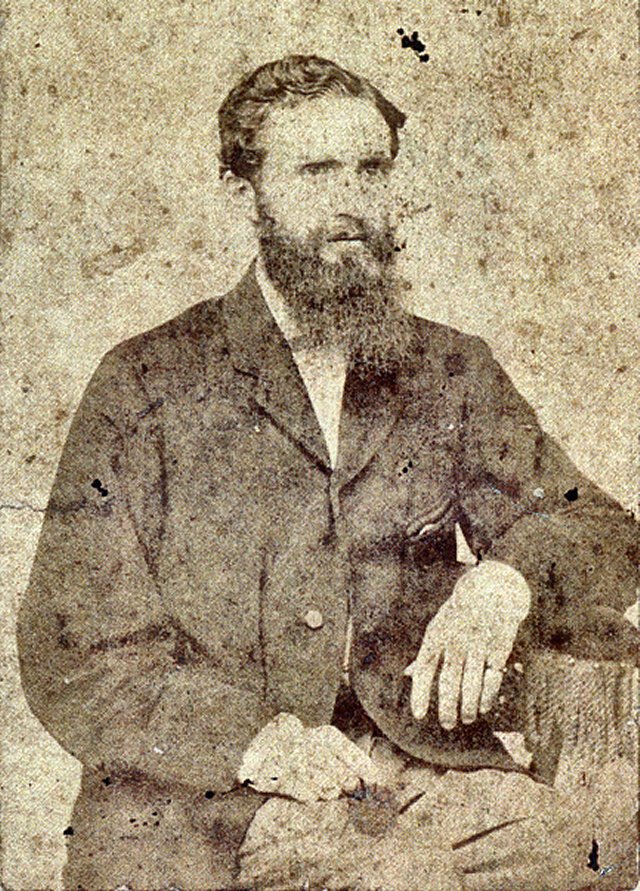
James S. Maxwell
Cinnie Davis married James S. Maxwell at Ocean Springs on August 4, 1887. They had three sons: George Davis Maxwell (1888-1951), Charles Richmond Maxwell (1891-1967), and Karl Case Maxwell (1893-1958). The Maxwell marriage ended in a divorce suit on August 16, 1895.(JXCO, Ms. Chancery Court Cause No. 647, July 1895)
George Davis Maxwell
George Davis Maxwell (1888-1951) was born at Pachuta, Mississippi on September 6, 1888. He was named for his grandfather, George W. Davis. Circa 1912, George D. Maxwell married Floi Porter of Mobile. Their children were: George Porter Maxwell (1913-1914), Wallace B. Maxwell (1916-1991) of Mobile, Rozier Maxwell, Sidney R. Maxwell (1917-1992), Ellie M. Klein (1919-2010), the spouse of Ralph D. Klein (1916-1995), and Mary Maxwell.
Ellie Maxwell (1919-2010) married Ralph Kline in January 1942, in the Nativity BVM at Biloxi. Only immediate family members present.(The Daily Herald, January 5, 1942, p. 2)
George D. Maxwell operated a seafood market at the foot of Jackson Avenue in the mid-1920s. In early March 1929, the Maxwell oyster and fish house was struck by a storm and partially destroyed. After closing his seafood business, he became employed with the L&N Railroad in its shops at Mobile and Birmingham, Alabama. Maxwell returned to Ocean Springs and became employed with the A.C. Gottsche Store on Washington Avenue. George Davis Maxwell expired at his mother’s residence in Ocean Springs on March 21, 1951. His corporal remains were interred in the Evergreen Cemetery.(The Jackson County Times, February 23, 1924, p. 8, The Daily Herald, February 23, 1924, p. 2, The Gulf Coast Times, March 29, 1951, p. 8)
Charles Richmond Maxwell
Charles R. Maxwell (1891-1967) was born at Ocean Springs, Mississippi on January 6, 1891. He lived most of his life at Brooklyn, Forrest County, Mississippi. Charles R. Maxwell expired in February 1967. It is believed that Mr. Maxwell was the father of: Albert Maxwell (1915-1986) and Karl Maxwell (1919-1986).
Local manager of the I.H. Bass Nursery of Lumberton, Mississippi. Left in January 1923 for Lumberton.(The Jackson County Times, February 3,1923, p. 5)
Karl Case Maxwell
Karl Case Maxwell (1893-1958) was born on April 6, 1893, at Ocean Springs, Mississippi. In June 1919, he married Nellie Myrtle Morris (1893-1970), the daughter of Englishman Ernest Alford Morris (1860-1946) and Chicago native, Lydia Meyers (1870-1933). Mr. E.A. Morris built the Pines Hotel on the southwest corner of Washington Avenue. It opened for guests in October 1915. Unfortunately, the attractive hostel was the victim of a consuming conflagration on May 5, 1932.(Bellande, 1994, pp. 134-139)
Karl C. Maxwell was educated at Ocean Springs and subsequently attended Draughan’s Business College at New Orleans. He worked in J.O. Whittle’s pharmacy until the Bailey family consolidated with Mr. Whittle in August-September 1917.(The Ocean Springs News, July 3, 1958, p. 1 and The Jackson County Times, September15, 1917)
In May 1923, Karl and Myrtle M. Maxwell moved into their new residence at present day 525 Jackson Avenue, used today principally as the meeting place for BSA Troop 210, and other functions of St. Paul’s United Methodist Church, the owner. Here they reared their two sons: Robert Lynd Maxwell (1920-2008) and Albert Cecil Maxwell (1926-1981) m. Carolyn 'Lyn' King (1929-2011) of NOLA.(The Jackson County Times, May 19, 1923)
At the time of his accidental death, on June 29, 1958, in an automobile accident on US Highway 80, near Clinton, Mississippi, Karl C. Maxwell was manager of the Gottsche Store. He had returned from New Orleans to work in the business with his step-father, Albert C. Gottsche. After Mr. Gottsche’s death in 1949, Karl C. Maxwell became manager of the Gottsche Store. Mrs. Dena Atkinson Talbott (1886-1958) of Ocean Springs was also killed in the car with Karl C. Maxwell.(The Ocean Springs News, July 3, 1958, p. 1 and The Daily Herald, July 5, 1958, p. 2)
Albert Cecil Gottche
On September 30, 1896, Cynthia Davis Maxwell married Albert C. Gottsche (1873-1949), a salesman in her father’s mercantile business. Albert and Cinnie Gottsche had one son, Albert Lynd Gottsche (1902-1974).
Albert C. Gottsche resigned from the Davis Brothers Store on October 1, 1910. This is also the date that his father-in-law and senior partner of the firm, George W. Davis, retired. The former Davis Brothers business continued on as E.S. Davis & Sons under the ownership of Elias S. Davis (1859-1925) in conjunction with his sons, Elliot Davis (1892-1936) and Oscar T. Davis (1894-1936).
In late 1910, Mr. Gottsche began selling animal feed on Washington Avenue and Desoto in the present day Catchot-Lemon Building. He erected the Gottsche Store building across the street in 1912, and ran a first class grocery and market here until his death in March 1949. The old Gottsche Store is now corporate headquarters for Blossman Gas, Inc. They acquired the property from A.L. Gottsche in November 1962.(Jackson County Land Deed Book 232, p. 382)
Albert C. Gottsche expired on March 17, 1949. His wife, Cynthia Davis Maxwell Gottsche passed on September 18, 1951. They both rest in eternal peace at the Evergreen Cemetery in Ocean Springs, Mississippi.
Albert Lynd Gottsche
Albert Lynd Gottsche (1902-1974), called Lynd, was born at Ocean Springs, Mississippi on November 22, 1902. He attended the local public school and matriculated to Mississippi A&M College where he studied electrical engineering, graduating with the Class of 1923. Departing Starkville, Mississippi, Lynd Gottsche was employed at Atlanta, Georgia with the Westinghouse Electric and Manufacturing Co. He was transferred to South Bend, Indiana and came home for Christmas in 1924. By October 1926, Lynd was at Tampa, Florida working in the organizations street lighting division.( Jack Gottsche, December 17, 2001 and The Jackson County Times, December 27, 1924, p. 3 and October 2, 1926)
Lynd Gottsche married Mae Kettles (1907-2001), on March 31, 1928. She was a native of Alberta Province, Canada and resident of Macon, Georgia. Their children are: Albert Lynd Gottsche, Jr. (b. 1933) and John H. “Jack” Gottsche.(The Jackson County Times, April 21, 1928 and November 11, 1933, p. 3)
Mr. and Mrs.Lynd Gottsche were in residence at Baltimore, Maryland in March 1931.(The Daily Herald, March 18, 1931, p. 3)
Patricia Field (b. 1939), the daughter of Alden Waterbury Field (1900-1969) and Evelyn Smith (1926-1960) of Watervliet, Michigan married Albert Lynd Gottsche II in the Plymouth Congregational Church of Waverliet, Michigan in August 1958.(The Ocean Springs News, July 31, 1958, p. 5 and August 21, 1958, p. 5)
Mr. Gottsche returned to Jackson County in 1932, and commenced a career in commercial banking until his retirement in late 1971. He was inducted into the Rotary Club in November 1933, and became associated with the Ocean Springs State Bank in 1934. In 1941, Lynd Gottsche became employed with the First National Bank of Biloxi becoming its president. At retirement he was the executive vice president and a director of the First National Bank of Mississippi.(The Jackson County Times, November 11, 1933, p. 3, The Ocean Springs News, April 25, 1957, p. 1 and The Daily Herald, January 22, 1974, p. 2)
The Lynd Gottsche family home, Lynwood, was erected in 1946, at present day 915 Ocean Avenue. It is now owned by the Reverend Andy Wells of the First Presbyterian Church. The floors and other wooden structural components of the house were built from salvaged materials from the H.F. Russell (1858-1940) home on Washington Avenue, which partially burned in February 1933.(J.K. Lemon, 1996)
Mae D. Griffin
Mae M. Davis (1875-1917) was born at Ocean Springs on January 27, 1875. On March 10, 1903, she married Joseph C. Griffin (1864-1919), the son of W.C. Griffin and Mary Ann Byrd. Mr. Griffin was a businessman from Brooklyn, Forrest County, Mississippi. Their nuptials were held in the Davis home at Ocean Springs with the Reverend L.E. Hall in attendance. They had a daughter, Margaret Griffin Ingalls (1907-1989), who eventually settled at Twentynine Palms, San Bernardo County, California.(Jack Gottsche, December 17, 2001, The Pascagoula Democrat-Star, February 27, 1903, p. 3, and The Jackson County Times, December 2, 1933, p. 3)
Margaret Griffin
Margaret Griffin Ingalls*
After the death of her parents, Margaret Griffin lived with the A.C. Gottsches? She was very talented in the fine arts. In 1924, she attended Whitworth College at Brookhaven, Mississippi, where in October 1926, she was named “most talented” in the annual “Who’s Who” contest.(The Jackson County Times, October 16, 1926, p. 1)
Margaret Griffin later became art director at Whitworth College. In 1930, she went abroad and studied art in Paris, where she met her future husband, Frederick Henry Ingalls (1908-1989). In France, Mr. Ingalls worked for The Paris Tribune and the American Express Company. His home was at St. Louis, Missouri. Ingalls had attended the dramatic workshop at Yale University. The young couple were married at the Ingalls home at University City, a neighborhood of St. Louis. Miss Griffin was an art student at Washington University in St. Louis, at the time of her wedding.(The Jackson County Times, December 2, 1933, p. 3, December 27, 1924, p. 3, and July 14, 1934, p. 3)
*(SSDI has a Margaret Ingalls born June 15, 1907, died at Los Angeles on March 11, 1989 and Frederick Ingalls born May 17, 1908, died October 15, 1989, at Los Angeles)
Griffin home
The Griffins acquired the Thomas W. Grayson (1825-1904) home on Washington Avenue in July 1906, for $4000.(JXCO, Ms. Land Deed Bk. 31, p. 432) The domicile was just north of the Davis Brothers Store and south of the E.M. Westbrook (1858-1913) home.
In early April 1915, a large conflagration destroyed the Griffin home. At the time, it was being utilized by Dr. O.L. Bailey (1870-1938), as a sanitarium. The loss of the Griffin home and Dr. Bailey’s equipment, books, and records was estimated at $4000. Arson was suspected and a $100 reward was posted for information leading to the capture and conviction of the alleged incendiaries.(The Ocean Springs News, January 7, 1915, p. 1)
At the time of the fire, the Griffins were residents of Brooklyn, Forrest County, Mississippi. Here J.C. Griffin made his livelihood as a farmer and landowner. Mae Davis Griffin died at Brooklyn on November 19, 1917. She was followed to the grave by her spouse, on April 3, 1919. Their corporal remains were interred in the Evergreen Cemetery.(The Jackson County Times, November 24, 1917, p. 5 and April 5, 1919, p. 5)
H.C. Herring of Forrest County, Mississippi was appointed guardian of Margaret Griffin after her parent’s demise. In September 1924, she sold the Griffin lot on Washington Avenue to H.F. Russell (1858-1940) for $4250.(JXCO, Ms. Land Deed Bk. 54, pp. 371-372) Here in October 1926, the Bailey Building was completed by Kean & Company of Gulfport for Dr. O.L. Bailey. He operated his drug store and medical practice from the new structure. Today, this edifice is known as Lovelace’s Drugs.
Sadie D. Young
Sadie Davis (1878-1950) was born at Ocean Springs on April 10, 1878. She married Edward Young (1880-1959), a native of New Orleans. They had two daughters, Cynthia E. Young (1916-1925) and Florence Belle Young Robinson (1922-2001).
In March 1904, Alice Young (1888-1904), Mr. Young’s sister, died at New Orleans of Bright’s disease. He went to her funeral in the Crescent City.(The Pascagoula Democrat-Star, March 19, 1904, p. 4)
Edward Young stoked the coal furnaces for the steam heat at OSHS. Circa 1954, when the heating system changed he became custodian of the building. Mr. Young would take a break and sit in a broom closet doing class changes. The student body referred to Mr. Young's cubby hole as 'Mr. Young's Office'.(Larry Galle, January 26, 2009)
Florence Belle Young married Vesper Robinson. They had no children. Florence Belle Young died at Ocean Springs on November 4, 2001. Her remains were sent to the Southern Memorial Park Cemetery at Biloxi for internment.(The Sun Herald, November 9, 2001, p. A-10)
Sadie D. Young was a member of the Ocean Springs Baptist Church. She expired at Biloxi, Mississippi, on October 27, 1950. Edward Young died on September 5, 1959. Their corporal remains were interred in the Evergreen Cemetery at Ocean Springs.(The Daily Herald, October 27, 1950, p. 11 and The Daily Herald, September 7, 1959, p. 2 )
Mamie E. D. Bland
On November 17, 1904, Mamie Edwina Davis (1882-1965) married Roy Livingston Bland (1878-1970) at Ocean Springs. He was born at Pelahatchie, Mississippi on December 22, 1878, the son of George Duncan Bland (1853-1915) and Addie Spann (d. ca 1885). His siblings were: George Hall Bland (1882-1981) of Shreveport, La.; Irene B. Hilsman (1889-1987) of Orange, Texas; Estelle B. Cruthirds (1893-1986) of Longville, La.; Bessie B. Barnes (1898-1917+) of Bond, Mississippi, and Albert Davis Bland (1903-1919) of Longville, La.(letter from Sam Kinney, January 9, 1997)
Roy L. Bland’s uncle, was Dr. Jasper J. Bland (1850-1932), the founder of a magnificent resort, The Beach-New Beach Hotel, on the Front Beach at Ocean Springs, which existed from 1900 until about 1921.
In their young married life between 1904 and circa 1912, the R.L. Blands were peripatetic as he worked as a station agent for the Mobile, Jackson and KC Railroad and the Frisco Railroad at several Mississippi and Arkansas locations.(The Biloxi Herald, November 18, 1904, p. 5, c. 4., The Ocean Springs News ,July 23, 1910 and July 30, 1910)
Before leaving for Alexandria, Louisiana circa 1918, R.L. Bland made his livelihood at Ocean Springs, raising poultry and dairy cattle. Mr. Bland was the proprietor of Bland's Sanitary Dairy. He advertised in The Jackson County Times on October 13, 1917 as follows:
BLAND'S SANITARY DAIRY
Sweet Milk 12c Quart; 6c a Pint
Delivered Morning and Evening
PHONE 57 R.L. BLAND
Roy L. Bland took many photographs of Ocean Springs during his tenure here. Many of these black and white images were made into postal cards and survive to the present. Bland's postcards can be easily identified from his handwriting, which is usually written at the base of the card describing the scene. Sometimes, he autographed his postals.
The Roy and Mamie D. Bland children were: Roy Lamar Bland (1905-1971), Davis Duncan Bland (1908-1990), Tyler Hutchinson Bland (1912-1991+), and Margaret W. B. McConathy (1918-1997+).
Mr. R.L. Bland expired at Alexandria, Louisiana in December 1970. Mrs. Bland died there on January 25, 1965.
Georgia D. Whittle
Georgia Davis (1883-1945) married Joseph Otto Whittle (1880-1925) in 1904. They had a daughter, Margaret Virginia Whittle (1908-1909). J.O. Whittle’s brother, Floyd F. Whittle, a resident of Ashland, Oregon, also had a daughter named Virginia. His wife and child visited Ocean Springs in December 1911. They were en route to Greensboro, Alabama.(The Ocean Springs News, December 9, 1911)
J.O. Whittle made his livelihood at Ocean Springs, as a druggist, initially with the People Drug Company. In August 1917, he consolidated his business, The Whittle Drug Store with Dr. O.L. Bailey’s Ocean Springs Drug Store and managed the new organization. Apparently this relationship failed, as in August 1918, he resigned his position with the Ocean Springs Drug Store and relocated to Lake Charles, Louisiana. Here Mr. Whittle became general manager and pharmacist for J.H. Mathieu. The family later moved to Texas where J.O. Whittle expired from pneumonia at Dallas, Texas on February 5,1925.(The Jackson County Times, August 11, 1917, September 7, 1918, p. 5, and February 7, 1925)
Georgia Davis Whittle then married Karl K. Weaver and lived in Durham, California. She was killed in an automobile accident at Chico, California in late December 1945.(The Jackson County Times, January 5, 1946, p. 1)
ELIAS SAMUEL DAVIS (1859-1925)
Elias S. Davis (1859-1925) was the junior partner in the Davis Brothers firm. He was born east of Ocean Springs on May 17, 1859. He married Louise A. Friar (1874-1952), the daughter of Thomas R. Friar (1845-1916) and Marie L. Dolbear (1846-1914), on April 6, 1891. Their children were: George Elliott Davis (1892-1936), Oscar T. Davis (1894-1963), L. Gladys D. Quinn (1897-1990) and Samuel Chester Davis (1900-1973).
In August 1911, E.S. Davis acquired the one-half interest of his brother, George W. Davis (1842-1914), in the store and land known as the Davis Brothers Store on Washington Avenue for $2500. The new business was called E.S. Davis & Sons.(JXCO, Ms. Land Deed Bk. 37, pp. 197-198 and The Ocean Springs News, September 2, 1911)
Mr. E.S. Davis was the first Treasurer of the Town of Ocean Springs, serving his fellow citizens from December 1892 until 1910, when the office was eliminated, as a result of the opening of the Ocean Springs State Bank.(Schmidt, 1972, pp. 133-134)
Elias S. Davis was known for his “rugged honesty” and devotion to his business. His avocations were fishing and boating. In addition to his mercantile business, E.S. Davis was a director of the Farmers & Merchants State Bank, a stockholder in the Ocean Springs State Bank, and a stockholder in the Builders Supply Company, which he sold to B.F. Joachim in July 1920. He was elected president of the Farmers & Merchants State Bank in 1920. Elias Samuel Davis expired on June 13, 1925. His corporal remains interred in the Evergreen Cemetery at Ocean Springs.(Dabney, 1974, p. 19 and The Jackson County Times, June 20, 1925, p. 1 and July 24, 1920, p. 3)
Mrs. Louise F. Davis was active in social circles and a stalwart member of the local Baptist Church. Among her many good deed was the care of Evergreen Cemetery. In November 1933, Mrs. Davis with the assistance of welfare workers refurbished the Evergreen Cemetery to a state not seen in many years. She passed on April 1, 1952 at Biloxi and her remains interred at the Evergreen Cemetery.(The Jackson County Times, November 11, 1933, p. 3 and The Gulf Coast Times, April 3, 1952, p. 3)
George Elliot Davis
George Elliot Davis (1892-1936), called Elliott, was born in the year in which Ocean Springs became incorporated. On August 25, 1929, he married Vera Small, the daughter of Mr. and Mrs. W.G. Small at the home of the Reverend L.A. Darsey (1849-1929) of the Methodist Church. Before their marriage, Miss Small was employed in the telephone exchange of the Cumberland Telephone Company at Birmingham, Alabama.(The Jackson County Times, July 18, 1925, p. 3 and August 31, 1929, p. 3)
Elliott Davis worked in his father’s store and was admired for his “easy going” personality, which endeared him to store customers. He became ill several years before his demise at the family home on Bowen Avenue, the 19th day of November 19, 1936.
Vera S. Davis was in Birmingham at the fatal hour. Burial was in the E.S. Davis family plot at Evergreen Cemetery in Ocean Springs.(The Jackson County Times, November 26, 1936)
Oscar T. Davis
In late January 1925, Oscar T. Davis (1894-1963) married Cecelia Wieder (1902-1956), the daughter of Joseph A. Wieder (1877-1960) and Mathilda Endt (1875-1964). The Catholic wedding took place in Biloxi. Mr. Davis was employed in the family business, E.S. Davis & Sons at Ocean Springs. The newlyweds took an apartment in the Eglin House on Washington Avenue.(The Jackson County Times, January 31, 1925)
Cecelia was born at Ocean Springs on March 1, 1902 and expired at New Orleans on September 26, 1956. They resided at 8 Middle Avenue, now 1008 Joseph Street, which was named for her brother, Joseph C. Wieder (1905-1990). Mrs. Davis was passed through St. Alphonsus Roman Catholic Church with burial in the Southern Memorial Park Cemetery at Biloxi.(The Daily Herald, September 26, 1956)
After an April 1943 nomination, President F.D. Roosevelt (1882-1945) named Oscar T, Davis as US Postmaster at Ocean Springs, on August 1, 1943. He succeeded L. Morris McClure (1884-1940). Mr. Davis remained at his post until March 15, 1963, when he retired and was replaced by Orwin J. Scharr. At the time of his postmastership, Oscar T. Davis was manager of the E.S. Davis & Sons general store.(The Jackson County Times, April 10, 1943, p. 1)
In June 1957, after the death of Cecilia W. Davis, Oscar T. Davis married Birdine Perry Morgan (1896-1990), the daughter of L.H. Perry and Elizabeth Ireland. They resided at 1008 Middle Avenue.(JXCO, Ms. MRB 92, p. 314)
Oscar T. Davis was a veteran of WW I and attained the rank of Corporal in the U.S. Army. He was a member of the V.F.W., American Legion, World War I Veterans, and the Masons. His death came on October 9, 1963, only a few months post-retirement. The corporal remains of Oscar T. Davis were interred in the Evergreen Cemetery.(The Daily Herald, October 9, 1963, p. 2)
Mrs. Birdine P. M. Davis passed on June 16, 1990, at St Petersburg, Florida. She was survived by two children, Roscoe C. Morgan and Joyce M. Neal. Her remains were also interred in the Evergreen Cemetery.(The Ocean Springs Record, July 5, 1990, p. 3)
Lillian Gladys Davis Quinn
Lillian Gladys Davis (1897-1990), called Gladys, was born at Ocean Springs on December 24, 1897. She graduated from the Ocean Springs Public School with the Class of 1914. Miss Davis went to New Orleans post-graduation and studied shorthand, typing and business methods at Soule’s Business College. In July 1915, Gladys graduated first from that Crescent City educational facility in her class of sixty students. In addition to her keen mathematical mind and interest in business, she was an exceptional musician. Gladys Davis commenced her career in her father’s Washington Avenue mercantile store in July 1915.(The Ocean Springs News, July 8, 1915, p. 1)
In November 1920, Gladys Davis married Charles Gordon Quinn (1893-1970) of Anniston, Alabama at the Baptist Church in Gulfport, Mississippi. Mr. Quinn was manager of the C.C. Snyder Tobacco Company at Sheffield, Alabama. After a wedding trip to Birmingham and Anniston, the Quinns were at home in Sheffield.(The Jackson County Times, November 13, 1920)
Gladys Davis Quinn expired at Gulfport on August 5, 1990. Mr. Quinn died on August 4, 1970. Both were interred in the Southern Memorial Park at Biloxi.(The Daily Herald, August 5, 1970, p. 2 and The Sun Herald, August 6, 1990, p. C-2)
Samuel Chester Davis
Samuel Chester Davis (1900-1973) was known as Chester Davis. He was born at Ocean Springs on August 28, 1900, and attended the public school graduating as valedictorian of the 1918 Class. He married Eleanor May Baker (1903-1947), the daughter of Orion Stroud Baker (1898-1951) and Escambia McClure Baker Pabst (1880-1947) in the Methodist Church on November 8, 1929.(The Jackson County Times, June 8, 1918, p. 5 and October 19, 1929, p. 2)
Chester Davis was a soldier in WW I. Shortly after returning to Ocean Springs, he was elected as Ward 1 alderman and was in office from 1923-1924. In July 1925, he was the assistant cashier of the Farmers and Merchants State Bank and vacationed on an annual basis at Hot Springs, Arkansas.(Schmidt,1972, p. 135 and The Jackson County Times, July 18, 1925, p. 3)
During the Depression, Chester worked in Jackson, Mississippi for ERA.(The Jackson County Times, January 18, 1936, p. 3)
Eleanor May Baker was born at Ocean Springs on January 23, 1903. She was killed with her mother and Martha Anne Baker (1936-1947) in a fiery automobile crash at Biloxi on July 30, 1947.(The Daily Herald, July 31, 1947, p. 1)
Chester Davis married Evelyn Moody and moved to Mississippi City. He made his livelihood as a tax agent for the Mississippi State Tax Commission and was active in the Methodist Church, United Fund, and Masons and Shriners. S. Chester Davis passed on February 4, 1973 at Mississippi City. His body was sent to Ocean Springs for burial at the Evergreen Cemetery.(The Daily Herald, February 5, 1973, p. 2)
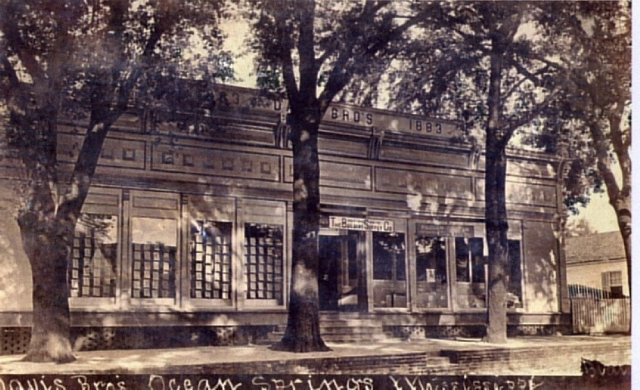
Davis Brothers Store
The Davis Brothers Store, a large 19th Century wood-framed, structure, was situated at Ocean Springs, Mississippi on a portion of Lot 2 and Lot 8 of Block 27, in Section 37, T7S-R8W. More familiarly, its site was on the west side of Washington Avenue between the present day structure formerly housing Martha’s Tea Room and the Manhattan Grill and Steakhouse. In 1883, George W. Davis (1842-1914) and Elias S. Davis (1859-1925) established a mercantile business on the southeast corner of County Road, now Government Street, and Washington Avenue. In 1888, they built a large building on the west side of Washington Avenue to house their merchandise. For over seventy years, it stood as a landmark on the streetscape of the central business district of Ocean Springs, until it was demolished by Clarence E. Galle (1912-1986) for the salvage of its valuable, heart pine, lumber.
Davis Brothers Store
In the 1870s, George W. Davis (1842-1914) and E.S. Davis (1859-1925), the Davis brothers, began their careers as merchants in the piney woods of Vancleve, an active charcoal and timber producing community on Bluff Creek situated northeast of Ocean Springs. By the early 1880s, they had returned to Ocean Springs and opened a store on the southeast corner of Washington Avenue and County Road, which later became know as Lundy’s Corner, after Franklin J. Lundy (1863-1912), a local merchant. In July 1888, the Davis brothers began acquiring land in Lot 8 of Block 27 (Culmseig Map of 1854) situated on the west side of Washington Avenue. At this time, Thomas W. Grayson (1825-1904) and Ann Hyde Grayson (1832-1906) sold their portion of Lot 8 in Block 27 to George W. Davis and Elias S. Davis for $400. The parcel had a fifty-foot front on Washington Avenue and ran to the west for two hundred feet.(JXCO, Ms. Land Deed Bk. 15, p. 611)
Prior to April 1867, Lot 8 of Block 27 had belonged to the A.F. Ramsay (1828-1864) Estate. It was conveyed by Enoch N. Ramsay (1832-1916) to A.W. Ramsay (1830-1916) on April 1, 1867, for $10.(JXCO, Ms. Land Deed Bk. 29, p. 430)
It is assumed that the Davis Brothers General Merchandise Store, that would become a landmark in Ocean Springs until the late 1950s, was erected in the summer of 1888, after the land acquisition from Mayor Thomas W. Grayson and spouse. The Davis brothers acquired the remainder of Lot 8-Block 27 in June 1894, as local druggist, Herman Nill (1863-1904) and spouse, Caroline Vahle Nill (1862-1949), sold them a part of Lot 8, described as forty-five feet on Washington Avenue and 200 feet deep, for $600.(JXCO, Ms. Land Deed Bk. 15, p. 611)
By August 1911, Lot 2-Block 27, which was contiguous and west of Lot 8-Block 27, was in the possession of George W. Davis, as at this time, he conveyed an undivided one-half interest in it and Lot 8 to E.S. Davis, for $2500. This final land acquisition gave the Davis Brothers a lot with 105 feet fronting on both Washington and Jackson Avenues. The parcel contained 1.08 acres and was 450 deep from east to west.(JXCO, Ms. Land Deed Bk. 37, pp. 197-198)
Town bankers
Prior to March 1903, when the Merchants and Marine Bank of Scranton opened a branch in the Davis Brothers Store with E.S. Davis as cashier, Ocean Springs relied on some of its merchants to function as banks. The Davis Brothers appear to have been the leaders of these “town bankers”.(The Pascagoula Democrat-Star, March 20, 1903)
As early as 1891, the Fortnightly Guild of St. John’s Episcopal Church proposed and accepted that the Davis Brothers General Merchandise Store be the repository for their building funds.(Schmidt, 1972, p.119)
From the J.K. Lemon Collection at the Jackson County, Mississippi Chancery Court Archives in Pascagoula, the following examples of information concerning some business transactions performed at the Davis Brothers Store were:
Julia E. Brown-Elk Lodge
In January 1898, Julia E. Brown of “Elk Lodge”, an East Beach estate, asked the Davis Brothers to pay Georgia Randolph $12 and charge it to her account.
In November 1898, she requested the Davis Brothers to pay Mr. Weider (sic) $23. Other requests by Mrs. Brown for the Davis Brothers was to pay Mr. Nill (the druggist) $6.55 and to place two stamps on a letter.
The Earle Farm
In February 1898, W.W. Cowly, manager of the Earle Farm (Rose Farm) asked the Davis Brothers to pay the following laborers for their toil on the Earle Farm: George Caldwell at $.90 per day for six days work-$5.40; Joseph Scarbrough (1849-1928) at $.90 per day for six days labor-$5.40; Daniel Ramsay(1875-1939) at $.90 per day for three days work-$2.70; and Albert Scarbrough (1880-1963) for clearing ten acres of underbrush $4.00.
Elizabeth McCauley Stuart
Elizabeth McCauley Stuart (1840-1925) also utilized the Davis Brothers as her banker. In February 1899, she asked them to pay E.A. Clark $75 for the stock of pecan trees on the Evans Place near Ocean Springs and charge this sum to her account.
The Scranton State Bank and the Ocean Springs State Bank were both established here in January 1905. Unfortunately, the Scranton State Bank failed in1906, which allowed the Ocean Springs State Bank, which was organized by Dr. O.L. Bailey (1870-1938) and F.M. Weed (1852-1926), who served as president and vice president respectively, with Alfred L. Staples (1881-1969) serving as cashier, to become the town’s chief financial institution until it merged with the Pascagoula-Moss Pont Bank in 1953. The first board of directors of the Ocean Springs State Bank were: G.E. Arndt (1857-1945), Hugh C. Seymour (1876-1913), Sidney J. Anderson (1867-1917), Alfred L. Staples, F.M. Weed, O.L. Bailey, and H.F. Russell (1858-1940).
Wool buyers
As early as 1890, the Davis Brothers were among the primary buyers and brokers of wool from stockmen, primarily situated in the Latimer and Vancleave regions. Some of the leading wool producers were: Sardin G. Ramsay (1837-1920), H.C. Havens (1831-1912), Thomas E. Ramsay (1845-1934), George W. Tootle (1841-1915), George Byrd (1824-1899) J.M. Breeland, T.C. Ruble, and Mary Doyle Krohn (1860-1944).
The merchantable wool was brought to Ocean Springs in large wagons drawn by oxen from a radius of about twenty-five miles of town. The spring clip market was usually held on Washington Avenue in front of the Davis Brothers Store. Some of the wool buying organizations represented by the Davis Brothers were: H. Piser & Company and the Metzker Brothers of Mobile, and William Mehle and William E. Vouchel & Son of New Orleans. A company representative was usually present at the sale.(The Pascagoula Democrat-Star, June 7, 1895, p. 3 and The Ocean Springs News, June 17, 1911, p. 1)
In 1891, nearly 63,000 pounds of wool were vended at Ocean Springs by local wool farmers, as compared to about 49,000 pounds in 1890. The Davis Brothers were acquiring large lots of wool for $.24 per pound while smaller lots were bought for a penny or two less. In 1890, prices were better.(The Biloxi Herald, June 27, 1891, p. 1 and The Pascagoula Democrat-Star, June 12, 1891, p. 2)
In June 1892, after the shearing season had closed, the Davis Brothers had shipped over 60,000 pounds for which they paid about $14,000 ($.23 per pound).
In June 1895, William Mehle of New Orleans acquired the entire clip of 26,000 pounds at the rate of $.12 per pound.(The Pascagoula Democrat-Star, June 7, 1895, p. 3)
In June 1897, Sardin G. Ramsay vended 6,000 pounds of wool to the Davis Brothers at Ocean Springs at the rate of $.15 per pound.(The Pascagoula Democrat-Star, June 4. 1897, p. 3)
In June 1909, the Davis Brothers of Ocean Springs shipped about 1200 pounds of wool to the H. Piser & Co. of Mobile. They expected about 20,000 pounds to be marketed in the next week and consigned to the Mobile firm. This was the remainder of the remarkable wool purchase made by H. Piser & Co. sometime ago at the top notch price of 31 1/2 cents per pound.(The Ocean Springs News, June 5, 1909)
1897 expansion
In 1897, the Davis Brothers enterprises at Ocean Springs continued to grow. Business had increased, which in the spring of 1897, necessitated the erection of a larger office to process grocery, hardware, and mercantile orders. The additional space also provided comfortable quarters for the management, as well as suitable place for record and asset storage. More personnel and equipment were integrated into the already efficient system as a clerk and fourth delivery wagon was now in service. Their bakery was vending on the average about six hundred loaves of bread to the community each week.(The Pascagoula Democrat-Star, July 9, 1897, p. 3)
Sportsmen-Fishermen and Catboat racers
The Davis Brothers enjoyed the outdoors and competition. In the 1890s, fishing at Ocean Springs was a competitive sport as well as an avocation. Two fishing clubs, the Kingfishers and Rod and Reel Club, were organized and supported by the town’s crème de la crème. George W. Davis (1842-1914) was a prominent member of the Rod and Reel Club. Some of his cohorts were: R.A. VanCleave (1840-1908), Edward Reneau Bragg (1862-1916), W.S. VanCleave, (1871-1938), J.D. Minor (1863-1920), Augustus von Rosambeau (1849-1912), Joseph Kotzum (1842-1915), Ross A. Switzer (1875-1945), B.F. Joachim (1853-1925), E.W. Illing (1870-1947), and Thornton A. Vaughn (1868-1933). The opposition Kingfishers had a membership consisting of D.D. Cowan (1850-1929), William H. Casey (1875-1960), Orey A. Young (1868-1938), Antonio P. Kotzum (1871-1916), Samuel T. Haviland (1845-1911), Robert A. Friar (1878-1948), and William Lorenzen (1844-pre 1910).(Ellison, 1991, pp. 111-112)
The Davis Brothers also had a keen interest in catboat racing. The catboat, that little gaff-rigged, workhorse of the local fishing fleet before mechanized vessels replaced them, became a favorite one-design boat to compete with at local regattas. Racing classes were established by the hull length of the craft.
One of the great match races ever sailed off Ocean Springs in Biloxi Bay occurred on August 21, 1901, when Orey Young’s Royal Flush, Davis Brothers, and Josephine competed for a $700 cash prize. Local merchants financed the jackpot. The exciting, three-cornered race was won by the Royal Flush over her nearest rival, Davis Brothers, by two minutes and one second. In a rematch in early September 1901, the Davis Brothers defeated the Royal Flush by twelve seconds. The People’s Brass Band was on hand to celebrate the occasion.( (The Biloxi Daily Herald, August 22, 1901, The Pascagoula Democrat-Star, September 6, 1901, p. 3 and Boating, November 1924)
Another race of record involved the Mamie M. owned by the Davis brothers. In June 1921, it sailed a match race in Pascagoula waters against the de St. Ferol, the catboat of W.E. Frederic.(The Pascagoula Democrat-Star, June 17, 1921, p. )
1903 Fire
Just before dawn on December 28, 1903, a large fire commenced in the millinery shop of Miss Jennie C. Fullem, (1865-1926), just south of the Davis Brother Store. Miss Fullem and her sister lived in an apartment on the second floor of the building. The structure was totaling consumed by the conflagration. The women escaped with their lives, although they lost their personal effects and store merchandise. The homestead of Mrs. Amelia Krohn Eglin (1855-1916), which was adjacent to the millinery shop, was also a total loss. Her rental building, south of her residence and occupied by attorney, Edwin A. Clark (1853-1936), was also destroyed with his law library. The merchandise of the Davis Brothers Store was severely damaged by heat and smoke. Only the valiant efforts of the volunteer fire companies saved their mercantile business from consumption. The Davis Brothers were the only property owners with fire insurance.(The Biloxi Daily Herald, December 28, 1903, p. 6)
In appreciation for their services on the morning of the December 1903 fire, which threatened their store building and merchandise, the Davis Brothers donated $25 to the Ocean Springs Volunteer Hook and Ladder Company No. 1. The local fire company was thankful for the money as it afforded them financial resources to further improve and equip its volunteer service.(The Progress, January 23, 1904, p. 4)
Miss Jennie C. Fullem was a native of New York and the daughter of Irish immigrant, Edward Fullem, and Alice Mitchell, who was born in England. She had two old maid sisters, Mary Alice Fullem (d. 1921) and Agnes E. Fullem (1876-1931). Another sister, Elizabeth F. Gillespie (1875-1910+), the spouse of Francis J. Gillespie (1870-1910+), resided on Government Street. When her health began to fail, Miss Fullem reluctantly retired from the millinery business in October 1910, and planned to remain at Ocean Springs.(The Ocean Springs News, October 7, 1910)
“Fire” Sale
By mid- January 1904, the Davis Brothers store was operating efficiently. A special sale was held to dispose some of the fire damaged goods. The business advertised as follows:
SPECIAL DELIVERY
Shoe : Sale
One Hundred pairs of Shoes slightly soiled and marked in the recent fire are offered at 35 to 50 per cent below usual price to close out. Mostly ladies and children’s sizes. Ask Albert about it.
DAVIS BROTHERS
Telephone No. 3
(The Progress, January 16, 1904, p. 1)
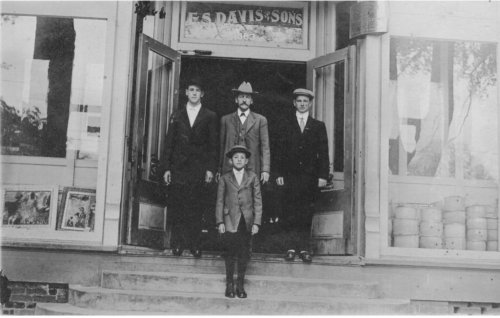
E.S Davis & Sons
George W. Davis retires
In August 1911, George W. Davis sold his undivided half interest in the Davis Brothers Store and land which included all of Lot No. 2 and Lot No. 8 of Block 27, to his brother, Elias Samuel Davis, for $2500.(JXCO, Ms. Land Deed Bk. 37, pp. 197-198)
The name of the business was changed to E.S. Davis & Sons. Almost immediately, the new proprietors effected repairs on the old structure. Salient among the improvements was the addition of a metal awning along the entire façade in order to shield the building from the intense summer sun and other unfavorable meteorological events.(The Ocean Springs News, September 2, 1911)
Robbery
The quite of the village was interrupted in the early hours of a cool January morning in 1915, when cat burglars entered the E.S. Davis & Sons store through a transom above the rear door. Approximately $100 in merchandise was pilfered. Marshall E.L. Tardy (1863-1943) was on alert and pursuing the thieves at last report.(The Ocean Springs News, January 14, 1915, p. 1)
Passing of E.S. Davis
With the death of Elias S. Davis in mid-June 1925, the E.S. Davis & Sons mercantile store remained in family hands. Josephine Friar (1883-1958), the sister of Mrs. E.S. Davis, worked in the business for many years.
In February 1940, Oscar Davis conveyed to Cecelia W. Davis, his spouse, all of his rights, title and interest in the mercantile business known as E.S. Davis & Sons. (JXCO, Ms. Land Deed Bk. 74, pp. 162-163)
By September 1944, Louise Friar Davis, the widow of E.S. Davis, had acquired for $2000, all the assets including the entire contents of the E.S. Davis & Sons store building and all accounts receivable from her sons, Oscar T. Davis and S. Chester Davis.(JXCO, Ms. Land Deed Bk. 87 , pp. 221-222)
When Louise Friar Davis passed on April 1, 1952. She legated all of her real and personal property to S. Chester Davis, her son.(JXCO, Ms. Chancery Court Cause No. 11,722-April 1952)
Drop advertisement
See The Jackson County Times, 1-5-1935, p. 3
The M & M Supply Company
In 1944, the M & M (Murphy & McPhearson) Supply Company began its occupancy of the old E.S. Davis & Sons building on Washington Avenue, with the catchphrase, “We sell everything, but groceries”. This enterprise, which vended dry goods, hardware, appliances, and farm implements, was owned originally by Palmer G. Murphy (1916-1990) of Vancleave and Chester M. McPhearson Sr. (1883-1969) from Wayne County and Jones County, Mississippi. P.G. Murphy and his brother, T.L. Murphy Jr. (1914-1996), were well-known entrepreneurs involved in seafood and cat food processing, timber and pulpwood, general merchandising, pharmaceuticals, and food vending.
In 1947, the two sons of Chester M. McPhearson Sr., William M. McPhearson (1913-1963) and Chester M. McPhearson Jr. (b. 1924), acquired the interest of Palmer G. Murphy. William M. McPhearson left the business in 1952, to go to Brewton, Alabama and Everett Eglin Busby (1912-1987) bought his stock.(C.M. McPhearson Jr., January 14, 2002)
In 1953, while managing M & M Supply, Chester M. McPhearson Jr. entered politics at Ocean Springs. He was elected and served his loyal constituents in Ward IV from 1953 until 1961. Chester was elected Mayor in 1981 and served two consecutive terms leaving office in 1989. Mayor McPhearson was the last Democratic Party candidate to win this distinguished position. His management philosophy, as applied to city business, was based on the pragmatic experiences that he had gained as a successful businessman, i.e. administer the city's business in a fair and dignified manner and bring good business management with a sound fiscal policy to the position. After M & M Supply liquidated its merchandise in December 1955, Chester M. McPhearson Jr. was named manager of Crestlawn Cemetery. In 1958, He founded McPhearson's Mens Wear, which he operated until 1982.(History of JXCO, Ms., 1989, pp. 285-286)
Family agreement
In March 1953, S. Chester Davis conveyed a 2/3rd interest in the E.S. Davis & Sons business and land on Washington Avenue to his sister, Gladys D. Quinn. They agreed that S. Chester Davis would manage the property until sold. At the end of each calendar year, net income from the business would be divided equally. In addition, the manager was required to consult with his partner before leasing or making repairs or remodeling requiring substantial costs. The property could be sold only by mutual agreement and the building would be insured for a minimum of $5000 in fire insurance.(JXCO, Ms. Land Deed Bk. 132, pp. 138-140)
McPhearson lease
In February 1954, Chester Davis and Gladys Davis Quinn granted a 30-month lease to the M & M Supply Company. The Davis lease ran from March 1, 1954 until August 31, 1956. The rent was $150 per month unless 2% of the gross sales exceeded the rental rate. In this scenario, M & M Supply was required to pay a monthly rental equal to the amount by which 2% of the gross sales exceeded $150 per month.(JXCO, Ms. Land Deed Bk. 137, pp. 410-411)
Final Sale
In January 1956, S. Chester Davis and his sister, Gladys D. Quinn sold their aging family property to Julius J. Strayham (1912-1991) and Annie Lang Strayham (1909-1997) for $15,000. The sale was subject to the lease to M & M Supply Company. Mr. Strayham conveyed the property to the Ocean Springs Lumber Company, a partnership held by A.P. “Fred” Moran (1897-1967), J. Duncan Moran (1925-1995), and A. Russell Moran (1930-1981), in March 1963.(JXCO, Ms. Land Deed Bk. 164, pp. 160-161 and Bk. 236, p. 316)
Demolition
In December 1957, Clarence Galle (1912-1986) and his son, Larry Galle (b. 1939), were contracted to demolish what should have become an architectural shrine on Washington Avenue, the Davis Brothers Store building. They were assisted by a crew of high school students who were paid $1.00 per hour for their manual labor. Among them were: R.F. ‘Bobby’ Schrieber, David Scharr, and Benny Spicer. Mr. Galle’s compensation for the task was the valuable lumber that was salvaged. Larry Galle remembers the high quality and large size of the pine boards used in the store’s construction. The joists were 2” x 12”, the sills were 8”x 8”, and the flooring was 1” by 6” tongue and groove. The building had ten-foot ceilings. Much of the recovered lumber was stacked and sold from the site.(Larry Galle, January 27, 2002 and R.F. ‘Bobby Schrieber, January 6, 2007)
From the ruins
In the late 1960s, the Moran family erected two buildings on the former Davis Brothers Store site at present day 705 Washington Avenue, known as the Mississippi Power Company building, and a smaller structure at 711 Washington Avenue. Today, they are rented to proprietors of two restaurants, the Manhattan Grill & Steakhouse and Southern Traditions.(Susie R. Moran, January 22, 2002)
Pepper Cottage-1201 Porter
Some of the lumber from the Davis Brothers Store building was utilized by Clarence Galle to erect a home for Coach Hugh Pepper, his son-in-law. In September 1958, Hugh Lauren Pepper acquired parts of Lot 8 and Lot 11 of the Kotzum Addition on the northeast corner of Porter and Kotzum from Inez A. Galle. The former Pepper cottage is situated at 1201 Porter and is now owned by Daniel K. Dubaz.(Larry Galle, December 12, 2001 and JXCO, Ms. Land Deed Bk. 181, p. 176)
Standish Bradford home-1314 Bowen
The Standish Bradford home at 1314 Bowen Avenue was also erected with some of the Davis Brothers salvaged lumber.(Larry Galle, January 27, 2002 and R.F. ‘Bobby Schrieber, January 6, 2007)
Post-mortem
The Davis Brothers Store is but a dim memory in the minds of all who remember this former architectural landmark on Washington Avenue. Like most of its 19th Century brethren, the Davis Brothers Store came down in the demolition decades, the 1950s-1970s. Unfortunately, other than the Catchot-Lemon building at Washington Avenue four surviving structures, the only records remaining of this interesting historical era are photographs, land records, Sanborn insurance maps, some promotional pamphlets, and the memories of older citizens. The loss of such architectural treasures is certainly a valid affirmation for historical preservation in this city.
REFERENCES:
Melba Goff Allen, 1850 Census of Jackson County, Mississippi, (Allen: Pascagoula, Mississippi-1988).
American State Papers (1815-1824, Volume 3, (Southern Historical Press: Greenville, South Carolina-1994).
Ray L. Bellande, Cemeteries Near Ocean Springs, Jackson County, Mississippi, (Bellande: Ocean Springs, Mississippi-1992).
Biographical and Historical Memoirs of Mississippi, (The Reprint Company: Spartanburg, South Carolina-1978-Originally published in 1891).
Thomas E. Dabney, Ocean Springs: The Land Where Dreams Come True, (reprinted by The 1699 Historical Committee: Ocean Springs, Mississippi-1974).
Genealogy Bulletin, “Roads to the Old Southwest”, No. 28, July-August 1995.
Jackson County, Mississippi Chancery Court Cause No. 4526, “Last Will of E.S. Davis”,
Journals
The Biloxi Daily Herald, “Fire At Ocean Springs”, December 28, 1903.
The Daily Herald, “Ocean Springs News”, March 18, 1931.
The Daily Herald, Klein-Maxwell”, January 5, 1942.
The Daily Herald, “Three Burned to Death in 3-Way Crash at Biloxi”, July 31, 1947.
The Daily Herald, “Injuries Fatal To Resident of Ocean Springs”, July 4, 1958.
The Daily Herald, “Edward Young”, September 7, 1959.
The Daily Herald, "Ocean Springs", March 16, 1929.
The Jackson County Times, “Death of Mrs. Mae M. Griffin”, November 24, 1917.
The Jackson County Times, “Local News Items”, September 7, 1918.
The Jackson County Times, “Joseph C. Griffin Passed Away Tuesday”, April 5, 1919.
The Jackson County Times, “Local News Items”, November 13, 1920.
The Jackson County Times, “Local and Personal”, May 19, 1923.
The Jackson County Times, "G.D. Maxwell Advertisement", February 23, 1924.
The Jackson County Times, “Local and Personal”, January 18, 1936.
The Gulf Coast Times, “Funeral Services Held For G.D. Maxwell”, March 29, 1951.
The Ocean Springs News, "Local News", June 5, 1909.
The Ocean Springs News, “Geo. W. Davis Retires From Business Oct. 1st.”, September 10, 1910.
The Ocean Springs News, “Wool Clip Is Marketed”, June 17, 1911.
The Ocean Springs News, “Local News”, September 2, 1911.
The Ocean Springs News, “Local News”, October 7, 1911.
The Ocean Springs News, “Local News”, December 9, 1911.
The Ocean Springs News, “Griffin Place Burns. Thought To Be Work Of Incendiaries”, January 7, 1915.
The Ocean Springs News, “Store of Davis & Sons Robbed”, January 14, 1915.
The Ocean Springs News, “Old Landmark To Be Torn Down; M & M Supply Co. Building Is Sold”, December 5, 1957.
The Ocean Springs News, “Karl Maxwell Dies In Auto Crash…”, July 3, 1958.
The Pascagoula Democrat-Star, “Ocean Springs News”, June 12, 1891.
The Pascagoula Democrat-Star, “Ocean Springs Locals”, June 7, 1895.
The Pascagoula Democrat-Star, “Ocean Springs Locals”, June 4, 1897.
The Pascagoula Democrat-Star, “Ocean Springs Locals”, July 9, 1897.
The Pascagoula Democrat-Star, “Ocean Springs Locals”, February 27, 1903.
The Pascagoula Democrat-Star, June 17, 1921.
The Pascagoula Democrat-Star, “Ocean Springs Local News”, October 19, 1924.
The Progress, “Special-Shoe: Sale!”, January 16, 1904.
The Progress, “Card of Thanks”, January 16, 1904.
The Pascagoula Democrat-Star, “Ocean Springs Locals”, May 18, 1900.
*******************************************************************************************************************************
EGAN FAMILY
John J. Egan (1827-1875), an Irish immigrant, arrived at America in 1849, probably entering at the port of New Orleans with his family. The Catholic Church records of the Diocese of Biloxi indicate that Egan was the son of Dennis Egan (died 1872) and Catherine Malony. He had a sister, Margaret Egan (1833-1871) who is interred at the Bellande Cemetery.
Young John Egan settled at Biloxi finding employment as a drayman. He came to Ocean Springs about 1853 eventually settling at the foot of Jackson Avenue east of the Ocean Springs Hotel tract. Here the industrious Irishman ran a mercantile store and barroom, served as Postmaster (1856-1866) and Justice of the Peace (1866), and was wharf master on the steamboat landing at the foot of Jackson Avenue.
John Egan was married to Julia Bridgit Elward ? (1833-1907), also Irish born. The Egan's had seven children, but only three survived into adulthood. They were: John J., Jr. (1856-1916), Richard (1858-1896), and Jefferson Davis (1864-1907).
John J. Egan. Jr. (1856-1916) worked as a clerk in the family store on Jackson Avenue. He moved to New Orleans before 1900, and died there on September 13, 1916. Egan owned the family home in 1903.
Richard Egan (1858-1896) resided at Ocean Springs and married Mary Helen Murray of New Orleans. He made his livelihood in the livery business and was a partner with Caspar Vahle (1869-1922) from March 1894 until his death in 1896. Their stable, Vahle & Egan, was located on the White House property on Robinson Avenue just east of the Frye Hotel (behind the Salmagundi Gift Shop).
After the death of her husband, Richard, on February 10, 1896, Mary Egan moved her rather large family to Biloxi. She had six minor children: Julia Agnes (married Frank J. Gillen on July 8, 1907), Richard Francis (married Irene Nielsen of Mobile on April 11, 1921), Louisa (LuLu) (married Frederic Frank of Baton Rouge on July 15, 1913), William James, Arthur Raymond (1896-1944)(married Elise Zimmerman on June 10, 1920), Agnes Loretta (b. 1895 and married Arthur Duvic on November 15, 1922).
Jefferson Davis Egan (1864-1907) was a skilled craftsman especially with wood. He constructed the cut glass doors for his friends, Jeremiah Joseph O'Keefe (1860-1911) and Alice Cahill O' Keefe (1864-1921), which that family has prized through the years. Today they grace the portal of the O'Keefe Funeral Home on Porter Avenue.
Jeff Egan was well liked in the Ocean Springs community. When the Knights of Pythias Lodge No. 66 installed officers in 1892, Egan served a master of ceremonies at that ritual. In the early months of 1900, Jeff Egan was residing at Ocean Springs with his mother and working as a cotton clerk. Later in 1900, he was caught in the killer hurricane, which struck Galveston, Texas. Egan survived this tempest to die later at New Orleans in February 1907.
After John Egan passed away on September 28, 1875, Julia Egan continued to run the family store on lower Jackson Avenue. As commercial activity at Ocean Springs shifted from lower Jackson Avenue to Washington Avenue due to the railroad, she may have closed the store and began to accept guests at her home. In 1894, Mrs. Julia Egan advertised as follows:
EGAN COTTAGE
Mrs. J. Egan, proprietress
Open during the summer for a limited number of guests at reasonable rates. Fronting the beach.
Mrs. Egan continued her tourist home business into the Twentieth Century. Her son, John Egan, sold the Egan Cottage to Jeremiah O' Keefe (1859-1911) in September 1903 for $1600. Ray and Maureen Hudachek occupy the Egan Cottage today at 314 Jackson Avenue.(JXCO, Ms. Land Deed Bk. 37, pp. 28-29)
Julia Egan died at New Orleans on December 4, 1907. Her body was sent to Ocean Springs for burial.
_________________________________________________________________________________________________
CLARENCE W. GORMLY
Founder of Gulf Hills
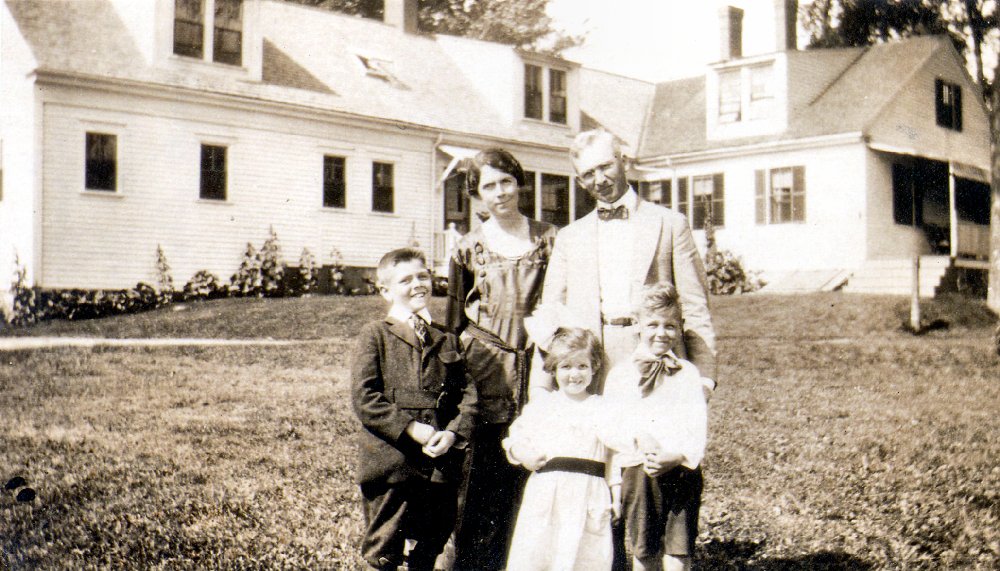
Clarence W. Gormly Family
[top l-r: Eleanor Meredith Gormly and Clarence W. Gormly; bottom l-r: Robert M. Gormly, Elizabeth Gormly, and Donald G. Gormly] - Courtesy of Martha Gormly Clement Wilcoxen, March 2006.
Clarence Wallace Gormly (1882-1957) was a land developer and resort builder from New York State. Presently little is known about his life prior to arriving on the Mississippi Gulf Coast, but in the 1920 Federal Census, he and his family were residents of Mount Vernon, Westchester County, New York. At this time, Mr. Gormly practiced law.(1920 NY Federal Census, Roll 625-1277, p. 6A)
It is known that C.W. Gormly was married to Eleanor Meredith (1883-1962) probably a native of Larchmont, New York, and that they had three children: Robert Meredith Gormly (1909-1969), Donald G. Gormly (1910-1980), and Elizabeth Gormly (1914-1996). Before arriving on the Mississippi coast, they may have resided in Oklahoma, as their oldest child, Robert M. Gormly was born here. The two younger children were New York natives.(Richard Gormly, June 21, 2000 and 1920 NY Federal Census, Roll 625-1277, p. 6A)
Mr. Gormly’s first project in coastal Mississippi was in western Harrison County near Bay St. Louis, called Shell Beach-on-the-Bay. It was commenced in May 1922. Between 1925 and 1930, Mr. and Mrs. Gormly worked diligently on Gulf Hills, Belle Fontaine, and Pointe aux Chene. These projects were situated near Ocean Springs, Mississippi in Jackson County.
Shell Beach-on-the-Bay/Pine Hills
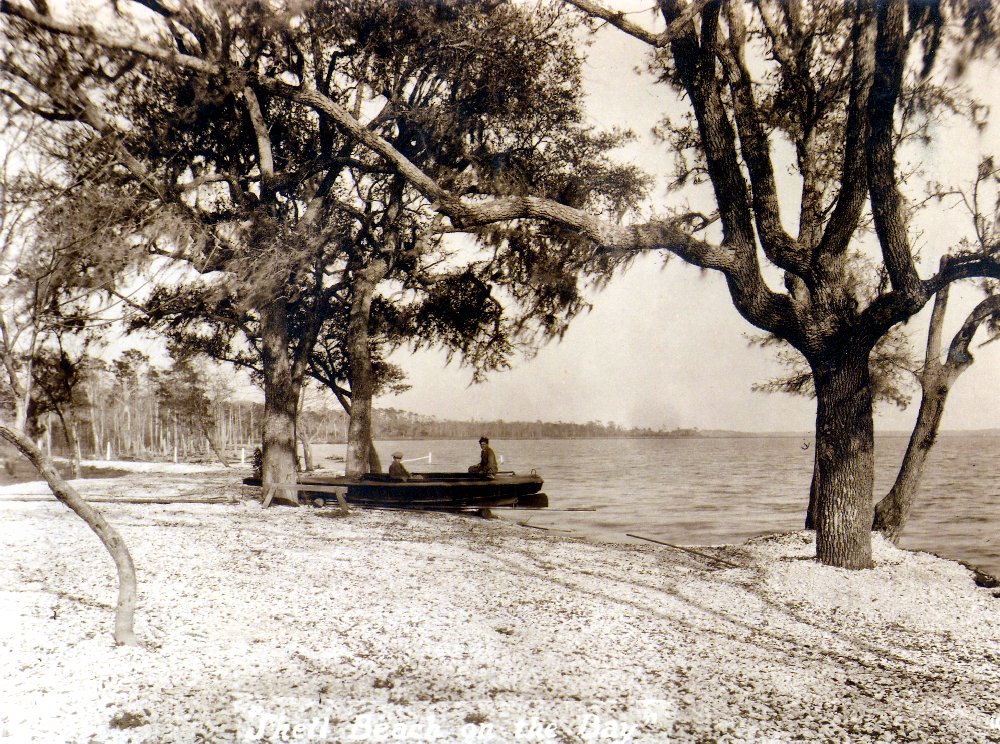
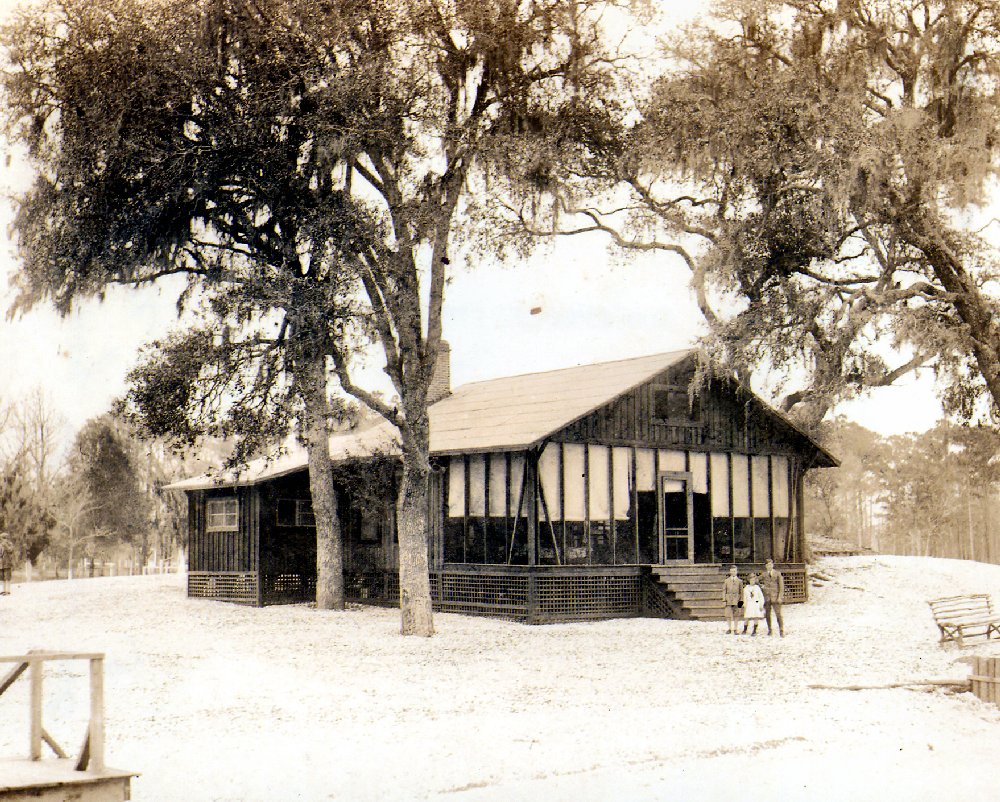
Shell Beach, Hancock County, Ms. and C.W. Gormly House, Benn-she-Wah, at Shell Beach
[Courtesy of Martha Gormly Clement Wilcoxen-March 2006)
Shell Beach-on-the Bay was located on the north shore of St. Louis Bay about 2 ½ miles as the crow flies from the town of Bay St. Louis, in Section 5, T8S-R13W, Harrison County, Mississippi. In May 1922, the Perkins Land Company sold to Clarence W. Gormly tracts of land situated in Section 31, 32, and 33, T7S-R13W and Section 5, T7S-R8W of Harrison County. In addition lands in Section 36, T7S-R14W and Section 1, T8S-R14W of Hancock County were part of this sale to C.W. Gormly. The consideration was $5000.(HARCO, Ms. Land Deed Bk. 134, pp. 276-277)
In October 1922, Mr. Gormly sold these lands north of the Bay of St. Louis to Shell Beach Properties for $10,000. His wife, Eleanor M. Gormly, was vice-president and acting president of this corporation at the time of the sale. J.F. Galloway, a Gulfport, Mississippi engineer, was the secretary of Shell Beach Properties.(HARCO, Ms. Land Deed Bk. 135, p. 585 and Bk. 137, pp. 620)
In 1923-1924, at Shell Beach on-the-Bay, C.W. Gormly’s company built the Mexican Gulf Country Club, an eighteen-hole course with country club, for about $125,000. Root & Hollister, landscape architects from Chicago, designed and landscaped the course and environs. They would later participate in the construction of Gulf Hills at Ocean Springs. In May 1925, this 2000-acre picturesque, elevated tract was sold to a New Orleans syndicate represented by Latter and Blum for a sum in excess of $300,000. The Mexican Gulf Country Club, a 6500-yard par 73, golf course was included in the sale. It was anticipated that a movie studio to rival Hollywood would be located on the premises.(The Jackson County Times, May 23, 1925, p. 1 and The Daily Herald, May 19, 1925, p. 1 and February 14, 1933, p. 6)
The new owners, primarily entrepreneurs from New Orleans, named their development Pine Hills. A large hotel of approximately two hundred rooms was constructed for $1,350,000. It had characteristics of both Spanish and Italian Renaissance architecture. The furnishing of the Pine Hills Hotel amounted to about $200,000. It was opened for business in late December 1926.(The Daily Herald, December 18, 1926, p. 1)
In June 1925, Frank Adams, golf professional at the Mexican Gulf Country Club, began litigation against the Shell Beach Development Company, C.W. Gormly, and trustee, D. Allen Johnson. He alleged in the Harrison County Circuit Court that his three-year contract with the organization was abrogated. He sought $14,500 for wages, expenses, and other perquisites promised to himself, his family, and Jack Brown, assistant golf professional. Frank Adams had come to the Bay St. Louis links from the Westward-Ho Golf Club situated in Chicago.(The Daily Herald, June 8, 1925, p. 1)
In December 1926, Mr. Gormly entertained the Biloxi High School football squad at “Benn-she-Wah” on the Bay of St. Louis. They were crowned State gridiron champions, having tied the undefeated Sunflower County Agricultural High School from Moorehead at Greenville, Mississippi on December 6, 1926, by a score of 7-7. The game went five quarters, although the Indians were outweighed 24-pounds per man. Athletes from Ocean Springs on this squad were: Dan Newcomb (1906-1967), Morris McClure “Babe” Baker (1907-1994), and Louis A. Lundy Jr. My uncle, Marcel J. Bellande (1909-1982), was the starting right half back on this team. He weighed 135-pounds. In later life, M.J. Bellande (1909-1982) was inducted into the Sports Hall of Fame of Spring Hill College (1974), the Mississippi Sports Hall of Fame (1975), and also the Gulf Coast Chapter of the National Football Foundation and Hall of Fame (1979).(The Jackson County Times, December 11, 1926, February 5, 1927, p. 1, The Daily Herald, December 7, 1926 and The Sun Herald, March 5, 1982)
Gulf Hills
Gulf Hills is a resort and real estate development with an eighteen-hole golf course located just north of Ocean Springs, Mississippi. In April 1925, land acquisition activity began here with land purchases in Section 13, T7S-R9W by Eleanor M. Gormly and W.E. Applegate, Jr. (1876-1948). Mrs. Gormly bought parts of Lot 6 and Lot 7 from H.F. Russell (1858-1940). She also acquired 15 acres in Lot 7 from David Ramsay (1873-1947). Also in April 1925, Mr. Applegate acquired 16 1/2 acres from H.F. Russell.(Jackson County Land Deed Book 55, pp. 147-148, pp. 378-379 and p. 146)
In April 1925, The Jackson County Times related that “C.W. Gormley (sic) has acquired additional acreage across the bayou adjoining the Applegare (sic) place for the proposed country club and golf links.” Mr. Gormly also acquired about sixteen acres from H.F. Russell and son across Old Fort Bayou adjacent to the Andrew Olson place.(The Jackson County Times, April 25, 1925, p. 3)
Prior to the incorporation of Gulf Hills, Clarence and Eleanor Gormly acquired several hundred acres in the area north of Old Fort bayou, which would become a part of the development. They appear to have been working with Allan B. Crowder in assembling about 700-acres of rolling pine lands bordered by Bayou Puerto on the west and Old Fort Bayou to the south.
Incorporation
Gulf Hills was incorporated in the State of Mississippi in mid-September 1925, by Allan B. Crowder, Pass Christian, Mississippi; William E. Applegate, Ocean Springs, Mississippi; Clarence W. Gormly, Ocean Springs, Mississippi; Ralph R. Root, Chicago, Illinois; and Harvey W. Branigar (1875-1953), Chicago, Illinois.(The Jackson County Times, September 19, 1925, p. 2)
Development
In October 1925, Clarence W. Gormly and W.E. Applegate Jr. (1876-1948) went to Chicago to meet with the other incorporators of Gulf Hills to perfect plans for the future development of the property.(The Jackson County Times, October 10, 1925, p. 5)
Construction at Gulf Hills began in May 1925. At this time, a labor crew was using dynamite to clear the topography in order that erection of the clubhouse and golf course could be commenced. By late September of that year, over one hundred workers were employed constructing the golf course, club house, and other improvements.(The Jackson County Times, May 16, 1925, p. 3 and September 9, 1925, p. 5)
The Golf Course
By June 1925, the first nine fairways of the planned eighteen-hole golf course at Gulf Hills had been cleared of trees and underbrush. Golf course architect, Jack Daray (1881-1958) of Olympia Fields, Chicago, Illinois, was in charge of the operation. Root & Hollister of Chicago, landscape architects, planned the roads, parks, and clubhouse grounds. In addition, waterfront and golf course, residential lots were surveyed and platted. Building covenants were established regarding use and cost. Homeowners had golf course privileges for themselves, their families, and houseguests.(The Jackson County Times, June 20, 1925, p. 1)
Vacation
In July 1926, the Gormly family drove to New York in their Lincoln roadster and planned to visit Canada and return in the fall. They also went to Bretton Woods, New Hampshire. The Gormlys returned to the Mississippi coast in August and took residency in the White House Hotel at Biloxi. Mr. Gormly was employed in the development of a large project near Bay St. Louis and was connected with the Gulf Hills development near Ocean Springs.(The Jackson County Times, July 10, 1926, p. 3 and August 21, 1926, p. 1)
Opening Day-January 15, 1927
Prior to and preceding the formal opening of The Gulf Hills Country Club on January 15, 1927, the Mississippi Gulf Coast was the scene of several other grand events. The Edgewater Hotel opened on January 10, 1927, followed by the formal opening of the Biloxi-D’Iberville bridge on January 12, 1927. The Tivoli Hotel designed by Carl Mathes opened on February 19, 1927.
At Gulf Hills, several thousand people were invited to the ceremony. A 36-hole medal play golf tournament was held.(The Jackson County Times, January 15, 1927, p. 5)
Gormly lauded
In March 1927, Clarence W. Gormly was praised as follows: Most credit for the success of the Mississippi Gulf Coast is due to C.W. Gormly, the genius behind Pine Hills, Gulf Hills and other developments. And now Mr. Gormly is developing Point aux Chenes, which mean Point of Oaks. This will soon be a development of first importance. No one appreciative of natural beauty and a sloping white sand beach overlooking the broad expanse of the waters of the Mississippi Sound, can doubt.
Mr. Gormly, inspired by the vision of this 2,000 acres in Point aux Chenes future is fired with a pioneer spirit that has built America, is creating an earthly paradise along the white beach shores and rolling land among the stately pines, oaks, and magnolia trees.(The Jackson County Times, March 5, 1927, p. 2)
Gormly and Belle Fontaine
In March 1925, it was rumored that Robert W. Hamill (1863-1943), a resident of Clarendon Hills, Illinois, a small village situated in DuPage County, some 17 miles southwest of Chicago, would establish a town on the beach at Belle Fontaine south of the village of Fontainebleau. Belle Fontaine is part of the “Isle of Belle Fontaine” and situated on the Mississippi Sound between Ocean Springs and Gautier, Mississippi. It affords an excellent view of Horn Island, which is only six miles south. The seashore here has the only natural sand beach in Jackson County, Mississippi. Mr. Hamill’s plan called for a road to the beach and a modern hotel to be erected there. This dream was reminiscent of the 1890s “New Chicago” of his late father-in-law, John Bacon Lyon (1829-1904).(The Jackson County Times, March 28, 1925, p. 1)
Financing for the Hamill project at Belle Fontaine came in mid-year 1928, when R.W. Hamill placed a five-year, $300,000 bond issue with Dangler, Lapham Company of Chicago, which was bought by the Illinois Merchants Trust Company. The bonds paid 6% interest and were secured by 9,000 acres of Hamill land valued at $1,660,000.(The Jackson County, August 18, 1928, p. 1.)
In July 1928, the construction of a road system for the Hamill project at Belle Fontaine Beach began, when the four-mile section from the Old Spanish Trail, US 90, to Graveline Lake, was commenced. Lynn Watson and Fred Ryan (1886-1969) with road building equipment and a crew of fifteen men were assigned the task. At this time, R.W. Hamill was planning for a golf course, airport, and an elaborate road network as ancillary developments to his beach hotel project.(The Jackson County Times, July 14, 1928, p. 3)
In November 1928, Clarence W. Gormly (1882-1957) and Albert E. Lee (1874-1936), the editor of The Jackson County Times, set out to view the 9,000-acre Belle Fontaine tract of Mr. Hamill. Mr. Gormly had been placed in charge of the Hamill project and had traversed the tangle undergrowth of the pine forest on foot to layout the road to Graveline Lake and others in order that the Hamill tract could be open for viewing and development.(The Jackson County Times, November 24, 1928, p. 1)
In March 1929, Clarence W. Gormley continued the supervision of an extensive road building and other developmental projects on the Hamill tract. He opened two new roads. One called the East Shore Road extended along the shoreline of the Mississippi Sound east of the Hamill home at Belle Fontaine Beach. The other went westward to Pointe-aux-Chenes. Both were considered excellent thoroughfares.(The Jackson County Times, March 2, 1929, p. 5)
In April 1929, a deepwater pier was erected on the Hamill property. There were eight to ten feet of water at the pier head. Fred Ryan (1886-1969) constructed the wharf with the F.H. McGowen firm providing the civil engineering studies. Mr. McGowen (1894-1985) was active in the area having supervised the construction of the sea wall at Ocean Springs and the 1929 Fort Bayou Bridge.(The Jackson County Times, April 7, 1929)
The Depression halted the Hamill development at Belle Fontaine. In 1935, H.P. Flateau (1888-1955) was named receiver of the Hamill Corporation by Federal Court Judge, F.R. Holmes. Mr. Flateau came to the area in 1933, and resided on Pointe-aux-Chenes at “Holly Lodge” near the Leavells.(The Jackson County Times, March 2, 1935, p. 1 and JXCO, Ms. Chancery Court Cause No. 5520-August 1933)
Pointe-aux-Chenes and "The Oaks"
Pointe-aux-Chenes, “Point of the Oaks”, is a real estate development situated on the Mississippi Sound just east of Ocean Springs, Mississippi. It is the western terminus of the “Isle of Belle Fontaine” and situated in the Jean-Baptiste Baudrau Claim of T 8S-R8W. The approximately 1000-acre land development, also the traditional homestead of the Daniel Huey Ramsay (1814-1867) clan, was founded and platted by the Pointe aux Chenes Corporation headed by Clarence W. Gormly and Eleanor M. Gormly in April 1930. The Gormlys had acquired a large tract in the J.B. Baudrau Claim from Walter E. White and John T. White of Harrison County in December 1929.( JXCO, Ms. Chancery Court Land Plat Bk. 1, p. 120 and The Daily Herald, January 27, 1927)
The Continental Illinois Bank and Trust Company of Chicago headed by James R. Leavell (1885-1974) financed the project. Mr. Leavell and his wife, Lorna Carr (1892-1976), were among the first of wealthy Midwesterners to buy one of the ten large lots with a 450-foot front on the Mississippi Sound, in the Gormly development. Circa 1935, they built “Doonegate”, their retirement home. Other affluent individuals to acquire property here were: L.L. Cooke, Abner J. Stillwell, Samuel C. Witting, Mabel Stompe, Carl Asa Birdsall (18-1956) and Francis Deneen Birdsall, who built “Oaknolia”, and Joe Jones.
In January 1927, Jack Daray (1881-1958), the professional instructor at the Biloxi Golf Club and summer teaching golf professional at the Olympia Fields Country Club at Chicago, began laying out an eighteen-hole golf course at Pointe-aux-Chenes, to be called “The Oaks”. Mr. Gormly expected his course to be open for play in early 1928. The project was to include a hotel, riding paths and tourist attractions. (The Daily Herald, January 18, 1927, p. 3 and January 27, 1927)
Road and bridge
By early February 1927, C.W. Gormly had completed a dirt road into Pointe-aux-Chenes and was awaiting the placement of a suitable sized culvert before placing gravel aggregate on this temporary road. At this time over 150 motorcars, transporting interested parties from along the Mississippi Gulf Coast were viewing his large project. The salient natural feature of Pointe-aux-Chenes was its 1800-foot quartz sand beach. Gormly planned a bridge to span Davis Bayou from the west end of Point-aux-Chenes to reduce travel time to Ocean Springs to only ten minutes.(The Jackson County Times, February 5, 1927, p. 1)
Gormly camp
In 1927, the Gormley family was domiciled on West Beach Boulevard near McDonald Avenue in Biloxi. At this time, Clarence W. Gormly was erecting a weekend camp on the west end of Pointe-aux-Chenes. He had built a similar structure at Shell Beach-on-the-Bay, which he called “Benn-she-Wah”. A.O. Bourdon was the keeper of the Gormly camp.(Polk’s Coast Cities Directory, 1927, p. 97 and The Jackson County Times, January 25, 1927, p. 2 and January 27, 1927)
In February 1927, C.W. Gormly at Pointe-aux-Chenes, hosted a fish dinner prepared by one of Biloxi’s finest cooks, Arsene O. Bourdon (1868-1959). Honored guests were: W.E. Applegate, John T. Connery, president of the Edgewater Hotel; Matt Winn, a renown horseman; and the venerable golf professional and course architect, Jack Daray.(The Jackson County Times, February 21, 1927)
In July 1930, the Gormley’s were living on Pointe-aux-Chenes in 1930, as they gave a party for Miss Mary Helen Fain from Chicago at their home here. The Carron Orchestra from Biloxi played dance music for the approximate thirty young folks from Biloxi and Ocean Springs.(The Daily Herald, July 22, 1930, p. 2)
1934-The Biloxi Country Club
In January 1934, Clarence W. Gormly leased the Biloxi Golf Club and planned to incorporate it as the Biloxi Country Club. The Biloxi Golf Club had been founded in May 1918, by a group of wealthy Biloxi citizens led by Edward Brady (1867-1939), John J. Kennedy (1875-1949), and Elbert L. Dukate. Its membership included such local notables as: John W. Apperson (1862-1939), Byrd Enochs (1875-1940), Lyman Bradford (1863-1944), Walter E. White (1891-1940), Louis B. Joyner (1889-1926), and James C. Elmer (1888-1920). The Biloxi Golf Club had a capital stock of $30,000, which was increased to $50,000 in March 1925.(HARCO, Ms. Charter Bk. 18, p. 253 and Bk. 34, p. 518)
The Biloxi Golf Club was situated on a 110-acre tract acquired from Cora E. White (1864-1934) in northwest Biloxi. Construction of the golf course commenced in mid-March 1918, under the supervision of golf professional, Jack Daray (1881-1958) of Grand Rapids, Michigan. In 1941, the course and clubhouse became integrated into the new Army Air Corps training school, which was later named Keesler Air Force Base. (The Daily Herald, January 9, 1934, p. 6 and March 23, 1918, p. 1, and Husley, 1996, p. 134)
South Florida
Clarence W. Gormly and family departed the Mississippi Gulf Coast circa 1935 for south Florida. He settled at 2783 SW 14th Street Kendall, Florida where he worked as a salesman for the Keys Realty Company and raised fruit trees as an avocation. C.W. Gormly expired on October 3, 1957. His corporal remains were interred in the Miami Memorial Park Cemetery. Mrs. Eleanor M. Gormly lived until February 1962. She rests eternally besides Mr. Gormly.(Richard Gormly, June 21, 2000 and The Miami Herald, October 4, 1957 and February 8, 1962, p. 9)
The Gormly Children
Elizabeth W. Gormly (1908-1996) never married. She was born February 22, 1908 and graduated with brother, Donald G. Gormly, in the Class of 1932 at Biloxi High School. In June 1930, Elizabeth visited her aunt at Louchman, New York before going to camp in Maine for July and August. In May 1934, Elizabeth left Ocean Springs to visit relatives at Larchmont, New York and then went on to Camp Coaquan? at Belgrade, Maine where she was a camp counselor. Miss Gormly served as an Army nurse during the Korean War She expired at Miami, Dade County, Florida on February 25, 1996.(Richard Gormly, June 20, 2000 and The Daily Herald, June 21, 1930, p. 3 and The Jackson County Times, May 12, 1934, p. 3)
Robert M. Gormly
Robert Meredith Gormly (1909-1969), called Bob, was a native of Oklahoma. He was born there about 1909. While a resident of the Mexican Gulf Coast, Bob Gormly developed into a champion amateur golfer and created much ink for the local press. It’s a shame that they never learned to spell “Gormly” correctly. In the many sports page articles about Bob Gormly’s golf skills, his name was invariably spelled “Gormley”.
As a teen, Bob Gormly competed in major amateur events throughout Mississippi during his families’ tenure at Shell Beach, Gulf Hills, and Biloxi. As one can imagine golf at Ocean Springs in the1920s, was a novelty. There was a nine-hole, 4000-yard, golf course established in 1914, appropriately called The Ocean Springs Country Club. A Canadian born physician, Dr. Henry Bradford Powell (1867-1948), was the prime organizer of the club, which was situated on a sixty-five acre tract leased from proprietors of the Rose-Money Farm, two miles north of Ocean Springs.

Bob Gormly (June 1927)
Some of the members of the Ocean Springs Country Club were: Albert E. Lee (1874-1936), George E. Arndt (1857-1945), J.O. Whittle (1880-1925), Albert C. Gottsche (1873-1949), E.R. Glasscock, Hernando DeVeaux Money (1869-1936), M.R. Hicks, Theo Bechtel (1863-1931), J.H. Behrens (1848-1918), and Charles B. Ver Nooy (1860-1921).(The Ocean Springs Record, March 28, 1996, p. 24)
At the time of Bob Gormly’s rise to local golf prominence, The Jackson County Times in June 1927, related that there was serious competition here between Dr. Henry B. Powell (1867-1948), Stewart C. Spencer (1867-1959), George W. Anderson (1861-1937), and Chester Davis (1900-1973). As one can observe, these men with the exception of Chester Davis were in there sixties and well past their athletic prime. It must have been difficult for Bob Gormly to find a competitive golf game from the local links talent.(The Jackson County Times, June 27, 1927, p. 3)
Bob Gormly reached manhood with a lightly built frame, but he able to generate power with his golf swing and drive the ball a long distance. His short game was very accurate and he was good with the flat stick.(The Daily Herald, June 9, 1931)
In addition, Gormly younger brother Don, was also a fine golfer. In 1928, the Gormly brothers were lauded as follows: Bob Gormly is recognized as one of the states’ best golf stars and has won the state championship twice. His younger brother, Don, is almost as good….(The Jackson County Times, June 23, 1928, p. 3)
By the end of 1931, Bob Gormly had won many local links tournaments and had claimed the Mississippi State Amateur Golf Championship three times. He vanquished the competition in 1926 at Laurel, in 1929 at Biloxi, and in 1930, also at Laurel. Gormly was runner-up in this tournament in 1928 at Gulf Hills.
A chronology of Bob Gormly’s local golf career follows:
1924
The 1924 Mississippi Golf Association championship was held at the Biloxi Golf Club. Bob Gormly, a resident of Shell Beach, lost to E.L. Enochs of Fernwood 2-1, in the 2nd Flight.(The Daily Herald, June 6, 1924, p. 1)
1925
The Gulf States Championship held in late March 1925, at the Biloxi Golf saw young Bob Gormly of Pass Christian lose in the championship flight to Don Hamilton of Chicago 2 up. Fred Lamphrect, a student at Tulane and playing out of the Audubon Country Club of New Orleans was the winner.(The Daily Herald, March 20, 1925, p. 3 and March 25, 1925, p. 1)
At the age of fourteen, Bob Gormly defeated a veteran player from New Orleans, Al Reuning, in the 1st flight of the Mid-Summer tournament held at the Biloxi Golf Club. Don Gormly only twelve beat Phil Parker, also from New Orleans, for the 2nd flight. The format was match play.(The Daily Herald, June 13, 1925, p. 8)
In June 1925, Bob Gormly traveled to Jackson, Mississippi to compete in the annual tournament of the Mississippi Golf Association. After the opening round, he faced medallist, Oren Williams (b. 1900) of Biloxi. He lost to Williams, the eventual champion, but won a trophy for his finish in the First Flight of the links contest.(The Daily Herald, June 22, 1925, p. 5)
In mid-July 1925, Bob Gormly and younger brother Don Gormly won the first and second flights of the mid-summer golf tournament held at the Biloxi Golf Club. Both teens defeated older gentlemen, Al Reuning (1908-1974) and Phil Parker, from New Orleans. Their father presented them their awards.(The Jackson County Times, July 18, 1925, p. 3)
1926
State Champion-11th Mississippi State Championship
In early June 1926, Clarence and Bob Gormly attended a celebration in the Crescent City honoring Marion Turpie, Southern Woman’s Golf Champion. Miss Turpie was a close family friend.(The Jackson County Times, June 12, 1926, p. 3)
In late June 1926, Bob Gormly defeated Al Welch of Biloxi for the Mississippi State Amateur Golf Championship on the Laurel Country Club links at Laurel, Mississippi. Gormly was accompanied to Laurel by Mark Lee of Ocean Springs. Lee had won tournaments in Arkansas and Mississippi. Gormly competed in the National Junior golf championships at Chicago in August 1926.(The Jackson County Times, June 19, 1926 and Way Down South, July 17, 1926, p. 6)
1927
March 1927 was a busy month in the amateur golf career of young Bob Gormly. His first match was an annual competition between a team of Mississippi Gulf Coast amateur golfers and the New Orleans Golf Association. The Crescent City links squad of thirty players was recruited from the five New Orleans country clubs in the association. Only Bob Gormly and Mark E. Lee (1898-1990) of Ocean Springs were invited to participate in the inaugural contest, which was held at Gulf Hills.(The Daily Herald, March 3, 1917, p. 5)
Mark Enos Lee
Mark E. Lee, the son of Albert E. Lee (1874-1936), editor and publisher of The Jackson County Times, was a natural athlete. He excelled in all sports, especially baseball and golf. Young Mark E. Lee attended Mississippi A&M College (now Mississippi State University) where he played shortstop on the 1916 state college championship team. He was presented a gold watch fob which was in the shape of a baseball with the inscription, "State Champions, 1916". His team defeated some of the strongest university teams in the South and split a series with the University of Illinois, the champions of the Midwest. Mark E. Lee led the team in batting and fielding.
In late summer 1916, young Lee was traveling weekly to Bay St. Louis to baseball with the Tosa Stars.(The Daily Herald, September 2, 1916, p. 2)
After a few years in minor league baseball, Lee’s peripatetic career had brought him to northeast Texas. He played second base for the Texarkana Twins in the 1923-1924 baseball seasons. Lee left baseball at Texarkana, Texas in May 1925, to manage the Texarkana Country Club. The Daily Texarkanian spoke highly of Mark E. Lee and wrote, "on account of his attractive and genial personality, and the fact that he is a first class golf player, he is peculiarly adapted to the country club work".(The Jackson County Times, May 16, 1925, p. 4)
Later in early March 1927, Bob Gormly, then a student at Biloxi High School, ran roughshod over F.L. Binford of Indianapolis, Indiana winning the Mississippi Coast Amateur Championship 7 and 5 on the Great Southern course at Gulfport. In late March, he teamed up with professional, Matt Matteson, of Chicago to play in a 36-hole, best ball format, Pro-Am event held at the Biloxi links. W.P. Conley of Chicago and Eddie Murphy, the Gulf Hills pro, won the event by three strokes over Gunnar Nelson of the Biloxi Golf Club and Dr. A.L. Henning of Chicago. Gormly-Matteson team tied for fifth, while Don Gormly and his playing partner, Frank Florence, were sixth.(The Daily Herald, June 26, 1926, p. 3 and March 4, 1927, p. 5 and March 29, 1927, p. 9)
Bob Gormly ended the month as medalist of the 5th Annual Gulf States Championship held at the Biloxi Golf Club. He shot a 75 on March 29th while Don Gormly carded an 82, which was the fifth best round played on the opening day of the tournament. Three time champion and former inter-collegiate champion, Fred Lamprecht of Tulane University chose not to defend his title. Don Armstrong (b. 1905) of Aurora, Illinois won the tournament in an exciting 37 hole final match conquering Bob Gormly one up.(The Daily Herald, March 29, 1927, p. 9, April 2, 1927, p.10, and April 4, 1927, p. 3)
Prior to the 1926, Mississippi Amateur Golf Championships, which were to be held in Jackson, Gar Moore of The Item-Tribune related the following about Gormly: “Bob Gormley (sic) defends his Mississippi state championship this week and Bob isn’t likely to be beaten. He will be a much better golfer this season than last and a big part of his progress can be attributed to the defeat Don Armstrong handed him in the Gulf States finals.” (The Daily Herald, June 7, 1927, p. 8)
Mr. Moore’s prediction was like a gim’me putt that lipped out for a bogie, as link prodigy, Bob Gormly, failed to defend his 1926 Mississippi Amateur Golf at Jackson in mid-June 1927. He lost to Charles Ratcliffe, a native of Natchez and former Ole Miss golf star. However, Gormly’s personality and tenacity on the golf links captured the hearts of those who were fortunate to have observed his shot making.(The Daily Herald, June 15, 1927, p. 8)
At Jackson, Oren Williams, the Biloxi realtor, lost in the finals to Charles W. Kittleman of Greenville in the 36-hole match by the score of 5 and 3.(The Daily Herald, June 18,1927, p. 8)
1928
Bob Gormly started his 1928 links competition at Gulf Hills playing in the Riviera Championship. After defeating several opponents, Gormly met Oren Williams of Biloxi in the 36-hole finals. The match went the distance with Gormly losing on the last hole as a result of poor play. Eddie Murphy, Gulf Hills pro, presented Williams with a silver trophy while young Gormly was awarded a dressing case for his second place effort.(The Jackson County Times, January 28, 1928, p. 3)
In late February 1928, Bob Gormly, a student at Biloxi High School, defending his Mississippi Coast Amateur Championship at the Great Southern Golf Course, defeated Al Welch of Biloxi in the 18-hole finals by a score of 2 and 1. He had routed L.K. Vaughn of Hamilton, Ohio in the semi-finals, while Welch upset Oren Williams of Biloxi also by a 5 and 4 score.(The Daily Herald, February 24, 1928, p. 12 and February 25, 1928, p. 3)
In mid-March 1928, Bob Gormly participated in the 36-hole Pan American Golf Tournament at the Edgewater course in Biloxi. He was knocked out of the event by Glenn Crissman, former Southern Amateur champion.(The Daily Herald, March 23, 1928, p. 14)
The St. John’s Golf Club of New Orleans defeated a squad from the Biloxi Golf Club in mid-March 1928. The Biloxians were defending their crown. Willis Carvin (1908-1928+) was medalist on the first day with a 71. Bob Gormly played one match with Dr. Henning of Chicago against Harry Turpie and Mr. Vernon.(The Daily Herald, March 26, 1928, p. 3)
Also in mid-March, Bob and Don Gormly qualified for the 5th Annual Gulf States Championship held at the Biloxi Golf Club. Leading contenders for the title were: Don Armstrong, Oren Williams, Frank Thomas, Bob Gormly, and Gus Navotny. Although young Bob Gomly was medalist, he lost in the semi-finals. Don Gormly won the championship consolation flight. Glenn Crissman (b. 1906) of Selma, Alabama won the tournament. (The Daily Herald, March 26, 1928, p. 3)
The 1928 Mississippi State Golf Championship was played at Gulf Hills in Ocean Springs in late June. Bob Gormly met Oren Williams, the 1925 State Champion, in the finals. Williams led Gormly 3 up at the completion of the first 18 holes of the 36 hole finals and he went on to defeat Gormly.(The Daily Herald, June 30, 1928, p. 7)
1929
State Champion-14th Mississippi State Championship
In March 1929, Bob Gormly, a student at Biloxi High School, repeated as low medalist in the qualifying round of the seventh annual Gulf States Championship held at the Biloxi Golf Course. He shot a 75 on the par 70 course to lead Don Armstrong of Aurora, Illinois and Al Welsh of Biloxi. Young Gormly was eliminated by eventual champion, Don Hamilton of the Olympia Fields golf club at Chicago in the semi-finals 1 up in 19 holes. Don Hamilton beat Don Armstrong 1 up after 37 holes in the finals.(The Daily Herald, March 18, 1929, p. 8, March 21, 1929, p. 8 and March 23, 1929, p. 8)
In late March 1929, the Gulf Hills golf team faced their Crescent City rivals for the third time in their annual links competition. Bob Gormly was again chosen as a part of this team competition to be held at the Gulf Hills Country Club near Ocean Springs.(The Jackson County Times, March 30, 1929, p. 3)
In June 1929, brothers, Bob and Don Gormly along with fellow Biloxi linksters, W.V. Joyce, John E. Breaux, Al Wambsgan, and Al Welch, went to Greenwood, Mississippi to play in the State amateur golf tournament. Bob Gormly was low medalist and went on to win his second State golf championship in a very convincing manner over W.E. Ware of Greenwood, 8 and 7 in the 36 hole finals. In the semi-finals, he had defeated Will Miner of Meridian by the same score. Gormly was driving the ball 300-yards from the tee against Miner. Don Gormly won the second flight consolation match.(The Daily Herald, June 7, 1929, p. 10, June 8, 1929, p. 5, and June 10, 1929, p. 5)
In late August 1929, Bob Gormly went to Greenwood, Mississippi to play in a Labor Day invitational golf match composed of the best Mississippi linksters. He played well enough to place second and tied for first place in the special Labor Day contest. (The Jackson County Times, September 14, 1929, p.2)
1930
State Champion-15th Mississippi State Championship
Bob Gormly won his third Mississippi State Golf Championship at Laurel, Mississippi in June 1930. In the 36-hole semi-finals, he beat medalist, Eugene Vinson of Meridian, 4 and 3. In the 36-hole finals, Gormly bested his teammate, A.D. Warner, 5 and 4. The Biloxi Golf Club Team composed of Bob and Don Gormly, Al Welch, W.V. Joyce, W.E. Beasley, Al H. Wambsgan, John E. Breaux, Irwin Cowie Jr., and A.D. Warner won the Griffith Trophy for shooting the low medal score in the team competition.(The Daily Herald, June 14, 1930, p. 3 and June 16, 1930, p. 6)
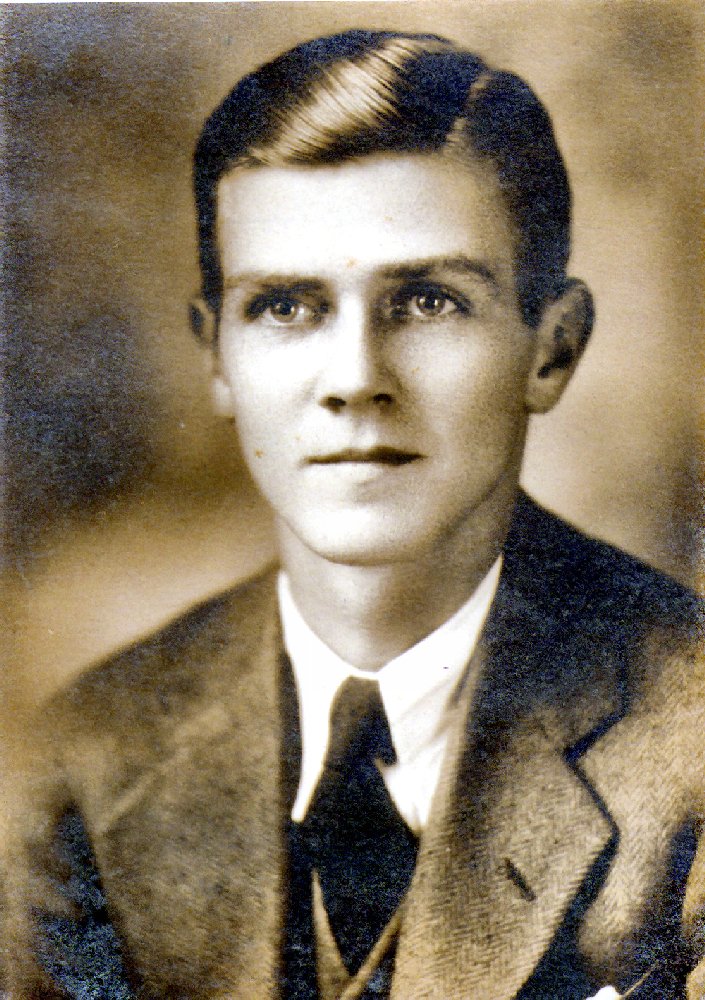
Robert M. Gormly
[Image made at Tuscaloosa, Alabama. Courtesy of Martha Gormly Clement Wilcoxen-March 2006]
n the fall of 1930, Bob Gormly matriculated to the University of Alabama. By the spring of 1931, he was Captain of the Crimson Tide gold squad.(The Daily Herald, June 9,1931)
1931
In June 1931, Bob Gormly did not defend his Mississippi State Golf Championship title at Jackson. He chose to remain at Biloxi to practice for the Southern Amateur, which was to be held in Chattanooga, Tennessee. Gormly was paired against Chasteen Harris of Memphis who soundly whipped the young Biloxian by the score of 5 and 4.(The Daily Herald, June 8, 1931, p. 8 and June 9, 1931)
In September 1931, Bob Gormly of Biloxi went to Canton to play in the Mississippi Open Championship. He didn’t play well and finished in a tie for sixth place. Gene Vinson of Meridian, the 1931 State Amateur Champion defeated Nelson Giddens, a golf professional from Tupelo, to win the contest.(The Daily Herald, September 10, 1931, p. 3)
1932
In April 1932, Bob Gormly defeated Al Welsh 4 and 3 to add the first annual Edgewater Gulf Country Club championship to his long list of golfing titles.(The Daily Herald, April 18, 1932, p. 3)
In June 1932, Bob Gormly did not compete in the 17th Mississippi State Golf Championships, which were held at the National Park course in Vicksburg. Eugene Vinson of Meridian, Mississippi bested Harry Prichett of Columbus for the crown.(The Daily Herald, June 10, 1932, p. 3 and June 11, 1932, p. 3)
1933
In mid-June 1933, Bob Gormly made an appearance at Laurel in the 18th Mississippi State Amateur Championships. He lost a semi-final match to Robert E. Mulloy of Laurel by the score of 3 and 2. Mulloy lost in the finals to perennial champion, Eugene Vinson of Meridian.(The Daily Herald, June 10, 1933, p. 3)
1934
Bob Gormly and Eugene Vinson did not compete in the 1934 Mississippi State Amateur Golf Championships were held in June at Meridian, Mississippi. This opened the doors for an eighteen-year old lad from Tupelo, Jim Patrick, to win the crown over L.L. McAllister of Jackson.(The Daily Herald, June 6, 1934)
1935
In 1935, Bob Gormly left the Mississippi Gulf Coast with his family for south Florida. He settled in the Miami area and was the proprietor of an appliance store in North Miami. Bob Gormly and his spouse were the parents of two daughters.(George Gormly, July 18, 2000)
1969
Robert M. Gormley expired in Dade County, Florida in February 1969.
Donald G. Gormly
Donald G. 'Don' Gormly (1910-1980) was born on September 7, 1910 in Ithaca, New York. Like his older brother, Bob, Donald was an excellent amateur golfer. He was a member of the Biloxi Golf Club and participated with the team in the State Amateur Championship and club matches. In March 1931, Don Gormly went to Meridian to play a high school golf match. His team Biloxi High team mates were: Bob Daray, Ernest Carvin, and John Breaux Jr. Al Bellande did not make the journey.(The Daily Herald, March 20, 1931, p. 5)
Don Gormly received lacerations and contusions on present day Le Moyne Boulevard in early May 1930, when his motor car struck a cow near the St. Martin school. He was taken to the Biloxi Hospital and returned to his domicile the next day. Young Gormly said that he was blinded by the headlamps of an on coming vehicle.(The Daily Herald, May 5, 1930, p. 2)
In April 1932, Don was a member of the Biloxi High School golf team. He shot a 76 in a match against Murphy High School of Mobile in April 1932. Other members of this links team were: John E. Breaux Jr., Alton L. Bellande (1912-1970), my father, and John Lee.(The Daily Herald, April 2, 1932, p. 10 and Social Security Death Index)
It appears that Don Gormly was a student in the Ocean Springs Public School system in 1928, as there was a running back named Gormly on the 1928 Ocean Springs football team, which interestingly was the first to be called “The Greyhounds”. Donald G. Gormly graduated from Biloxi High School with the Class of 1932 on May 27, 1932.
In the mid-1930s, Donald Gormly relocated from coastal Mississippi with his family to south Florida. He made his livelihood in the nursery business at south Dade County, Florida. During WW II, Mr. Gormly supervised German and Italian POWS in the Key lime groves of the region. He had married Edna Gormly (d. 1981) and was the father of: George Gormly (b. 1943) and Richard Gormly (b. 1945). Don Gormly expired on January 18, 1980, in Miami, Florida. His remains were interred in the Miami Memorial Park Cemetery.(George Gormly, July 18, 2000)
EPILOGUE
Clarence W. Gormly and his family lived on the Mississippi Gulf Coast from Bay St. Louis to Ocean Springs-Biloxi for about a dozen years. A lawyer by training, Mr. Gormly made his livelihood here promoting and developing resorts and golf courses. Pine Hills on the Bay of St. Louis, Gulf Hills at Ocean Springs, and Pointe-aux-Chenes east of Ocean Springs were the direct result of his planning and execution. Like many entrepreneurs of this era, Gormly’s sails were emptied by the foul financial winds of the Depression. By 1936, the Gormly family had abandoned Mississippi for brighter lights on the southeast Florida coast. The Gormlys spent the remainder of their lives in the Miami area.
Clarence W. Gormly’s son, Robert M. “Bob” Gormly, while a seventeen-year old lad, won the first of his three Mississippi State Amateur Golf Championships. Younger brother, Don Gormly, was also a fine amateur golfer, but not quite in the same league with Bob. Both young men were successful at Miami and reared fine children.
May those who live and play at Gulf Hills today, long remember that Clarence W. Gormly placed them on the map. The Branigar Brother from Chicago came later.
REFERENCES:
F. Val Husley, Keesler Air Force Base: A history of the site and its environs to 1941, (Office of History, 81st Training Wing: KAFB-1996).
The Mississippi Gulf Coast Yesterday and Today, (WPA-1939), p. 108.
Stephen M. Oivanki (editor), Belle Fontaine, Jackson County, Mississippi: Human History, Geology, and Shoreline Erosion, Mississippi Office of Geology, Bulletin 130, (Mississippi Department of Environmental Quality: Jackson, Mississippi-1994), pp.
Polk’s Coast Cities Directory 1927, (R.L. Polk: Richmond, Virginia-1927).
Way Down South, “Golfers Of Note”, Vol. 3, No. 2, July 17, 1926.
Court Cases
Jackson County, Mississippi Chancery Court Cause No. 9911, “Will of L.L. Cooke”-February 1944.
Journals
The Daily Herald, “Work On Biloxi Golf Club Course Will Begin On Monday Morning”, March 23, 1918.
The Daily Herald, “Browns Well Tournament”, June 20, 1923.
The Daily Herald, “Golfers Go To Jackson Next”, June 7, 1924.
The Daily Herald, “Gulf States Championship Draws To Successful Close”, March 20, 1925.
The Daily Herald, “Fred Lamphrect Wins Gulf States Championship”, March 25, 1925.
The Daily Herald, “Shell-Beach-On The-Bay Reported Sold At $300,000, May 19, 1925.
The Daily Herald, “Shell Beach Sued For $14,500”, June 8, 1925.
The Daily Herald, “Bob Gormly Wins Flight”, June 13, 1925.
The Daily Herald, “Williams Paired Off With Gormley (sic) in Match Play”, June 17, 1925.
The Daily Herald, “Williams New State Champ”, June 22, 1925.
The Daily Herald, “Welch Leads Bob Gormley (sic) at Noon; Mrs. Hervig Wins”, June 26, 1926, p. 3.
The Daily Herald, “Pine Hills to be Name of New Hotel”, October 10, 1925.
The Daily Herald, “Daray Begins Work on Course”, January 18, 1927.
The Daily Herald, “Establishing Camp Site", January 20, 1927.
The Daily Herald, “Ocean Springs”, January 25, 1927.
The Daily Herald, “Visit Point Aux Chenes", January 27, 1927.
The Daily Herald, “Gormley (sic) and Binford Meet Today in Titular Match”, March 3, 1927.
The Daily Herald, “Coast Golf Team Match With New Orleans Sunday”, March 3, 1927.
The Daily Herald, “Bob Gormley (sic) Triumphs In Finals of Great Southern (photo)”, March 4, 1927, p. 5.
The Daily Herald, “Murphy-Conley Win Amateur-Pro Event”, March 29, 1927.
The Daily Herald, “Bob Gormley (sic) Cards Lowest Score in Qualifying Round”, March 29, 1927.
The Daily Herald, “Gormley (sic) 2 up in finals for Gulf States", April 2, 1927.
The Daily Herald, “Gormly loses on last hole", April 4, 1927.
The Daily Herald, “Will Defend Mississippi Title”, June 7, 1927, p. 8.
The Daily Herald, “Biloxi in Golf”, June 7, 1927, p. 8.
The Daily Herald, "Golf in the Gulf", June 8, 1927, p. 10.
The Daily Herald, “Oren Williams Beaten in Finals at State Match”, June 18, 1927.
The Daily Herald, “Golf in the Gulf”, June 18, 1927, p. 8.
The Daily Herald, “Gormley (sic) Beaten at Golf Tourney”, June 15, 1927, p. 8.
The Daily Herald, “Oren Williams Beaten in Finals at State Match”, June 18, 1927, p. 8.
The Daily Herald, “Gormley (sic) and Welch Meet In Finals Of Coast Golf Tourney”, February 24, 1928.
The Daily Herald, “Bob Gormley (sic) Wins Coast Golf Crown Again This Year”, February 25, 1928.
The Daily Herald, “Lamprecht trailing Armstrong at half of 36-hole grind”, March 23, 1928, p. 14.
The Daily Herald, “Qualify Today in Fifth Annual Gulf States Play”, March 26, 1928, p. 3.
The Daily Herald, “St. John’s Club Defeats Biloxi”, March 26, 1928, p. 3.
The Daily Herald, “Crissman six up on Sweet at turn of Biloxi finals”, March 30, 1928, p. 14.
The Daily Herald, “Gormley (sic) Defeats Reunning Today In Second Round”, June 28,1928, p. 8.
The Daily Herald, “Williams Eliminates Champ Today While Gormley (sic) Wins”, June 29, 1928, p. 12.
The Daily Herald, “Williams leading Gormley (sic) at Turn of 36-Hole Finals”, June 30, 1928.
The Daily Herald, “Bob Gormley (sic) Medalist In Qualifying Round at Biloxi”, March 18, 1929, p. 8.
The Daily Herald, “Bob Gormley (sic), Welsh defeated in semi-finals”, March 21, 1929, p. 8.
The Daily Herald, “Hamilton wins Gulf States”, March 23, 1929, p. 8.
The Daily Herald, “Welsh and Gormley (sic) To Bid Strong For State Golf Title”, May 31, 1929.
The Daily Herald, “50 Graduate at Biloxi High”, June 1, 1929.
The Daily Herald, “Bob Gormley Plays Against Will Minet (sic) in Golf Semi-Finals”, June 7, 1929.
The Daily Herald, “Bob Gormley Leads Opponent in Final Match of Tourney”, June 8, 1929.
The Daily Herald, “Bob Gormley (sic) Wins State Golf Title”, June 10, 1929.
The Daily Herald, “Don Gormly injured", May 5, 1930.
The Daily Herald, “Gormley (sic), Warner Leading at End of Eighteen Holes”, June 13, 1930.
The Daily Herald, “Gormley (sic), Warner In Semi-Finals”, June 13, 1930, p. 13.
The Daily Herald, “Two Biloxians in Finals at Laurel Golf Tournament”, June 14, 1930.
The Daily Herald, “Gormley (sic) Beats Warner to Keep State Golf Cup”, June 16, 1930.
The Daily Herald, “Gormley (sic) Visitor Complimented”, July 22,1930.
The Daily Herald, “Biloxi Golfers to Play Meridian”, March 20, 1931, p. 5.
The Daily Herald, “Bob Gormley (sic) Out of Southern Golf Test of Amateurs”, June 8, 1931, p. 8.
The Daily Herald, “Covering the Coast”, June 9, 1931.
The Daily Herald, “High School Boy of Meridian Golf Champ of State”, June 15, 1931, p. 3.
The Daily Herald, “Gormley (sic) Fourth in State Open Golf Tourney at Canton”, September 8, 1931.
The Daily Herald, “Gene Vinson and Pro are Tied For State Open Title”, September 9, 1931.
The Daily Herald, “Biloxi Hi Golf Team Selected By School”, April 1, 1932.
The Daily Herald, “Biloxi Leads in Tennis-Golf Meet”, April 2, 1932.
The Daily Herald, “Bob Gormley (sic) Wins First Annual Title at Edgewater Gulf”, April 18, 1932, p. 3.
The Daily Herald, “Meridian Hi Youth In Golf Semi-Finals”, June 10, 1932.
The Daily Herald, “Vinson-Pritchett Playing Today in State Golf Final”, June 11, 1932, p. 3.
The Daily Herald, “Ocean Springs”, December 29, 1932.
The Daily Herald, “Vinson and Gormley (sic) advance in State golf match”, June 9, 1933, p. 2.
The Daily Herald, “Vinson in Finals, Bob Gormley (sic) Loses to Robert Mulloy”, June 10, 1933, p. 2.
The Daily Herald, “Pine Hills Golf Club Reopens with Dedeaux in Charge”, January 9,1934.
The Daily Herald, “Formal Opening of Biloxi Country Club”, January 9, 1934.
The Daily Herald, “Coast Golfer in State Running”, June 6,1934, p. 6.
The Daily Herald, “Young Tupelo Golfer Triumphs In Finals”, June 9, 1934, p. 3.
The Daily Herald, “James R. Leavell”, July 12, 1974.
The Miami Herald, “Clarence W. Gormly”, October 4, 1957.
The Miami Herald, “Eleanor M. Gormly”, February 8, 1962.
The Jackson County Times, “Talk Of A New Town At Fontainebleau”, March 28, 1925.
The Jackson County Times, “Gulf Coast Resort Brings Huge Sum”, May 23, 1925.
The Jackson County Times, “Ocean Springs Boys Winners At Biloxi Golf Tournament”, July 18, 1925.
The Jackson County Times, “Charter of Incorporation of Gulf Hills”, September 19, 1925.
The Jackson County Times, “Local and Personal”, October 10, 1925.
The Jackson County Times, “Local and Personal”, June 12, 1926.
The Jackson County Times, “Local and Personal”, June 19, 1926.
The Jackson County Times, “Local Golfer May Win State Championship”, June 26, 1926.
The Jackson County Times, “Local and Personal”, July 10, 1926, p. 3.
The Jackson County Times, “Mr. and Mrs. Gormly Return”, August 21, 1926.
The Jackson County Times, “Point Aux Chenes To Be Made Beauty Spot”, October 2, 1926.
The Jackson County Times, “Local and Personal”, December 11, 1926.
The Jackson County Times, “Point Aux Chenes”, February 5, 1927.
The Jackson County Times, “Local and Personal”, February 21, 1927.
The Jackson County Times, “Now The Facts About Ocean Springs, Mississippi”, March 5, 1927.
The Jackson County Times, “Local and Personal”, June 8, 1927.
The Jackson County Times, “Bob Gormley (sic) Loses To Oren Williams in Finals”, January 28, 1928
The Jackson County Times, “Golf Tournament At Gulf Hills”, June 23, 1928.
The Jackson County Times, “Bob Gormley (sic) Loses to Oren Williams in Finals”, January 28,1928.
The Jackson County Times, “Bob Gormley (sic) Playing For State Golf Title”, June 30, 1928.
The Jackson County Times, “300,000 bond issue”?, July 7, 1928.
The Jackson County Times, “Work Starts Monday on Hamill Property”, July 14, 1928.
The Jackson County Times, “Hamill Co. Owns Miles of Beach Front”, August 18, 1928.
The Jackson County Times, “See Belle Fontaine, A Major Development”, November 24, 1928.
The Jackson County Times, “Local and Personal”, March 2, 1929.
The Jackson County Times, “Another Golf Match At Gulf Hills”, March 30, 1929.
The Jackson County Times, Local and Personal”, March 2, 1929.
The Jackson County Times, “Local and Personal”, April 7, 1929.
The Jackson County Times, Local and Personal”, August 3, 1929.
The Jackson County Times, “Local and Personal”, September 14, 1929.
The Jackson County Times, “Local and Personal”, May 12, 1934.
The Jackson County Times, “Flateau Names Receiver for Hamill Corp.”, March 2, 1935.
The Mississippi Press, “Family wants name spelled right”, February 29, 1988.
The Ocean Springs News, “The Weekly Roundup”, January 16, 1909.
The Ocean Springs News, “Local News”, January 22, 1910.
The Ocean Springs News, “Golf Records”, November 4, 1915.
The Ocean Springs Record, “Sous Les Chenes”, March 28, 1996.
__________________________________________________________________________________________________
DANIEL JUDSON GAY FAMILY
Daniel Judson Gay (1870-1949), the son of John W. Gay and Salida Lanier, was born in Emanuel County, Georgia, which is governed from Swainsboro. He came to Biloxi in 1902, from turpentine operations in Florida. Gay married Lee B. Champlin (1884-1964) on December 8, 1903. She was the daughter of Judge Zachary Taylor Champlin (1847-1924) and Virginia White Champlin of Handsboro. Their other children were: William Henry Champlin (1870-1931), Maggie Champlin, Nellie Champlin, and Walter Champlin.
The children of D.J. Gay and Lee B. Champlin were: Louise G. Dantzler Duncan (1904-1975+), Daniel J. Gay Jr. (1906-1964+), John Champlin 'Champ' Gay (1909-1975), Edna G. Jenkins (1910-1975+), and Katherine G. Farrar (1915-1975+). D.J. Gay taught school and was in the naval stores, banking, and realty business. In 1905, Gay organized and was president of the Harrison County Bank of Biloxi. It merged with the Peoples Bank in 1914. Mr. Gay was president of the Peoples Bank for a number of years.
Daniel J. Gay built the Gay Building on the southeast corner of Lameuse and Howard Avenue in 1910. The Jett Brothers of Mobile made the lowest construction bid of $18,274. The Harrison County Bank occupied the ground floor. The Peoples Bank acquired the Gay Building and occupied it in 1924.(The Daily Herald, August 2, 1910, p. 4)
The Gay family resided at Biloxi on the Beach east of the Dantzler House. They later lived on the Tchoutacabouffa River and at Ocean Springs, Mississippi.
Naval stores
D.J. Gay was locally involved in the naval stores business operating turpentine operations in Harrison and Jackson Counties. His first partner was fellow Georgian, Charles B. Elarbee (1861-1917). Gay later worked with George L. Robinson (1848-1919+) and Robert W. Hamill (1863-1943) of Chicago. His son, J. Champlin Gay, and brother, Edward C. Gay, also were associated with Gay in the turpentine business. It is believed that E.C. Gay residing at San Antonio, Texas ran the family turpentine operation near Durango, Mexico between 1927 and 1932.
The Gay Turpentine Company was incorporated in 1911, and domiciled at Larue, Mississippi. Robert W. Hamill was the president and Daniel J. Gay, the secretary-treasurer. Stockholders were: Lyon Company-60 shares; D.J. Gay-20 shares; R.W. Hamill-15 shares; Frank Matlock-3 shares; and W.G. Beasley of Leesville, Louisiana-2 shares. The Daily Herald of August 21, 1920, related in an article, "Daisy and Vestry Thriving", that "the Gay Turpentine is doing a fine business with O.J. Cuevas as manager. The company was dissolved in May 1921.(Ex parte-Gay Turpentine Company, JXCO Chancery Court-Cause No. 4187)
D.J. Gay was a philanthropist. In December 1926, he donated land for the erection of the public high school on Government Street at Ocean Springs.
In March 1945, Gay also donated ground for the Triumph Church west of Denny.(JXCO, Ms. Land Deed Bk. 88, pp. 495-496).
In May 1926, D.J. Gay platted the Forest Hills Subdivision at Ocean Springs. It is located in the NE/4 of Section 30, T7S-R8W, and include the home of Mrs. W.R. Stuart.(Plat Book 1, p. 92).
Daniel J. Gay like most Americans lost his fortune during the Depression. He never declared bankruptcy and paid his creditors. In 1945, Mr. Gay moved to Tampa, Florida where his daughter, Louise Dantzler, resided. He passed on here in early December 1949. Mrs. Gay expired at Inverness, Mississippi in February 1964. They are both interred in the Southern Memorial Park Cemetery at Biloxi.(The Daily Herald, December 5, 1949 and The Daily Herald, February 11, 1964, p. 2)
REFERENCES:
The Daily Herald, Biloxi Farms Co. organized; will develop county, June 17, 1916.
__________________________________________________________________________________________________
ROBERT WALBRIDGE HAMILL FAMILY
As early as 1905, Robert W. Hamill (1863-1943), treasurer of the Lyon Company at Chicago, Illinois, began sojourns to Jackson County, Mississippi to manage the properties of his recently deceased father-in-law, John Bacon Lyon (1829-1904). Mr. Lyon had passed on December 20, 1904. Hamill had married Katharine Bacon Lyon (1864-1964) on June 23, 1892, in the Lyon home at 262 Michigan Avenue in Chicago. The Sheraton-Blackstone Hotel is located here today.(The Chicago Sun Times, August 27, 1964)
Katharine B. Lyon was the daughter of John B. Lyon and Emily Wright (1833-1892+). After the nuptial celebrations, the young couple departed Chicago for New York where they embarked on an ocean liner for Europe. They planned to be in Switzerland during the summer.(The Chicago Tribune, June 26, 1892)
Robert W. Hamill’s father-in-law, John B. Lyon, was a very successful grain trader at Chicago. He was born April 15, 1829, at Canandaigua, in western New York. Lyon married Emily Wright. They had four children: William Lyon (b. 1853), Mrs. Calvin (Fannie) Cobb (b. 1856) of Boise, Idaho, Mrs. William P. (Emily) Conger (b.1861), John B. Lyon Jr. (1864-1929), and Mrs. Robert W. (Katharine) Hamill (1869-1964). In addition to his wheat and corn trading and real estate holdings at Chicago, Mr. Lyon managed sugar plantations in Louisiana, oyster production in Mississippi, and had timber and turpentine operations in Florida, Alabama, and Mississippi.(The Chicago Daily Tribune, 1904)
Mr. Lyon’s son, John B. Lyon Jr. (1864-1929), resided at Harbor Oaks, Florida where he managed the Lyon Pine Company at Odessa, Florida. Mr. Lyon was married to Mary Horrie. He was also a director of The Idaho Daily Statesman of Boise, Idaho.(The Clearwater Sun, February 4, 1929).
Mr. Lyon expired in Pinellas County, Florida on February 3, 1929. In addition to his wife, Lyon siblings and the children of Robert W. Hamill, John B. Lyon Jr. legated some of his vast estate to: Cornelia Conger, Margaret Cobb (Boise, Idaho), Courtney J. Northrop Jr. (Boise, Idaho), and Agnes W. Lyon (Tacoma, Washington).(Jackson County, Mississippi Chancery Court Cause No. 5315-January 1931)
Prior to employment with the Lyon Company, Robert W. Hamill was employed with his father, Charles Davisson Hamill (1839-1905). The elder Hamill was a native of Bloomington, Indiana and had come to Chicago in 1851, with his parents, Dr. Robert C. Hamill (1808-1886) and Eliza Davisson (b. 1809-1893+). His uncle, a Mr. Davisson, was a Lake Street Chicago Banker and he employed his young nephew in his financial institution. Charles D. Hamill later joined the Marine Bank at Chicago. He rose to the position of teller before resigning in 1864, to become an operator on the board of trade with the Howard Priestly organization. A brother of Charles D. Hamill, Ernest A. Hamill, was also in banking. Ernest Hamill later became the president of the Corn Exchange National Bank at Chicago.(The Chicago Tribune, January 12, 1905, p. 5)
Bright and ambitious, Charles D. Hamill commenced his own firm, Van Inwagen & Hamill, in 1873. By 1887, Charles D. Hamill began to trade in the Chicago markets under his own name. After the 1882 dissolution of Van Inwagen & Hamill, he became associated with George Brine.(Ibid.)
In 1862, Charles D. Hamill had married Susan F. Walbridge, the daughter of Judge Henry Waldbridge of Ithaca, New York. In addition to Robert W. Hamill, their children were: Paul Hamill (Montreal); Charles H. Hamill, Philip W. Hamill, Laurence Hamill (New York-Cleveland); and Mrs. Edward (Fanny) J. Phelps. Charles H. Hamill, was a lawyer and business associate of Governor Deneen of Illinois.(Ibid.)
Robert W. Hamill matriculated to Yale University at New Haven, Connecticut and graduated in 1884. He was a charter member of the University Club. Returning to Chicago from Yale, Robert W. Hamill took employment with his father as a commercial merchant. Their office was in the Board of Trade Building. The Hamills resided at 2126 Prairie Avenue in Chicago.
Clarendon Hills
In 1898, the Hamill family relocated to Clarendon Hills, Illinois, a small village in DuPage County, some 17 miles southwest of Chicago. Mr. Hamill chose this locale since it was in proximity to the hub of the railroads which he used extensively in his business travels.(The Surburban Post, August 8, 1992) He did not believe in the automobile and did not acquire one, a Model T Ford, until 1921, when his future daughter-in-law, Katharine Porter, who was visiting her fiancé, Robert Lyon Hamill, at Clarendon Hill’s suggested that the Hamill family acquire one.(unpublished notes of Katharine F. Hamill) Aubrey “Bill” Webb drove Mr. Hamill while on the Hamill Estate at Belle Fontaine Beach in Jackson County, Mississippi.(Genevieve B. Webb, November 1997)
At Clarendon Hills, Robert W. Hamill rented before buying a 40-acre farm. The Hamill Farm at Clarendon Hills consisted of a large two-story house, three-story stable, windmill, and peat bogs. There was an indoor basketball court inside the stable. Their address was 48 Harris Avenue.(The Suburban Times, August 18, 1992)
The Hamill Children
It was at Hinsdale, Illinois, a small community near Clarendon Hills, that the children of Robert W. Hamill and Katharine B. Lyon came into the world. They were: Robert Lyon Hamill (1899-1974), Katharine Frances Hamill (1901-1980), Emily H. Workum (1902-1979), and Frances Hamill (1904-1987). A brief biography of each child follows:
Robert L. Hamill
Robert Lyon Hamill was born on April 4, 1899. He grew to be a tall man reaching approximately six feet four inches in height and of good physical strength. Young Hamill would spend his summers on the Hamill Farm in south Mississippi. In September 1917, The Jackson County Times reported that he and John Bryant of Chicago and Gus Stuart of Baltimore returned to school. In later years, Robert L. Hamill would come to the farm when the stockmen were branding cattle. He enjoyed the rugged sport of bull dogging the young calves before the hot iron marked them.(Elvin O. Ramsay, October 1996) Before his betrothal, young Robert L. Hamill served in the U.S. Navy, during WW I. Like his father, he graduated from Yale University (1920).(letter of Ann Hamill Koehne-May 1998). On October 9, 1920, at Hewlitt, Long Island, Robert Lyon Hamill married Katherine Delano Porter (d. 1973), the daughter of Mr. and Mrs. H. Hobart Porter, of Lawrence, Long Island, New York. His best man was B. Brewster Jennings.(The Jackson County Times, October 23, 1920)
The newly weds traveled to Fontainebleau and made their home with his parents at Belle Fontaine Beach until 1927. Their first child, Katharine Delano Hamill Garde (1921-1975), was born in 1921. Another daughter, Ann Hamill Koehne, followed in 1923. She was born at New Orleans. In 1927, the Robert Lyon Hamill family relocated to Cedarhurst, Long Island, New York. Two additional Hamill children were born at Long Island: Joan Hamill Atwater Porter (b. 1930) and Robert Lyon Hamill Jr. (b. 1940). The family wintered at Belle Fontaine until 1932.(letter of Ann Hamill Koehne-May 1998)
Robert L. Hamill followed in the career path of his father. He became president of the Lyon Company and ran it for several decades from New York City. After the death of his father-in-law, Mr. R.L. Hamill was involved in the electrical engineering contracting business in the New York City area. Robert Lyon Hamill expired in April 1974.
Katharine F. Hamill
Katharine Frances Hamill was born on January 9, 1901. She was educated in local Illinois schools and at Farmington, Connecticut in Miss Porter’s School. Before working as a reporter for The Chicago Herald and Examiner in 1928-1929, Miss Hamill was secretary for a Women’s Republican club at Chicago (1920-1924) and was political secretary to Ruth Hanna McCormick (1924-1928). She returned to the employ of Mrs. McCormick in 1929, and remained until 1931, when she became a researcher and contributor to Fortune Magazine.(JXCO, Ms., WPA, p. 398)
In August 1965, the Peter Anderson family of Ocean Springs received Miss Hamill for a brief visit. She was in the area to research an article for Fortune magazine.(The Ocean Springs News, July 29, 1965, p. 1)
In the early 1930s, Katherine Hamill wrote Swamp Shadow (Knopf-1936). It was written from her child experiences on the Mississippi Gulf coast. There is a copy of her book in the reference section of the Jackson County Regional Library at Pascagoula, Mississippi. Several families at Belle Fontaine Beach and Ocean Springs also have copies of Swamp Shadow. Katharine Hamill resided at Washington Crossing, Pennsylvania and expired at Newtown, Pennsylvania in April 1980.
Emily L. Hamill Workum
Emily Lyon Hamill was born November 8, 1902. She also attended Miss Porter’s School in Connecticut. Before her marriage in February 1931, to Fifield Workum (1899-1989), the son of Mrs. Julius F. Workum of New York City, Emily Hamill was an actress. Among her acting credits was the New York production of “Street Scene” and “The First Mrs. Fraser” at Chicago.
The Workums resided on Hook Road at Bedford, Westchester County, New York. Here they reared their two sons: Robert Workum and Peter Workum. Mrs. Workum was an active Democrat in politics at Bedford. She assisted in the formation of the Bedford Democratic Club and ran unsuccessfully for Town Board.
Emily H. Workum worked as a volunteer for nearly fifty years in the Planned Parenthood movement. In 1935, she was one of the founders of the Northern Westchester clinic at Mount Kisko, New York. In 1976, the Mount Kisko unit of Planned Parenthood was renamed in her honor. Emily H. Workum was also active in the International Planned Parenthood Federation, Planned Parenthood of America and Planned Parenthood of New York City. She was the guiding force to build the Margaret Sanger Center, an international training facility for family planning personnel in fields of human reproduction and development, at New York City.
Alfred Moran, vice president of Planned Parenthood of New York City and a work companion of Mrs. Workum, said of her:
“a thoroughly remarkable woman committed to the principle that every individual has the right to their own fertility. I never met anyone who, upon meeting Em, didn’t respond to her immediately”
Emily Hamill Workum was killed in late February 1979, when she was thrown from a horse at the La Osa Ranch, about 70 miles south of Tuscon, Arizona. She was vacationing with her husband. The remains of Emily H. Workum were interred in the St. Matthew’s Episcopal Cemetery at Bedford, New York.(The Patent Trader, March 1, 1979).
Frances Hamill
Frances Hamill was born March 30, 1904. In the 1920s, she worked in a retail bookstore at Chicago owned by Fanny Butcher, literary editor of the Chicago Tribune. In 1928, Frances Hamill formed a partnership with Marjorie Barker. They established Hamill & Barker, a firm dealing in rare books and manuscripts, in the Wrigley Building. (The Chicago Tribune, October 24, 1987)
The two women often went to Europe to collect manuscripts and rare journals. In August 1960, Frances and Marjorie journeyed to London to visit Vita Sackville-West (1892-1962), a poet and novelist of the Bloomsbury Group and friend of Virginia Woolf (1882-1941), the English novelist and critic. They offered Mrs. Sackville-West 600 English pounds for the manuscript of Woolf’s Mrs. Dalloway. The tender was rejected. Hamill and Barker had bought other manuscripts of Virginia Woolf from her husband, Leonard Woolf. In 1962, Vita Sackville-West sold Frances Hamill eight of her manuscripts for 1500 English pounds. The remuneration paid for her fifth cruise to the Caribbean.(Glendining, 1983, pp. 396-397 and p. 402)
Hamill & Barker sold rare books to the Harvard and Yale libraries as well as other major repositories. They vended a copy of The Guttenburg Bible to the Lilly Library at Indiana University. Frances Hamill was the first woman president of the Antiquarian Booksellers Association of America. She expired at Hinsdale, Illinois on October 21, 1987. Hamill & Barker is extant at 400 North Michigan Avenue.(The Chicago Tribune, October 24, 1987).
New Chicago
In May 1890, John B. Lyon (1829-1904) was appointed trustee for a Chicago syndicate composed of: Emily C. Lyon (42%), Sidney A. Kent (8%), C.R. Cumings (8%), John B. Carson (8%), S.E. Gross (8%), William J. Watson (8%), E.F. Cragin (4%), Addison Ballard (4%), Henry Baleford (4%), Morton B. Hull (3.2%), Mrs. Solomon Thatcher Jr. (2%), and J.C. Aldus (.008%). These Chicago investors had committed a maximum of $125,000, and authorized John B. Lyon to purchase the Alfred E. Lewis Estate tract, which was located in southern Jackson County, Mississippi between Ocean Springs and Gautier. Although the land lay on the Mississippi Sound, the price was not to exceed $5.75 per acre.(JXCO, Ms. Land Deed Book 11, p. 301)
The A.E. Lewis tract, which consisted of approximately 16,000 acres of timberland, was a portion of the lands formerly granted to French Colonial adventurer, Jean Baptisite Baudreau (1671-1762), dit Graveline. His great granddaughter, Margaret Baudreau (1785-1863), had married Edwin Lewis (1782-1830) in 1811. Lewis was a Virginian, who had practiced law at Mobile before arriving at Pascagoula circa 1810.
In June 1890, the heirs of Alfred E. Lewis (1812-1885), who was the son of Edwin Lewis and Margaret Baudreau, sold the Lewis tract to H.J. Russell for $80,000. The heirs of Alfred E. Lewis were his widow, Ann Farrington Lewis (1821-1901), his surviving children, Eugenie Lewis Orrell (1850-1932), Kate Lewis Staples (1859-1930), A.E. Lewis Jr. (1862-1933), and Frank H. Lewis (1865-1930), and Mathilde A. Staples (1858-1928+), the widow of his son, Robert Walter Lewis (1857-1886).(JXCO, Ms. Land Deed Bk. 68, pp. 562-564)
In June 1890, H.J. Russell, a land speculator from Iowa who resided at Ocean Springs at this time, sold the large Lewis parcel to John B. Lyon for the same amount of money. On October 24, 1890, Trustee, John B. Lyon, conveyed the Lewis tract to the Gulf of Mexico Land and Improvement Company for $1,000,000.( JXCO, Ms. Land Deed Bk. 11, pp. 205-208 and Bk. 12, pp. 41-45)
The Pascagoula Democrat-Star reported this event on January 2, 1891, as follows:
The site now known as New Chicago, at West Pascagoula (formerly the Colonel A.E. Lewis tract), was sold by John B. Lyon, trustee to The Gulf of Mexico Land and Improvement Company, of Chicago, for one million dollars. This is, up to date, the largest real estate transfer ever made in any of the southern or piney woods counties.(p. 3, c. 3)
John B. Lyon,, John B. Carson, and Addison Ballard were respectively, president, vice-president, and secretary of The Gulf of Mexico Land and Improvement Company, a Mississippi corporation. Mr. Lyon envisioned that this company would erect a large resort and hotel on the Mississippi Sound. It was to be called Belle Fontaine Park. The resort area was surveyed and platted by E.W. Morrill in December 1890.(JXCO, Ms. Land Deed Book 12, pp. 158-161)
In 1892, litigation in the Chancery Court of Jackson County, Mississippi was filed following the conveyance of the 16,000- acre, A.E. Lewis tract to John Bacon Lyon (1829-1904) of Chicago, when William R. Snyder (1864-1918) sued H.J. Russell and Dr. D.P. Russell. The lawsuit was known as Chancery Court Cause No. 413, Snyder v. Russell. Colonel Snyder, a Virginia transplant, alleged that he had been a partner with the Russells to sell the Lewis lands to John B. Lyon. In a deposition given at Chicago on August 20, 1892, Mr. Lyon stated that, “I was first approached by a man named Carson, who proposed that a lot of us go in together and purchase the land at $150,000”.
John B. Carson
Probably the first structure built on the newly acquired Gulf of Mexico Land & Improvement parcel was erecteby its vice-president and investor, John B. Carson. Mr. Carson was a prominent railroad manger of the Midwest. During his career, he had been affiliated with the following rail lines: Michigan Southern Railway; New York Central; Wabash & Western; Hannibal & St. Joseph; Chicago, Burlington, & Quincy; Louisville, New Albany, & Chicago; Chicago & Western Indiana; and the Chicago Belt Line.
John B. Carson was an extremely affluent gentleman. He was associated with the construction of the Express Building at Chicago. It was a multi-storied structure with rental totaling $90,000 annually. Mr. Carson also owned and erected the Columbia Theatre in the Windy City. He and his spouse, Jennie E. Carson, often wintered at Biloxi, Mississippi.(The Biloxi Herald, January 9, 1892)
Mr. Carson purchased two hundred-twenty acres of land at Belle Fontaine Beach from the Gulf of Mexico Land & Improvement Company in April 1891. Unfortunately, he expired on January 4,1892, while at the Hotel Metropole in Chicago. The grounds were being cleared for his winter home at Belle Fontaine when Carson expired.(JXCO, Ms. Land Deed Book 12, pp. 409-410)
The Carson edifice at Belle Fontaine, was designed and built by John R. Harkness & Sons of Biloxi. John .Rankin Harkness (1827-1903), a native of Amherst, Massachusetts, had commenced his contracting business at Biloxi in 1868. The two-story residence cost $5000 and was shingled from the ground to the cone. Mr. Harkness and his family and friends occasionally sailed to the construction site, often referred to as “New Chicago”, for a days outing. J.R. Harkness & Sons completed the Carson home in October 1892.(Dyer, 1895, “Biloxi”, The Biloxi Herald, April 9, 1892, p. 4, July 30, 1892, p. 4, and September 28, 1892, p. 4)
Mrs. Jennie E. Carson resided in her Belle Fontaine home until it was destroyed by a large conflagration on April 14, 1899. Mrs. Parker Earle and Mrs. Farmer were visiting her when the fire occurred. After the blaze, Mrs. Carson relocated to Ocean Springs where she was a houseguest of Mrs. Parker Helmuth Earle (1862-1919), the future grandmother of Mrs. Peter Anderson (1906-1973) and Mrs. Walter I. Anderson (1909-1991).(The Pascagoula Democrat-Star, April 21, 1899.
Genevieve Byrd Webb (1910-2003), the wife of Aubrey Webb (1910-1995), the former caretaker of the Hamill place at Belle Fontaine Beach, relates that the remains of the charred and scorched Carson home were removed when the Hamill’s built their tennis court northeast of their edifice. Mrs. Webb was told that the rooms in the Carson home were named for their colors, i.e. blue room, silver room, pink room, etc. (personal communication, November 1997.
Enter Robert W. Hamill
Robert W. Hamill in the employ of the Lyon Company of Chicago, began coming South from Chicago to manage their properties as early as 1905. He and his family usually came to the area in January and remained until summer thereby eluding the harsh Midwest winters. The Pascagoula-Democrat Star reported of February 4, 1905, that the Hamills were vacationing at “Lake View Villa”. This was the retreat of New Orleanian, Charles W. Ziegler. The Ziegler cottage was located on Front Beach at Ocean Springs where D.V. Purington (1841-1914) of Chicago would later retire. At this time, the parents of Robert W. Hamill were here also. The two Hamill men, with Dr. Henry B. Powell (1867-1949), a Chicago transplant by way of Canada, went bird hunting at Fontainebleau and killed 32 snipe, 10 quail, and 2 rabbits.
Shortly after returning to Chicago from his Mississippi coast winter sojourn, Charles D. Hamill expired on June 11, 1905. In addition to his business acumen in the markets of Chicago, he was remembered by the cultured at Chicago for his work in developing the Chicago orchestra. In this regard, Mr. Hamill brought Theodore Thomas from New York in 1891. He was a force in getting Orchestra Hall built on Michigan Avenue, as well as President of the Apollo Club, another musical organization. (The Chicago Tribune, June 12, 1905)
Until they built a home at Belle Fontaine Beach in 1915, the Robert W. Hamill family generally rented an estate home at Ocean Springs. In January 1909 and 1910, Robert W. Hamill let the DePass Place.(The Ocean Springs News, January 16, 1909 and January 22, 1910)
This became the “Fairhaven” of George Walter Anderson (1861-1937) and Annette McConnell Anderson (1867-1964), in 1918. We know this property as “Shearwater” today. In February 1914, Hamill leased “Lyndhurst”, the Thomas B. Lynd (1862-1915) place on Front Beach, now owned by Alice B. Austin. 1915 saw the Hamills settle for the season in the Christian Hanson home on Biloxi Bay. This property, now known as “Shadowlawn” and owned by Nancy White Wilson, is our premier bed and breakfast inn.(The Ocean Springs News, Local News, February 4, 1915)
Turpentine and Timber
In the longleaf pine belt of coastal Mississippi and southern Alabama, Robert W. Hamill was a prominent businessman. He was involved in several companies that produced naval stores and timber in this region. In 1910, 1911, and 1912, the Lyon Turpentine Company, Gay Turpentine Company, and Hamill Turpentine Company were organized at Gautier, Larue, and Latimer respectively. Larue and Latimer, both small communities, are located in western Jackson County, Mississippi, just north of Ocean Springs.
Robert W. Hamill was president of the Lyon Turpentine Company. D.J. Gay of Biloxi served the organization as secretary-treasurer. Stock holders were: The Gulf of Mexico Land & Improvement Company-40 shares; Daniel J. Gay-40 shares; Robert W, Hamill-17 ½ shares; and Frank Matlock of Irvington, Alabama-2 ½ shares.(Jackson County Chancery Court Cause No. 4188, May 1921). This outfit probably operated the Hilda camp west of Gautier, Mississippi in Section 34 or 35, T7S-R7W. It was taken over by the Gay-Hamill Company and abandoned in June 1924.(The Jackson County Times, June 27, 1924)
R.W. Hamill was the president of the Gay Turpentine Company while Daniel J. Gay (1870-1949) served the organization as secretary-treasurer. Mr. Gay was a native of Emanuel County, Georgia. He came to Biloxi in 1902, probably from the pine belt of northwest Florida. Here Mr. Gay, in addition to his naval stores enterprises, became involved in real estate and banking. In 1905, he organized the Harrison County Bank of Biloxi, which merged with the Peoples Bank in 1914. Daniel J. Gay will always be remembered at Ocean Springs for his donation of a tract of land to build the 1927 Ocean Springs High School on Government Street.(Bellande-unpublished)
The largest stockholder of the Gay Turpentine Company was the Lyon Company of Chicago, which held sixty shares of the one hundred shares of stock issued. Other owners were: Daniel J. Gay (20 shares); R.W. Hamill (15 shares); Frank Matlock of Irvington, Alabama (3 shares); and W.G. Beasley of Leesville, Louisiana (2 shares).(Jackson County, Mississippi Chancery Court Cause No. 4187, May 1921)
R.W. Hamill was also president of the Hamill Turpentine Company. Its stock holders were: Katherine Lyon Hamill (51 shares); Daniel J. Gay (30 shares); R.W. Hamill (12 shares); the Lyon Company (4 shares); and Frank Matlock (3 shares).(Jackson County, Mississippi Chancery Court Cause No. 4186, May 1921)
In May 1921, the Lyon Turpentine Company, Gay Turpentine Company and Hamill Turpentine Company dissolved their charters. It is very probable that the Gay-Hamill Turpentine Company formed after these organizations were dissolved. Gay-Hamill maintained their corporate office at Biloxi, in the Gay Building (now Peoples Bank building) on Lameuse Street and Howard Avenue.
Gay-Hamill had a large turpentine still and commissary at Hilda, which may have been situated in the SW/4 of Section 35, T7S-R7W. In 1920, Roswell S. Kimball (1886-1948), a native of Scriven County, Georgia, was the manager of this operation. After the naval stores operation ceased at Hilda, Mr. Kimball bought the general store of Horace Hinds at Gautier. The R.S. Kimball Store was located near the L&N depot and U.S. Post Office. The L&N Railroad owned the land and building. In the early 1940s, Roswell S. Kimball sold the store to P.J. Ziegler, and relocated to present day 227 Front Beach, the W.B. Schmidt Home, at Ocean Springs with his family, Elva Stiglets (1888-1980) and Roswell S. Kimball II (1923-1995). Here he was employed as a pulp wood agent with theInternational Paper Company.(The Jackson County Times, October 8, 1948)
In June 1924, the naval stores operation at Hilda was discontinued. Gay-Hamill transferred their personnel and equipment to their other camps. The Cedar Creek Camp near Americus was their most recent venture. The company originally had about 90,000 acres of land in Jackson County from which to harvest pine gum for their stills.(The Jackson County Times, June 7, 1924)
Gay-Hamill had other operations in Mississippi at McHenry, Louin (near Soso), and near D’Iberville, west of Ocean Springs. Between 1927 and 1932, Edward C. Gay, the brother of Daniel J. Gay, managed a naval stores facility near Durango, Mexico for the partnership. Mr. Gay resided at San Antonio, Texas.(Dick Gay, 1995)
In the late 1930s, The company also operated a twenty-five barrel turpentine still at Ocean Springs which was financed by the Taylor, Lowenstein & Company of Mobile.(JXCO, Ms. Deed of Trust Book 19, pp. 184-198).
In addition to their naval stores enterprises, the Hamill family was involved in the timber business at the small community of Hilda, west of Gautier. The Hilda Lumber Company was operated by Robert Lyon Hamill from New York City. His partner, Jerry Oliver, resided at Hilda.
Hilda School
The Lyon Consolidated School at Hilda opened in February 1919. Joseph A. Wieder (1877-1960) of Ocean Springs constructed the school building from indigenous lumber. Leonard B. Fuller states that, “a site of ten acres was offered by Mr. Beasley, the owner of the turpentine plant”. Hilda was the name of Mr. Beasley’s wife.(The Jackson County Times, February 22, 1919 and The History of Jackson County, Mississippi,1989, p. 49)
In February 1923, R.W. Hamill representing the Gulf of Mexico Land & Improvement Company, donated ten acres of land situated in the SW/4 of the NW/4 of the SW/4 of Section 35, T7S-R7W to the Jackson County, Mississippi Board of Supervisors. It appears that the Hilda School was built before title to the land was acquired by the citizens of Jackson County. The school was apparently named for John B. Lyon, the father of Mrs. R.W. Hamill. Mr. Beasley was probably in the employ of Mr. Hamill who was the proprietor of the turpentine still.(JXCO, Ms. Land Deed Bk. 61, p. 413)
In 1940, a modern masonry school building and cafeteria were erected at Gautier negating the Lyon Consolidated School. In the 1950s, the old wooden structure was demolished and materials from it were utilized to build several houses in the immediate area of the former Lyon School.(The History of Jackson County, Mississippi-1989) In May 1941, the Jackson County Board of Supervisors sold the Lyon Consolidated School and ten acres of land to Anthony Joseph Zigenfelder (1882-1967) for $1150.(JXCO, Ms. Land Deed Book 81, pp. 195-196)

Hamill House-Belle Fontaine Beach
(before and after destruction by erosion of bluff circa late 1960s)
Courtesy of Genevieve Byrd Webb
The Hamill Home
The Robert W. Hamill home was built on a high bluff at Belle Fontaine Beach in the summer and fall of 1915. It faced Horn Island to the south. The two-story, wood framed structure was probably erected by the Wieder brothers, Joseph A. Wieder (1877-1960) and Philip Jacob Wieder (1887-1985), of Ocean Springs. The Ocean Springs News of February 24, 1916 announced that, “they (the Hamills) are occupying their new house at Fountainbleau (sic). Mr. Hamill is conducting some elaborate experiments with tile drainage, and a success will mean a great deal to this community. On the Hamill grounds is a concrete tennis court”. It is interesting to note that the Hamill tennis court is extant on the former Hamill grounds.
Although their new structure was not built until 1915, there is evidence that Hamills’ had a habitation at Fontainebleau as early as May 1914. The Ocean Springs News reported in late May 1914, that “Ed Shelton, a negro servant and yardman employed as a caretaker on the Hamill place, whipped out a pistol and shot his wife twice through the head and then turned the weapon on himself, with fatal effect in both instances”. Edward Shelton (1884-1914), a mulatto, had a prior conviction for wife beating and had served a thirty-day sentence working on the county road. His wife, Ella Bradford (1887-1914), was also a mulatto and the mother of three children. Two them were: Orrell Shelton (b. 1904) and Helen Shelton (b. 1908).(The Ocean Springs News, May 30, 1914, p. 5, c. 5 and 1910 Census)
Riley Webb (1878-1925) and his wife, Columbia Spradley (1880-1958), were the caretakers of the Hamill property when they were away at Clarendon Hills, Illinois. The Webb cottage was east of the large Hamill home. Clarence Gridley later resided on this site. He was a piano repair technician and maintained a piano “warehouse” on the property.
After Riley Webb passed on, his son, Aubrey “Bill” Webb, inherited his duties. The 1947 September Storm partially destroyed the Hamill residence. The Aubrey Webb family resided here until they moved about a mile north off the beach, to 6600 Center Street, in 1968. Ken Webb, a son of Aubrey, lived in the derelict Hamill place until it was completely destroyed by Hurricane Camille in August 1969.
Genevieve B. Webb (1910-2003), wife of Aubrey Webb (1910-1995), remembers that the Hamill home was horseshoe shaped in plan view. A patio and fountain were enclosed on three sides by the home, which consisted of a living room, dining room, five bedrooms, and five fireplaces. The master bedroom was on the west and the dining room to the east. An extant, cedar tree, lined driveway approached the house from the north. There was a small guest quarter structure several hundred feet northwest of the home. Mr. Hamill kept a cow and horse in the barn, which was located north of the guest quarter. Mrs. Webb also recalls that some of the domestic help utilized by the Hamills were: Bella Jacobs, cook; Wilda Mayfield (1912-1996), dining room; and Buddy Roberts.
In July 1993, The Tanglewood Bluff Subdivision at Belle Fontaine Beach was platted. Five water front lots ranging in size from 2.54 acres to 3.68 acres were created from a portion of the former R.W. Hamill estate. Lot 5 of this development, now owned by Dr. J.E. Dodd Jr. of Jackson, Mississippi, is the former site of the Hamill home. Dr. Dodd has done a remarkable job landscaping the property and erecting bulkheads to negate the marine erosional processes active along the shoreface here. In 1996-1997, Dr. Barat Sangani constructed a large home designed by Gerald Rembowski, an architect, from Fairlawn-Elyria, Ohio, on Lots 1 and 2, west of Dodd.(JXCO, Ms. Plat Book 149, p. 22)
Some Hamill Family deja vu
It is remarkable that we have several people living who were contemporaries of the Hamill children. I have spoken with several of them and report their observations as follows:
Elvin O. Ramsay
Elvin O. Ramsay (1907-2000), the son of Oscar Ramsay (1852-1929) and Sue Cooper (1852-1936), was reared in the Pointe-aux-Chenes area where the Ramsay family were well known stockmen. As a young man, Elvin Ramsay ran cattle on the Hamill Farm. When the Hamill children were on their father’s Fontainebleau Farm from Illinois, young Ramsay would often take them on night excursions into the pine forests to “tree possums”. Being somewhat urban children, the Hamills were thrilled by the “wild animals” of the area. Mr. Ramsay also recalls how Katharine Hamill, called Kitty, ran off the road and hit a tree with her father’s automobile while rounding a curve north of the Hamill house. Old timers of the Fontainebleau area still refer to this place as the “Kitty curve”.(E.O. Ramsay, October 1996)
Genevieve Byrd Webb
Genevieve Byrd Webb (1910-2003) is the daughter of Hessey Carl Byrd (1889-1959) and Almeda Tillman (1892-1958). In 1926, she married Aubrey “Bill” Webb (1910-1995), the son of Riley Webb (1878-1925) and Columbia Spradley (1880-1958). Riley and Columbia Webb married in 1897 and had sixteen children. Some of them were: Florian “Bud” Webb (b. 1901), Benton Webb (b. 1903), Theresa Webb Ott (b. 1907), Catherine Webb Garland (b. 1916), and R.C. Webb (b. 1918). Riley Webb expired from tuberculosis.
Bill and Genevieve Webb had six children of which four survived: Aubrey Webb Jr. (1929-1989), Ronald Webb (b. 1930), Kenneth Webb (b. 1942), and Sheila Webb (b. 1945).
Genevieve B. Webb recalls that the Hamill family came to their Belle Fontaine retreat in February and left the area after Easter to return to Clarendon Hills, Illinois. Mr. Hamill was involved in the Gay-Hamill turpentine operations and sawmill at Hilda near Gautier. Her husband, Bill, drove Mr. Hamill as he had an aversion to automobiles. The George W. Anderson family of Ocean Springs and the Robert W. Hamill family were friends. Their children sailed and fished the sparkling waters of the Mississippi Sound.
Mrs. Webb remembers the following about the R.W. Hamill children:
Katharine Hamill-rode horses and participated in dressage. When she wrote Swamp Shadow (1936) at Belle Fontaine Beach, her wastebasket was filled with rewrites.
Emily Hamill-married Fifield Workum of Bedford, New York. They had two sons, Robert Hamill and Peter Hamill. Emily played the violin while her mother was a pianist. Emily’s death resulted from falling from a horse.
Robert Lyon Hamill-his wife may have been called Sissy? Her parents were water works owners in the New York City area. She preceded him in death.
The Hamill Farm
The Hamill farm, called Fontainebleau Farm, was located primarily in Section 31, T7S-R7W and Section 6, T8S-R7W. The only buildings extant are the foreman’s house, barn, and machine shop, which are located in the N/2 of Section 31, T7S-R7W, south of the Old Spanish Trail (old US 90) where Mississippi State Highway 57 intersects it. Here the Hamill Corporation also had a store and offices for their timber and naval stores operations. The offices were erected and the store enlarged in February 1929.(The Daily Herald, February 4, 1929, p. 2)
The Fontainebleau Farm primarily raised cattle and pecans. Brahma cattle roamed the open range in summer and foraged in the vast marshes surrounding the Isle of Belle Fontaine in winter. There were several hundred acres of pecan orchards.(Elvin O. Ramsay, October 1996)
The large Hamill barn was utilized to stable mules and oxen, and to shelter hay feed, and ancillary farm equipment. Natural fertilizer, which was purchased at New Orleans stockyards and shipped by rail to Fontainebleau, was also stored here. The L&N had officially opened a combination freight-passenger station at Fontainebleau just north of the Hamill Farm in May 1905. Charles Richter (1878-1945), a native of Iowa, was the first station agent.(LaChaussee, p. 12)
Prior to 1928, the Hamills had built a number of modern cottages on the west side of Hamill Farm Road for their farm laborers. There were six or seven families who resided here and worked about five acres of land. Some of these structures are extant. During the shipbuilding boom at Pascagoula during WW I, some shipyard workers resided here. Roy Reviere (1914-2000) came here to live on the Hamill farm with his family when he was four years old from Patterson, Louisiana. His father was a shipyard laborer.(Roy Reviere, October 1996)
In 1917, Lloyd Matlock was the manager of the Hamill Farm. Matlock was the champion trap and wing shot of the State of Mississippi. He left the employ of Mr. Hamill to join the Army at Florida in 1917.(The Jackson County Times, June 30 and July 17, 1917)
In 1920, Lynn B. Watson (1880-1920+) was the foreman of the Hamill plantation. His children were: Hazel Watson (1902-1920+), Horace Watson (1905-1920+), and Lynn Boyd Watson (1908-1920+). Jack Parks, husband of Essie C. Parks (1893-1996), ran the machine shop, which repaired the farm tools.
In the 1920s, Lynn Goff (1892-1966) worked for the Hamills. Goff later managed the Frank Bryan Farm and worked for pecan orchardist, Chauncey Bell (1842-1925). Other believed to have worked for the Hamills were: Newton Wiliams (b. 1907), George H. Bilbo (1860-1932), Ernest Williams (b. 1888), Francis Martin (b. 1897), Thomas Garlotte (b. 1897), and George Green (b. 1857).
The Lyon dream-Belle Fontaine
In March 1925, it was rumored that Robert W. Hamill would establish a town on the beach at Belle Fontaine south of the village of Fontainbleau. Belle Fontaine is part of the “Isle of Belle Fontaine” and situated on the Mississippi Sound between Ocean Springs and Gautier, Mississippi. It affords an excellent view of Horn Island, which is only six miles south. The seashore here has the only natural sand beach in Jackson County, Mississippi. Mr. Hamill’s plan called for a road to the beach and a modern hotel to be erected there. This dream was reminiscent of the “New Chicago” of his late father-in-law, John Bacon Lyon (1829-1904), in the 1890s.(The Jackson County Times, March 28, 1925, p. 1)
Financing for the Hamill project at Belle Fontaine came in mid-year 1928, when R.W. Hamill placed a five-year, $300,000 bond issue with Dangler, Lapham Company of Chicago, which was bought by the Illinois Merchants Trust Company. The bonds paid 6% interest and were secured by 9,000 acres of Hamill land valued at $1,660,000.(The Jackson County, August 18, 1928, p. 1.)
In July 1928, the construction of a road system for the Hamill project at Belle Fontaine Beach began, when the four-mile section from the Old Spanish Trail, US 90, to Graveline Lake, was commenced. Lynn Watson and Fred Ryan with road building equipment and a crew of fifteen men were assigned the task. At this time, R.W. Hamill was planning for a golf course, airport, and an elaborate road network as ancillary developments to his beach hotel project.(The Jackson County Times, July 14, 1928, p. 3)
In November 1928, Albert E. Lee (1874-1936), the editor of The Jackson County Times, set out with Clarence W. Gormly (1882-1957), the builder of Shell Beach-on-the Bay, a hotel and golf course north of Bay St. Louis, Gulf Hills at Ocean Springs, owner of a large tract of land at Pointe-aux- Chenes, and now in charge of construction for the Hamill Corporation, to view the 9,000-acre Belle Fontaine tract. Mr. Gormly had traversed the tangle undergrowth of the pine forest on foot to layout the road to Graveline Lake and others in order that the Hamill tract could be open for viewing and development.(The Jackson County Times, November 24, 1928, p. 1)
In March 1929, Clarence W. Gormley (1882-1957) continued the supervision of an extensive road building and other developmental projects on the Hamill tract. He opened two new roads. One called the East Shore Road extended along the shoreline of the Mississippi Sound east of the Hamill home at Belle Fontaine Beach. The other went westward to Pointe-aux-Chenes. Both were considered excellent thoroughfares.(The Jackson County Times, March 2, 1929, p. 5)
In April 1929, a deepwater pier was erected on the Hamill property. There were eight to ten feet of water at the pier head. Fred Ryan constructed the wharf with the F.H. McGowan firm providing the civil engineering studies. Mr. McGowan was active in the area having supervised the construction of the sea wall at Ocean Springs and the 1929 Fort Bayou Bridge.(The Jackson County Times, April 7, 1929)
The Great Depression
Unfortunately, the stock market crash of October 1929, dashed the fortunes and aspirations of many thousands of American entrepreneurs. Robert W. Hamill of Fontainebleau Farm was no exception. In the spring of 1935, Federal Court Judge F.B. Holmes named Mr. H.P. Flateau as receiver of the Hamill Corporation assets in Jackson County. His mission was to oversee the operation of all the pecan orchards, lumber tracts, and all cut-over and improved lands and real estate for the Managing Committee of the Hamill Properties Trust, a working agreement between the Hamill Corporation and the Bank of Commerce Trust Company of Memphis, Tennessee, Trustee of the Hamill Properties Trust.(The Jackson County Times, March 2, 1935, p. 1 and JXCO, Ms. Chancery Court Cause No. 5520-August 1933)
H.P. Flateau
Harrison Pitts Flateau (1888-1955) was very likely born in Massachusetts as William Harrison Pitts, but he was known in Jackson County as Harrison Pitts Flateau..(JXCO, Ms. Chancery Court Cause No. 12983) He came to the Fontainebleau, Mississippi area circa 1933, and resided in a home at Pointe-aux-Chenes, which he called “Holly Lodge”.
H.P. Flateau was politically and socially active in the Fontainebleau and Ocean Springs communities. In July 1934, he sponsored the formation of the Ocean Springs Little Theatre Guild. He was elected president of the organization which included Mrs. Annette McConnell Anderson (1867-1964), vice president; Mrs. Chester Davis, treasurer; and Miss Elsie McFarland (1881-1956), secretary.(The Jackson County Times, July 28, 1934, p. 3)
In 1939, H.P. Flateau and J.C. Wright (1879-1941), the brother-in-law of H.L. Hunt (1889-1974), were operating the Rite-O Pecan Company. It was situated in the Schmidt Building on the northwest corner of Washington Avenue and Desoto. The name was derived from Wright (Rite) and Flateau (Flay-toe). It bought and processed thousands of pounds of local pecans. Flateau was also chairman of the Red Cross drive in the Fontainebleau area in 1939.(The Jackson County Times, October 21, 1939, p. 4 and November 11, 1939, p. 1)
In 1940, H.P. Flateau was named executive chairman of the Pageant Committee of the City of Ocean Springs. He planned the “Landing of d’Iberville” for the March 1940 event.(The Jackson County Times, March 2, 1940, p. 1)
In March 1941, H.P. Flateau ran for Justice of the Peace of Beat Four in a special election following the demise of JP Charles E. Pattison (1866-1940). Ballot boxes for this election were at Ocean Springs, Jacobs, Fontainebleau, and Gautier. He was a member of the Jackson County Democratic Party executive committee. Flateau’s honorable opponents were Herbert “Cub” Beaugez (1895-1954), and J.S. Bradford (1884-1963). H.P. Flateau lost the election to Herbert Beaugez, as he received only 77 votes of the 482 votes cast. At his home box, Fontainebleau, Mr. Flateau got 15 votes of the 19 ballots placed.(The Jackson County Times, March 1, 1941, p. 1, March 15, 1941, p. 1, and March 22,1941, p.1)
H.P. Flateau resigned from the Ocean Springs School Board in July 1949. He had served many years on this august body. Mr. Flateau was replaced by Major Daniel Bernard Van Court (1910-1976) who had just been elected to the board. Other members of the local school board at this time were: Lynd Gottsche (1901-1974), Gus R. Nelson (1886-1970), George Arndt (1909-1994), and Mrs. Eleanor Scharr (1913-1953).( The Gulf Coast Times, July 29, 1949, p. 1)
The Katharine Lyon Community Center
In January 1936, the Hamill Properties Trust conveyed two parcels of land to H.P. Flateau. The first tract consisted of 3.02 acres in the NW/4 of the NE/4 of Section 31, T7S-R7W, on the west side of Mississippi State Highway No. 59, which is now Highway 57. The deed to Flateau stipulated that this land was to be conveyed to the citizens of Jackson County for use as a playground and recreation center. Mr. Flateau conveyed this tract to Jackson County on October 7, 1936.(JXCO, Ms. Land Deed Bk. 69, pp. 331-332) A community center was erected here, and it was named for Mrs. Robert W. Hamill, nee Katharine Francis Lyon.( JXCO, Ms. Land Deed Bk. 68, pp. 562-564)
The Fontainebleau Farm
The other land parcel which H.P. Flateau purchased from the Hamill Properties Trust in January 1936, was that 34-acre portion of the R.W. Hamill farm, called the Fontainebleau Farm, situated along US 90, in the S/2 of the NE/4 of Section 31, T7S-R7W.(JXCO, Ms. Land Deed Bk. 68, pp. 562-564) Flateau bought the remaining 125-acres of the Fontainebleau Farm from Coast Properties Company of Chicago, Illinois, in June 1941. This tract was contiguous and situated south of his initial purchase and extended into the N/2 of the SE/4 of Section 31, T7S-R7W. The Hamill Farm Road was the western perimeter of these lands while the Old Spanish Trail formed their northern limits.
Flateau’s Corner
The intersection of Mississippi State Highway 59, now Highway 57, and US 90, now known as Old US 90, was called Flateau’s Corner. It was situated in the NW/4 of the NE/4 of Section 31, T7S-R7W and consisted of several commercial enterprises including a grocery store, gasoline filling station, pecan factory, and restaurant. The Katharine Lyon Community Center was just north and Mr. Flateau’s sister, Lotawanna F. Nims, the spouse of Eugene Nims (1897-1963), owned a 20-acre pecan orchard on the east side of Highway 59.
Evan Byrd (1924-1952) operated the store and filling station for Mr. Flateau. It was closed before January 1952, as the property was sublet to the Mississippi Highway Department some months prior.(The Gulf Coast Times, January 3, 1952, p. 1)
Camille Bought the Farm
By 1950, H.P. Flateau was nearing retirement age. He conveyed Fontainebleau Farm which included his residence to Camille Morgan Ruddiman (1891-1989), the spouse of Stanley P. Ruddiman (1890-1986), for $35,000 in September 1950. Camille Morgan, a native of Goodman, Attala County, Mississippi, had met her husband in the early 1920s at Birmingham, Alabama, where he worked for her uncle, the City Engineer of the Iron City.( JXCO, Ms. Land Deed Bk. 114, pp. 255-256 and Edsel Ruddiman, November 2, 2000)
Armed with a civil engineering degree from Vanderbilt University, Stanley P. Ruddiman had gone to Birmingham, Alabama where he worked in the city engineering department. After marrying Camille, they departed Birmingham for Michigan. Here Stanley P. Ruddiman was employed by the Detroit, Toledo & Ironton Railroad. This railway was owned by the Ford Motor Company of Detroit, Michigan, young Ruddiman’s birthplace. Stanley’s father, Edsel A. Ruddiman, was an associate of Henry Ford (1863-1947), the founder of the Ford Motor Company. Mr. Ford had acquired the Detroit, Toledo, & Ironton to haul coal from eastern Kentucky to his automotive plant at Detroit. When he required a young engineer to design a rail system to the Appalachian coalfields, which supplied power for his plant, Stanley P. Ruddiman was hired. Henry Ford named one of his sons, Edsel B. Ford (1893-1943), for Stanley’s father. In 1952, Mr. Stanley P. Ruddiman retired as president of the Detroit, Toledo & Ironton Railroad.(Edsel Ruddiman, November 2, 2000)
H.P. Flateau ran an advertisement in The Gulf Coast Times in mid-November 1950, which read as follows:
Sold Farm
All Household Furnishing
All Farm Impliments (sic) and Equipment
All Chicken Equipment Including Battery Brooder
See H.P. Flateau
Fountainebleau (sic) Farm (November 10, 1950, p. 10)
The Ruddimans sold their 160-acre Fontainebleau Farm to William and Flossie Burch in December 1955.(JXCO, Ms. Land Deed Bk. 154, pp. 153-155)
The Wisteria House
Before she had bought the Fontainebleau Farm from H.P. Flateau, Mrs. Ruddiman acquired a restaurant, called The Wisteria House, from Lorna Carr Leavell (1892-1976), in September 1949. Mrs. Leavell was a native of Mt. Pleasant, Texas. She married James Reader Leavell (1884-1974), from Fulton, Missouri who would become a successful Chicago bank president. In fact, Mr. Leavell’s bank, the Continental Illinois Bank and Trust Company, was financially involved in the Hamill Corporation’s Jackson County, Mississippi operations. The Leavells retired to this area and owned a home at Pointe-aux-Chenes called “Doone Gate”.(JXCO, Ms. Land Deed Bk. 110, pp. 4-5)
Mrs. Ruddiman’s son, William B. Ruddiman (1928-1978), ran the eatery at Flateau’s Corner. Camille M. Ruddiman sold The Wisteria House for $3300, James W. Gibson and Willie C. Gibson in July 1956.(JXCO, Ms. Land Deed Bk. 159, pp. 367-369)
Barnes & Davis
In December 1936, the Barnes & Davis Lumber Company acquired from the Bank of Commerce and Trust of Memphis, Tennessee for $190,000, a five-year lease to cut, haul, manufacture, and remove all merchantable timber from the pine forests formerly possessed by the Hamill Corporation in T7S-R7W and T7S-R8W, Jackson County, Mississippi. Only those trees 8 inches in diameter a foot above ground level could be felled. This operation exploited the virgin forest on the Hamill tract at Fontainebleau, which was estimated to contain 12,000,000 board feet of lumber. The principals, Homer C. Barnes and William A. Davis, resided at Gulfport.(JXCO, Ms. Land Deed Bk. 69, pp. 469-474 and The Jackson County Times, August 18, 1928, p. 1)
Ground was broken for the Barnes & Davis sawmill on January 15, 1937, which was located in the NE/4 of Section 7, T8S-R7W. It replaced a smaller mill operated by the Noble Lumber Company for about one year. A.P. 'Fred' Moran (1897-1967) was the Noble Lumber Company manager. Some of the first timber cut from this tract and milled by Noble was shipped to Egypt from Gulfport. In this shipment were twenty-five beams, which measured 12 inch x 12 inch and twenty-five feet in length.(The Jackson County Times, January 16, 1937, p. 1)
Fred H. Heyer (1883-1941), a Chicago native, and son of German immigrant, Fred H. Heyer and Hattie Pinkham, ran the commissary at the Barnes & Davis mill. Heyer and his wife, Katie Ehrlich, had come to Jackson County in 1917, probably to manage the Hamill store. Mrs. Katie Heyer later relocated to Bowen Avenue at Ocean Springs where she taught school.
The Barnes & Davis sawmill employed forty-eight men with an annual payroll of $26,208. It had the capacity to cut 25,000 board feet of lumber daily. Estimates said that there was enough timber on the Hamill tract for five years of harvesting. Timber products were sold locally and abroad.(WPA-JXCO, Ms.,1936-1937, p. 321 and The Jackson County Times, January 16, 1937, p. 1))
In January 1937, Barnes & Davis granted a turpentine lease to the Gay-Hamill Turpentine Company.(JXCO, Ms. Land Deed Book 70, pp. 340-344)
The final years
The Hamill era at Fontainebleau-Belle Fontaine ended for the most part with the death of Robert Waldbridge Hamill on September 17, 1943, at his home on No. 48 Harris Road at Clarendon Hills, Illinois. His corporal remains were interred in the Graceland Cemetery at Chicago, Illinois. Robert Lyon Hamill and his mother remained in possession of the Hamill homestead property at Belle Fontaine Beach, until August 1966, when they conveyed it to W.B. Rudolph et al for $98,750. The Tanglewood Subdivision was created here and has become the site of several upscale littoral edifices. (JXCO, Ms. Land Deed Bk. 298, pp. 20-23)
Circa 1952, H.P. Flateau left Jackson County, Mississippi and relocated to Webster Groves, Missouri. He expired on January 31, 1955, at St. Louis, Missouri, following a major medical operation. Flateau was survived by five sisters: Mrs. Eugene D. (Lotawanna) Nims of St. Louis, Mrs. T.D. (Kate) Ratcliffe of New York, Mrs. Tom (LuLu) Gooch of Dallas, Texas, Mrs. Winnie Long of Hartford, Connecticut, and Miss Sadie Flateau of Dallas, Texas.(The Daily Herald, February 8, 1955, p. 2 and The Pascagoula-Chronicle, February 11, 1955, p. 3)
REFERENCES:
Charles L. Dyer, Along The Gulf, (Women of the Trinity Episcopal Church: Pass Christian-1971.[originally published 1895]
Belle Fontaine, Jackson County, Mississippi: Human History, Geology, and Shoreline Erosion, Geological Bulletin 130, (Mississippi Department of Enviromental Quality: Jackson, Mississipi-1994), pp.
The History of Jackson County, Mississippi, “Lyon Rural Consolidated Separate School District”, (Jackson County Genealogical Society: Pascagoula, Mississippi-1989), pp. 49-50.
Victoria Glendining, Vita, The Life of V. Sackville-West, (Alfred A. Knopf: New York-1983), pp. 396-397 and p. 402.
Jerry G. LaChaussee, L&N Stations in Jackson Couty, Mississippi.
Lois L. Leipper, Clarendon Hills: The Village of Volunteers, (1974).
WPA For Mississippi Historical Data, Jackson County, Mississippi (Statewide Historical Project 1936-1937), “Katherine Hamill”, p. 398.
WPA For Mississippi Historical Data, Jackson County, Mississippi (Statewide Historical Project 1936-1937),, “Barnes & Davis Lumber Company”, p. 321.
Chancery Court Causes
Jackson County, Mississippi Chancery Court Cause No. 413, “W.R. Snyder v. D.P. Russell, et al", June 1890.
Jackson County, Mississippi Chancery Court Cause No. 4186, “Ex parte, Hamill Turpentine Company”-May 1921.
Jackson County, Mississippi Chancery Court Cause No. 4187, “Ex parte, Gay Turpentine Company”-May 1921.
Jackson County, Mississippi Chancery Court Cause No. 4188, “Ex parte, Lyon Turpentine Company”, May 1921.
Jackson County, Mississippi Chancery Court Cause No. 5315, “Last Will and Testament of John B. Lyon”, filed January 5, 1931.
Jackson County, Mississippi Chancery Court Cause No. 5498, “S.C. Spencer v. Hamill Corporation, et al”, May 1933.
Jackson County, Mississippi Chancery Court Cause No. 5499, “S.C. Spencer v. Hamill Corporation, et al”, May 1933.
Jackson County, Mississippi Chancery Court Cause No. 5520, “Frank F. Taylor, Trustee v. Hamill Corporation”, August 12, 1933.
Jackson County, Mississippi Chancery Court Cause No. Cause No. 5592, “Frank F. Taylor” v. Hamill Corporation”, June 4, 1934.
Journals
The Biloxi Herald, “Death of John B. Carson”, January 9, 1892, p. 4.
The Biloxi Herald, “Local Happenings”, April 9, 1892.
The Biloxi Herald, “Local Happenings”, July 30, 1892.
The Biloxi Herald,, “Local Happenings”, September 28, 1892.
The Chicago Sun Times, “Mrs. Hamill, 95, Dies; A Pioneer in Social Work”, August 27, 1964.
The Chicago Tribune, “Chicago Society Women Enjoyed A June Novelty”, June 26, 1892.
The Chicago Tribune, “Noted Grain Man Dead in Chicago”, December 21, 1904, p. 4.
The Chicago Tribune, “Death Comes To Retired Broker”, January 12, 1905.
The Chicago Tribune, “Charles D. Hamill Dead”, June 6, 1905.
The Chicago Tribune, “Mrs. Charles D. Hamill Dies Following A Long Illness”, April 11, 1909, Section I, p. 5.
The Chicago Tribune, “Mrs. Hamill Dies at 95; Led Civic Groups”, August 27, 1964.
The Chicago Tribune, “Frances Hamill, 83, dealer of rare books”, October 24, 1987.
The Clearwater (Florida) Sun, “John Bacon Lyon Is Dead in City”, February 4, 1929.
The Daily Herald, “Ocean Springs”, February 23, 1924, p. 3.
The Daily Herald, “Ocean Springs”, February 4, 1929.
The Daily Herald, “H. Pitts Flateau”, February 8, 1955, p. 2.
The Gulf Coast Times, “Ocean Springs’ School Board Loses Faithful Member and Gains A Promising Member”, July 29, 1949.
The Gulf Coast Times, “Sold Farm”, November 10, 1950.
The Gulf Coast Times, “Evan Byrd Killed; Brother Injured in Hiway Crash”, January 3, 1952, p. 1.
The Jackson County Times, “Local News Interest”, June 30, 1917.
The Jackson County Times, “Local News Interest”, July 21, 1917.
The Jackson County Times, “Local News Interest”, February 22, 1919.
The Jackson County Times, “Hamill-Porter Wedding”, October 23, 1920, p.3.
The Jackson County Times, “Local News Items”, November 6, 1920.
The Jackson County Times, “Local and Personal”, June 7, 1924, p 4.
The Jackson County Times, “Talk of New Town at Fontainebleau”, March 28, 1925, p. 1.
The Jackson County Times, “Now The Facts About Ocean Springs, Mississippi”, March 5, 1927.
The Jackson County Times, “Local and Personal”, March 26, 1927.
The Jackson County Times, “Local and Personal”, May 19, 1928.
The Jackson County Times, “Work Starting Monday on Hamill Property”, July 14, 1928, p. 3.
The Jackson County Times, “Hamill To Own Miles of Beach Front”, August 18, 1928, p. 1.
The Jackson County Times, “Bellefontaine, a Major Development”, November 24, 1928, p. 1.
The Jackson County Times, “Local and Personal”, March 2, 1929.
The Jackson County Times, “Local and Personal”, April 7, 1929.
The Jackson County Times, “Organization of Little Theatre Guild in Ocean Springs, July 28, 1934, p. 3.
The Jackson County Times, “Named Receiver of Hamill Corporation”, March 2, 1935, p. 1.
The Jackson County Times, “Work started on new mill in Hamill Tract", January 16, 1937.
The Jackson County Times, “Local and Personal”, October 21, 1939.
The Jackson County Times, “Chairman of Red Cross Drive in Fontainebleau area”, November 11, 1939, p. 1.
The Jackson County Times, “Pageant committee Meets”, March 2, 1940.
The Jackson County Times, “H.P. Flateau Announces For Justice of Peace”, March 1, 1941, p. 1.
The Jackson County Times, “Special Election For Justiceof the Peace Held Today”, March 15, 1941.
The Jackson County Times, “Beaugez elected JP Beat Four”, March 22, 1941.
The Jackson County Times, “Local and Personal”, February 7, 1942, p. 4.
The Jackson County Times, “Ralph C. Hamill Jr. Dies”, September 11, 1943, p. 6, c. 3.
The Jackson County Times, “Roswell S. Kimball”, October 8, 1948, p. 1.
The Mississippi Press, “Family wants name spelled right”, February 29, 1988.
The New York Times, “Emily Workum, 75, Victim of Fall”, March 1, 1979.
The Ocean Springs News, “The Weekly Roundup”, January 16, 1909.
The Ocean Springs News, “Local News”, January 22, 1910.
The Ocean Springs News, “Ed Shelton Murders Wife Then Suicides”, May 30, 1914.
The Ocean Springs News, July 29, 1965.
The Ocean Springs Record, “West Jackson County Naval Stores: 1860-1950”, April 30, 1998-June 11, 1998.
The Pascagoula-Chronicle, “Funeral Services For H.P. Flateau Held in Missouri”, February 11, 1955, p. 3.
The Pascagoula Democrat-Star, “Big Deal”, January 2, 1891, p. 3, c. 3.
The Pascagoula Democrat-Star, “Ocean Springs Locals”, March 18, 1898.
The Pascagoula Democrat-Star, “Ocean Springs Locals”, April 21, 1899.
The Pascagoula Democrat-Star, “Ocean Springs Locals”, February 24, 1905.
The Patent Trader, “Emily Workum, civic leader is killed horseback riding”, March 1, 1979.
The Suburban Tribune, “Ties to past provide roots of business and pleasure”, August 18, 1992.
Personal Communication:
Dick Gay-March 1995.
Elvin O. Ramsay-October 1996
Roy Reviere-October 1996
J.K. Lemon-December 1996
Elise Davis Everett-April 1997
Genevieve Byrd Webb-November 1997
Beverly Erickson (Clarendon Hill, Illinois)-November 1997.
Ann Hamill Koehne (Shipman, Virginia), letter dated May 14, 1998.
Robert L. Hamill Jr. (Hobe Sound, Florida), telephone conversation-May 5, 1998.
Edsel Ruddiman, November 2, 2000.
______________________________________________________________________________________
WALLACE HENRY JAKINS FAMILY
(French=Jacquin)
Wallace Henry Jakins
Wallace Henry Jakins (1873-1929) was born at Islesboro, Waldo County, Maine in May 1873, the son of Henry Jakins (1799-pre-1880) and Elizabeth ? Jakins (1831-1880+), both Maine natives. In 1870, Henry Jakins was a farm laborer.(1870 Waldo County, Maine 1870 and 1880 Federal Census T9-488, p. 15, ED 80 and M593_560. p. 140)
In 1900, Wallace H. Jakins was domiciled on Warren Street at Mobile, Alabama with George W. Jakins (1863-1900+), his brother. George had just married Cora ?, an Alabama native. Both men made their livelihoods as house painters.(1900 Mobile County, Alabama Federal Census T623 31, p. 16B, ED 103, Ward 6)
At Ocean Springs, Mississippi Wallace H. Jakins married Adele Adelaide Catchot (1895-1981), the daughter of Arnold “Boy” Catchot (1869-1939) and Anna Laura Ryan (1872-1930) in the Methodist Church on May 3, 1909.(JXCO, Ms. MRB 9, p. 63)
Wallace and Adelle were the parents of: George E. Jakins (1909-1977), Marie Jakins Mathieu (1913-2003), Alice Jakins Tanner (1917-2001), Alvin Jakins Sr. (1919-1981), Laura Jakins Dubuisson (1922-1977) m. H.F. Dubuisson (1922-2008), Leona Jakins Vaughan (1923-2010) m. William E. Vaughan Sr. (1920-2002), Janice Jakins Byrd (192? -2010+), and Ernest “Buddy” Adelburt Jakins Sr. (1928-2010+).
Wallace H. Jakins made his livelihood as a fisherman. The family resided on Porter Street. He expired at Ocean Springs on October 17, 1929. His corporal remains were passed through St. Alphonsus Catholic Church. After his demise, Adele made her livelihood as a launderer to support her family.(The Daily Herald,, October 18, 1929, p. 2 and 1930 Jackson Co., Mississippi Federal Census R 1150, p. 9B, ED 13))
After the demise of her husband, Adele Catchot Jakins married widower, Charles Ernest VanCourt (1885-1984), the son of John Norman VanCourt (1864-1927) and Madeline Pons. Charles E. VanCourt had married Eugenie Beaugez (1888-1931), the daughter of John B. Beaugez (1857-1913) and Euphrosine (Frazine) Catchot (1866-1916), and they had two children: Lilly Mae VanCourt Fayard (b. 1911) and Clifford VanCourt. Adele Catchot Jakins VanCourt expired at Ocean Springs on May 16, 1981. Her remains were interred in the Bellande Cemetery at Ocean Springs, Mississippi.(The Ocean Springs Record, May 21, 1981, p. 3)
George E. Jakins
George E. Jakins (1909-1977) was born on October 9, 1909. George married Mrs. Annette Mathieu Belton at Pascagoula, Mississippi on November 30, 1929.(JXCO, Ms. MRB 19, p. 231)
On June 27, 1955, George E. Jakins married Mrs. Iris Kolb Nowell (1916-1997), the daughter of Joseph Thomas Kolb and Clara Mae Kolb (1888-1981), on June 27, 1955, at St. Paul’s United Methodist Church in Ocean Springs.(JXCO, Ms. MRB. 82, p. 436)
Iris Kolb was born on January 30, 1916, at Clyde, Mississippi. She was the sister, Anna Ruth Kolb Schrieber. Expired on March 22, 1997. Buried Crestlawn Memorial Park.(The Ocean Springs Record, March 27, 1997, p. 5)
Marie Jakins Mathieu
Marie Jakins Mathieu (1913-2003) was born at Ocean Springs. She married Thomas F. Mathieu (1909-1995). Children: Mary Ellen M. Fero; Frances M. Venus; and Anne M. Tarazano. Homemaker and member of St. Alphonsus Catholic Church. Expired May 27, 2003. Buried Bellande Cemetery.( The Sun Herald, May 29, 2003, p. A-6)
Alice Jakins Tanner
Alice Jakins (1917-2001) was born on January 12, 1917, at Ocean Springs. She married James “Don” Tanner. Four sons: George ‘Tiny’ Tanner (1941-1990) married Dorothy ‘Midge’ Marie Webb; James D. “Jimmy” Tanner II (1945-2008) married Mary Yarborough; Jessie Tanner, and David Tanner. Alice Jakins Tanner expired August 11, 2001. Interred Bellande Cemetery at Ocean Springs, Mississippi.(The Sun Herald, August 13, 2001, p. A-4)
George “Tiny” Tanner
George Tanner (1941-1990) was born on June 13, 1941. He married Dorothy “Midge” Marie Webb. One son, Tommy Tanner. Made his livelihood as a truck driver. Expired on June 27, 1990. Buried at Evergreen Cemetery, Ocean Springs, Mississippi. (The Sun Herald, June 28, 1990, p. C-2)
James D. Tanner
James D. ‘Jimmy’ Tanner (1945-2008) expired April 1, 2008. Married Mary Yarborough. Worked Jackson County District Road Maintence. Buried Bellande Cemetery.(The Sun Herald, April 3, 2008, p. A6)
Leona Jakins Vaughan
Leona Jakins (1924-2010) married William E. Vaughan (1920-2002), called Doc, a native of Mulga, Alabama. He was the son of Claude M. Vaughan Sr. and Edna Earl Vaughan. They married circa 1942, and were the parents of William E. Vaughan II, John Ray Vaughan, and Rebecca V. Edwards. Doc Vaughan joined the Army Air Corps in 1941 and retired in 1963. He was highly decorated for his military duties, which took him to Korea, Panama, Brazil, and Japan. Vaughan joined NASA in Huntsville, Alabama and worked on the Saturn projects and in electro-mechanical technology. He became an instructor at the Jackson County Jr. College at Gautier where he taught industrial electricity for ten years. Doc Vaughan expired at the VA Hospital in Biloxi, on March 13, 2002. His life was full as he was a photographer, educator, chaplain, and electronics technician. In 1947, Vaughn was a member of the National Geographic Society team, which covered the total eclipse of the sun in Brazil. His corporal remains were interred in the Biloxi National Cemetery.(The Sun Herald, March 15, 2002, p. A-7)
Leona Jakins Vaughan (1924-2010)
Leona Jakins Vaughan (1924-2010) was born at Ocean Springs on June 6, 1924. She expired here on June 24, 2010. Her corporal remains were interred in the Biloxi National Cemetery after requiem services at St. Alphonsus Catholic Church at Ocean Springs. William E. Vaughan Jr., Rebecca V. Edwards, and John Ray Vaughan, her children, survive her.(The Sun Herald, June 26, 2010, p. A-4)
Ernest Adelburt Jakins
Ernest A. ‘Buddy’ Jakins was born at Ocean Springs circa 1928. Married
Ernest A. Jakins II
Ernest Adelburt Jakins II and Winton Faye Jalanivich married at St. Alphonsus Catholic Church in Ocean Springs, Mississippi, on September 12, 1965.(JXCO, Ms. MRB. 106, p. 161 and The Daily Herald, September 15, 1965, p. 22)
Ernest A. Jakins II was born on September 22, 1945, while Winton Faye Jalanivich came into the world on May 24, 1945, the daughter of David Warren Jalanivich (1920-1980) and Winton Faye Krohn (1919-1999). David W. Jalanivich was born October 14, 1920 at Biloxi, Mississippi. Like his father, he worked in the contracting and building trades and was owner of the Kool Vent Metal Awning Company. David married on August 17, 1945, Faye Winton Krohn (1919-1999) who was born on January 12, 1920. She was the daughter of Lazarus Sylvester Krohn (1890-1952) who was born on June 11, 1890 and expired on August 15, 1952. Lazarus S. Krohn was theson ofAnthony S. Krohn (1859-1953) andOctavia Seymour (1861-1918). Lazarus S. Krohn marriedHazel McQueen (1894-1950) who died on March 18, 1950.(The Daily Herald, November 10, 1980, p. A-2 and Lepre, 2001, pp. 56-57)
Ernest A. Jakins II and Winton Faye Jalanivich are the parents of Ernest A. Jakins III who was born June 9, 1969 and Benjamin O. Jakins born January 18, 1974. Ginger Springsmarried Ernest A. ‘Chip’ Jakins III on April 27, 1996.(Lepre, 2001, p. 57 and The Ocean Springs Record, February 8, 1996, p. 8)
Jakins Obituaries
Wallace Jenkins (sic)
Wallace Jenkins (sic) a fisherman, died last night in Ocean Springs, of which he was a native and lifelong resident. The funeral was held this afternoon with services under the auspices of St. Alphonsus Catholic Church.(The Daily Herald, October 18, 1929, p. 2)
Adele VanCourt
Mrs. Adele Van Court, 86, of 322 Magnolia Avenue in Ocean Springs, died May 16, 1981, in Ocean Springs. A mass was celebrated May 19th at St. Alphonsus Catholic Church in Ocean Springs followed by burial in Bellande Cemetery. A native and lifelong Ocean Springs resident, she was a member of the St. Alphonsus and the Altar Society.
Among her survivors are her husband, Charles VanCourt of Ocean Springs; four daughters, Mrs. Frank (Marie Mathieu), Mrs. J.D. (Alice) Tanner, Mrs. W.E. (Leona) Vaughn Sr., and Mrs. Larry (Janice) Byrd, all of Ocean Springs; two sons, Alvin Jankins Sr. (sic) of Kennebunkport, Maine and Ernest Jankins (sic) Sr. of Ocean Springs; a step-daughter, Mrs. Ambrose (Lily Mae) Fayard of Ocean Springs and a step-son, Clifford VanCourt of Gulfport; a sister, Mrs. Williamena (sic) Bellman of Ocean Springs ands four brothers, John Catchot, Adelbert Catchot, both of Ocean Springs, and Arthur Catchot and Stanford Catchot of Biloxi; twenty-three grandchildren and twenty-seven grandchildren.(The Ocean Springs Record, May 21, 1981, p. 3)
REFERENCES:
Books
Jerome Lepre, Catholic Church Records Diocese of Biloxi, Mississippi, (Catholic Diocese of Biloxi: Biloxi, Mississippi-1991)
Jerome Lepre, GulfCoast Genealogy: The Seymour Family, (Lepre: Biloxi, Mississippi-2001)
Journals
The Daily Herald, “Wallace Jenkins (sic)”, October 18, 1929.
The Daily Herald,, “Jalanivich and Jakins wedding St. Alphonsus”, September 15, 1965.
The Daily Herald, “David W. Jalanivich Sr.”, November 10, 1980.
The Ocean Springs Record, “Adele VanCourt”, May 21, 1981.
The Ocean Springs Record, “Springs-Jakins”, February 8, 1996, p. 8.
The Ocean Springs Record, “Iris K. Jakins”, March 27, 1997.
The Sun Herald, “George ‘Tiny’ Tanner”, June 28, 1990.
The Sun Herald, “Alice Jakins Tanner”, August 13, 2001.
The Sun Herald, “William ‘Doc’ Vaughan Sr.”, March 15, 2002.
The Sun Herald, “Vaughan had several careers”, March 15, 2002.
The Sun Herald, “Mrs. Marie Jakins Mathieu”, May 29, 2003.
The Sun Herald, “James D, ‘Jimmy’ Tanner”, April 3, 2008, p. A6.
The Sun Herald, “Mrs. Leona J. Vaughan”, June 26, 2010, p. A4.
Personal Communication:
Gertrude Jalanivich Medlock-conversation at 13809 Plano Road, Gulf Hills, January 11 and January 12, 2002.
E Michael Jakins
Homelea
2 Southview Place
Midsomer Norton
Bath
BA3 2AX
__________________________________________________________________________________________
ALBERT E. LEE (1874-1936): A LEGEND OF LOCAL JOURNALISM
Ocean Springs has had newspapers as early as December 30, 1854, as evidenced by a surviving copy of The Ocean Springs Gazette No. 13 of Volume 1 of March 24, 1855, donated by Paul S. Bradford and preserved in the local public library. The next forty odd years saw several local journals rise and fail after short runs. Among them were The Ocean Springs Tattler of the 1870s, The Ocean Springs Signal (1892), The Ocean Springs Leader (1893), and The Ocean Springs Wave (1896). Very little is known or has been saved as regards local journalism until the appearance of the Albert E. Lee in the late 1890s.
Webster City
Albert Enos “Bert” Lee (1874-1936), a master printer and career newspaperman, was born at Webster City, Iowa on December 12, 1874. His parents were Flavis Quincy Lee (1846-1894), also an Iowa native, and Alice Hughes (c. 1860-1929+) of Oklahoma. Bert Lee had a brother, J.W. Lee. F.Q. Lee was the owner and publisher of The Webster City Graphic. During its publication this north central Iowa journal was a very strong proponent of the Democratic Party. Bert Lee learned the newspaper business from his father in Webster City.(The Ocean Springs News, August 12, 1911)
The Hammond Vindicator
The Lee family relocated from Iowa to Hammond, Tangipahoa Parish, Louisiana. Here Lee and his father, who taught him the printing trade, published The Hammond Vindicator. Mr. F.Q. Lee died at Hammond, Louisiana in 1894. Alice Hughes Lee appears to have relocated to Webster City, Iowa where she was residing in June 1929. The Hammond Vindicator is viable today as a small weekly journal.
Circa 1894, Albert E. Lee married Verna Case (1878-1948), a native of Michigan. She was born there on January 28, 1878. Her parents were John R. Case (1837-1908), a native of New York, and Mary M. Case (1842-1931), who was born in Canada. Her father was Scottish and mother a Canadian of English ancestry. Mrs. Mary M. Case immigrated to the U.S. in 1893 and became an American citizen in 1895. The Cases were residing at Ocean Springs in 1900. They had four children: Verna C. Lee, E.L. Case (Madisonville, Louisiana), and Edwina C. Forbes (Pensacola). The other child died before 1900. At Ocean Springs, Mr. Case was the manager of a local sawmill.
The children of Albert E. and Verna Case Lee were: Gladys Lee Worthington (1894-1975), Mark E. Lee (1898-1990), and Harry R. Lee (1903-1951). Gladys Lee was born at Hammond, Louisiana. The Lee boys were natives of Ocean Springs, Mississippi.
Albert E. Lee and family came to Ocean Springs, Mississippi circa 1896. At this time, the local newspaper, The Ocean Wave, was under the proprietorship of a fiery Frenchman by the name of Jules Soule (d. 1896). A man from Illinois, Edward H. Benedict (1868-1920), was his partner. The Ocean Wave appears to have commenced publication in 1895. The Biloxi Herald of April 14, 1894, related that Joseph H. Carew, general real estate agent at Ocean Springs, said that Ocean Springs is to have another newspaper soon. A stock company was formed and capitalized at $5,000. This may have been the genesis of The Ocean Wave. Regardless, Jules Soule left Ocean Springs for Biloxi to and became editor of The Biloxi Review. He was shot and killed in a crime of passion on December 11, 1896, by Captain J.H. Miller, editor of The Biloxi Herald. Benedict also worked for The Biloxi Review and The Biloxi Herald.
The Progress
Albert E. Lee started a journal, The Progress, at Ocean Springs in March 1897. Early in his career at Ocean Springs, he was lauded by the editor of The Biloxi Daily Herald as follows: Mr. A.E. Lee, editor of the Ocean Springs Progress, whom we found a very agreeable young gentleman and well informed in the practical details of the newspaper business.(The Biloxi Daily Herald, April 10, 1897, p. 8)
The 1897 Yellow Fever epidemic and subsequent quarantine at Ocean Springs of July-September, almost caused his fledgling journal to fail. Lee toiled as editor, publisher, printer, and devil. He never missed an issue and printed the truth concerning health conditions in the town. When his paper and ink supply were almost exhausted and he was preparing to publish his newspaper on brown wrapping paper with home made ink, the quarantine was lifted. A.E. Lee received printing supplies from the outside and continued his dutiful work.
By 1900, business conditions at Ocean Springs improved remarkably and The Progress began to thrive. By 1904, the health of A.E. Lee (1874-1936) began to fail and he sold The Progress to his printer, Ernest E. Beaugez (1881-1907). Lee left Ocean Springs for New Orleans and was there when a conflagration destroyed the printing plant of Mr. Beaugez on March 4, 1905.
Returning here after the fire in order to review his business interests, Lee was met by enthusiastic supporters who were desirous of him to commence a new publishing venture at Ocean Springs. Thusly, The Ocean Springs News was born on March 15, 1906, from a two hundred dollar loan to A.E. Lee for the initial payment on a small printing plant. The Ocean Springs News was a success from the initial issue.
Thomas E. Dabney
In November 1914, Thomas Ewing Dabney (1885-1970), bought Lee's journal. Dabney was the son of Dr. Thomas Smith Dabney (1851-1923). He came to Ocean Springs in 1912, to recuperate from a bout with yellow fever. Dabney owned the Boscobel Dairy on the west end of town near the L&N tracks at Porter. Here at what was know as The Field, he developed his herd and a pecan orchard. Dabney was reputed to have one of the finest herds in the state. He catered to the upper class families as he charged 12 cents per quart for his high quality milk.
When Dabney decided to get into the newspaper business, he sold the dairy to Charles Snyder (1877-1963) in December 1914. The deal included nine cows, cream separator, utensils, and good will. Snyder was already in the dairy business with a herd of twelve cows.
In mid-July 1916, Dabney suspended production of The Ocean Springs News. He had gone to Pensacola, Florida in April and secured a position with The Pensacola Journal. His wife, Winifred Hilda Michaels, an English lady, and E.T. Simpson (1884-1960) ran The Ocean Springs News in his absence.
T.E. Dabney during his short tenure at Ocean Springs also published a promotional pamphlet, "Ocean Springs: The Land Where Dreams Come True (1915)". He joined the staff of The Times Picayune in 1933, and had a marvelous career as an author, lecturer, adventurer, and expert on Shakespeare.
Upon his return to Ocean Springs in August 1916, Mr. Albert Enos Lee bought a two-story home on the southeast corner of Iberville and Ames Avenue across from the Mineral Springs Park from C.A. Geier.(1) It is believed that The Lee house burned in the early 1920s. It is known that and a smaller one-story bungalow was erected by G.N. Tillman, in May 1923.(The Daily Herald, May 22, 1923, p. 7) The second Lee home is extant at 1102 Iberville. In 1996. a new addition to the rear of the old structure was constructed by the present owners, Mr. and Mrs. Drew Seghers.
A.E. Lee ran a job printing establishment at Biloxi during his two year hiatus from Ocean Springs. On July 29, 1916, Lee published the first issue of The Jackson County Times. It was printed at his Biloxi plant until he could relocate his printing equipment to Ocean Springs. C.E. Schmidt (1904-1988) wrote in his Ocean Springs Beachhead (1972) that "the local newspaper of greatest endurance was The Jackson County Times published by A.E. Lee. The Jackson County Times continued up until the fifties, for the most part under the editorship of son Harry R. Lee".(Schmidt, 1972, p. 126)
The office of The Jackson County Times like its antecedent, The Ocean Springs News, was located in the Bertuccini building at 623 Washington Avenue which now houses Art Who?-Who's Inn? of the McQuilkins. In August 1937, Harry and Virginia Lee bought a .27 acre tract in parts of Lots 9-11 of Block 34 (Culmseig Map) situated on the south side of Porter Avenue from O.T. White for $600.(3) Here, Lee erected a building and moved The Jackson County Times to present day 922 Porter Avenue, now the dental office of Dr. Cecil W. Guyton. Dr. Guyton purchased the property from the Heirs of Harry R. Lee in October 1959.(4)
When Arthur V. Smith (1893-1978) of Moss Point, the editor of The Pascagoula Chronicle-Star, served in the Mississippi State Legislature from 1924-1932, A.E. Lee assisted as the acting editor of that journal as well as running The Jackson County Times. In October 1925, The Jackson County Times purchased a new type-casting machine from the Mergenthaler Linotype Company of Brooklyn, New York. The machine cost about $3,000. Mr. Lee announced that month that the new lenities would allow his journal to double in size and greatly improve its news and typographical appearance. Before Lee acquired a linotype machine, his journal was hand set by Mr. and Mrs. Gautreaux. Jesse Colligan Illing (1903-1972) also worked for Lee.
The Lees left Ocean Springs on June 16, 1929, for a family visit to Iowa. At this time, Gladys L. Worthington resided at Emmetsburg and Mark Lee at Sioux City. A.E. Lee's mother still lived at Webster City. Mr. Lee's brother-in-law, E.L. Case, and family from Madisonville, Louisiana would make occasional visits to Ocean Springs. The Cases were residing at Montgomery, Alabama in December 1922.
1923 Lee home
Lee home built in spring 1923 by G.N. ‘Git’ Tillman (1872-1925), a local contractor. Simultaneously, Git Tillman was also building a house for August Knotzsch (1864-1943), an engraver from New Orleans. The Knotzsch house is located at present day 305 Ward Avenue.(The Jackson County Times, April 27, 1923, p. 5 and May 14, 1923, p. 5)
A.E. Lee expired at his Iberville residence at Ocean Springs on September 12, 1936. He had been a member of the Rotary Club, Ocean Springs Brass Band, Mississippi Press Association, Mississippi Gulf Coast Publishers Association, and the Baptist Church. Lee was survived by his wife, three children, several brothers and sisters, and three grandchildren.
Verna Case Lee lived until June 18, 1948. She expired at Sioux City, Iowa. The corporal remains of Albert E. Lee, Verna Case Lee, John R. Case, Mary M. Case, Harry Randolph Lee and his spouse, Virginia Thompson Lee, are interred at the Evergreen Cemetery at Ocean Springs, Mississippi.
Gladys L. Lee married Roy V. Worthington of Clarion, Iowa in the Methodist Church at Ocean Springs on September 24, 1923. Mr. Worthington was an executive with the Northern Iowa Light and Power Company. The young couple made their home at Humboldt, Iowa. Their only child was Robert R. Worthington (b. 1926), who was born on August 16, 1926, at Clarion, Iowa. He is retired from the insurance and real estate business at Humboldt.
MARK ENOS LEE(1898-1990)
Mark E. Lee was a natural athlete. He excelled at all sports, especially baseball and golf. Young Mark Lee attended Mississippi A&M College (now Mississippi State University) where he played shortstop on the 1916 state college championship team. He was presented a gold watch fob which was in the shape of a baseball with the inscription, "State Champions, 1916". His team defeated some of the strongest university teams in the South and split a series with the University of Illinois, the champions of the Middle West. Mark Lee led the team in batting and fielding.
At A&M College, Mark E. Lee studied electriclal engineering, played French Horn in the college band, and was treasurer of the golf course country club.(The Daily Herald, May 16, 1916, p. 2)
During the summer of 1917, Mark Lee attempted to play independent baseball for a team at Greenville, Mississippi. He turned down a lucrative offer from Pocatello, Idaho to be nearer Ocean Springs. The team at Greenville disbanded due to a lack of interest from other towns in the region to organize teams.
In the summer of 1918, Mark Lee spent a month at Fort Sheridan, Illinois, returning to Ocean Springs in mid-July. He was sent here as part of the R.O.T.C. program at Mississippi A&M. Lee received military training equivalent to that given at regular Army officer training bases. The four week course included intensive physical and combat training as well as the study of military tactics.(The Jackson County Times, July 13, 1918, p. 5)
In November 1918, Lee was at the artillery training facility at Camp Zachary Taylor, Kentucky. He had resigned and was mustered out of the military and planned to resume his education at Mississippi A&M in January 1919.(The Jackson County Times, December 7, 1918, p. 5)
In February 1919, Mike Finn, scout for the Detroit Americans and coach of the San Antonio, Texas team forwarded a two-year contract to Mark Lee. Lee, if he accepted the well paying job, would report to San Antonio, around June 1st, following the end of the college baseball season.(The Jackson County Times, February 8, 1919, p. 5)
Mark Lee signed a contract in early March to play baseball with Spartanburg in the South Atlantic League. He had been a member of this squad for a portion of last season and had performed well at the plate and in the field. Mark departed Ocean Springs in late March 1920 for Spartanburg, South Carolina. A surprise going-away party was given for him at the Bayou Inn before his departure.(The Jackson County Times, March 6, 1920, p. 5 and April 3, 1920, p. 5)
In March 1922, Lee went to Bay St. Louis to play with the Mex-Pets, a semi-pro team from Destrehan, Louisiana. They played Atlanta from the Southern League and lost 2-0. Lee played with Greenwood in the Cotton States League later in 1922.
In the summer of 1923, Mark Lee led all shortstops in fielding and batting while a member of the Milan-Trenton baseball squad in southwestern Tennessee, near Jackson. He planned to go to Greenwood, Mississippi to work for the Staple Cotton Co-Op Association.(The Jackson County Times, September 8, 1923, p. 5)
In March 1924, Mark Lee trained with the Joplin baseball team at Hope, Arkansas. In June, he transferred to the Texarkana Twins where he played second base. Mark found employment at Greenwood, Mississippi in 1924, in the cotton business. Mark Lee left baseball at Texarkana, Texas in May 1925, to manage the Texarkana Country Club. The Daily Texarkanian spoke highly of Mark Lee and wrote, "on account of his attractive and genial personality, and the fact that he is a first class golf player, he is peculiarly adapted to the country club work".(The Jackson County Times, March 29, 1924, p. 5, June 21, 1924, p. 5, December 27, 1924, p. 3 and May 16, 1925, p. 4)
Mark Lee returned to Ocean Springs in 1926. In the fall of that year, he played shortstop and was assistant manager of the L&N squad, which won the Biloxi Winter League. Lee qualified to play in the America’s Riviera golf amateur golf tournament held at Gulf Hills in February 1927. He signed a contract also in February 1927, to play baseball with the Hattiesburg Pinetoppers. Lee planned to report for spring training to Herschel Bobo at Hattiesburg in early April. He played golf in the winter months as a cross training method to maintain his physical conditioning for the diamond sport.(The Daily Herald, February 22, 1927, p. 8)
Lee found work at Texarkana as city sales manager for Frigidaire.(The Jackson County Times, December 24, 1927, p. 5)
In 1929, Mark Lee with a degree in engineering relocated to Sioux City, Iowa where he was employed by the Sioux City Gas & Electric Company. Here he met Marie Donner (1911-1993) and married her at Lemars, Iowa on August 15, 1936. They had a son, Robert Mark Lee (b. 1938), who now has an architectural practice at Sioux City.(The Daily Herald, August 29, 1936, p. 2)
HARRY R. LEE
Harry R. Lee attended high school at Biloxi where he graduated with the Class of 1921.(The Jackson County Times, May 28, 1921, p. 3)
In May 1923, Lee worked for Frank Joachim (1882-1970) as a car salesman in Mr. Joachim’s Ford agency on Washington Avenue, in Ocean Springs.(The Jackson County Times, May 12, 1923, p. 5)
He married Virginia Thompson (1901-1986) at Holly Springs, Mississippi on December 29, 1926. She had come to Ocean Springs to teach school. Miss Thompson and other young single teachers rented rooms from Mrs. Gruaz of New Orleans who owned the Wing-Tebo Cottage at present day 214 Washington Avenue. It is now the residence of Lawrence and Jett Leake. The newly wedded Lees lived at the Eglin House on Washington Avenue after honeymooning in Memphis where they stayed at the Peabody Hotel. They later resided on Cleveland Avenue and Ruskin Avenues. In 1936, Mrs. Lee initiated the Mother Goose Kindergarten to provide her young daughter and other Ocean Springs children with an early educational experience. Due to a lack of qualified teachers because of the war effort, Mrs. Lee resumed her career in education during World War II. She taught elementary school grades. Mrs. Virginia Lee was chosen "Career Woman of the Year" in 1968.
The Lees had two daughters: Virginia L. Lester (b. 1929) and Edna Lloyd Thompson (b. 1932). Virginia L. Lester resides at Arlington, Virginia while Lloyd L. Thompson lives in the historic Ver Nooy-Van Alstyne Home at Ocean Springs.
Before the A.E. Lee family moved to their Iberville home in 1916, they rented the E.M. Westbrook (1858-1913) cottage at present day 1203 Washington Avenue. It was very near the Indian Springs which Dr. Henry B. Powell (1867-1949) utilized for his patrons at his turn of the Century sanitarium and later Bayou Inn both situated on Fort Bayou. Mrs. Virgina L. Lester remembers her father, Harry R. Lee, telling her that he would sell the "mineral water" by the cup to people from New Orleans who arrived here on the excursion trains.
After graduation from Ocean Springs High School in June of 1921, Harry R. Lee went to Nashville, Tennessee in the fall of 1921, to pursue a technical studies course at the Nashville School of Typography. After graduation, he went to work for The Joplin Daily News at Joplin, Missouri. Harry Lee returned to Ocean Springs to work for The Jackson County Times in July 1922, and continued the tradition of his editor-publisher father, A.E. Lee, when he succeeded him before his demise in 1936. Lee sold his share of The Jackson County Times in 1947. He worked for The Natchez Times, and two years before his death, Lee was employed by The New Orleans Item as a type casting machine operator.
Harry R. Lee was active in politics at Ocean Springs. He served as alderman for Ward 4 from 1939 until 1946. Lee was president of the Rotary Club. He was a Mason and like his mother, a Presbyterian.
Harry Lee's avocation was fishing, and he could often be seen alone in his small boat working the grass beds flanking the banks of Fort Bayou for green trout. He enjoyed the early morning and would arise before sunrise to start his day at The Jackson County Times. Here through the years, Lee trained many people in the printing trade. Among his apprentices were: Roy J. Riviere (1914-2000), Russell Hrabe, Ralph Kolb, Dode McEwen, Frank Barhonovich, Billy McDaniel, Dot Ryan Gilmore (1926-1991), Catherine Carver, and his daughter, Virginia Lee. The women worked principally as linotypists.
After Harry R. Lee expired on November 28, 1951, the Lee family craft of printing, journalism, and publishing, which was presented to the citizens of Jackson County for fifty years, primarily in the format of The Jackson County Times, ceased. Both Lees, Albert Enos Lee and his son, Harry Randolph Lee, will be remembered for their dedication, honesty, toil, and love of community. Their legacy, the many surviving editions of their journals, are a treasure house of local history and fact. I and others who peruse the past will always be grateful for their detailed observations of life at Ocean Springs and surroundings during their long and honored tenure here.
REFERENCES:
1. Jackson County, Ms. Land Deed Book 42, pp. 537-538.
2. ----------------------------- Book 70, pp. 4-5.
3. ----------------------------- Book 70, p. 213.
4. ----------------------------- Book 194, p. 367.
Ray L. Bellande, Cemeteries Near Ocean Springs, Jackson County, Mississippi, (Bellande: Ocean Springs, Mississippi-1992), p. 95.
C.E. Schmidt, Ocean Springs French Beachhead, (Lewis Printing Services: Pascagoula, Mississippi-1972), p. 27, p. 126 and p. 136.
The History of Jackson County, Mississippi, "Thomas Ewing Dabney", (Jackson County Genealogical Society: Pascagoula, Mississippi-1989), p. 180.
Bradford-O'Keefe Funeral Records, Book 23-A, "Albert E. Lee", 286.
Bradford-O'Keefe Funeral Records, Book 32-C, "Mrs. Verna Case Lee", p. 579.
Jackson County, Ms. Chancery Court Cause No. 5872, "Merganthaler Linotype Co. v. Harry R. Lee, et al", May 1937.
JOURNALS
The Biloxi Herald, "Local Happenings", April 14, 1894, p. 8.
The Biloxi Daily Herald, "A Statement", December 12, 1896, p. 1.
The Biloxi Daily Herald, "Latest City News”, April 10, 1897.
The Biloxi Herald, "City Paragraphs", March 31, 1906, p. 8.
The Daily Herald, "Mark Lee to return", May 16, 1916, p. 2.
The Daily Herald, "Will Start Ocean Springs Weekly", July 25, 1916.
The Daily Herald, "E.H. Benedict Passes Away", December 18, 1920, p. 1.
The Daily Herald, “Ocean Springs”, May 22, 1923.
The Daily Herald, "Worthington-Lee", September 25, 1923, p. 2.
The Daily Herald, “Ocean Springs”, August ?, 1926, p. .
The Daily Herald, "Ocean Springs", January 8, 1927, p. 12.
The Daily Herald, “Mark Lee Signed With Hattiesburg”, February 22, 1927, p. 8.
The Daily Herald, June 5, 1931, p. 1.
The Daily Herald, “Ocean Springs”, August 29, 1936, p. 2.
The Daily Herald, "A.E. Lee", September 12, 1936, p. 1.
The Daily Herald, "Harry Lee Dies After Illness Of Over A Year", November 29, 1951, p. 1.
The Jackson County Times, "History of Newspapers at Ocean Springs", August 12, 1916, p. 1.
The Jackson County Times, "Local News Interest", June 2, 1917.
The Jackson County Times, "Local News Interest", June 9, 1917.
The Jackson County Times, “Local and Personal”, July 13, 1918.
The Jackson County Times, “Local News Items”, December 7, 1918.
The Jackson County Times, “Local News Items”, February 8, 1919.
The Jackson County Times, “Local News Items”, March 6, 1920.
The Jackson County Times, “Local News Items”, April 3, 1920.
The Jackson County Times, “Local and Personal”,May 28, 1921.
The Jackson County Times, "Local and Personal", March 11, 1922.
The Jackson County Times, "Local and Personal", March 22, 1922.
The Jackson County Times, "Local and Personal", July 8, 1922.
The Jackson County Times, "Local and Personal", December 23, 1922.
The Jackson County Times, “Local and Personal”, April 27, 1923.
The Jackson County Times, “Local and Personal”, May 14, 1923.
The Jackson County Times, "Local and Personal", May 23, 1923.
The Jackson County Times, "Local and Personal", September 8, 1923.
The Jackson County Times, “Local and Personal”, March 29, 1924.
The Jackson County Times, “Local and Personal”, June 21, 1924.
The Jackson County Times, “Local and Personal”, December 27, 1924.
The Jackson County Times, "Mark Lee Quits Baseball to Manage Country Club", May 16, 1925, p. 4.
The Jackson County Times, "Local and Personal", June 27, 1925.
The Jackson County Times, "Local and Personal", October 10, 1925.
The Jackson County Times, "Local and Personal", January 27, 1927.
The Jackson County Times, “Local and Personal”, December 24, 1927.
The Jackson County Times, "Local and Personal", June 22, 1929.
The Jackson County Times, "Donner-Lee", August 29, 1936.
The Jackson County Times, "Albert E. Lee Editor of The Times, Passes", September 19, 1936, p. 1, c 7.
The Jackson County Times, "Albert E. Lee",September 26, 1936, p. 4.
The Jackson County Times, "A Tribute To Editor A.E. Lee", September 26, 1936, p. 2.
The Ocean Springs News, “Local News”, August 12, 1911.
The Ocean Springs News, "Boscobel Dairy Changes Hands", December 10, 1914, p. 1.
The Ocean Springs Record,"Virginia Lee Chosen Career Woman of the Year", October 24, 1868, p. 1.
The Ocean Wave, December 5, 1896, p. 1.
US CENSUS-Jackson County, Mississippi (1900, 1910, and 1920).
PERSONAL COMMUNICATION:
J.K. Lemon-August 1996.
Virginia L. Lester, Arlington, Virginia-September 1996.
Robert R. Worthington, Humboldt, Iowa-September 1996.
_________________________________________________________________________________________
THE LUNDY-McCLURE FAMILY
It is generally believed that the Lundy Family were Quakers from England who settled in William Penn's, Pennsylvania, in the late 1600s or early 1700s. From this ancestral home in the northeast they moved to the Carolinas and Georgia. The first Lundys probably settled at the Mississippi Territory in the early 1800s.
The Lundy Family of Ocean Springs, Mississippi arrived here circa 1889, moving from Mobile, Alabama. William Lundy (1827-1880), the patriarch of the Lundy Family, had been born in Mississippi circa 1827. He went, as a young man, to make his living in Mobile arriving there by 1850. Young Lundy found employment as a clerk in a dry goods store. In October 1852, he married Margaret Broughton (1835-1903), who was a native of Alabama. Her parents were from North Carolina.
From the early 1850s to his death in 1880, William Lundy worked for various dry goods establishments in Mobile. Initially he was with John Smith, but most of his career was with the J.T. & H.P. Herpin Company. For Herpin, he sold foreign and domestic dry goods comprising blankets, kerseys, osnaburgs, homespuns, denims, calicos, and checks. The store was located at 131 Dauphin Street.
In 1866, The Lundy Family resided on the west side of Pine Street north of Shell Road. They later lived at No. 2 Marine Street north of New Jersey Avenue. While at Mobile, the family appears to have always been located in the 8th Ward.
At Mobile, William and Margaret Lundy reared four children all born in that city.* They were: Cornelia (Corrine) Lundy McClure (1854-1930), Helen Lundy Horton (1857-1890), Frank J. Lundy (1863-1912), and Louis A. Lundy (1876-1941).
Mr. William Lundy died in February 1880, and was buried at the Zion Baptist Church Cemetery on Hall's Mill Road in Mobile, Alabama.
*Their may have been another daughter who married a Murphy, but at this time the author has very little information about her.
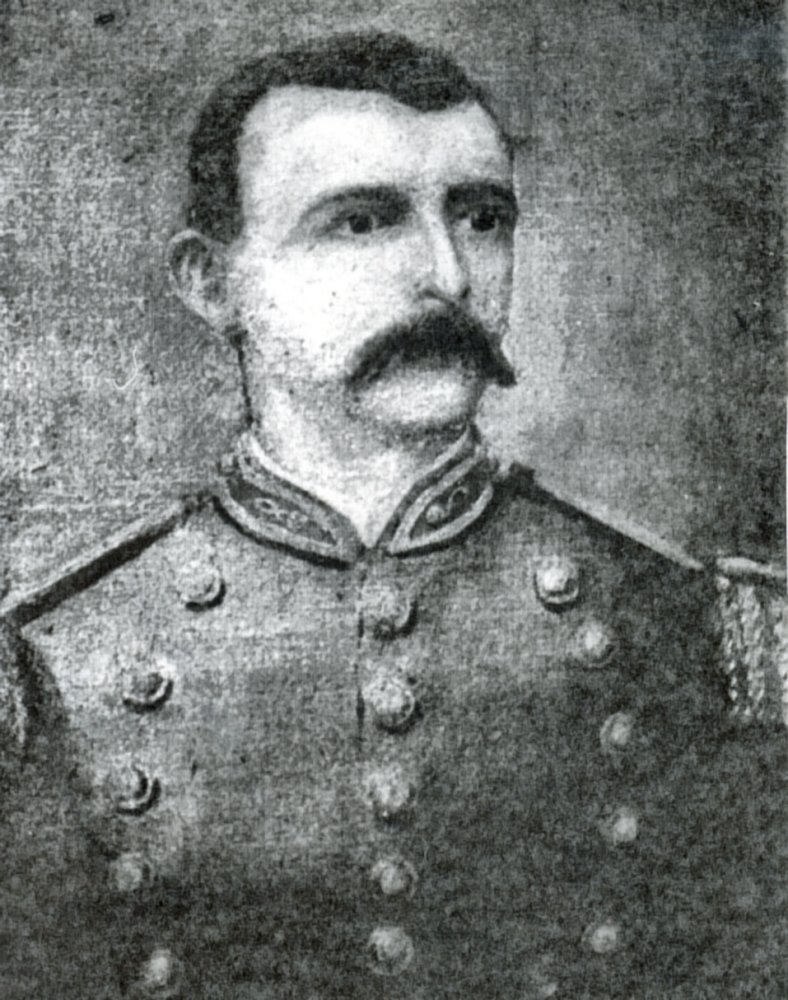
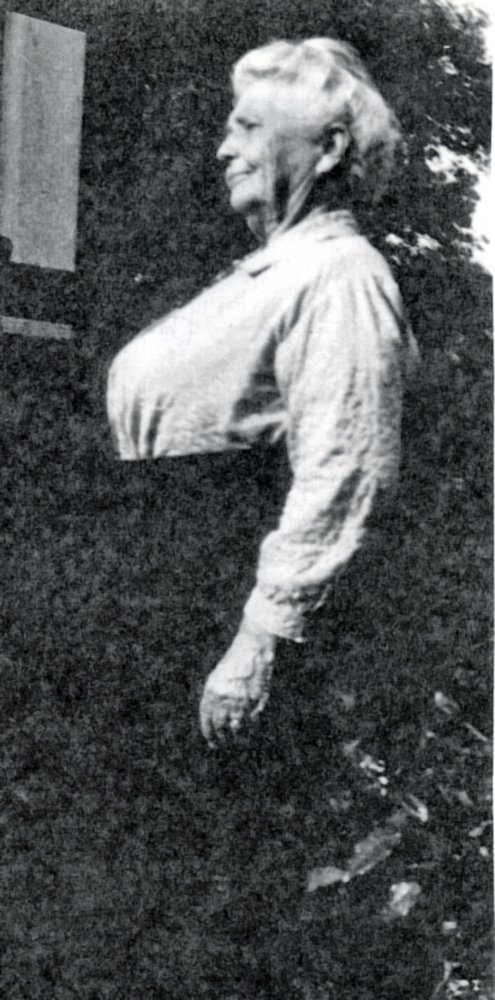
Marastella McClure and Corrine "Granny" Lundy McClure
[Courtesy of Orion Baker, Auburn, California]
CORRINE LUNDY McCLURE (1854-1930)
Corrine was born in Mobile in July 1854. She was the oldest of the four Lundy children. At Mobile in October 1868, Corrine Lundy married Marstella Eugene McClure (1852- c. 1889), an artist and photographer from Bainbridge, Georgia, and commenced their family, which was composed of: Clarence McClure (b. 1870); Arthur McClure (1871-1928); John Sim McClure (1874-1927); Nannie McClure Anderson (1877-1898); Escambia M. Baker Pabst (1880-1947) married Orion A. Baker (1869-1908) and Ernest G. Pabst (1883-1927); Helen M. McClure (1885-1937) married Calvin Dees (1877-1954); and Corrine “Cody E. McClure (1887-1961).
In 1870, Marstella and Corrine L. McClure were living in Ward 6 at Mobile with his parents, John S. McClure (1827-1870+) and Nancy McClure (1831-1870+). At this time, both Marstella and his father were photographers. TMarstella and Corrine's son, Clarence McClure (b. 1870), and John Lewis McClure (1855-1897), Marstella's brother, was also in the household. As early as 1859, John S. McClure was had operated an ambrotypist shop at Mobile.(1870 Mobile Co., Alabama Federal Census M593_31, p. 137)
Moss Point
In 1880, Marstella E. McClure was domiciled at Moss Point, Mississippi where he made his livelihood as a photographer. Corrine and their children were not living with him at this time. They were probably at Mobile waiting for the move to New Orleans, which occurred circa 1881. At Moss Point, Marstella E. McClure, who was well-known in the community, established a branch, photographic gallery for Wallace, Barnes & Company of Mobile. He worked in a large tent near the Denny & McInnis Store taking photographs, copying engravings, and enlarging images from miniature to life-size.(The Pascagoula Democrat-Star, June 18, 1880, p. 3 and 1880 Jackson Co., Mississippi Federal Census T9_650, p. 46, ED 152)
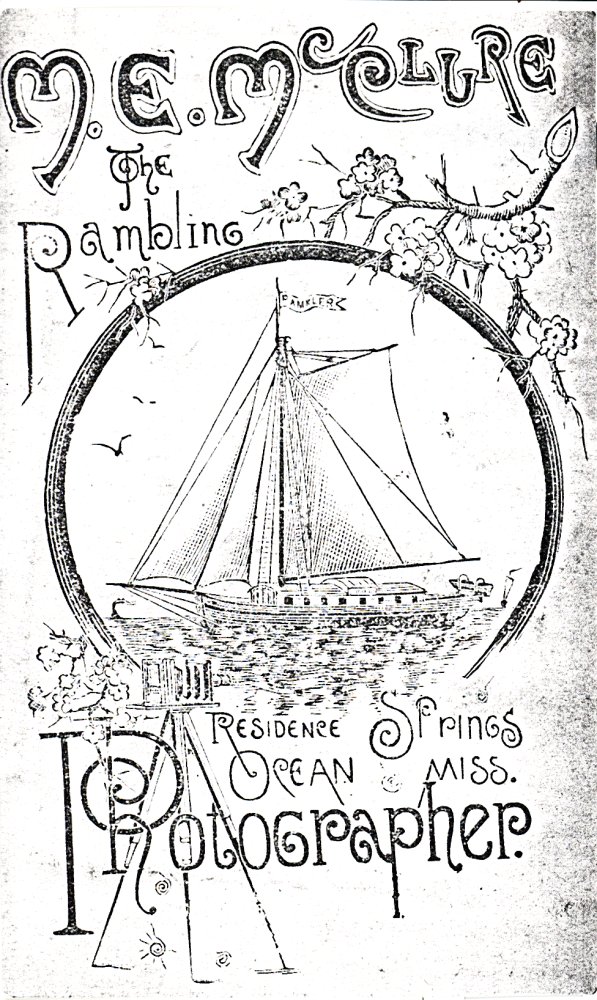
M.E. McClure Logo
This logo was printed on the back of Marstella E. McClure's photographs.
New Orleans-Ocean Springs
Marstella Eugene McClure moved the family from Mobile to New Orleans circa 1881. In the Crescent City, he owned and operated McClure's Paragon Art Gallery at 131 Poydras Street. Son, Lewis Morris McClure, called Morris, was born in New Orleans in September 1884. Circa 1885, the McClure clan relocated to Ocean Springs, Mississippi.
At Ocean Springs, Corrine Lundy McClure who came to be known as "Granny Mac" settled on the northeast corner of Ames and Reynoir Street north of the L&N Railroad. The house was moved northwest to 1011 Iberville when US 90 was relocated from Porter Avenue in 1952. Mrs. McClure is reported in the local news section of local journals to have traveled frequently to Mobile and Pensacola to visit her older children who settled there. She died at Ocean Springs on December 12, 1930. The lives of her younger children who settled at Ocean Springs are related as follows:
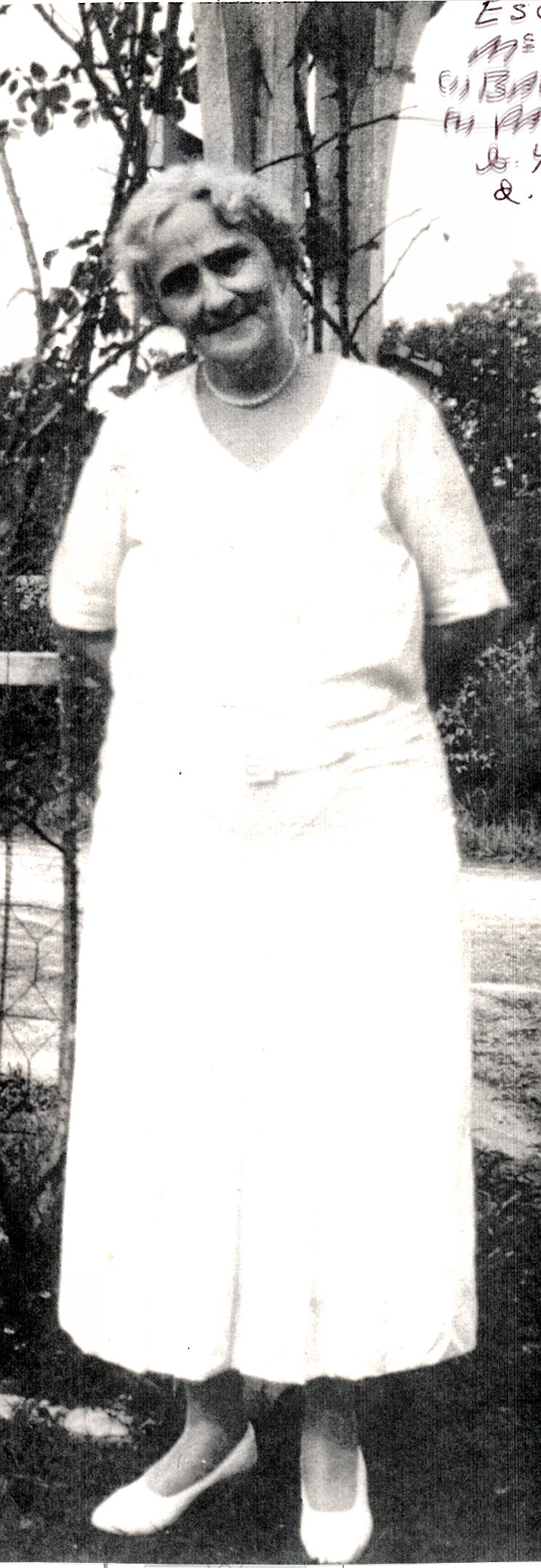
Escambia McClure (1880-1947)
[Courtesy of Orion Baker, Auburn, California]
Escambia O. McClure (1880-1947) married Orion Applin Baker (1869-1908), a native of Lee County, Alabama, in 1896. Baker made his livelihood as a telegraph lineman for the railroad. The Bakers had five children who were reared at Ocean Springs: Frank E. Baker (1897-1958): Orion S. Baker (1898-1951) married Eula Tiblier (1900-1996); Richard M. Baker (b. 1900); Eleanor Baker Davis (1903-1947) married Oscar T. Davis (1894-1963); and Morris Baker (1907-1994) married Eleanor Yusko (1907-1994).
In the 1920s, Orion Stroud Baker operated the Baker Grocery & Coffee Company on Washington Avenue just south of the Eglin House. The building was owned by Miss Annie O. Eglin (1881-1963). It burned on October 18, 1926, destroying the stock and most of the fixtures. Baker estimated his goods worth approximately $7500. The fire was believed to have been caused by an arsonist. Ironically, the old VanCleave Mercantile Store on the east side of Washington Avenue between Desoto and Robinson burned the week before.
Escambia McClure Baker married Ernest Ghem Pabst (1883-1927) in July 1916, several years after the death of Orion A. Baker. She was killed in a fiery automobile crash just west of Biloxi on US 90 in July 1947, with her daughter, Eleanor Baker Davis, and granddaughter, Martha Ann Baker (1937-1947).
.jpg)
L. Morris McClure
[Courtesy of Orion Baker, Auburn, California]
Lewis Morris McClure (1884-1940), called Morris, married Gertrude Margaret Wattleworth (1890-1971) of New Orleans on January 4, 1909. The McClures resided at present day 208 Washington Avenue. Gertrude W. McClure's sister, Alberta May Wattleworth (1885-1962), married Louis A. Lundy (1876-1941), the uncle of Morris McClure. Mr. McClure was a self made man. He began working at a local store at the age of eleven and studied at night to finish school. Eventually, he owned one of the best stores on the Mississippi coast, L.M. McClure & Co. McClure sold groceries and clothes until 1914. He then became a successful traveling salesman and broker representing New Orleans produce houses. McClure was also a partner with L.A. Lundy in the Ocean Springs Packing Company (1914), the first shrimp cannery at Ocean Springs.
In 1914, he ran against John O'Keefe (1891-1985) for postmaster at Ocean Springs, and was elected in a close race. Morris McClure was appointed postmaster at Ocean Springs in March 1915, by President Wilson, and served until 1925. He officiated another term from 1934 to 1940.[see Mayors and Postmasters of this website for more on Morris McClure]
McClure served the people of Ocean Springs as Alderman-at-Large in 1925-1926, and as their Mayor in 1933-1934. He resigned his post and was replaced by Charles R. Bennett (1884-1971). Morris McClure died in late October 1940, of a heart attack while on duty at the Ocean Springs Post Office. He was buried at the Metairie Cemetery. The couple did not have any children.
Helen M. McClure (1885-1937), married Calvin Eugene Dees (1877-1954) of Perkinston, Mississippi. Their children were: Calvin E. Dees, Jr. (1904-1965), Houston Longino Dees (1905-1935), John Dees, Billy Jack Dees (1915-1976), and infant Dees (1917-1917). Like his brother at Vancleave, Clifton L.Dees (1886-1963), Calvin Dees ran a general store and also served as the local undertaker. Most of this family is buried at the Perkinston Cemetery in Stone County.
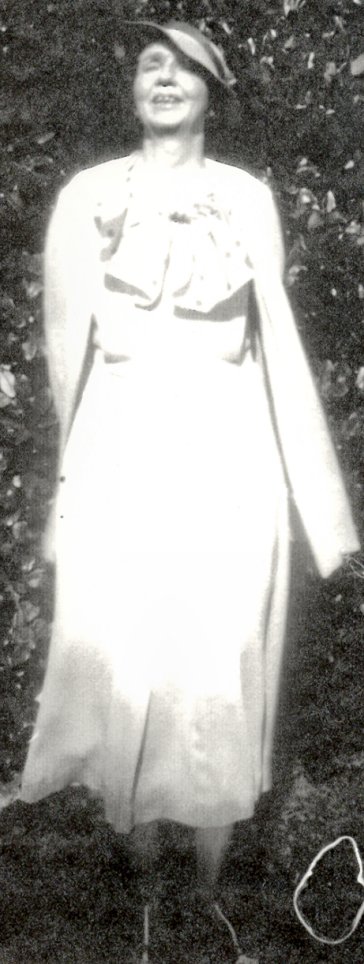
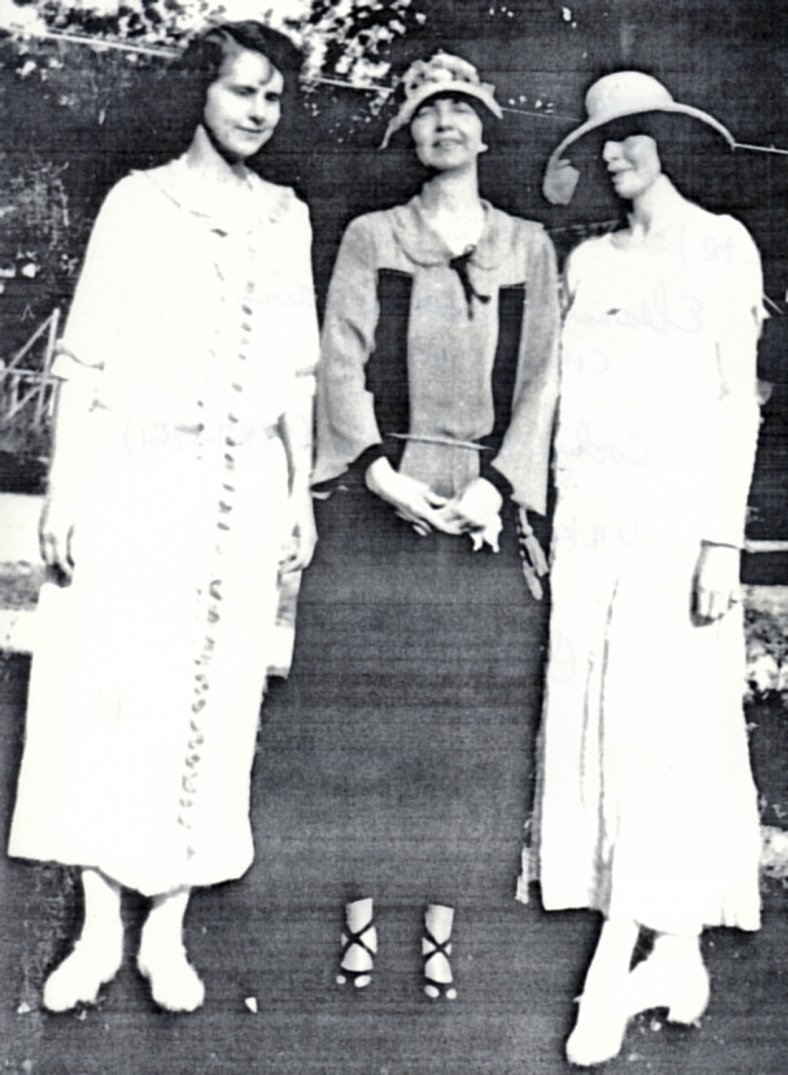
[Corrine E. "Cody" McClure] [Eleanor Mae Baker Davis, Cody McClure, unknown]
[Courtesy of Orion Baker, Auburn, California]
Corrine E. McClure (1887-1961), was known as "Cody". She taught school and music at Ocean Springs. Miss McClure was well educated having studied at Whitmore College, the Cincinnati Conservatory of Music, the Chicago School of Music, and Birmingham Southern. Her residence was on Ward Avenue. Cody McClure never married. Her corporal remains were interred in the Perkinston Cemetery at Stone County, Mississippi.
HELEN LUNDY HORTON (1857-1890)
Helen Lundy (1857-1890) was born at Mobile, Alabama. She was the sister of Frank. J. Lundy (1863-1912) and Louis A. Lundy (1876-1941), both outstanding merchants and entrepreneurs at Ocean Springs. She married William A. Horton (1863-c. 1906), a grocery merchant and farmer at Ocean Springs. Helen died at Mobile on November 10, 1890, after a lingering illness. The Hortons had no children.(The Pascagoula Democrat-Star, November 14, 1890, p. 2)
In 1893, W.A. Horton was in the mercantile business with F.J. Lundy as Horton & Lundy.(The Biloxi Herald, December 9, 1893, p. 8)
In 1893, after his spouse's demise, William A. Horton married Ida L. Carter (1878-1910+). They had four children: Williford Horton (1894-1910+); Corrine Horton (b. 1896); Otis J. Horton (1897-1925+) married Eula Trepagnier (1896-1925) of New Orleans; and Violet Horton (1898-1926+) married Worth W. Jones, a bank cashier, of Coushatta, Red River Parish, Louisiana. In 1900, W.A. Horton made his livelihood at Ocean Springs as a grocer and farmer.(1900 Jackson Co., Mississippi Federal Census, T623 812, p. 3B, ED 45)
William A. Horton expired before July 1907, as Ida L. Carter Horton, his widow, married Jacob C. Tucker (1845-1917) at this time. Mr. Tucker was a native of Alabama and Civil War veteran. Prior to his arrival in Ocean Springs, he had made his livelihood for over thirty years as the railroad agent at Opdyke, Jefferson County, Illinois. J.C. Tucker was at Ocean Springs as early as 1905, as he was the proprietor of the Gulf Coast School of Practical Railroad Telegraphy.(The Biloxi Daily Herald, February 3, 1905, p. 6)
Jacob C. Tucker expired in the domicile of his daughter at Ensley, Alabama, near Birmingham in November 1917. His corporal remains were sent to Opdyke, Illinois for internment in the Opdyke Cemetery with his first spouse, Martha E. Tucker, who expired there on August 20, 1878, and an infant daughter, Mattie Tucker (1873-1874).(The Jackson County Times, November 24, 1917, p. 5)
Tucker Building-our first cinema?
The Tucker Building was once the office of The Ocean Springs News and probably the first movie house at Ocean Springs. It was situated on the west side of Washington Avenue between Desoto and Robinson. Marion Illing Moran (1899-1993) who grew up in the cinema business at Ocean Springs with her father, Eugene W. Illing Sr. (1870-1947) and his Illing's Photo-Play Air Dome and Illings Theatre, related in an interview in 1992, that when she was at the age of five (circa 1904), that the first movie house was located on Washington Avenue, near the present day Arndt Building, now utilized as an office for the Kirk Halstead Realty. This is corroborated somewhat by an announcement in The Ocean Springs News of February 20, 1909, which related that "S.O. Ingram will soon open a grocery and notion store formerly used as a picture show house in the Horton Building next to the news office". On the 1909 Sanborn Insurance Map of Ocean Springs, the newspaper office is located approximately where the Arndt Building is today. It is assumed that the Horton Building later became known as the Tucker Building, when the marriage between Ida Carter Horton and J.C. Tucker had become established in the community.(Marion Illing Moran interview with the author-September 1992 and Sanborn Insurance Map, “Ocean Springs”, 1909, Sheet-2)
The Tucker Building was consumed in a fire in late February 1926 by fire.(The Jackson County Times, February 27, 1926, p. 1)
FRANKLIN JEFFERSON LUNDY (1863-1912)
Franklin Jefferson Lundy was born on October 23, 1863 at Mobile, Alabama. As early as 1880, following in the footsteps of his father, he began work as a clerk for Wolff & Hogg in Mobile. He resided with his mother and grandmother, Eliza Lundy, on Marine Street until about 1887, when they moved to the southeast corner of Broad Street and New Jersey Avenue.
After moving to Ocean Springs with his family about 1889, F.J. Lundy met and married Vera Poitevent (1874-1897) circa 1892. She was the daughter of Captain Junius Poitevent (1837-1919) and May Eleanor Staples (1847-1932) of New Orleans. Captain Poitevent grew up in Gainesville on the Pearl River in Hancock County. His father, W.J. Poitevent (1814-1890) of Huguenot descent, came to the lower Pearl River country in 1832, from North Carolina (possibly Columbus County), and became engaged in the sawmill business. After a career on lumber schooners and residing in Texas, the Poitevents settled at Ocean Springs in 1877.
As early as 1892, F.J. Lundy was a merchant and operated a general store on the southeast corner of Washington Avenue and Government Street. He was in business with Horton as Horton & Lundy in March 1895. Lundy was successful and acquired substantial real estate holdings in Ocean Springs, including the Ocean Springs Hotel, which he bought with his brother, L.A. Lundy, from the Schmidt & Zeigler Co. of New Orleans in 1901.(JXCO, Ms. Land Deed Bk. 23, pp. 213-232).
When the Ocean Springs Hotel burned on May 25, 1905, it was leased to Dr. H. B. Powell (1867-1949) of Chicago. The building and contents were valued at $12,000. Unfortunately, the building was only insured for $5000, and the furniture owned by Dr. Powell was protected for $2000. The only articles not destroyed in the conflagration were a piano and a few tables valued at $500.
In 1905, Frank Lundy joined in the establishment of the Ocean Springs State Bank with Dr. O.L. Bailey (1870-1938), George E. Arndt (1857-1945), H.F. Russell (1858-1940), and Alfred L. Staples (b.1881). Capital stock in the bank was set at $15,000. F.J. Lundy and Vera Poitevent had a daughter, Virginia May, called Vera, who was born at Ocean Springs in May 1893. Mrs. Lundy died in 1897, at the young age of twenty-four years, leaving young Vera to the care of her father. Vera Lundy was at Ohio in February 1919 and at Chicago in 1920.
At Chicago, Dr. Powell and Mrs. Emma Powell met and invited a young woman, Mignon Coursen (1877-1957), who was possessed of grace, intelligence, and musical talent to Ocean Springs. Here Miss Coursen met the widowed F.J. Lundy. On September 24, 1901, Lundy married Mignon Coursen at the Presbyterian Church at Ocean Springs with the Reverend W.C. West in attendance. Miss Coursen was born at Marshalltown, Iowa, the birth state of her mother, Mae Swearingen, who was born at Alvion, Iowa. Her father, Professor Henry E.B. Coursen, was born at Warren, Ohio. The Coursen Family resided at Marion, Ohio. A daughter, Margaret Lundy (1902-1986), was born at Ocean Springs in July 1902. Mignon Lundy was a skillful violinist and occasionally entertained in public. Mignon's sister, Camilla Coursen (b. 1892) in Ohio, was living with the Lundys in 1910.
About 1902, the Frank Lundys bought property from New Orleans merchant, Albert G. Tebo (1848-1929), on a knoll at the southeast corner of Washington and LaFontaine. The domicile was known as "Haven-On-The-Hill". Lundy also owned a summer residence called "Deepwood" which may have been at Florala, a small community, eleven miles northwest of Ocean Springs. (Jackson County Deed Records Book 23, pp.512-513)
In 1906, Lundy purchased additional lands north of Ocean Springs: 40 acres (NW/4, NW/4 of Section 26, T6S-R8W) from James Noble (JXCO, Ms. Land Deed Bk. 31, pp 100-101), and 5 acres in the NW/4, SW/4 of NW/4 of Section 19, T6S-R7W from T.H. Brown (JXCO, Ms. Land Deed Bk. 31, pp 100-101 and Bk. 31, p. 101.).
In early November 1908, the residence in the rear of the F.J. Lundy store was destroyed by fire. Only the valiant effort of local citizens, the Hook & Ladder Company and OS Volunteer Fire Company No. 1 prevented the central business district from total destruction from this large conflagration.(The Biloxi Daily Herald, November 9, 1908, p. 2)
Unfortunately Franklin J. Lundy died suddenly on February 9, 1912, in the prime of his active life after a short illness. He was survived by his brother, L.A. Lundy, and two sisters, Mrs. C.E. McClure and Mrs. Murphy of Mobile.(The Daily Herald, February 10, 1912, p. 8)
Sometime after F.J. Lundy's death, Mrs. Lundy moved to London, England with her daughters, and is known to have been there in July 1914. In their absence, the Lundy's Washington Avenue home was used by the women employees of the D.H. Holmes store of New Orleans as a summer retreat. The Lundy home was destroyed by fire in April 1926.
F.J. Lundy's daughters, Vera May and Margaret, were put in the guardianship of Mignon Coursen Lundy (Jackson County, Mississippi Chancery Court Cause No. 3056). Lundy had died intestate and his estate was probated as Jackson County Chancery Court Cause No. 3127. The corporal remains of F.J. Lundy were interred in the Evergreen Cemetery in an unknown plot-very probably within the coping of Junius Poitevent family.(The Daily Herald, February 10, 1912, p. 8)
Regardless there is a small monument to him located in the Evergreen Cemetery at Ocean Springs, which states:
In memoriam of Frank Jefferson Lundy born October 23, 1863, died February 9, 1912.
Mrs. Lundy and family returned from Europe to Jackson County, Mississippi by November 1920, as Vera May Lundy sued her step-mother, Mignon C. Lundy, and her uncle, L.A. Lundy, in a forced heirship suit titled Jackson County Chancery Court Cause No. 4066. In 1925, she sold her one-third interest in the Washington Avenue home to J.F. Zaehringer of Jackson County.
Mignon Coursen Lundy and her natural daughter, Margaret Lundy, moved to the "Terraced Fields Farm" at Townshend, Vermont prior to June 1930. She may have supplemented her income in Vermont by giving violin lessons. Mrs. Lundy died in Vermont on April 20, 1957 and is buried in the Oakwood Cemetery at Townshend in Windham County, Vermont. The whereabouts of Margaret and Vera May Lundy is presently unknown. Margaret Lundy, a spinster, died in May 1986, at Bryn Mawr, Pennsylvania.
LOUIS ALEXANDER LUNDY (1876-1941)
L.A. Lundy was a teenager when his family came to Ocean Springs circa 1889. He moved to New Orleans before 1900, and worked as an operator at the Cotton Exchange. In October 1900, Lundy returned home to take charge of the Postal Telegraph Company, which was owned by his brother, F.J. Lundy (1863-1912).
L.A. Lundy married Alberta May Wattleworth (1885-1962) at the Jesuit Church of New Orleans on March 26, 1906, with the Reverend Father Murphree officiating. Her sister, Gertrude Wattleworth, was married to Morris McClure (1884-1940), his nephew, who later acted as postmaster at Ocean Springs. The Wattleworths' father was English and their mother a native of Louisiana, probably New Orleans. At this time, Lundy was the cashier in the branch of the Scranton State Bank at Ocean Springs, which was located on the northeast corner of Washington and County Road (Government).
L.A. Lundy inherited the business acumen of his father and learned well the skills of commerce from his older brother, F.J. Lundy. His entrepreneurial genius led to the development of the first commercial icehouse and shrimp factory on the Bay of Biloxi at Ocean Springs. The properties were located just southeast of the CSX (L&N) Railroad bridge. The Ocean Springs Ice and Coal Company opened about 1900. It primarily served the thriving seafood industry, and lasted about twenty five years (name may have changed to People's Ice Company). Mr. Lundy is believed to have given Jackson County the land where the old US 90 highway bridge crosses the Bay of Biloxi.
The Lundy seafood factory, known as the Ocean Springs Packing Company, opened circa 1914, and processed vegetables (okra and sweet potatoes) when the seafood season ended. E.W. Illing, Jr. (1895-1978) took over the operations about 1934, and may have changed the name to Bay Bridge Seafood. Illing employed approximately one hundred people during the shrimp season and eighty during the oyster harvest. The payroll was about $7700 per year and was spent locally.
The remainder of the Beach property was sold in 1961, to the Allman Family who built a restaurant on the tract west of US 90. The foundation pilings for the seafood factory and the ice plant can still be seen here at the shoreface on the former Lundy property.(JXCO, Ms. Land Deed Bk. 213, p. 465)
Other entrepreneurial activities attributed to L.A. Lundy are: he may have also held a seat on the Cotton Exchange at New Orleans with H.F. Russell; and he is believed to have owned an interest in seafood factories at Biloxi, Bayou LaBatre, Alabama, and Westwego, Louisiana.
The L.A. Lundy home was on Washington Avenue at Iberville where the Church of Christ is now located. Their neighbors were the Garrards, Lemons, Hodges, Friars, and Dr. H.B. Powell.
Lundy Children
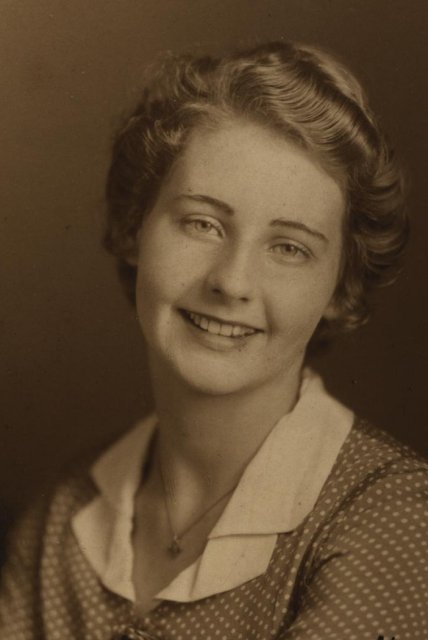
Katherine Lundy Howland (1914-1978)
[Courtesy of John Howland-Houston, Texas-December 2009]
The Lundys had five children born at Ocean Springs, but only three survived to adulthood. They were: a girl who died at birth (b. circa 1907); Louis A. Lundy Jr. (1908-1992); John Wattlesworth Lundy (1910-1911) who died young; Frank J. Lundy (b. circa 1912); and Katherine Lundy Howland (1914-1978), spouse of Henry Howland (1911-1957).
Louis A. Lundy Jr.
Louis A. Lundy Jr. (1908-1992) who resided at Corpus Christi, Texas attended Biloxi High School and was a four-year letterman in football. He was a basketball star at Ocean Springs before he went to school at Biloxi. In 1926, Lundy's senior year, Biloxi was the champion of the Big Eight Conference. He attended Tulane and worked in the insurance industry at Houston for many years. Lundy sold his insurance agency in 1972, and retired to the lower Texas coast to enjoy the sun and sea.
In May 1935, Louis A. Lundy Jr. married Hilda Theresa Mass (1908-1981), the daughter of V. Anton Mass of New Orleans in the Sacred Heart of Jesus Catholic Church in the Crescent City. They lived in New Orleans on Fontainebleau Drive.(The Daily Herald, May 10, 1935, p. 5)
John W. Lundy
John Wattlesworth Lundy was born in September 1910 and expired at Ocean Springs on March 20, 1911. His corporal remains were sent to New Orleans, Louisiana for internment.(The Ocean Springs New, March 25, 1911, p. 1)
Retirement
After L.A. Lundy sold the factory to Illing, he basically retired from the business community in which he was very active. It is believed he enjoyed his later years socializing with his many friends in the Ocean Springs community. It is known that in 1927, he paid the taxes on the F.J. Lundy-Mignon Coursen Lundy Washington Avenue home located at Washington and LaFontaine, and the Ocean Springs Hotel tract (Jackson County Chancery Court Causes No. 5255 and No. 5266-June 1930).
J.K. Lemon (1914-1998), a local historian, had an anecdotal story about Mr. Lou Lundy as he was respectfully known in the small community. Lemon remembered vividly when he owned and operated the Felix Cat Restaurant, Anderson Service Station, and Greyhound Bus agency on Government Street. Mr. Lundy and Morris McClure owned the building and were his landlords. The Felix Cat Restaurant was opened in November 1928, by H.B. Felix who came to Ocean Springs from Beardon, Arkansas.
The year was 1936, and J.K. Lemon sold the best hamburger on the Mississippi coast. People would drive from Biloxi and surroundings to buy sacks of his ten-cent burger which featured pickle, onion, lettuce, tomato, mayonnaise, and a quarter pound of fresh ground Gottsche beef.
Mr. Lundy was a member of an informal social club called the Lion Tamers Club. It consisted of successful, local businessmen and politicians who met in the afternoons to discuss politics, drink coffee, and play poker.
The club met on the second floor of Mr. Lundy's building, which was the former Scranton State Bank Building. It had been moved east from the corner of Washington and Government in 1909, when the Ocean Springs State Bank Building had been commenced. A poker game might be in progress between one and four o'clock any afternoon of the week except Sunday. It wasn't unusual for someone from the Lion Tamer's to lower a window and shout across Government and request a Cuban cigar, coffee, or hot hamburger from the Felix Cat restaurant.
Each day after the social gathering was completed, Mr. Lundy would drop in the Felix Cat for a cup of coffee. This was the era of the five-cent cup of coffee with unlimited refills. Pie was ten cents a slice and stomach filling.
At this time, John Mitchell (1915-1963) worked for Lemon in the restaurant and would generally wait on Lou Lundy. After he finished the freshly brewed java, Mr. Lou would always say, "that sure is good coffee, John, but it is not hot enough for me". After hearing this litany many times even after putting the control on the pot to high, Mitchell decided to make Mr. Lundy a really "hot" cup of the liquid brew. He took a cup and placed it in a pan of water and brought the water to its boiling point. He then poured the already hot coffee into the "hot" cup and delivered it to Lou Lundy with a grin. Well, after finishing his coffee, Mr. Lou said, "John, that was a good cup of coffee, but it wasn't hot enough".
At this point Mitchell began to get frustrated. He came upon the idea of taking a pair of pliers and holding the cup at the handle and placing it in the open flame from the stove to heat it to a very high temperature. This scheme proved disastrous as the cup shattered when he poured the hot coffee into it. History will record that Mr. L.A. Lundy never got his "hot" cup of coffee at least from the Lemon restaurant.
L.A. Lundy died at Ocean Springs on June 4, 1941. He is buried in the Metairie Cemetery. His wife survived until 1962. She is also buried at Metairie, Louisiana.
REFERENCES:
Lucille Mallon Connick, Death and/or Burial Records Mobile County, Alabama 1871-1880, (Connick: Mobile 1987), p. 88.
Regina Hines, Ocean Springs 1892 (2nd Edition), (Lewis Printing Services: Pascagoula 1991), p. 50.
C.E. Schmitz, Ocean Springs French Beachhead, (Lewis Printing Services: Pascagoula 1972), pp. 72, 73, and 135.
WPA For Mississippi Historical Data-Jackson County, (State Wide Historical Project 1936-1937), p. 328.
Mississippi Department of Archives and History, "Poitevent Family Papers", (Jackson: 1981).
The Biloxi Herald, “Local Happenings”, December 9, 1893.
The Biloxi Daily Herald, "Lundy-Coursen", September 26, 1901, p. 8.
The Biloxi Daily Herald, March 29, 1906, p. 4.
The Biloxi Daily Herald, "Mississippi-what the old State is doing", November 9, 1908.
The Daily Herald, "Death of Frank Lundy", February 10, 1912, p. 8.
The Daily Herald, “Ocean Springs”, May 10, 1935.
The Daily Herald, October 24, 1940, p. 9.
The Daily Herald, "Orion S. Baker Dies", April 10, 1951, p. 7.
The Jackson County Times, March 24, 1917, p. 5.
The Jackson County Times, June 23, 1917, p. 1.
The Jackson County Times, "Eula Trepagnier Horton Obit", March 21, 1925, p. 3.
The Jackson County Times, "Business Bldg. Destroyed by Fire", October 16, 1926, p. 1.
The Jackson County Times, "Fires damages Baker store", October 26, 1926, p. 1.
The Jackson County Times, "Local and Personal", November 8, 1928, p. 3.
The Ocean Springs News, "Death of an infant”, March 25, 1911.
The Ocean Springs News, "McClure gets Postmastership", December 17, 1914, p. 1.
The Ocean Springs News, "Local News", September 30, 1915.
The Pascagoula Democrat-Star, "Mrs. W.A. Horton", November 14, 1890, p. 3.
The Pascagoula Democrat-Star, "Local News", March 25, 1898.
The Pascagoula Democrat-Star, "Local News", October 5, 1900.
The Pascagoula Democrat-Star, "Local News", October 26, 1900.
The Pascagoula Democrat-Star, August 4, 1905, p. 3.
The Pascagoula Democrat-Star, "Horton & Lundy Ad", March 15, 1895, p. 3.
The Times-Democrat and Picayune, September 19, 1915, p. 14.
Mobile City Directory (1851-1890)
Mobile City Map 1878
US Census-Mobile County, Alabama 1850 and 1870
US Census-Jackson County, Mississippi 1900 and 1910
Personal Communication:
L.A. Lundy, Jr., December 20, 1991.
F.J. Lundy, Jr., December 19, 1991.
J.K. Lemon, December 21, 1991.
Orion Baker, July 14, 1992.
__________________________________________________________________________________________________
MORRIS-MAXWELL
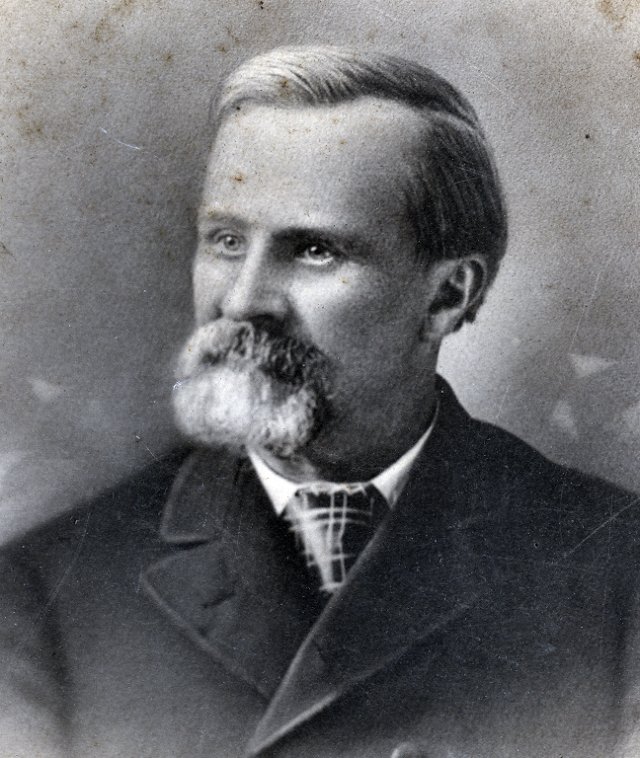
Ernest A. Morris (1860-1946)
[Courtesy of Patricia Maxwell Letort, October 2008]
Ernest Alfred Morris (1860-1946) was born at Brighton, Sussex County, England on October 12, 1860 to Thomas Morris (1829-1902), a shoemaker of the Parish of Henfield in Sussex County, and Hannah Elizabeth Baker (1836-1920+), a spinster, domiciled at 62 Rose Hill Terrace in Brighton. Thomas and Hannah were married on May 12, 1856 in the St. Nicholas Church in the Parish of Brighton. Brighton is fifty miles south of London on the English Channel, but has no harbor. For several hundred years it was a small fishing village. Today it is a seaside resort and home to electrical equipment and machine tool manufacturing.(Marriage Register No. 18 Parish of Brighton, Sussex Co., England, p. 181 and Webster’s New Geographical Dictionary, 1988, p. 177)
Thomas Morris (1829-1902)
[Courtesy of Patricia Maxwell Letort, October 2008]
Thomas Morris family
Before Thomas and Hannah E. Baker Morris left Sussex County, England and settled at Chicago in Cook County, Illinois in 1872, they had four children of which three are known: Laura Morris (1867-1900+); Charles Morris (1859-pre-1900); and Ernest A. Morris (1860-1946). In 1880, Thomas Morris owned a confectionery store on South Halstead in the Windy City. The entire family was employed at making, vending and shipping candy. By 1900, Thomas and Hannah Morris were running their candy store on Ogden Avenue and Laura Morris taught art.(1880 and 1900 Cook Co., Illinois Federal Census T9_192, ED 95, img. 0332 and T623 259, p. 10A, Ward 12)
Citizenship
Thomas Morris received his American citizenship in Cook County, Illinois on October 12, 1888. Ernest A. Morris became a citizen of the United States of America on October 24, 1887 at Cook County, Illinois. Laura Morris became an American on June 22, 1893 at Cook County, Illinois.
Lydia E. Meyers (1872-1933)
Marriage and family
Ernest A. Morris married Lydia E. Meyers (1872-1933) at Chicago, Illinois on September 1, 1892 before the Reverend J.C. Cromer. Lydia was born at Chicago, Illinois the daughter of Leo Meyers and ? Meyers on February 15, 1872. Her sibling were: Nellie E. Meyers (1861-1930+) m. Parker A. Jenks (1861-pre-1930); Blondine [Bonnie] Meyers (1869-) m. Franklin C. Mahnke (1870-1930+); and Sybel S. Meyers (1870-1930+) m. John Vennema (1871-1930+)
Nellie Meyers, Parker A. Jenks (1861-1927), and servant
Nellie Meyers and Parker A. Jenks
Parker Austin Jenks (1861-1927) was born in June 1861 in Canada. He immigrated to America in 1870. Circa 1894, he married Nellie Meyers, a native of New York. They were the parents of two children, but only Parker Alfred Jenks (1897-1930+), who married Pearl B. ? (1896-1930+), survived to adulthood. Mr. Jenks made his livelihood in Chicago as a retail haberdasher. Parker A. Jenks expired in Cook County, Illinois on July 4, 1927. The family lived on Malden Street until the Depression. In 1930, the widow Nellie M. Parker was a resident of the Parker Arms Hotel in Chicago.(1900, 1910, 1920, and 1930 Cook Co., Illinois Federal Census T623 275, p. 1B, Ward 25; T624_267, p. 6A, ED 1053; T625_342, p. 6B, ED 1460; and R 491, p. 12A, ED 1810)
Blondine Meyers and Franklin C. Mahnke
Franklin C. Mahnke (1870-1930+) was born in Germany. He came to America in 1871 and married Blondine Meyers circa 1901. They were the parents of Franklin C. Mahnke II (1902-1973) and Marion Mahnke (1911-1930+).
Sybel Meyers and John Vennema
John [Johnannes] Vennema (1871-1930+) was born in October 1871at Holland, Michigan the son of Ame Vennema, a cooper, and Johanna Vennema, both natives of Holland. He practiced law in Chicago as early as 1900 and circa 1903, married Sybel Meyers (1870-1930+). They were the parents of Marcelle Vennema (1907-1930+) and John Vennema II (1919?-1930+). By 1930, John Vennema was a lawyer and owned a $22,000 home on Willow Road in Cook County, Illinois.(1880 Ottawa Co., Michigan and 1930 Cook Co., Illinois Federal Census T9_601, ED 245, img. 0223 and R503, p. 11A, ED 2222)
No further information.
Ocean Springs
The Morris Family had moved to Ocean Springs from Chicago in1910 where Mr. Morris was in the candy manufacturing business. He was a native of England, the son of Thomas Morris and Elizabeth Baker, having emigrated from that country in 1872. Morris probably settled at Chicago where he met and married his wife Chicago native, Lydia E. Meyers (1872-1933), the daughter of Leo Meyers and Mrs. Meyers. Two children were born in Illinois: Nellie Myrtle Morris Maxwell (1893-1970) and Robert E. Morris (1902-1970). Ernest A. Morris acquired a home in Ocean Springs on Washington Avenue in late 1910, from Ellen Fox, who was divorced from Michael Gallagher. The home, which was located in Lot 5 of Block 5 (Culmseig Map of 1854), was adjacent to a very old cottage that had once belonged to the Wing and Tebo families from New Orleans. It was also once called the Bartlett Place, from the original owner, Louisa Burling Bartlett (1823-1889), an affluent New Orleans lady, who was instrumental in organizing the Presbyterian Church at Ocean Springs. The Pines Hotel was located across the street and to the north from the Morris home.(JXCO, Ms. Land Deed Bk. 38, pp. 190-191)
After the home purchase, Mr. Morris left for Chicago to make arrangement for having the family furniture and personal effects shipped to Ocean Springs. As Mr. Morris intended to make his relocation to Ocean Springs permanent, he planned to improve the Gallagher house to first class status. The Gallagher and Bartlett places were destroyed in a large conflagration in late February 1924. Local realtor, F.E. Lee (1874-1932) owned the Bartlett cottage at this time.(The Ocean Springs News, December 3, 1910 and The Daily Herald, February 29, 1924, p. 3)
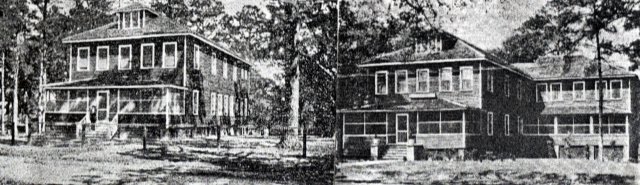
Pines Hotel
[Before and after addition]
Pines Hotel
When Ernest Alfred Morris (1860-1946) purchased Lots 1 thru 3 from Mrs. Emma Bullen Pace (1851-1936) for $1000 on August 7, 1915, the Pines Hotel on the southwest corner of Washington Avenue and Ocean Avenue commenced as a commercial enterprise.(JXCO, Ms. Land Deed Bk. 41, p. 540)
The Pines Hotel was built to accommodate seasonal tourist and itinerant workers. During the short history of the Pines Hotel, Ocean Springs was a citrus and garden center. Horticulturist and orchard men such as, Charles E. Pabst (1843-1925), H.D. Money (1869-1936), Theodore Bechtel (1863-1931), E.W. Halstead Sr.(1876-1933), and C.S. Bell (1843-1925), among others were actively engaged in commercial agriculture. As government inspectors were sent to survey the citrus groves and nurseries in the immediate area, they required a comfortable place to stay. The Pines Hotel afforded this ambience. Ernest A. Morris probably opened the Pines Hotel for business in October 1915. He had The Ocean Springs News office prepare and print an attractive brochure describing Ocean Springs and his new hotel at this time. Thomas Ewing Dabney (1885-1970) was editor of the journal.
At Thanksgiving 1915, E.A. Morris ran the following advertisement in The Ocean Springs News:
YOU WILL APPRECIATE
The beauties of the Southland doubly if you stay at THE PINES HOTEL. Situated on a lofty hill overlooking the Bay, the tang of the sea air and the health giving odor of the pines, sweep across its spacious veranda and through its commodious rooms alternately. It is a new building, having just been built, is newly furnished from top to bottom. It is screened, double floored, steam heated, and fitted with hot and cold water in each room. There are commodious baths on each floor. Special attention will be centered on the cuisine. All the delicacies of the sea and country can offer constitute the menu: Oysters, chickens, fresh milk and butter, sheephead, flounders, etc. A special effort will be made to have everything as much like home as possible. The water supply is from an artesian well.
On August 30, 1920, the Morris family sold their Pines Hotel to Albert Levy. They relocated to the Pace Cottage on Washington Avenue for the winter season. The Morrises returned to Chicago for a brief time, but returned to Ocean Springs and rented the Arndt Cottage at 822 Porter. Mr. Morris went to work for Albert Gottsche as a clerk in Gottsche’s Thrify Nifty on Washington Avenue and Desoto while Robert Morris who had gone to Buffalo, New York in June 1920 to work for Curtiss Aircraft joined him, and worked in the market at the Gottsche Store.(JXCO, Ms. Land Deed Bk. 48, p. 479 and The Jackson County Times, June 12, 1920, p. 5 and September 4, 1920, p. 3)
Spring flames
Like so many of Ocean Spring's historic structures, the Pines Hotel burned to the ground. A fire of unknown origin started late in the evening of May 5, 1932 and was discovered shortly after 2 a.m. on May 6th. The loss was estimated at approximately $20,000. The structure was never rebuilt.(The Daily Herald, May 6, 1932, p. 1)
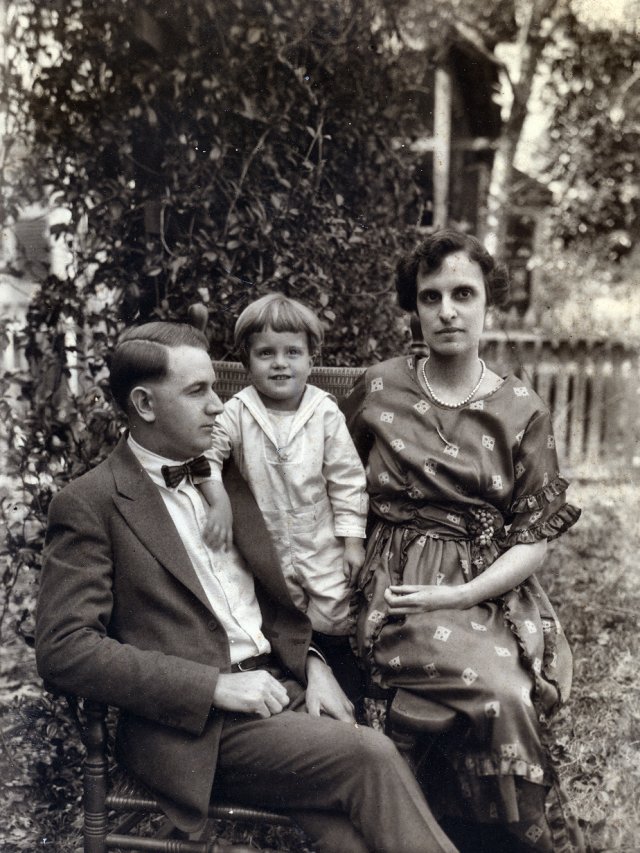
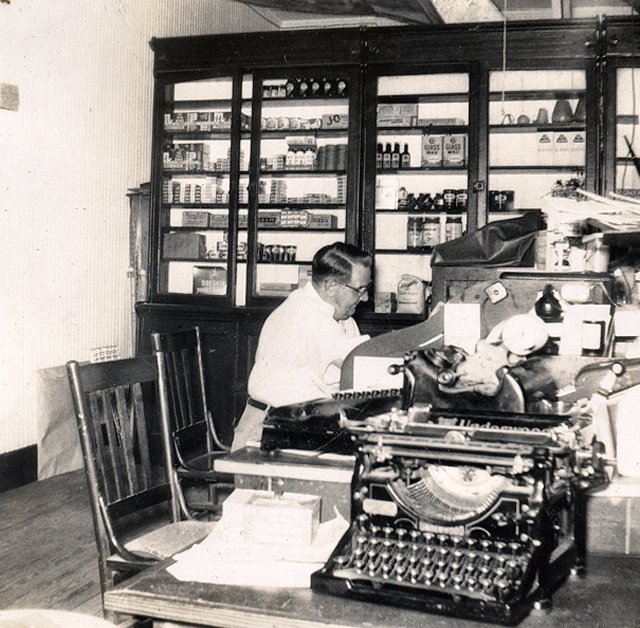
Karl C. Maxwell Family circa 1923 and Karl C. Maxwell in the Gottsche Store
[L-R: Karl Case Maxwell, Robert Lynd Maxwell, and Myrtle Morris Maxwell. Images courtesy of Patricia Maxwell Letort, October 2008]
Nellie Myrtle Morris Maxwell
Nellie Myrtle Morris, called Myrtle, was born at Chicago on August 17, 1893. On June 10, 1919, Myrtle Morris married Karl Case Maxwell (1893-1958) of Ocean Springs. Karl was born on April 6, 1893, at Ocean Springs, Mississippi the son of James S. Maxwell and Cynthia “Cinnie” Davis (1869-1951), the daughter of George W. Davis (1842-1914) married Margaret Bradford (1846-1920). Their nuptials were performed by the Reverend Thomas Bennett Clifford in the St. John’s Episcopal Church at Ocean Springs. Witnesses were: Amy Mestier Foster; Marion Illing; Margaret Davis; Ben O’Keefe; Robert Morris; and Lynd Gottsche..
Cinnie Davis had married James S. Maxwell at Ocean Springs on August 4, 1887. They had three sons: George Davis Maxwell (1888-1951), Charles Richmond Maxwell (1891-1967), and Karl Case Maxwell (1893-1958). The Maxwell marriage ended in a divorce suit on August 16, 1895. Cinnie Davis Maxwell then married Albert C. Gottsche (1873-1949).(JXCO, Ms. Chancery Court Cause No. 647, July 1895)
Karl C. Maxwell was educated at Ocean Springs and subsequently attended Draughan’s Business College at New Orleans. He worked in J.O. Whittle’s pharmacy until the Bailey family consolidated with Mr. Whittle in August-September 1917.(The Ocean Springs News, July 3, 1958, p. 1 and The Jackson County Times, September15, 1917)
In May 1923, Karl and Myrtle M. Maxwell moved into their new residence at present day 525 Jackson Avenue, used today principally as the meeting place for BSA Troop 210, and other functions of St. Paul’s United Methodist Church, the owner. Here they reared their two sons: Robert Lynd Maxwell (1920-2008) and Albert Cecil Maxwell (1926-1981).(The Jackson County Times, May 19, 1923)
At the time of his accidental death, on June 29, 1958, in an automobile accident on US Highway 80, near Clinton, Mississippi, Karl C. Maxwell was manager of the Gottsche Store. He had returned from New Orleans to work in the business with his step-father, Albert C. Gottsche. After Mr. Gottsche’s death in 1949, Karl C. Maxwell became manager of the Gottsche Store. Mrs. Dena Atkinson Talbott (1886-1958) of Ocean Springs was also killed in the car with Karl C. Maxwell.(The Ocean Springs News, July 3, 1958, p. 1 and The Daily Herald, July 5, 1958, p. 2)
Robert L. Maxwell
Robert Lynd Mawell was born at Ocean Springs on April 5, 1920. He graduated from OSHS in May 1940 and enlisted in the U.S. Army Air Corps in December 1940.
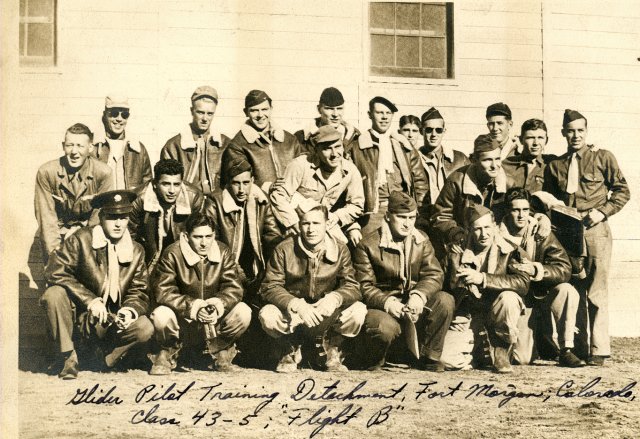
Gordon R. Pittenger (1920-1996), Modesto, Ca.; Fred W. Perry, Los Angeles, Ca.; William Pfeifer (1920-1990), Zap, North Dakota, Edward Palaskis (1918-2008), Chicago, Il.; William Jette, Queens, NY; Lester G. Lowe, Miami, Fl; Frank J. Malinak (1919-1996), Shiner, Texas; Bob J. Karl, Glendale, Ca; Joseph B. Joncas (1921-1981), Columbia, SC; Robert E. Montague, Lake City, Fl; Jans A. Petersen, Neenah, Wisconsin; Ray J. Mohr (1913-1974), Chicago, Il; Fay H. Peterson (1921-1995), Karnas, Utah; J.D. Muse, Atlanta, Ga; Glenn E. Murray, Cordova, Ala; Harold I. Pierce, Oakland, Ca; Richard E. Martin, Bishop, Ca; Howard N. Max, Cincinnati, Ohio, Lester A. Mizer (1921-1988), Rogersville, Ohio; Leslie J. Kinney, Winnebago, Minn; and Robert L. Maxwell (1920-2008), Ocean Springs, Ms. [Maxwell is on the front row and last man from the left] Image made in December 1942 or January 1943 and courtesy of Patricia Maxwell etort, .
Robert L. Maxwell (1920-2008)
[Ft. Morgan Colorado, December 1942 -January 1943. Courtesy of Patricia Maxwell Letort, October 2008)
Military service during WW II
From military orders, personal notes, and other documents in the Maxwell family papers, it was possible to construct a credible history of Robert L. Maxwell’s military career after he joined the Army Air Corps on December 30, 1940. Robert went to basic training at MacDill Air Base or Drew Field, Tampa, Florida. Sergeant Robert L. Maxwell was at Private Drew Field, Tampa, Florida on February 2, 1942 when he applied for the National Service Life Insurance policy in the amount of $5000. Maxwell was selected for training in July 1942 as a Class “B” glider pilot. He was assigned to Randolph Field situated near San Antonio, Texas for training as an aviation student. It appears that young Maxwell had a short stay at Lockbourne Army Air Base in Columbus, Ohio before an assignment in August 1942 for glider pilot training at Stillwater, Minnesota. After a brief stay at Kirtland Air Base in Albuquerque, New Mexico, Staff Sergeant Robert L. Maxwell reported in December 1942 to the 1st Army Air Force Glider Training Detachment Plains Airways at Fort Morgan, Colorado. His assignment was to train with Class 43-5 as an Aviation Glider student. While in the advanced training glider squadron at Kirtland Field, Albuquerque, New Mexico in January 1943, Robert Lynd Maxwell was certified to be on pilot status. He had 36 solo flight hours with 31 hours completed in the last twelve months. In April 1943, Staff Sergeant Robert L. Maxwell was characterized as “an excess glider student pilot”. He was assigned to Sheppard Field at Wichita Falls, Texas to train as an armorer. By July 1943, Maxwell was enrolled in the Airplane Mechanics Course studying aircraft instruments at Sheppard Field. From his notes, it seems that he had additional training in Florida and at Barksdale Air Base at Shreveport, Louisiana.
B-26 Marauder Crew
[L-R: Lt. Kusluck; Lt. Anthony Koschak (1913-1997); Lt. Daigle; Staff Sgt. Robert L. Maxwell (1920-2008), top turret gunner; Staff Sgt. Smith; and Staff Sgt. Leo MacCarthy (1918-2005), tail gunner. Image made June 16, 1944, probably in England. Sergeants Maxwell and MacCarthy flew 27 combat missions in the B-26 Marauder over Germany. Image published in The Sun Herald, September 5, 1998. Courtesy of Patricia Maxwell Letort, October 2008]
Europe with the 9th Air Force-322nd Bombardment Group-450th Bomber Squadron
Very likely in the late summer of 1943, Robert L. Maxwell left Barksdale Air Base with the 322nd Bombardment Group for England via Lake Charles, Louisiana; Hunter Field, Georgia; Dow Field, Bangor, Maine; Goose Bay, Labrador; Greenland; Iceland; Prestwick, Scotland; Stone, England; Northern Ireland; and his duty station at Andrews Field, Great Saling, Essex, England. The 450th Bomber Squadron had arrived at Saling, England in June 1943 and it was transferred from the 8th Air Force to the 9th Air Force. Staff Sgt. Robert L. Maxwell was a top turret 50-caliber machine gunner and engineer on the Martin B-26 Marauder. This twin-radial engine, medium bomber was about sixty-feet in length and had a cruising range of 1150 miles flying at 215 mph. It could deliver 4000 pounds of high explosives to its target and was armed with twelve 50-caliber machine guns. The B-26 Marauder was built by the Glen L. Martin Company at Middle River, Maryland near Baltimore.
In September 1944, Staff Sergeant Maxwell’s unit was transferred to Beauvais, France. They later relocated to Le Culot, Belgium where he lived in a children’s home at Dongelburg, Belgium.
Combat missions and awards
Staff Sergeant Robert L. Maxwell flew twenty-seven bomber sorties with the 9th Air Force against German forces in Europe between September 16, 1944 and April 20, 1945. He was credited with an additional 3/4 missions because his aircraft flew had flown lead position on some combat sorties. Sergeant Maxwell was awarded the Air Medal in November 1944 and had accumulated his 4th oak leaf cluster for the Air Medal by May 1945. The Purple Heart was presented to him on May 17, 1945. In addition, Sergeant Maxwell was authorized the Bronze Service Star for Northern France, Ardennes, Rhineland, and Central Europe. He received the last two Bronze Service Stars in July 1945.(Letter by Captain Byron J. Bartellis for the Group Commander 394th Bombardment Group dated August 28, 1945 in the possession of Patricia Maxwell Letort)
Coming home
Although the 450th went from Belgium to Fritzlar, Germany in June 1945, Robert L. Maxwell was not with them. He spent some time in Venlo, Holland and at a base near Paris, France before being sent in late July 1945 to Camp Lucky Strike at Saint-Sylvian near Le Havre, Normandy, France for processing for return to the United States. The Army had several of these expatriate repatriation centers near Le Havre and they were named for American cigarette brands, i.e. Camp Old Gold, Camp Philip Morris, Camp Chesterfield, etc.. At Camp Lucky Strike, Staff Sgt. Maxwell reported to possess the following captured enemy military equipment: one 7.65 mm Hungarian pistol and one clip; one German officers dress sword eighteen inches long; one small German dagger of twelve inches; and one German steel helmet. Staff Sergeant R.L. Maxwell was sent to Camp Miles Standish at Taunton, Massachusetts upon arriving in the United States from here he went to Camp Shelby, Mississippi where he was mustered out of the service. He was discharged with honors from the USAF in October 1945 and the USAF Reserves in October 14, 1948.
Family
In 1948, Robert L. Maxwell married Edna Mae Evers (1924-1991), a native of Georgiana, Butler County, Alabama, at St. Paul's Methodist Church in Ocean Springs, Mississippi. He had met her when they were teenagers as Edna M. Evers would come to Ocean Springs with her parents who worked for the L&N Railroad. Homer L. Evers (1893-1930+), Edna's father was a carpenter and engineer, and Viola Coven Evers (1895-1969), her mother, cooked on a 'camp car' for railroad construction crews. Hiram 'Hank' Williams (1923-1953), legendary Country artist, was reared in the same neighborhood as the Evers children at Georgiana, Alabama Edna had two brothers: Zolen Evers (1912-1969) and William 'Billie' Evers (1916-1930+).(Patrica Letort Maxwell, January 5, 2009 and 1930 Butler Co., Alabama Federal Census R4, p. 3A, ED 20)
In 1951, the Maxwells contracted with Bosarge & Powell Contractors of Biloxi, Mississippi to erect a wood-frame house at 1118 East Cherokee in the Cherokee Glen Subdivision in west Ocean Springs, Mississippi. Here they reared thier four children: Robert Lynn Maxwell II (1951-1979); Stephen L. Maxwell (b. 1954);Patricia Leslie Maxwell (b. 1957) m. Stanley F. Letort; and Bradley Karl Maxwell (1959-2007). Edna Mae Maxwell had worked as a clerk in retail sales. She died at Ocean Springs, Mississippi on August 9, 1991. Robert Lynd Maxwell expired at Ocean Springs, Mississippi on June 13, 2008. Their corporal remains were interred in the Evergreen Cemetery on Old Fort Bayou.(Patrica Letort Maxwell, January 5, 2009 and The Ocean Springs Record, August 15, 1991, p. 9)
Post-war
Before the fall of 1946, Robert Lynd Maxwell had returned to his family home at 65 Jackson Avenue. He found temporary employment as a laborer with the Veterans Administration in Biloxi. By late November 1946, Robert was a seaman and oiler on the U.S.A.T. Blanche F. Sigman. This vessel was employed in transporting surplus war materials from Army bases in the Caribbean Sea basin. It appears that R.L. Maxwell visited Trinidad and Panama while employed on U.S.A.T. Blanche F. Sigman. He was discharged from duties on July 16, 1947.
After his wedding and with Edna Mae, his beautiful Alabama bride, as life partner, Robert L. Maxwell found employment with United Gas as a meter reader. He was sent to Charleston, Panola County, Mississippi. As he was a 'Coast boy', Mr. Maxwell yearned for the salt air and fresh seafood of Ocean Springs. Circa 1963, he left United Gas and found employment as a technician with the Water Department of the City of Ocean Springs. He retired from this position.(Patricia Maxwell Letort, January 5, 2009)
A. Cecil Maxwell
[1st Image made circa 1942 at 65 [now 525] Jackson Avenue, Ocean Springs, Mississippi. 2nd image circa 1943. Both courtesy of Patricia Maxwell Letort, October 2008]
Albert Cecil Maxwell
Albert Cecil Maxwell (1926-1981), called Cecil, was born at Ocean Springs, Mississippi on May 12, 1926. Cecil joined the U.S. Navy during WWII. He married Lynn King (b. 1929), a native of New Orleans, and the daughter of John Hardee King (1900-1958) and Caroline 'Dolly' E. Bentley (1900-1987). J. Hardee King was born at Covington, Tipton County, Tennessee, the son of Clifford Alonso King (1864-1931), native of Savannah, Georgia, and Catherine Easton (1865-1945), native of Austin, Texas. Caroline E. Bentley was the daughter of Clark Gardner Bentley (1870-1944) and Pauline Rauch (1872-1944+), also native of New Orleans. J. Hardee King was a newspaper man for The Times Picayune at New Orleans. Before arriving at Ocean Springs in 1950, the King family had lived at Tylertown, Mississippi were Mr. King published the local journal. In Ocean Springs, the Kings rented a home from the Rehage family on Harbor Drive. J. Hardee King was editor of The Gulf Coast Times at Ocean Springs and later moved to Gulfport and commenced The Gulf Coast Sunday Star in the mid-1950s. He died there in late January 1958 while serving as vice-president in charge of production for the Great American Dispensing Service at Mandeville, Louisiana. J. Hardee King's brother, Easton King (1906-1958+), was publisher of The Pascagoula Chronicle-Star.(The Ocean Springs News, January 30, 1958, p. 1 and Missy Maxwell Marshall and Lynn King Maxwell, January 25, 2009)
Cecil Maxwell and Carolyn 'Lyn' King (1929-2011) met at Ocean Springs and married in St. Paul's Methodist Church on November 25, 1952. Cecil initially made his livelihood selling insurance, but soon joined United Gas, later called Entex and Center Point Energy. They were the parents of: John 'Tad' Maxwell (1955-1974), who died in boating exciting on Graveline Bayou in Jackson County, Mississippi; Margaret 'Missy' Maxwell Marshall (b. 1958), and Mary Maxwell (b. 1962). Cecil Maxwell expired at Long Beach, Mississippi on November 15, 1981. The Maxwell family has survived Camille and Katrina at Long Beach and has now relocated further inland to Johnson Road in Long Beach from their near waterfront property. Lyn King Maxwell died at Long Beach, Mississippi on December 19, 2011.(Missy Maxwell Marshall and Lyn King Maxwell, January 25, 2009 and The Sun Herald, December 21, 2011, p. A4)
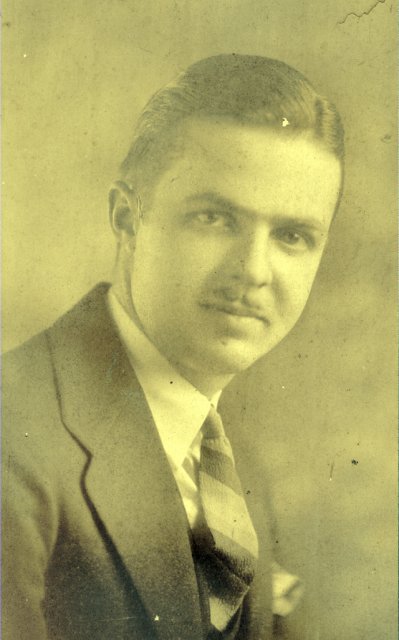
Robert E. Morris (1902-1970)
Robert Ernest Morris (1902-1970) was born at Chicago, Illinois. He graduated from Ocean Springs High School in May 1918. Robert E. Morris went to Buffalo, New York in June 1920 to work for Curtiss Aircraft. He came home and worked with his father in the market at the Gottsche Store.
Robert E. Morris and George E. Arndt II (1909-1994) formed an electrical contracting firm at Ocean Springs in July 1926. Armed with their pragmatic and school experience in the electrical field, they planned to do electrical wiring, installation, and repair. Their company was called the Electrical Construction Company and all work was performed within the regulations and requirements of insurance underwriters. Bob Morris was a resident of Wisconsin Rapids, Wisconsin in March 1954.(The Jackson County Times, July 31, 1926 and August 7, 1926)
Robert E. Morris married Una Rita ? She was called Rita and was an attorney at Washington D.C. Robert E. Morris traveled extensively with his work and is known to have been at Fargo, North Dakota in June 1946 and in Milwaukee, Wisconsin in late June 1946. He and Rita divorced in late 1946 or early 1947.(Correspondence of Robert E. Morris to Myrtle and Karl Maxwell dated June 16, 1946)
Family deaths
Lydia M. Morris had expired in July 1933. She had been a member of Eastern Star Ada Chapter No. 49, which conducted her funeral rites at the Morris home and as she was passed through St. John’s Episcopal Church. Both Mr. and Mrs. E.A. Morris were interred in the Evergreen Cemetery on Old Fort Bayou.(The Daily Herald, July 26, 1933, p. 8)
Ernest A. Morris expired at Ocean Springs on May 22, 1946. He had been a charter member of the Dearborn Masonic Lodge of Chicago and a Mason for sixty-four years. Morris was a member of the Tourist Club, an election official, and enjoyed fishing the local waters.(The Jackson County Times, May 25, 1946, p. 1)
REFERENCES:
Webster’s New Geographical Dictionary, (Merriam-Webster Inc.: Springfield, Massachusetts-1988).
Journals
The Daily Herald, “Pines Hotels Burns”, May 6, 1932.
The Daily Herald, “Morris Funeral”, July 26, 1933.
The Jackson County Times, June 1, 1916, p. 1.
The Jackson County Times, September 9, 1916, p. 5.
The Jackson County Times, "Local News Items", June 12, 1920.
The Jackson County Times, "Local News Items", September 4, 1920.
The Jackson County Times, "Local News Items", October 2, 1920.
The Jackson County Times, "Local and Personal", May 14, 1921.
The Jackson County Times, "Local and Personal", January 13, 1923.
The Jackson County Times, "Local and Personal", March 9, 1924.
The Jackson County Times, “Local and Personal”, August 16, 1924.
The Jackson County Times, “To Our Hostess At The Pines”, March 20, 1926.
The Jackson County Times, “Local and Personal”, July 31, 1926.
The Jackson County Times, “Electrical Construction Company”, August 7, 1926.
The Jackson County Times, "Employees of Biloxi Store Enjoy Banquet at The Pines Hotel", January 15, 1927, p. 3.
The Jackson County Times, “Local and Personal”, March 12, 1927.
The Jackson County Times, “Local and Personal”, March 20, 1926.
The Jackson County Times, "Frank Raymond President of New Laundry Company", April 14, 1928, p. 3.
The Jackson County Times, “The Pines Hotel In hands Of Former Owner”, June 8, 1929.
The Jackson County Times, “E.A. Morris Dies”, May 25, 1946.
The Jackson County Times, June 8, 1929, p. 1.
The Jackson County Times, E.A. Morris Obit, May 25, 1946, p. 1.
The Ocean Springs News, “Local News”, December 3, 1910.
The Ocean Springs News, “Local News”, October 14, 1911.
The Ocean Springs News, “The Pines Hotel”, Thanksgiving 1915.
The Ocean Springs Record, "Edna M. Maxwell", August 15, 1991.
The Sun Herald, "Carolyn 'Lyn' King Maxwell", December 21, 2011. _______________________________________________________________________________________________
McEWEN FAMILY
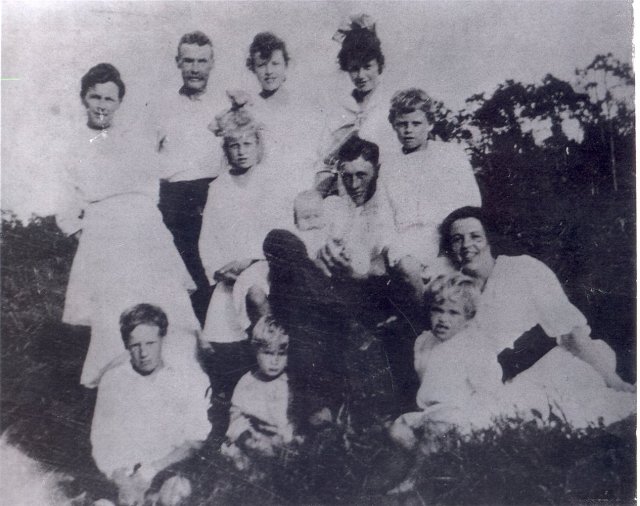
George Elmer McEwen Family of Ocean Springs circa 1917
[L-R: Bottom-George A. McEwen (1904-1983); Wylie E. McEwen (1912-1972); Fitz McEwen (1895-1969) with Baby Dan Allen McEwen (1917-1918); Seth McEwen (1909-1986); and Beatrice McEwen (1898-1984). L-R: Middle-The McEwen Twins, Ursula McEwen (1906-1994) and Donald I. McEwen (1906-1997). L-R: Top-Henrietta J. 'Etta' Darling McEwen (1870-1931); George E. McEwen (1965-1961); Rebecca E. McEwen (1898-1968); and Henrietta McEwen (1900-1978). Courtesy of Rebecca Clark Bishop, Forts Lake Community, Jackson County, Mississippi.]
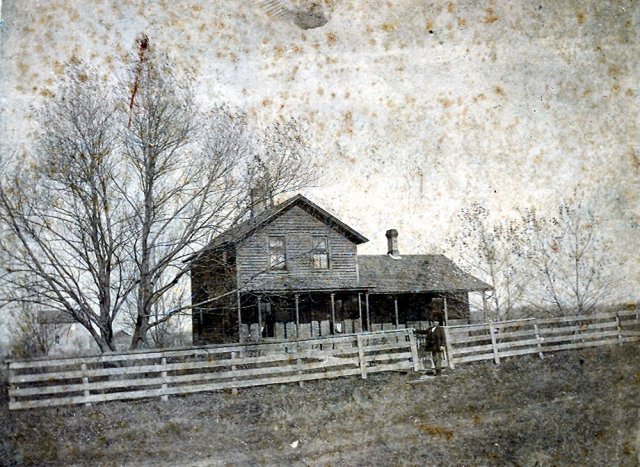
Fitz H. Darling Home at Unity, Clark County, Wisconsin
This is the home and farm where Henrietta Janetta “Etta” Darling (1870-1931), the spouse of George E. McEwen (1865-1961), was reared. Fitz H. Darling (1835-1915+) was a New York native and made his livelihood as a carpenter and farmer. Circa 1859, he married Ellen ?, an 1844 Norwegian immigrant. Mrs. Ellen McEwen (1836-1915) was the mother of seven children, but only five daughters survived: Frances E. Darling (1862-1880+); Ella C. Darling (1864-1900+); Elsie E. Darling (1866-1880+); Henrietta J. Darling McEwen (1870-1931); and Margaret B. Darling Vaughan(1873-1915+) married Ralph T. Vaughan (1874-1920+). Ellen Darling (1836-1915) expired at the Fontainebleau farm of her daughter, Mrs. Ralph T. Vaughan (1873-1920+) on December 9, 1915.(The Ocean Springs News, December 23, 1915) Courtesy of Rebecca Clark Bishop, Forts Lake Community, Jackson County, Mississippi.
George E. McEwen
George Elmer McEwen (1865-1961) was a native of Williamsport, Pennsylvania. He married Henrietta Janetta “Etta” Darling (1870-1931), a native of Unity, Wisconsin on December 24, 1888. Etta’s parents were Fitz H. Darling (1835-1915+), a native of New York and Ellen ? McEwen (1836-1915), an 1844 Norwegian immigrant. George and Etta McEwen were a peripatetic pair and lived in many places. Their rather large family consisted of eleven children: Beatrice McEwen (1891-1984); Lucius Darling McEwen (1893-1938) married Alice Dick (1897-1958) and Jennifer ? McEwen (1903-1930+); Fitz Elmer McEwen (1895-1969); Ellen Rebecca McEwen (1898-1968) married Robert L. Clark (1900-1979); Henrietta McEwen (1900-1978) married Horace “Preacher” Gladney (1894-1975); George Arthur McEwen (1904-1983); Ursula McEwen (1906-1994); Donald Ivan McEwen (1906-1997); Seth Henry McEwen (1909-1986); Wylie Etienne McEwen (1912-1972); and Dan Allen McEwen (1917-1918). The McEwen children were born at various times in Wisconsin, Louisiana, California, Texas, and Mississippi:
Peripatetic family
In the early 1890s, the McEwens were domiciled in Wisconsin. By August 1893, they had relocated to the Crescent City. After December 1895, the McEwens went to southern California, before returning to central Louisiana by 1900. At this time, they were situated south of Alexandria, Rapides Parish, Louisiana in the farming community of LeCompte. It appears that the McEwen family arrived at Ocean Springs, Mississippi from Louisiana between July 1909 and April 1910.
Shannondale
Shannondale was the name of a large farm and plantation owned by Dr. Harry Shannon (1831-1906) and Fountain E. Pitte Shannon (1836-1883), his brother, both natives of Sumner County, Tennessee. They acquired 340 acres in Section 21, T7S-R8W from W.H. Gill and 240 acres in Section 22, T7S-R8W from James A. Watt, for $4200. Here the Shannon Brothers began raising farm stock, primarily cattle.(JXCO, Ms. Land Deed Bk. 6, p. 340 and Bk. 7, p. 269)
Dr. Harry Shannon was born at Sumner County, Tennessee in January 1831. During the Civil War, he served as a First Lieutenant in Sweet’s Battery. He made Company Captain by the close of the war. Dr. Shannon was a graduate of the Reform Medical College of Georgia and the New Orleans School of Medicine. Dr. Shannon was issued license No. 307 to practice at Jackson County in April 1882, while residing at Vicksburg, Mississippi.(The Pascagoula Democrat-Star, May 18, 1906, p. 3 and Rodgers, 1990, p. 19)
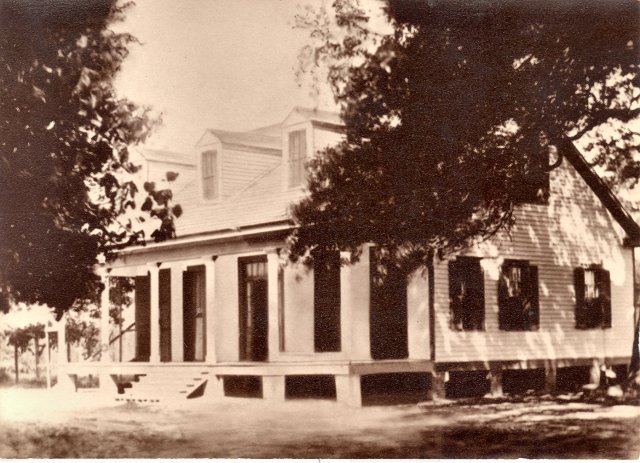
'Shannondale', the home of George E. McEwen and family from 1909 to 1928
[Courtesy of Rebecca Clark Bishop, Forts Lake Community, Jackson County, Mississippi]
Shannondale Orchards-Enter McEwen
In July 1909, Shannondale became the property of George E. McEwen who acquired it from Wylie E. Thibodeaux (1879-1920+), a Terrebonne Parish, Louisiana merchant. Mr. Thibodeaux had just bought Shannondale from Lucy Irwin Shannon (1838-1909+), domiciled at Nashville, Tennessee through Irvin Vick Shannon (1870-1960), her son and agent, who lived in New Orleans. Here on five hundred acres George E. McEwen had a citrus orchard composed of over three thousand grapefruit and satsuma oranges. Today, the Fort Bayou Estates and Braemar Subdivisions occupy lands formerly ‘Shannondale’.
In 1915, Shannondale Orange and Grape Fruit Orchards were described in a local pamphlet as: This citrus fruit enterprise is one of the largest in process of development in Jackson County. The orchards and farm is owned by Mr. George E. McEwen, who move to Ocean Springs from the City of New Orleans five years ago. He has gone into this line of agriculture with intense enthusiasm and hard work, and is already deriving the fruits of his industry. The Shannondale orchards comprise two hundred acres under fence. On this land is growing a large orchard of three thousand one hundred and eighty trees, composed of grape fruit and Satsuma oranges. Mr. McEwen proposes setting out thirty-five hundred more trees this coming spring. He has a large orchard of Lecompte pears growing on ten acres of this land, and last spring he shipped two hundred barrels of these fine pears. During our representative’s visit to the Shannondale orchards he found Mr. McEwen gathering a very large crop of fine sweet potatoes. Mr. McEwen has achieved great success as a grower of citrus fruits, and was manager for two years of one of the large orange groves in the orange belt of Southern California. He proposes a number of important improvements to his grove in the near future. His residence is very comfortable and roomy two-story house. Mr. McEwen, since residing at Ocean Springs, has taken a leading part in all moves for the improvement and advancement in this section. He is on the board of directors of the Farmers and Merchants Bank. The McEwen school building was built by Mr. McEwen, and the property is furnished to the school board without cost, in order to provide suitable school for the growing juvenile population of this section. Mr. McEwen owns and operates a sawmill which has the capacity of ten thousand feet daily. This mill is for the sole purpose of getting out timber and making lumber on his own place. He owns all four hundred and fifty acres of choice land which is suitable for the culture of pecans and citrus fruits. This land is delightfully situated in the Ocean Springs district, and has a frontage of one and three quarters miles on Fort Bayou. To those readers desiring to locate at Ocean Springs we would advise them to corresponding with Mr. McEwen, who will cheerfully furnish data and information on the productiveness of the soil and on land values and other features of Ocean Springs.
Shannondale caught fire in February 1923. Phil Wieder and the local fire company and chemical engine were called by Mrs. McEwn and extinguished the blaze. The home was saved with only a large hole in the roof resulting from the conflagration.(The Daily Herald, February 13, 1923, p. 3)
New Orleans
In December 1928, George E. McEwen defaulted on an $18,000 mortgage to Shannondale Orchards held by Charles R. White, John Richardson, C.H. Sherrill, and W.E. Applegate Jr. McEwen’s lands were sold by Trustee H.P. Heidelberg to the mortgagees. In 1929, the McEwen family relocated to New Orleans and settled on North Broad Street. Lucius D. McEwen, a son, lived next door and made his livelihood as a car salesman in the Crescent City. Mr. McEwen expired in the Crescent City in November 1961 at the age of ninety-four years. His body was sent to Ocean Springs for internment in Evergreen Cemetery on Old Fort Bayou.(JXCO, Ms. Trust Deed Bk. 11, p. 292, JXCO, Ms. Land Deed Bk. 62, p. 106, 1930 Orleans Parish, Louisiana Federal Census R 803, p. 27B, Ed 87 and The Daily Herald, November 14, 1961, p. 2)
REFERENCES:
Betty Clark Rodgers, Miscellaneous Records of Jackson County, Mississippi, Volume I, (Jackson County Genealogical Society: Pascagoula, Mississippi-1990).
Ocean Springs 1915
Journals
The Daily Herald, “Ocean Springs”, February 13, 1923, p. 3.
The Daily Herald, “McEwen birth [Lucius Edward McEwen]”, August 19, 1948, p. 5.
The Daily Herald, “George E. McEwen”, November 14, 1961, p. 2.
The Daily Herald, “Fitz E. McEwen”, June 27, 1969, p. 2.
The Ocean Springs News, “McEwn has fine citrus plantings”, November 4, 1915, p. 1.
The Ocean Springs News, “Entered into Rest [Ellen Darling (1836-1915)]”, December 23, 1915.
The Ocean Springs News, “Loving tribute to Mrs. McEwen [Alice Dick McEwen] in final rites”, September 11, 1958, p. 1.
The Ocean Springs News, “Shannondale Orchards”, March 17, 1966, p. 1.
The Pascagoula Democrat-Star, “Ocean Springs Locals”, May 18, 1906.
_____________________________________________________________________________________
O' KEEFE [see www.biloxihistoricalsociety.org]
The Jeremiah J. O' Keefe Family history is well known. Of all Hibernian families immigrating to Ocean Springs in the 19th Century, they are certainly the best known and probably the most successful of those who remained in this area. The O' Keefes' have made their mark in business, education, politics, historical and cultural preservation, and philanthropy.
The History of Jackson County, Mississippi (1989), which is available at any local public library has an extensive history of this family.
_________________________________________________________________________________________________
EARLY SEYMOUR FAMILY SETTLEMENTS
Although the Seymour family has been in this area since Colonial times, there is not much published information on this clan. Brother Jerome Lepre of New Orleans et al have been working several years on The Seymour Family, another cog in his Gulf Coast Genealogy series titled, Early Mississippi Coast Families. Brother Lepre has already written thirteen early Mississippi Coast family history books, Cannette-Moore-Fayard-LaFontaine-Graveline (1983), The Despau Family (1984), The Caillavet Family (1984), The Saujon Family (1984), The Carriere Family (1985), The Ignacio Sierra Family (1987), The Delaunay Family (1988), The Krohn Family (1989), The Santa Cruz Family (1990), The Trochesset Family (1991), The Fountain Family (1992), The Meaut Family (1995), and The Seymour Family (2001), which have proven to be invaluable to local genealogical researchers.
In addition, Brother Lepre has provided researchers important references works, such as: Catholic Church Records Diocese of Biloxi, Volume I (1991), Catholic Church Records of Biloxi, Volume II, (1995), Catholic Church Records of Biloxi, Volume III, (1995), and Index to the Records of Old Mobile-Cathedral of the Immaculate Conception 1704-1891, (1992).
This essay is not meant to compete with Brother Jerome Lepre and his cohorts or other Seymour family historians, but rather to complement their genealogical research with early Seymour land records to define locales where the primal Seymour families lived.
An admonition to Seymour descendants, although there is much genealogical information in this article, I know that some of it must be incorrect. This is the nature of family research. One strives for perfection, but it is seldom attained. If I have erred in describing your Seymour ancestors, please forgive me.
Other researchers known to this writer who have published on the Seymour family are Ellen E. Kuehn, "Seymour Family", Annette R. Seymour, "Seymour Family" and "John Chester Seymour and Annette Raley", and Betty Clark Rodgers, "Lazarus Seymour and Nancy Seaman", all published in The History of Jackson County, Mississippi (1989). Pauline H. Entrekin wrote "The Seymore Family Tree" for The Mississippi Coast History and Genealogical Society Journal (Volume 20, No. 2) in June 1984. The Seymour family is mentioned briefly in A History of the Mississippi Beef Cattle Industry (1985).
The author has utilized these and other common genealogical sources to create this essay. The Chancery Court Land Deed Records of Jackson and Harrison County, Mississippi, as well as the Jackson County Archives directed by Betty C. Rodgers and Lois Castigliola at Pascagoula were invaluable to this study.
The genesis of the large Seymour family of the Mississippi Gulf Coast traces its ancestry from St. Cyr Seymour (1788-1845) and Marie-Josephe Ryan (1786-1876). The origin of the name Seymour is quite obfuscated by the Roman Catholic Church records of Colonial times and later. In July 1995, Brother Lepre published an article, "Solution To A Mystery? LeBlanc-White-Moore-Zamora-Seymour", in The Mississippi Coast History and Genealogical Society Journal.
Jerome Lepre relates that the man we know today as St. Cyr Seymour is referred to in various Catholic Church documents as St. Cyr LeBlanc, St. Cyr White, Jose St. Cyr, St. Cyr Zamora, Jose Zamora, and Joseph S. Moore. The name on his tombstone in Section B of the Old Biloxi Cemetery is St. Cyr Zamor. St. Cyr Seymour died on January 1, 1845 at New Orleans.
Regardless of this ubiquitous nomenclature from LeBlanc to Zamora, the name Seymour has survived in various forms, such as Seamore, Seymore, and Seymoure. Their appears to be absolute certitude that the man who was once "commonly called Joseph S. Moore", the patriarch of all Mississippi coastal Seymours, is St. Cyr Seymour.
In June 1808, St. Cyr Seymour married Marie-Josephe Ryan, the daughter of Jean Ryan and Marie Gargaret at St. Mary's Church on Chartres Street in New Orleans.(Lepre, 1995). Their known children were: Edward Seymour (1809-1868+), Pierre Seymour (1810-1888), Jean-Baptiste Seymour (1811-1887), Lazarus Seymour (1816-1902), Narcisse Seymour (b. 1818), Victoria Seymour Fayard (1819-1904), Josephine Seymour Fayard (c. 1825-1852), and St. Cyr Seymour II (1827-1903).
FONTAINEBLEAU-THE PATRIARCH'S SETTLEMENT
The homestead of St. Cyr Seymour is clearly defined in the American State Papers and the early land records of the Chancery Court of Jackson County, Mississippi. In January 1816, William Crawford, Land Commissioner for the District East of the Pearl River, submitted Report No. 234 to the 14th Congress. His abstract No. 12, included the 174 settlers who had land claims east of the Pearl River whose land claims were not derived from the French, British, or Spanish. Joseph S. Moore (St. Cyr Seymour) was one of these claimants. His land claim, Claim No. 161, was at Belle Fontaine (Fontainebleau) and was settled in 1799, by himself.(American State Papers, 1994).
The Joseph S. Moore Claim, No. 161, consisting of 640 acres in Section 5, T8S-R7W, Jackson County, Mississippi
Claim No. 161 was confirmed by an Act of Congress in March 1819. It was surveyed in 1827-1828 by Thomas Bilbo, Deputy Surveyor. The Seymour donation encompassed Section 5, T8S-R7W, which contains 640 acres. The St. Cyr Seymour acreage was highly variable topographically. The south perimeter consisted of a large estuarine marsh on the west, which became the open waters of Graveline Lake to the east. Above the tidal marsh, the western half of Section 5, T8S-R7W is a broad, northwest-southeast striking ridge, which reaches a maximum elevation
of 20 feet above mean sea level. The culmination of this ridge in the S/2 of the NW/4 of Section is the most desire-able location for a settlement. A small, southeast meandering, bayou, which was alluded to as Bayou Derion? on the 1835-1838 tax rolls, flows into Graveline Lake in the
SE/4 of Section 5, T8S-R7W, diagonally transects the east half of Section 5.(USGS Topographic Maps, Gautier and South Gautier)
Francois Rillieux and Jean-Baptise Baudrau dit Graveline and his heirs, very early settlers of the general Pascagoula area with the Krebs and La Pointe families, were also land claimants near the St. Cyr Seymour parcel. (Higginbotham, 1967). Early maps depict what we know today as Graveline Bayou as Bayou Rilicax (sic).(1) This name had degraded to Bayou Pilicox by the 1920s, probably due to typographical errors by the cartographers.. Vincent Rillieux (1740-1800), a son of Francois Rillieux and Marie Chenet, is the great grandfather of Edgar Degas (1834-1917), a French painter and sculptor, and friend of the French Impressionist movement of the late 19th Century. The Rillieux family left the Pascagoula area for New Orleans prior to 1763.(Higginbotham, 1967).
French Canadian adventurer, Jean-Baptiste Baudrau (1671-1761), called Graveline, who came to Fort Maurepas, at present day Ocean Springs, of the Louisiana Colony with d'Iberville (1661-1706) in 1700, remained and settled permanently in what became in December 1812, Jackson County of the Mississippi Territory. Today, his descendants from daughter, Magdeline, and her spouse, Pierre Paquet, number in the thousands. Graveline's granddaughter, Catherine-
Louise Baudreau (1742-1806+), wedded Joseph Bosarge (1733-1794), a native of Poitiers, France in 1763, founding another large coast family.(Lepre, 1983)
Another early settler in the Fontainebleau area was Charles C. Russell. His claim, Claim No. 148, was at Bayou Relliaux (sic), east of St. Cyr Seymour. Russell settled here in April 1809. His claim included 160 acres comprising the E/2 of the NE/4 and the E/2 of the SE/4 of Section 5, T8S-R7W.(American State Papers, 1994). In September 1848, the heirs of St. Cyr Seymour, quitclaimed their "rights, titles, claims, and interests" in this parcel to Alfred E. Lewis (1812-1885). (JXCO, Ms. Land Deed Bk. 3, pp. 28-30)
The Charles C. Russell claim lies for the most part on the east side of a small, unnamed bayou which should fittingly be called St. Cyr or Seymour Bayou. Although low topographically, this land is suitable for habitation. The Old Shell Landing Road takes a sinuous path across the
northern perimeter of the NE/4 of Section 5. A.E. Lewis had purchased the Russell claim from Thomas L. Fletcher in August 1842.(JXCO, Ms. Land Deed Bk. 3, pp. 23-24)
A Federal land patent was issued on November 22, 1895, to St. Cyr Seymour, his legal representatives, and heirs on 480 acres in Section 5, T8S-R7W. The heirs of Charles C. Russell received their Federal land patent on October 9, 1895, on 160 acres in the E/2 of the E/2 of Section 5, T8S-R7W.(JXCO, Ms. Land Deed Bk. Bk. 242, pp. 457-459 and Bk. 17, p. 151)
The Seymour name has long been linked to beef cattle. Their maternal ancestor, Jean-Baptiste Baudreau (1671-ca 1762) dit Graveline, is credited with the importation of cattle into the Louisiana Colony during Colonial times. In June 1748, Pierre de Rigaud, Marquis de Vaudreuil, then Governor of French Louisiana, in a letter to Jerome Phelypeaux, Comte de Maurepas, Minister of Marine for Louis XV, King of France, wrote the following about Graveline: “he has generously risked so many times for the service of his majesty, first in expeditions in which he took part in Canada against the Iroquois, where he always distinguished himself, as well as in the journeys that were made there by sea to take Hudson's Bay and ravage the coasts of Newfoundland, and since he has been in Louisiana in the difficult journeys he has undertaken, both to manage certain Indian nations for us and to suppress the insolence of several others, having marched at the head of the militia, of which he is the oldest captain, whenever we have formed an army to fight them.”
Graveline, one of the first voyagers from Canada who came here for the settlement of the colony, at which he has worked steadily, both by the frequent voyages which he made to France to contract and conduct people here and by the voyages he has made to Vera Cruz and Havana in order to open commerce there and to have transported to this country the first purebred horned livestock seen here.(Rowland, et al, 1984)
When Thomas Hutchins (1730-1789), Surveyor-General of the United States came to the area in 1784, he observed:
There are still a few inhabitants at Biloxi, some of whom are the offspring of the original settlers. Their chief employment is raising cattle and stock, and making pitch and tar: but the natives (Indians) are very troublesome to them.(Hutchins, 1784)
Hutchins had first come to the area in 1772, when he was a young lieutenant in the British Navy at Pensacola. He was searching for an English military vessel, Mercury, which went aground at Free Masons Island in the Bernard Roman's Hurricane of September 1772. While at Biloxi, Hutchins "was advised that all the coastal islands had been awash during the storm. Cattle and hogs had been lost, some said as many as three hundred from Horn, Buck (Deer), and Ship Island".(Rea, 1990, p. 58) Cattle were kept on the barrier islands to reduce their theft by the Native Americans.
Possibly one of the earliest corroborations of the Seymour link to cattle is the 1827 Tax Roll of Jackson County, which indicates that St. Cyr Seymour was residing at Belle Fontaine and possessed 300 cattle ($4 per head) and 8 horses (valued at $300) worth $1500. By 1856, the county tax rolls indicate that the widow Seymour, Marie-Josephe Ryan, and her four sons still owned over 300 cattle and seven slaves. Many of St. Cyr Seymour's descendants became well-known stockmen and butchers in towns along the Mississippi coast.
When the children of St. Cyr Seymour and Marie-Joseph Ryan became of marriageable age, one could speculate that the sparse population in the Belle Fontaine-Fontainebleau area and the probable desire to select spouses of the Roman Catholic faith led their children to seek mates in other areas of the county. At this time, their particular environs near Fontainebleau were inhabited for the most part by strongly Protestant families, such as those of William Ramsay, Daniel H. Ramsay (1814-1867) and Daniel Webb.
To understand population distributions at this time, one can observe the 1840 Federal Census for Jackson County, which indicates that there were only 1459 Caucasians residing in over 1300 square miles. With the religious factor and paucity of eligible women near their Fontainebleau homestead, it is easy to imagine how the first three Seymour sons found mates at East Biloxi (now Ocean Springs). Here in the early 1800s, on the eastern shore of the Bay of Biloxi resided the family of Andre Fournier II (died pre-1851) and Catherine Bouzage (1780-1841+). They occupied a three arpent tract on the east end of the LaFontaine tract. A small bayou on the eastern perimeter of the Fournier land, called Bayou Bouzage, is now the main channel of the Ocean Springs Inner Harbor. The present home of Mrs. Alice T. Austin at 545 Front Beach Drive probably occupies the same site as the primal Fournier settlement. The Fourniers came to Ocean Springs from the Bayou La Batre area of coastal Alabama. They had a large family with many daughters: Gertrude F. Carco (1805-1850+), Andre Fournier III (1809-1878), Emilie F. Bouzage (ca 1811-1850+), Maria Evaline Foretich (1813-1854), Louise F. Seymour (1815-1860+), Marie F. Seymour (1817-1890), Catherine F. Ryan Moran (1819-1887), Delphine F. Llado (1819-1906), and Adele F. Seymour (1823-1890).(Adkinson, et al, 1991)
In December 1849, Andre Fournier III (1809-1878) also acquired land at Ocean Springs. His tract consisted of 160 acres in the SW/4 of Section 19, T7S-R8W. This tract is east of Martin Avenue projected north along the range line between Range 8W and Range 9W to Fort Bayou, and includes all land south of Fort Bayou to Government Street projected to the range line. The eastern perimeter of the Fournier parcel is a line from Blount Avenue north of Government to Fort Bayou. George A. Cox (1811-1887) acquired 78 acres in the western portion of the Fournier tract in December 1859.
Here, this entrepreneur from Yazoo City homesteaded on the old Fournier place which was probably located near the present day PFG Precision Optic plant at 733 Bienville. The road leading to his home became known as Cox Avenue and a family burial plot was commenced near the west boundary of the former Coca Cola bottling plant.(Schmidt, 1972, p. 29).
From the Andre Fournier II family at East Biloxi, Edward Seymour married Adele Fournier. Pierre Seymour married Louise Fournier and Jean-Baptiste Seymour married Marie Fournier. The tax rolls of Jackson County, Mississippi, indicate that these Seymour brothers and St. Cyr II, and their families continued to reside in the Fontainbleau area as late as 1856. Their father St. Cyr Seymour had passed on January 1, 1845.
As we will see, the children of St. Cyr Seymour and Marie-Josephe Ryan eventually moved to the western side of Jackson County and into eastern Harrison County. With the exception of Jean-Baptise Seymour, who settled at Ocean Springs with his wife, Marie Fournier, the other Seymour male siblings found habitations to the north and west of Fort Bayou in what today we know as the St. Martin and Latimer communities. This area of western Jackson County is also the primal haunts of the Jean Ryan family from which the Seymours were maternally related. The Seymour girls, Victoria and Josephine, married Fayard cousins, Narcisse Fayard (1825-1896) and Charles Fayard (1822-1897), and settled at heavily Roman Catholic Biloxi.
Before leaving the original St. Cyr Seymour settlement at Fontainebleau, it is important to know that as late as 1914, the children of St. Cyr Seymour II (1827-1903) were involved in litigation concerning the western 480 acres of Section 5, T8S-R7W in the Chancery Court of Jackson County, Mississippi. It is from depositions in these Chancery Court cases that much interesting information on the original Seymour claim was revealed. In what may be described as a story within a story, the following is generally what transpired on the primal St. Cyr Seymour homestead after his demise at New Orleans in January 1845.
We will probably never know precisely why the family of St. Cyr Seymour abandoned their home place north of Lake Graveline after his demise. As previously suggested, the paucity of eligible life mates in the immediate area of the Seymour settlement with similar religious tenets, may have been a contributing factor.
Another consideration in the Seymour migration to the western end of Jackson County, is that between August 1852 and October 1860, no fewer than six hurricanes struck the coast of the Mexican Gulf. The Great Mobile Hurricane of August 1852, landed between Pascagoula and Mobile and was particularly devastating in the Pascagoula region.
The Year 1860 saw three storms affect the Mississippi coast. The August 1860 tempest passed between Biloxi and Pascagoula, which was very near the St. Cyr Seymour homestead. The September 1860 Hurricane saw sea level rise seven feet in 20 minutes, inundating the village of Pascagoula.(Sullivan-?) The third tempest hit Louisiana in early October 1860, and did some damage to the west side of the Mississippi coast sparing the Fontainebleau area.(Sullivan-?).
One can only imagine the effects of a tidal surge, emerging swiftly through the churning waters of Lake Graveline, over the lower elevations of the Seymour plantation during one of these tropical storms. How did their home, large herd of cattle and other livestock, and virgin forests fare during the banshee-screaming, tornado winds and driving rain of these great tempests?
Regardless of all suppositions, it is known from the land deed records, land rolls, and tax rolls of the Chancery Courts of Jackson and Harrison Counties, that the six surviving heirs of St. Cyr Seymour, one daughter, Josephine S. Fayard, had expired childless in February 1852, began selling their legacy at Fontainebleau, in the late 1860s.
In December 1868, the first Seymour heir to sell his interest at Fontainbleau was Edward Seymour who sold to James Mulholland (1823-1871).( JXCO, Ms. Land Deed Bk. 6, pp. 548-549). Mr. Mulholland was an Irish immigrant who operated a store on the Daisy-Vestry Road (now Old Biloxi Road). His daughter, Elizabeth Mulholland (1859-1936), married Calvin Seymour (1850-1922), the eldest son of St. Cyr Seymour II and Anne McCarty. A son, Jeff Davis Mulholland (1861-1930), sometimes in alliance with the Quave family, was a leading merchant and entrepreneur at North Biloxi in the late 19th and early 20th Century.(Bellande, 1992)
In January 1876, Narcisse Fayard (1825-1896) and his wife, Victoria Seymour (1819-1904), sold their 1/6 interest to Alfred E. Lewis (1812-1885) for $50.( JXCO, Ms. Land Deed Book 3, pp. 74-75)
Jean-Baptiste Seymour sold for $100 his interest, which was described as one-half in the "Joseph S. Moore grant" to his son, Moses Seymour, in August 1887.(JXCO, Ms. Land Deed Bk. 10, p. 32) He must have acquired the interests of his brothers, Pierre Seymour and St. Cyr II. These conveyances were lost or destroyed, as they were never recorded in the Chancery Court post-1875.
Lazarus Seymour and Martha Fayard for $100 conveyed to Delmas and Emily Seymour their 1/6 interest in February 1890.(JXCO, Ms. Land Deed Bk. 10, p. 547) Delmas Seymour was the son of Jean-Baptise Seymour.
The heirs of St. Cyr Seymour II claimed that he never sold his 1/6 interest in his father's Fontainebleau estate. They pursued unsuccessfully for many years in the Chancery Court of Jackson County, to be remunerated for their alleged interest in the St. Cyr Seymour homestead.
By 1893, M.D. Russell, a land speculator from Iowa, who was residing in the O'Keefe Cottage at Ocean Springs with his new bride, was in control of the old St. Cyr Seymour tract. Young Russell and his father, Doctor D.P. Russell, a veterinarian, who resided at Belle Fontaine, were involved with Colonel W.R. Snyder (1864-1918) in local land speculation. The three men were alleged partners in the sale of the A.E. Lewis Estate, a small portion which had been the St. Cyr Seymour homestead, to the John B. Lyon (1829-1904) family of Chicago.(JXCO, Miss. Chancery Court Cause No. 413, "Snyder v. Russell", June 1890) The Lewis tract later became known as the Hamill Farm in the Fontainebleau area.
From depositions given in Jackson County, Mississippi Chancery Court Cause No. 3336, "H.F. Russell v. Calvin Seymour, et al", March 1914, the following information was revealed concerning the Seymour land in Section 5, T8S-R7W:
H.F. Russell (1858-1940), the plaintiff in the case, testified that D.P. Russell, called Doc Russell, and the father of M.D. Russell, was the agent for the owners in the 1890s. Between 1895 and 1901, the virgin timber was cut or worked off the property by the timber crews of Doc Russell. Richmond Spradley (1847-1900+) became the tenant for then proprietors, Moses L. Pervin and Wilson. Spradley lived in a frame and log house with his wife, Elizabeth (1833-1900+), and son, Elias (1878-1900+). Their country house was located on the middle bayou near the center of Section 5. Here Spradley cultivated a garden and burned charcoal to make his livelihood. He left the land in 1906, when his wife became ill. Others who worked on the land were John Webb (1854-1900+) and A.B. Spradley (1874-1900+).
Thomas E. Ramsay (1845-1934), who owned the Seymour tract with H.F. Russell (1858-1940) from 1902 to 1909, testified that Mr. Spradley was the tenant of M.D. Russell and that he resided on the land for about eleven years. Ramsay said that Spradley built one or two houses and 'raised some mighty fine sugar cane and potatoes".
John Webb testified to the Chancery Court that D.P. Russell lived on the Seymour land and had logs cut and charcoal burned there during his occupancy. Webb stated that "he (D.P. Russell) lived on what they call the Seymour place". Russell built a house, barn, and a structure for his teamsters to occupy. John Webb further averred that this was the same site that Richmond Spradley later resided on commencing in 1895 or 1896. Webb also revealed that there were hundreds of charcoal kilns on the property. The average kiln produced about 350 barrels of charcoal. When asked if he ever knew of any Seymours living on the tract, John Webb replied negatively. He did say that "there was an old man living there once, that we called Uncle Baptiste". Webb did not know with any degree of certitude that this man, Uncle Baptiste, was Jean-Baptiste Seymour, the son of St. Cyr Seymour.
From testimony given in Cause No. 3336, H.F. Russell v. Calvin Seymour, et al, one could conclude that the homestead of St. Cyr Seymour was located in the SE/4 of the NW/4 of Section 5, T8S-R7W. Here the tenant, situated near a navigable bayou and protected from the hurricane prone shores of the Mississippi Sound to the south, was ideally situated to take advantage of the fecund waters of Graveline Lake with its fine oysters and fish. Access to the open waters of the Gulf of Mexico and a window to the outside world via coastal schooner was available through Graveline Bayou. High land suitable for cultivation and stock raising lie nearby as well as lush tidal marshes suitable for winter foraging for livestock.
Camp Graveline
Today, this area of Jackson County is still sparsely settled. In August 1977, Louis A. Fayard, Inc. and Mary C. Mahoney, Inc. opened a subdivision called the "Father Mullin Lake Graveline Properties". It consists of nineteen lots on the north shore of Lake Graveline in the southern 3/4 of the S/2 of the Joseph S. Moore Claim.(JXCO, Ms. Land Plat Book 15, p. 37)
A second unit consisting of twenty lots was added in Section 19, T8S-R7W, on the John Baptiste Beaudreaux (sic) Claim, in August 1978.(JXCO, Ms. Land Plat Book 16, p. 3) In the same general area, Graveline Pointe Subdivision, is now being developed by James Reeves Development, Inc. of Laurel, Mississippi.
The Reverend Herbert Mullin and Monsignor Geofrey O'Connell, Roman Catholic Irish priests, acquired this land in April 1944, from Charles S. Gerth of New Orleans.( JXCO, Ms. Land Deed Bk. 87, pp. 491-492) Here with the assistance of the Brothers of the Sacred Heart from Bay St. Louis, they developed Camp Graveline at Graveline Point just west of where "St. Cyr Bayou" enters Graveline Lake.
According to Bob Mahoney of Biloxi, who spent many summers of his youth here, Camp Graveline was a vacation camp, which catered to the recreational needs of the Coast's juveniles. It offered two sessions and could accommodate about 150 campers. Girls went for four weeks commencing in June. The boys session was six weeks terminating in August. Both groups enjoyed fishing, swimming, sailing, water skiing, hiking, and horseback riding. In addition to Bob Mahoney, a well known Coast restaurateur and amateur golfer, singer-song writer-author, Jimmy Buffett (b. 1946) of Pascagoula and Key West, may be Camp Graveline's most famous alumni.
Camp Graveline was owned by the Sisters of Mercy from May 1958 until March 1961, when it was quitclaimed to Father Mullin, et al.(JXCO, Ms. Land Deed Bk. 185, pp. 357-359) It is believed that Camp Graveline ceased to function as a summer holiday resort in the late 1950s, and was subsequently a victim of Hurricane Camille in August 1969. The Creare Corporation purchased it from the Catholic priests, Mullin and O'Connell, in June 1969.( JXCO, Ms. Land Deed Bk. 357, p. 467)
We are now ready to investigate the migration of the children of St. Cyr Seymour and Marie-Josephe Ryan from the primal Seymour homestead at Fontainebleau to other areas of the Mississippi coast, primarily western Jackson County. For the most part, they settled in what we know today as the Latimer community. The primary focus of this late 1860 Seymour settlement is in and around the intersection of Tucker Road and the Old Biloxi Road (Daisy-Vestry Road).
North of the "Big Ridge" on the east side of the Tchoutacabouffa River water shed is an area that could be described as an "inland peninsula". With Bayou Costapia to the north, Perigal Creek to the north and east, and Cypress Creek to the south, some of the Seymour family chose the high land amidst these waterways to settle. Here, elevations range between 40 and feet above sea level.
It is interesting to note that this general locale was the childhood home of their mother, Marie-Josephe Seymour, nee Ryan. She was reared on the Jean Ryan settlement about two to three miles south, in the vicinity of present day Bayou Porteaux-Gulf Hills. It was a homecoming for her.
EDWARD SEYMOUR SETTLEMENT-LATIMER/LARUE
Edward Seymour (1809-1898), the eldest of the Seymour children, married Adele Fournier (1818-1890), the daughter of Andre Fournier and Catherine Bouzage, circa 1829. They may have started their lives south of Edward's birthplace at Fontainebleau. The 1833 tax roll of Jackson County demonstrates that Edward Seymour was at Belle Fontaine Pointe where he owned 10 acres of land. By 1842, he owned 60 head of cattle.
The Mississippi agricultural census of 1850, reported Edward Seymour's holdings as: 10 acres of improved land, 400 acres of unimproved land, cash value of farm $300. Stock included 4 horses, 1 mule, 30 milch cows, 4 working oxen, 10 other cattle, and 38 swine valued at $850. Seymour also owned 50 bushels of Indian corn and 50 pounds of butter.
By 1856, the tax rolls have Edward Seymour in possession of 80 cattle and one slave.
It cannot be ascertained with a high degree of certitude when Edward Seymour and family left the Fontainebleau area for the Latimer area in western Jackson County. The land deed records of Jackson County indicate that in June and November 1851, Edward Seymour purchased two contiguous tracts of land on the Daisy-Vestry Road (Old Biloxi Road) about one mile southwest of its intersection with present day Tucker Road. From James L. Condry, Seymour acquired the NW/4 of the SE/4 and the SW/4 of the SE/4 of Section 27, T6S-9RW.(JXCO, Ms. Land Deed Bk. 10, p. 384) He bought from Peter Scarborough of Harrison County, in November 1851, with tenements, the NW/4 of the NE/4 of Section 34, T6S-R9W.(JXCO, Ms. Land Deed Bk. 10, p. 383)
Edward Seymour and his wife reared a large family consisting of the following children: Raymour Seymour (1829-1911), Elizabeth Richard (1836-1905), Suzanne Dupree (b. 1839), Lewis Seymour (b. 1939), Antoine Seymour (b. 1840), Joseph Edward Seymour (b. 1842), Josephine "Coriene" Cates (1843-1929), and Clement Fayard Seymour (1846-1915).
Some corroboration for the relocation of Edward Seymour to the Latimer area, is given in 1867. At this time, his mother Marie-Josephe or Mary Seymour purchased 160 acres in the north half of Section 26, T6S-R9W from the State of Mississippi.(JXCO, Ms. Land Deed Book 22, p. 368) Also, at the same time, his, son, Clement Seymour, son-in-law, Fred Dupree (1833-1911),
and grandson, Edward Richard, bought the SE/4 of Section 26, T6S-R9W from the State of Mississippi. These tracts are all on the northeast side of Tucker Road, varying from one mile southeast of its intersection with the Old Biloxi Road to the intersection with same, in the NW/4 of Section 26.
In 1872, Edward Seymour sold his land in the Latimer area to Clement Seymour and St. Cyr Seymour II. It appears from the land assessment records of Jackson County, that by 1875, Edward Seymour, who was approximately sixty-six years of age, had disposed of all land holdings in the county. His name is not on the 1875 Land Rolls of Jackson County. One would assume that he and his wife were residing with an offspring.
Annette Raley Seymour, the wife of John Chester Seymour (b. 1929), relates in the "Seymour Family" in The History of Jackson County, Mississippi (1989), that "Edwour Seymour lived with his son (Raymour) and his wife (Lucinda Williams) for about four years after his wife died. His death occurred on August 1, 1898 and he is buried in the Wilkerson Cemetery in Larue Community". John Chester Seymour is the great great-grandson of Edward Seymour and Adele Fournier.
The Seymour encroachment into the Larue area began in 1891. In September 1891, Raymour Seymour acquired Federal patents on the following lands in T5S-R9W of the Larue area: SW/4 of SW/4 of Section 14; SE/4 of SE/4 of Section 15; and the NE/4 and the NW/4 of the NE/4 of Section 22.
At the same time, his brother, Clement Seymour, and son, Albert Jackson Seymour (1867-1951), received Federal patents, also on lands in T5S-R9W. Clement received the NW/4 and SW/4 of the NE/4 of Section 10, while Albert got 160 acres in Section 11.
PIERRE SEYMOUR SETTLEMENT-FORT BAYOU
Pierre Seymour (1810-1888) married Louise Fournier, the daughter of Andre Fournier and Catherine Bouzage circa 1833. Their known children are: Joseph Lazarus Seymour (1835-1920), William Seymour (1837-1908), Clo Seymour (b. 1842), Louisa S. Garlotte (1838-1916), Adele S. Bullock (1844-1913), Sherrod Seymour (1846-1928), May Seymour (b. 1847), and John Peter Seymour (1852-1938).
The early tax rolls of Jackson County have very little information on Pierre Seymour. One could deduce that he resided in the Fontainebleau area, probably on the St. Cyr Seymour homestead with his siblings until he relocated to the Fort Bayou area of Jackson County.
Like his brothers, Pierre Seymour owned cattle. In 1843, he was assessed with 40 bovines. By 1856, his herd had grown to 50 beef cattle. In the 1860 Federal census, Pierre is a butcher making his livelihood from the sale of beef and other animal meat. He is a farmer in 1870.
There is a high degree of certitude that Pierre Seymour and his family settled on the north shore of Fort Bayou in Section 17, T7S-R8W. He acquired land patents from the Federal government as well as the State of Mississippi on lands here as early as 1847. In fact, the first Federal patent acquired by Pierre Seymour, in January 1847, the SE/4 of the SW/4 of Section 17, is the most probable homestead. He paid $50.00 for this land.( JXCO, Ms. Land Tract Book 1, p. 199.) The Peter Seymour site rests at an elevation of 25 feet above sea level with good drainage and easy access to Fort Bayou.
Topographically, this habitat is very similar to the original Seymour land at Fontainebleau. Here Pierre Seymour encountered navigable water, marsh, timber, and some flat areas suitable for subsistence agriculture.
By 1875, Pierre Seymour owned about 300 acres of land in Section 17 and several tracts to the south in Section 20, T7S-R8W. The Pierre Seymour family cemetery developed in the NE/4 of the NE/4 of Section 20.
It appears that several of the children of Pierre and Louise Fournier found settlements near their primal haunts on Fort Bayou. The 1875 Land Assessment Book of Jackson County, reveals that William Seymour (1837-1908), owned 320 acres in Sections 7, 8, and 9 of T7S-R8W while brother, Sherrod Seymour (1846-1928), possessed 40 acres in Section 8. The Old Fort Bayou Road is near or transects several of these parcels which indicates that these Seymour brothers may have lived just north of their parents. Many of their descendants still reside in the immediate area.
Ina Goff Clarke, a descendant of Peter Sherrod Seymour (1870-1934), remembers that as a child, in the 1930s, she was brought to the "William Seymour place". It was located just west of the Seymour Cemetery. There are groves of live oaks in these areas today, which may indicate old Seymour home places.
Today, the former lands of Pierre Seymour in Section 17 and Section 20, T7S-R8W are for the most part owned by the heirs of J. Duncan Moran (1925-1995) and his brother, Alfred R. Moran (1930-1981). With the exception of the Woodfield Subdivion and the Windsor Park Subdivision on the northeast and southwest perimeters respectively, and Bayou Talla Road which goes to the Seymour Cemetery, this land is lightly timbered and undeveloped. Directly across Fort Bayou to the south, Maurepas Landing Subdivision is presently developing on the former Wright-Hunt property in Section 20.
It is believed that these Pierre Seymour lands came into the Moran family through their grandparents, May V. Minor (1866-1910) and H.F. Russell (1858-1940), who acquired much real estate in Jackson County, for taxes during their lifetime. In October 1910, H.F. Russell conveyed one acre in the NW corner of the NE/4 of the NE/4 of Section 20, T7S-R8W to the heirs of William Seymour.(JXCO, Ms. Land Deed Book 39, pp. 182-183)
An excerpt from this conveyance reads as follows:"it is understood and agreed by all parties interested in this deed that the one acre here in conveyed is to be used as a family cemetery only. It is also understood and agreed that the said heirs and their family shall have the right to go to and from said cemetery through the NE/4 of the NE/4 at any time that they may deem necessary".
JEAN-BAPTISTE SEYMOUR SETTLEMENT-OCEAN SPRINGS
Jean-Baptise Seymour (1812-1887) married Marie Fournier (1817-1890) circa 1835. She was born at Ocean Springs, after the Andre Fournier family had relocated post-1813, from the Bayou La Batre area of Mobile County. Her parents, Andre Fournier and Catherine Bouzage, resided on a three arpent tract fronting Biloxi Bay just west of the present day Inner Harbor. The Louis Auguste LaFontaine family were their western neighbors. As previously mentioned, Marie's brother, Andre Fournier III (1809-1878), acquired the SW/4 of Section 19, T7s-R8W, at Ocean Springs in 1849. He sold his land and relocated to the North Biloxi area where many of his descendants reside to day.
Before arriving at Ocean Springs, Jean-Baptiste Seymour resided at Fontainebleau. Early Jackson County, Mississippi tax records indicate that his land holdings at the "Seashore" and Belle Fontaine, increased from 43 acres to 280 acres between 1836 and 1839. By 1856, he was the
most successful of the Seymour brothers running over 170 head of cattle in the Lake Graveline area. He also owned 4 slaves, attesting to his affluence.
Jean-Baptiste Seymour and Marie Fournier reared a large family in Jackson County. Their children were: Zeolide S. Krohn (1836-1898), Moses Seymour (1838-1893), Anatole Seymour (b. 1840), Jean Seymour (1843-1903+), Henry Seymour (1844-1924), Narcisse Seymour (1849-1931), Cecilia S. Mathieu (1850-1903+), Rose Seymour (b. 1852), Marie S. Borries (1853-1900), Louise S. Meaut (1855-1939), Caroline S. Beaugez (1858-1933), and Delmas Seymour (1863-1912).
It is not known with a high degree of certitude, when Jean-Baptiste Seymour and family quit the Fontainebleau area for Ocean Springs. It is known that on September 15, 1849, Jean-Baptiste Seymour purchased a 13-acre tract of land at Ocean Springs from Dr. Andrew B. Dodd (1806-1850+), a Kentucky born physician. The Seymour tract ran from Government Street to LaFontaine Avenue and was only 150 feet wide, except on its southern termination near present day LaFontaine Avenue, where it widened to 165 feet. Its western perimeter began 200 feet east of Dewey Avenue. The Jean-Baptise Seymour tract was originally a part of Andre Fournier's three arpent tract on the Bay of Biloxi and Bayou Bauzage (Inner Harbor). Seymour paid Dr. Dodd $11.54 per acre for this land.
Before Jean-Baptise Seymour expired on October 14, 1887, he began selling his land at Ocean Springs to his children and others. In October 1875, Thomas Cochran (1852-1883) purchased all of Jean-Baptiste Seymour's land north of Porter Avenue to Government Street for $200. He obtained $77.52 per acre for this tract as compared to his original cost of $11.54 per acre. This particular plot was soon purchased by Joseph Kotzum (1842-1915) who incorporated it into his Kotzum Addition subdivision of January
1895.
Moses Seymour
Son, Moses Seymour (1838-1893), was the first sibling of the family to acquire land in the Seymour tract from his parents. In September 1877, Jean-Baptiste and Marie Seymour sold him and his wife, Adolphine Bellman (1838-1920), for $25, a 300-foot deep lot on the south side of
Porter Avenue near present day Minor Lane. It appears that the homestead of Jean-Baptiste Seymour and Marie Fournier was also located on this tract. In July 1890, when Delmas Seymour sold a house for $35 to his brother, Moses, the deed concerning this structure read, "a certain house built
by me in Ocean Springs for the use of my mother during her life on the said Moses Seymour lot south of his residence on Porter Avenue".
From his obituary, it appears Moses Seymour was a resident of Scranton (Pascagoula) at the time of his demise. He expired suddenly, probably from a heart attack, at the L&N Depot in New Orleans as he awaited for a train to return home. Moses was a well known butcher. He had
married Adolphine Bellman (1838-1893), the daughter of Charles Bellman (1806-1860+) and Pauline Ryan (1815-1899). Their children were: Edwin McLan Seymour (b. 1864), Isabella S. White (1866-1928+), Norman A. Seymour (1868-1910+), Robert F. Seymour (1870-1939), and Ernest Adolph Seymour (1875-1877).
At Pasacagoula, Norman A. Seymour married and later divorced Condalaura Flechas (1872-1935), the daughter of Captain Joseph Flechas (1824-1883) and Condalaura Villar (1842-1908). Like his father, Moses, he made his livelihood as a butcher. Their family was: Hilda Seymour
(b. 1897), Mildred Seymour (b. 1899), Lois Seymour(b. 1901), Hulbert Seymour (b. 1903), Norman Seymour (b. 1905), Blanche Seymour (b. 1907), and Bernard Seymour (b. 1910).
Robert F. Seymour also appears to have settled at Pascagoula. With Laura Tousell (1869-1909), he had at least two children: Martin Van Buren Seymour (1897-1897) and Leo R. Seymour (1902-1934). Members of both these Seymour families are buried in the Greenwood Cemetery at Pascagoula.
Narcisse J. Seymour
Narcisse J. Seymour (1849-1931) was the next of the children to acquire land from his parents in the Jean-Baptiste Seymour strip. In September 1879, he purchased a lot on the south side of Calhoun Avenue from his parents for $50. The warranty deed states that Calhoun had not been laid out yet. It is known that Narcisse Seymour contracted with Westbrook and Buehler to erect two cottages on Calhoun in the Spring of 1892. One of these Queen Anne style homes is extant and owned by Harriet Perry at 1108 Calhoun Avenue.
Narcisse Seymour acquired other lands in the immediate area. In April 1881, he bought Lots 1-3 in Block 41 (Culmseig Map of 1854) from Edward Clark of Philadelphia, Pennsylvania through his agent, George A. Cox (1811-1887), for $100. These lots were contiguous with his Calhoun property and in fact today make up the southeast corner of Dewey and Calhoun. Land for the construction of Dewey Avenue was acquired by the city of Ocean Springs from Joseph Bellande in May 1898, but wasn't completed until later. It is believed that Alderman-at-Large, George E. Arndt (1857- 1945), recommended that the new route be named for Commodore and later Admiral George Dewey (1837-1917), the hero of the Battle of Manilla Bay in the Philippines, during the Spanish-American War.
Narcisse Seymour acquired additional lands on Dewey Avenue in February 1912, when he purchased for $1500, two distinct tracts on the west side of Dewey Avenue. The first parcel ran 656 feet south of the Bellande Cemetery to the Bruno Reus property and then 200 feet west towards Washington Avenue. The second tract was a lot with a front of 150 feet on the west side of Dewey commencing north of the Shanahan Hotel tract (now Little Childrens Park). It was also 200 feet deep. These parcels were sold to Seymour by Commissioner Taylor, as the result of a forced heirship suit, Mrs. Delphine Bellande Ryan, et al vs. Eugene Bellande, et al, Cause No. 1779.
Narcisse Seymour and his family had a large impact on the economic history of Ocean Springs. They with Antonio Catchot (1828-1885) and his son, Joseph "Joe Tony" Catchot (1858-1919), were early leaders of the fledgling commercial seafood industry at Ocean Springs. Fresh seafood and Seymour were synonymous at Ocean Springs for many decades.
Narcisse had married Amelia Kendall (1840-ca 1873), the daughter of Louis Kendall (1822-1894) and Celestine Ryan (1829-1894), circa 1868. She had been reared on Lot 4 in the Jerome Ryan tract on the east side of present day Martin Avenue. Before her demise, Narcisse and Amelia had three children: Marie Cecilia Dick (1869-1953), Louis Seymour (1871-1871), and Nacisse Joseph Seymour (1873-1873).
After the untimely death of his wife, Narcisse Seymour married in September 1873, Caroline V. Krohn (1847-1895), the daughter of Henry A. Krohn (1811-1850+) and Marie Solitelle Cuevas (Quave) (1807-1860+). His sister, Zeolide Seymour, had married her brother, John H. Krohn (1831-1912).
The children of Narcisse and Caroline Krohn were: Raymond Seymour (b. 1874), Charles Hugh Seymour (1876-1913), Harriet S. Dale (1877-1956), John R. Seymour (1879-1938), Alice S. Bellman (1880-1957), Benjamin Seymour (1882-1904), J. Frank Seymour (1884-1933), Wilhemine Seymour (1886-1889), Carrie S. Ames (1889-1979), George J. Seymour (b. 1889), and Leona A. Seymour (1891-1900).
Mrs. Narcisse Seymour acquired property on Calhoun Avenue in June 1883, when she purchased Lot 1-Block 36 (Culmseig Map of 1854) from E.W. Clark. It was sold for $2000 to local realtor, F.E. Lee (1874-1932), in January 1926, as a result of Jackson County Chancery Court Cause No. 4633, Narcisse Seymour v. Mrs. Eugene Dick, et al. This parcel was contiguous with the earlier land acquisitions of Narcisse Seymour along Calhoun Avenue. It gave the family over 450 feet fronting on Calhoun east of Dewey Avenue.
Seafood
Near the turn of the Century, Narcisse Seymour (1949-1931) and some of his children and their spouses continued to acquire land on the east side of Dewey Avenue between Calhoun and LaFontaine which comprises ten lots in Block 41 (Culmseig Map of 1854). They and their kindred families, the Beaugezs, Bellmans, and Dicks, made their livelihoods in the seafood industry as fishermen and oystermen. Their neighborhood on the east side of Dewey Avenue became the primary hub of an early 20th Century seafood culture at Ocean Springs. Without question, Seymour Avenue is now a more appropriate historic appellation for the present thoroughfare.
In time, several local seafood enterprises, some of regional distinction, arose from the incipient organization of Narcisse Seymour & Son, which was established in the 1890s. They were: Hugh C. Seymour, VanCourt & Seymour (D.B. VanCourt and J.R. Seymour), The Eagle Point Oyster Company (Phillip M. Bellman), J.R. Seymour Fish & Oyster Company, The Seymour Brothers (Bennie and Oscar Seymour), The Grace Seymour Crab Plant, and J&L Seafood (John H. Seymour and Lydia Beaugez). For the most part, these families resided on the east side of Dewey Avenue.
As previously mentioned, Narcisse Seymour had acquired Lots 1-3 of Block 41, in 1881. Lot 1 of Block 41 commenced on the southeast corner of Calhoun and Dewey while Lot 10 of Block 41 was on the northeast corner of LaFontaine and Dewey. Through the years, the Narcisse Seymour clan and affiliated families have had transactions on all lots on Dewey south of Calhoun Avenue with the exception of Lot 9 and Lot 10-Block 41, which is the location of Green Lawns, the Flood-Snyder home at 200 Dewey Avenue, on the northeast corner of LaFontaine. This property evolved from Scot immigrant, Jane Flood (1839-1904+), to Henry Wirth to Virginia LeCand (1887-1925) in October 1917. W.H. Lewis platted the Edgewater Court Subdivision on the south side of LaFontaine in September 1950.
The chronology of the various Seymour properties in Block 41 (Culmseig Map of 1854) is as follows:
LOT 3-BLOCK 41
In February 1885, Narcisse Seymour sold Lot 3-Block 41 to Benjamin Dick (1869-1904). Dick had married Louise Z. Seymour (1875-ca 1903), the daughter of Jean Seymour and Almenia Miller in November 1891. Dick died mysteriously after he had gone hunting in the marshes of the Weeks Bayou area in late January 1904. His remains were not found until early March 1904. The Dick orphans were: Benedict Dick, Jr. (1892-1967), Mamie Dick (b. 1894), Herman Dick (1896-1941), Gertrude Dick (b. 1898), and Edwina Dick (b. 1904). The Progress, the local journal at the time, collected money for the financial assistance of these children.
Before his demise in 1904, Ben Dick had sold Lot 3 to Thomas A. Friar (1871-1896) in April 1892. Mr. Friar's father, Thomas R. Friar (1845-1916), a local building contractor and seafood producer, probably had a cottage erected here. He conveyed it to Manuel Gonzales Fernandez in July 1896. (Manuel Gonzales of Mobile see PD-S, 6-7-1895, p. 3)
It is interesting to note that in the Federal Census of 1900, a Henry Seymour (b. 1873), possibly the son of Henry Seymour (1844-1924), is married to a Lizzie ? Slater (b. 1870), a native of Louisiana. They are residing in the Dewey Avenue area. Her father is Mexican. Could this Manuel Gonzales Fernandez be her father? Lizzie Seymour has a son, Wesley Slater (1882-1900+), by a prior marriage. Regardless of this coincidence, Senor Fernandez sold Lot
3 of Block 41 to Carrie Seymour (1889-1979), later Mrs. Theodore Ames, for $500 in September 1906. This home would become the property of Mark Seymour (1910-1944) in September 1938. His widow, Ruth Clark, sold it to Irving L. Cox in February 1948. It is believed that Mr. Cox had the old structure demolished. Gordon Mathieu, Jr. and family reside here today at 304 Dewey Avenue.
LOT 2-BLOCK 41
Narcisse Seymour conveyed Lot 2-Block 41 to Caroline Seymour (1847-1895) in May 1888, for $50. In August 1918, Narcisse Seymour sold a part of Lot 2 (100 feet by 86 feet) to John R. Woodcock. Cora A. Woodcock (1872-1934) vended a 50-foot lot fronting on Dewey Avenue to Louis R. "Boy" Ryan (1880-1960) in January 1922. Mr. Ryan built a vernacular cottage, which is extant at 308 Dewey Avenue. Jeweler, Phil N. Kreutz, once resided here and later the Crysell family. Cassie M. Parker acquired the south 50 feet of the Woodcock lot from Louis Ryan in September 1944. This residence is extant at 306 Dewey Avenue. Carrie Seymour Ames was quitclaimed the remainder of Lot 2 from the Heirs of Caroline K. Seymour, her mother, in March 1936.
LOT 1-BLOCK 41
Lot 1-Block 41 is located on the southeast corner of Calhoun and Dewey. Narcisse Seymour had several rental houses here. A portion of Lot 1 became the possession of Carrie S. Ames in October 1914, when her father, Narcisse Seymour, deeded it to her. After the old rental cottages burned or were demolished, she conveyed a lot (100 feet by 84 feet) on the southeast corner of Calhoun and Dewey to John J. Seymour (1898-1962) in February 1945. Mr. Seymour built a house, which is extant at 1102 Calhoun. It was formerly owned by Vernon F. Seymour and was acquired by Glen R. and Rose Skelton in May 1965. The Skeltons had previously obtained a smaller tract (25 feet by 84 feet) at 310 Dewey, south of this lot from Vernon F. Seymour in April 1962.
LOT 6-BLOCK 41
Charlotte Franco Cochran (1864-1939) sold Lot 6-Block 41 to Mary Cecile Seymour (1869-1953), wife of Eugene Dick (1868-1918), in September 1897. By 1916, H. Minor Russell was in possession of this property and conveyed it to Caroline M. Seymour, nee Domning. In April 1946, Mrs. Seymour sold the parcel to Joseph H. Thibodeaux. Robert J. Beaugez acquired the old cottage at 214 Dewey Avenue, from the Thibodeauxs in May 1969. This edifice has been moved eastward and extensively remodeled.
LOT 4 and LOT 5-BLOCK 41
In June 1902, John R. Seymour (1879-1938) acquired Lot 4 and Lot 5-Block 41, from Bartholmew Morere of South Port, Jefferson Parish, Louisiana for $350. The old house was demolished and a modern bungaloid erected here in 1928, for Mr. Seymour by Jean Basly and Joseph L. “Dode” Schrieber. The daughter of John R. Seymour and Lula VanCourt (1880-1956), Margaret S. Norman (b. 1908), resides here at 302 Dewey Avenue today. Mrs. Norman was recently recognized as the oldest living alumnae of the St. Alphonsus School. She is one of our most valuable living historians as her memory of past events is most remarkable. Mrs. Norman credits her mental capacity to the daily intake of fresh seafood that she ate while growing up on Dewey Avenue and working at her father's fish house at the foot of Washington Avenue. The small rental cottage at 300 Dewey Avenue on her property in Lot 5 was erected from lumber taken when the Anchor Inn of her brother, Mark Seymour, which was situated lower Washington Avenue, was demolished in the late 1930s.
LOT 7-BLOCK 41
Narcisse Seymour acquired Lot 7-Block 41 from Charlotte F. Cochran in October 1902. He sold it to his daughter-in-law, Caroline M. Domning 1887-1969), the wife of Frank J. Seymour (1884-1933), in February 1914. Their son, Oscar Seymour (1912-1964), acquired it from his mother in 1942. After Oscar Seymour and family moved to the Veillon-Fields Cottage at 300 Ward Avenue in 1944, he sold it back to her in January 1946. Mrs. Seymour then conveyed the home to another son, Bernard P. Seymour (1908-1969), in August 1958. This old Seymour residence at 212 Dewey Avenue has been in the possession of Larry and Celeste Maugh since July 1991. They have done an excellent job of preserving and improving this historic property.
LOT 8-BLOCK 41
Narcisse Seymour acquired Lot 8-Block 41 from Herman Nill in October 1903. He sold it to Caroline M. Seymour, his daughter-in-law, in March 1907. This is the homestead of the Frank J. Seymour (1884-1933) family. She conveyed the lot to her son, Milton J. Seymour (1917-1974), in July 1944. The Heirs of Milton Seymour Sr. and Virginia C. Clifton sold the parcel to David A. Schmirer (1934-1988) and his wife, Gladys M. Richard, in December 1975. The old Frank J. Seymour home is extant at 204 Dewey Avenue. In recent years, Mrs. Gladys M. Schmierer sold her home and a .32-acre lot carved from Lot 8-Block 41, to Catherine E. Schmirer et al. A new residence at 206 Dewey Avenue was erected in the rear of 204 Dewey about 1988, on the remainder of her original property.
On the west side of Dewey Avenue, Narcisse Seymour sold a narrow lot (55 feet by 200 feet) to his daughter, Alice S. Bellman (1880-1957), in January 1913. She and spouse, Philip A. Bellman (1872-1927), conveyed it to L. Morris McClure (1884-1940), in 1925, for $800. The McClure residence was on Washington Avenue. The other acreage on the west side of Dewey that Narcisse had acquired in February 1912, from the heirs of Joseph Bellande (1813-1907), was also conveyed to landowners who had frontage on Washington Avenue. These people of affluence were E.A. Morris (1860-1946), Emma E. Pace (1851-1936), Amanda Shaffer (1841-1920+), S.A. Calogne, and Elizabeth Holloway. In March 1976, Rita Kerry Holloway (1912-1982) vended to the City of Ocean Springs, an 80-foot parcel fronting on Dewey, which became the southern addition to the Bellande Cemetery.
Delmas Seymour
Continuing with the disbursement of the Jean-Baptise Seymour tract at Ocean Springs, a son, Delmas Seymour (1863-1912) acquired the southern most 350 feet of the Seymour tract from his father, Jean-Baptise Seymour, in December 1879. He sold a small lot off his parcel to Dr. J. Whitfield in March 1888, for $50. By May 1913, it belonged to Alphonse Beaugez, Jr. (1887-1945). Delmas Seymour sold off the lower 250 feet of his tract to Herman Nill (1863-1904) and his wife, Caroline Vahle (1862-1949), in July 1889 for $900. In March 1899, the Nills with B.F.
Joachim (1853-1925) opened a public street 35 feet wide and 590 feet in length on the southern perimeter. It was originally called Nill's Avenue, but is today that portion of LaFontaine east of Dewey Avenue. Nill was a druggist from New Orleans who resided on the old Andre Fournier tract fronting Deer Island while Mr. Joachim, also from the Crescent City, operated a small hostel, the Joachim Cottage, probably in the vicinity of the Jack Haviland property on Clark Avenue.
Delmas Seymour (1863-1912) was born in July 1863. He married Emma Bosarge in April 1884. They divorced in December 1886. Delmas then wedded Emily Morin Forstall (1864-1922), the daughter of Felix Morin and Emily Bernard. She had four children by a prior marriage: George Forstall, Marie Forstall Groue (b. 1877), Amanda F. Kelly (b. 1878), and Georgine F. Voivedich (1880-1964). Delmas Seymour and family moved to Biloxi where he was the animal control officer and policeman in the early 1900s.
Brothers, Jean-Baptiste Beaugez (1857-1913) and Alphonse M. Beaugez (1860-1942), were sold two lots in the Seymour strip by Jean-Baptise Seymour in March and May 1883, respectively. The Beaugez lots were between those of Narcisse Seymour, which was on the south side of Calhoun and Delmas Seymour. The Delmas Seymour parcel went as far south as present day LaFontaine Avenue. Alphonse M. Beaugez (1860-1942), the son of Stanislaus Beaugez (1813-1889) and Louise Ladner (1820-1897), married Caroline Seymour (1858-1933), the daughter of Jean-Baptiste Seymour and Marie Fournier in November 1881. Their children were: Alphonsine B. Domning (1882-1965), Rosa Mary Beaugez (1884-1937), Alphonse M. Beaugez, Jr. (1887-1945), Henry P. Beaugez (1889-1963), Moses H. Beaugez (1891-1973), and Herbert P. Beaugez (1895-1954).
It is interesting to note that apparently the only direct descendant of Jean-Baptiste Seymour to presently reside on the J.B. Seymour tract at Ocean Springs is Oswald P. Beaugez. Mr. Beaugez, the grandson of Caroline Seymour and Alphonse Beaugez, resides at 1116 Hellmers Lane on a portion of the parcel acquired in 1883, by his grandparents from Jean-Baptiste Seymour.
After the death of Jean-Baptiste Seymour in October 1887, his widow, Marie Fournier, sold May V. Russell (1866-1910), the wife of H.F. Russell (1858-1940), a 1.2-acre tract north of Calhoun Avenue for $145. This sale resulted in a law suit filed in August 1900, Jackson County Chancery Court Cause No. 921, Theodore Borries, et al v. Mrs. M.V. Russell. The Borries alleged that since Jean-Baptiste Seymour had died intestate, there was a cloud on the title because his daughter, Marie Eliza Seymour (1853-1900), the wife of Gustave Theodore Borries (1855-1920+), called Theodore, had not assigned her interest in the warranty deed to Mrs. Russell. It appears that there was a small structure built on the tract by Borries, which Duncan Minor (1863-1920) had improved for his sister, Mrs. Russell, in order that it could be let. The Borries may have resided here. We know this tract today as a portion of the Lloyd H. Catchot (1912-1995) Estate, which he acquired in November 1941, from Kate Wieder (1882-1963).
The children of Theodore Borries and Marie Eliza Seymour were: Clara B. Ramon (1875-1957), Charles Borries (1878-1957+), John Borries, Marie Eugenie Borries (b. 1883), and Agnes Borries (1890-1920+). In 1920, Mr. Borries made his livelihood as a butcher in Biloxi.
John Seymour
The final disposition of the original Jean-Baptiste Seymour tract occurred in September 1890, when his heirs sold their brother, Jean Seymour (1843-1903+), an approximate one acre lot north of Mrs. Russell's tract. It was midway between Porter and Calhoun and south of his mother's house. Jean or John Seymour married Armina Miller (1852-1929) in February 1871. Some of their children were: George Seymour (1873-1950), James Seymour (1887-1948), Adolph Seymour (d. 1951), and Alphonse Seymour.(The Jackson County Times, May 7, 1948, p. 1)
Their son, George Seymour (1873-1950), and his spouse, Josephine Cox (1878-1927), reared a large family at Ocean Springs. Jean Seymour served with the 3rd Mississippi, Company A and Company E, during the Civil War.
Henry Seymour
It is unknown why Henry Seymour (1844-1924) was the only son of Jean-Batiste Seymour who did not acquire land in the original Seymour Tract. He was also a veteran of the Civil war having served with the 3rd Mississippi, CO A Live Oak Rifles. It is believed that Henry Seymour married circa 1871, Armentine Ladner, who he divorced in December 13, 1886. Their may have been three children from this union: Evelina Seymour (b. ca 1871), Emilia Anna Seymour (b. 1873) and John Seymour (b. 1875).
The daughters of Jean-Baptise Seymour and Marie Fournier, Zeolide and Louise Seymour married local men. In July 1854, Zeolide Seymour (1836-1898) married John Henry Krohn (1831-1912), the son of John Henry Augustus Krohn (1802-1853) of Hamburg, Germany and Marie Solitelle Cuevas (1808-1861). They reared a family probably in the NE/4 of Section 36, T6S-R10W, northwest of present day D'Iberville on the Hudson-Krohn Road. Their children were: Amelia S. Eglin (1855-1916), Anthony S. Krohn (b. 1859), Louis H. Krohn (b. 1862), Moses L. Krohn (b. 1864), Mary V. Hosli (b. 1867), and Elizabeth J. Moran (b. 1874).
John H. Krohn owned large tracts of valuable lumber and naval stores lands in Sections 28 and 29, T6S-R9W, and Sections 25 and 36 in T6S-R10W, respectively northeast and north of Cedar Lake in eastern Harrison County. Most of this acreage was acquired from the Federal Government in 1854. The Native Lumber Company of L.N. Dantzler Jr. and Union Naval Stores later exploited these Krohn properties.
Amelia S. Krohn married Albert M. Eglin (1852-1891), an Alsatian émigré, in October 1873. They settled on the west side of Washington Avenue south of Government and established an entrepreneurial family, which was prominent in business, real estate, and banking at Ocean Springs until recent years. The meat market of Charles W. Eglin (1883-1966) and the Eglin House, a tourist home and apartment dwelling of his sister, Miss Annie O. Eglin (1881-1963), were very important commercial ventures in our local history. The old Eglin properties on Washington Avenue were demolished and the land on which they stood is now incorporated into the Villa Maria retirement community site on Porter and Washington.
Louise Seymour
In May 1883, Louise Seymour (1855-1939) married Justin Meaut (1847-1923) and relocated to Biloxi. Here at 437 Copp Street, they reared a family consisting of Justin T. Meaut (1884-1970), Oscar Meaut (1885-1954), Mary L. Michel (1887-1952), Oloff Meaut (1890-1972), Justine G. Elder (1892-1973), Edwin L. Meaut (1894-1961), Pascal Meaut (1896-1896). Mr. Meaut made his livelihood in the construction business.
At present, the author has very little familial information on Cecelia Seymour Mathieu (1850-1903+) and Mary Seymour Borries (1853-1900). Anyone willing to share their knowledge of these children of Jean-Baptiste Seymour and Marie Fournier would be appreciated.
Jean-Baptiste Seymour expired on October 14, 1887. His remains are interred near those of his father, St. Cyr Seymour, in Section B-Lot 24 of the Old Biloxi Cemetery. Mrs. Mary Fournier Seymour passed on at Ocean Springs on June 19, 1890. She was interred in the Narcisse Seymour family plot at the Bellande Cemetery on Dewey Avenue in Ocean Springs. Jean-Baptiste Seymour acquired this 11 acre tract in September 1849, from Dr. Andrew B. Dodd of Kentucky. Other children of the J.B. Seymour family to acquire land in the Seymour strip were: Moses Seymour (1838-1893), Delmas Seymour (1863-1912), Caroline Seymour Beaugez (1858-1933), and Jean Seymour (1843-1903+). Oswald P. Beaugez, who resides on Hellmers Lane east of Dewey, is believed to be the only descendant of Jean-Baptiste Seymour on the original Seymour strip.
LAZARUS SEYMOUR-NORTH BILOXI
Lazarus Seymour (1816-1902) was born on April 18, 1816, at Fontainebleau. Like his Seymour brothers, he engaged in stock raising and farming while in the Graveline Lake area. Lazarus married Nancy Ann Seaman (1826-1853), the daughter of William C. Seaman (1801-1844) and Catherine Sheffield Grantham (d. 1853). After Nancy Seaman expired in June 1853, Lazarus Seymour wedded Elizabeth Martha Fayard (1842-1907), the daughter of Augustine Fayard (1795-1857) and Louise Carco.
In his obituary of April 29, 1902, it relates that Lazarus Seymour relocated to Harrison County and entered the butcher business. It is known that in January 1853, Lazarus Seymour purchased a two-arpent tract of land on the north shore of the Back Bay of Biloxi in the Dominique Ladner Grant (Section 22, T7S-R9W), from his brother-in-law, Peter Lienhard (1812-1873), for $200. Mr. Lienhard was married to Melinda T. Seaman (1827-1890). The Seymour land was west of the of the L.A. Caillavet (1790-1860) lands and east of Lienhard and Spanish boat carpenter, Manuel Sanchez (1806-1877). The present day locale of this Seymour tract is in the city of D'Iberville from just east of Pringle Avenue, west to a point about 500 feet east of Church Avenue. There was approximately 400 feet fronting on the Back Bay of Biloxi and the parcel ran north to a point just south of Big Ridge Road. It encompassed about 60 acres of land.
In November 1866, Peter Lienhard sold an additional two acre-tract west of Lazarus Seymour to Lazarus Seymour (1835-1920), a son of Peter Seymour (1810-1872+), who is often referred to as Lazarus Seymour Jr. for $600. Lazarus Seymour Jr. and his wife, Elizabeth Seymour (1842-1917), the daughter of Lazarus Seymour and Nancy Ann Seaman, sold this tract in June 1870, to his father-in-law, Lazarus Seymour, for $1000. It can get familial confusing.
Here on the north shore of the Back Bay of Biloxi and later at Biloxi, Lazarus Seymour engaged in the stock raising and meat slaughtering business. His pens were always well stocked with cattle, swine, and sheep. Some of the accounting records between the years 1857 and 1862, from the Pierre Quave store at Back Bay (now D'Iberville) are preserved in the archives of the Biloxi Public Library having been donated to that institution by Wallace Quave. These worn and tattered pages, excellently scripted, in the finest cursive writing that one can ever hope to view, indicate that Lazarus Seymour, his mother, Marie-Josphe Ryan, who is referred to as "old lady Seymour", and his brothers, Edward, St. Cyr II, Peter, and Moses traded with the Quave family.
Mrs. Seymour's (old lady Seymour) account indicates that she purchased 1 sack of salt ($1.50), 1 bbl. of flour ($7.00), 5 yards of hicory ($.75) and 2 1/2 yards of cottonade ($.30) in 1858-1859. It is believed that she was residing at Latimer during this period.
During this ante-bellum time, Ramon John Quave (1851-1908), the son of Pierre Quave (1826-1862), ran the ferry from Back Bay to Biloxi. Lazarus Seymour, his father-in-law, was a good customer as indicated that in the month of July 1860, he transported 43 cattle, 89 sheep, and two horses across the waters of Back Bay.
Lazarus Seymour fathered four children with Nancy Seaman: Elizabeth Seymour (1846-1917), Edmund Seymour (1848-1925), Pliny Seymour (1852-1902), and Edward Seymour (1854-1944). His children with Elizabeth Martha Fayard were: Celestine Seymour (1858-1902+), Josephine S. Quave (1859-1934), Celina Boney (1861-1902+), Rosa S. Boney (1863-1929+), Pierre Ernest Seymour (1865-1891), Marie Eliza Seymour (1867-1928), Cecile S. Lepre (1869-1929), Moses (Maurice) Seymour (1872-1928), John Adolphe Seymour (1873-1896), Louis Seymour (1875-1916), and Lillian Esperance Seymour (1883-1899). Edmund Seymour and Pliny Seymour became butchers like their father, Lazarus, while Edward Seymour was a storekeeper at North Biloxi.
Lazarus Seymour remained active as a stock raiser until his final days. In his Estate, HARCO Chancery Court Cause No. 1421, it reveals that he owned 566 sheep and 124 head of cattle at the time of his demise in late April 1902. Mr. Seymour was also possessed of several lots in Biloxi. The remains of Lazarus Seymour were interred in the family tomb at the Old Biloxi Cemetery. It is believed that his corpse was the first to be transported across the original Back Bay bridge, a wooden structure, dedicated in August 1901. Prior interments at Biloxi required transportby steam ferry across the placid waters of Back Bay.
Lazarus Post Office
Joseph Lazarus Seymour (1835-1920), the son of Pierre Seymour and Louise Fournier, who was also called Lazarus Seymour Jr., and resided at Back Bay from about 1870, until his demise in September 16, 1920, married Elizabeth Seymour (1846-1917), the daughter of Lazarus Seymour and Nancy Ann Seaman. It is not know with any degree of certitude if the US Post Office here which was called "Lazarus" (1901-1907) and "Seymour" (1907-1911), was named for Lazarus, the son of St. Cyr Seymour, or his nephew, Lazarus, the son of Pierre. Edgar P. Seymour (1880-1943), a grandson of Lazarus Seymour (1816-1902), was the postmaster at "Lazarus" from 1901 to 1905. He was succeeded by Mary Quave Young (1853-1928), the wife of Captain William Young (1849-1911).
Lazarus Seymour Jr. was the father of Albert Seymour (b. 1873) and Oscar Seymour (b. 1882). His daughters were: Catherine Santa Cruz (1872-1921+), Isabella ‘Belle’ Price Morrison (1873-1921+), Clara Marchman Entrekin (1875-1965), Zulime S. Gollott (1881-1921+), Blanche Seymour (1884-1921+), Evelyn Seymour (1886-1921+), and Alphonsine Seymour (1888-1905).(1900 Jackson Co., Mississippi Federal Census T623 812, p. 6B, ED 43)
Lazarus Seymour Jr. left ‘Laurel Hill’, in his estate consisting of 120 acres in Jackson County, Mississippi and described as the E/2 of NW/4 and the SW/4 of the NE/4 of Section 34, T6S-R9W. His heirs sold this property to Edgar P. Seymour and Adolph Hunt in May 1921 for $2000.(The Biloxi Daily Herald, January 25, 1905, p. 5)
ST. CYR SEYMOUR II SETTLEMENT-LATIMER AREA
St. Cyr Seymour II (1827-1903) was born in August 1827, at Fontainebleau. He survived two spouses. His first wife was an English lady, Anna McCarty (1839-1872), from New Orleans. Their children as presently known were: Calvin Seymour (1850-1922), Coralie S. Cannette (1852-1920), Zeolide S. Delaunay (1854-1929), Clara S. McQueen (1857-1914+), St. Cyr Seymour III (1859-1912), Octavia S. Krohn (1861-1914+), Pierre Seymour (b. 1863), Beauregard Seymour (b. 1866), and Margaret Ann Scarborough (1868-1908+).
On November 25, 1874, St. Cyr Seymour married Victoire Delaunay (1848-1883), the daughter of Robert Delaunay and Clare Ladner. Their known family was: Morris Leger Seymour (1875-1941), Leon Seymour (1876-1959), Ernest Adolph Seymour (1878-1963), Mary Olevia Scarborough (1879-1960), Robert Seymour (1881-1952), and Victoria S. Fayard (1883-1914+).
St. Cyr Seymour II expired on October 15, 1903. His obituary states that he lived 72 years at his present home "across Back Bay", married twice and had fourteen children. I do not believe that St. Cyr II lived here 72 years as he would have had to come here in 1831. His remains were interred in the Seymour Cemetery, which is located two miles southeast of the Latimer Community in Section 13, T6S-R9W. Calvin Seymour, the eldest son of St. Cyr Seymour II and Ann McCarty, settled here in about 1885 with his wife, Elizabeth Mulholland (1859-1936). In August 1912, Calvin Seymour sold his son, Carmelious (Camille) Seymour (1883-1945), 60 acres of land in Section 13, T6S-R9W, which included the W/2 of the SE/4 of the SE/4 of Section 13, "less 1/2 acre for cemetery purposes". In addition to the family of St. Cyr Seymour II, this Seymour family cemetery has members of the Broadnax, Deloney (Delaunay), and Barthese (Barthes) families interred here.
The 1875 Land Roll Book of Jackson County, Mississippi indicates that St. Cyr Seymour II owned 1600 acres of land in T6S-R9W of western Jackson County. These lands were located as follows: the SE/4 of Section 22 (160 acres); W/2 of the SE/4, E/2 of the SW/4, W/2 of the SW/4, and the SE/4 of the SE/4 of Section 23 (280 acres); Section 26 (640 acres); the NE/4, W/2 of the NW/4, NE/4 of the SE/4, and the NW/4 of the SE/4 of Section 27 (320 acres); NE/4 of the SW/4, SE/4 of the SW/4 of Section 34 (80 acres); and the NW/4 of the NE/4, SE/4 of the SW/4, and the NE/4 of the NE/4 of Section 35 (120 acres).
The 1902 Land Roll Book of Jackson County, Mississippi demonstrates that near the time of his demise, St. Cyr Seymour II had reduced his land holdings in western Jackson County to 240 acres in T6S-R9W. These parcels were: the NE/4 of the NE/4 of Section 26 (40 acres) and the NE/4 and the SW/4 of the SW/4 of Section 27 (200 acres).
It would appear from this information that the homestead of St. Cyr Seymour II was located near the center of the NE/4 of Section 27, T6S-R9W. This site is on a narrow topographic ridge, which strikes northwest-southeast. It reaches a maximum elevation of fifty-two feet above sea level. The southeast corner of this tract is transected by the Old Biloxi Road (Daisy-Vestry Road).
Before the Sacred Heart Mission of the Roman Catholic Church was opened in North Biloxi circa 1884, masses were said by a visiting priest at the St. Cyr Seymour II home place near Latimer.
In December 1908, Commissioner F.H. Lewis sold the St. Cyr Seymour II place to Willie P. Ramsay (1870-1963), for $320. Mr. Ramsay served the people of Jackson County as tax assessor (1892-1899), Sheriff (1904-1908), and Beat Four Supervisor (1915-1919). He was married to Louise H. Krebs (1872-1954) of Pascagoula. Mr. Ramsay also farmed and dealt in pecans and real estate in the Latimer area.
The St. Cyr Seymour II estate property remained in the W.P. Ramsay family until November 1989, when current Beat Four Supervisor, Tommy Broadnax, inherited it from Miss Thelma Z. Ramsay (1899-1989). Mr. Broadnax is presently erecting a home here. There are no cultural remains of the Seymour or Ramsay occupation on this tract today.
ST. CYR SEYMOUR II
St. Cyr Seymour II (1827-1903) was born in August 1827, the son of St. Cyr Seymour (1788-1845) and Marie-Josephe Ryan. She was the daughter of Jean Ryan and Marie Gargaret. St. Cyr Seymour II was born at Fontainebleau where the family were farmers and stockmen.(1)
St. Cyr Seymour II survived two spouses. His first wife was an English lady, Anna McCarty (1839-1872), with whom the following issue are known: Calvin Seymour (1850-1922), Coralie Seymour Cannette (1852-1920), Zeolide S. Delaunay (1854-1929), Cora Seymour (1857-1860+), St. Cyr Seymour, III (1859-1912), Octavie Seymour (b. 1861), Pierre Seymour (b. 1863), Beauregard Seymour (b. 1866), and Margaret Ann Seymour Scarbrough? (b. 1868).
After the demise of Anna McCarty, St. Cyr Seymour II married on November 25, 1874, Victoire Delaunay (1848-1883), the daughter of Robert Delaunay and Clare Ladner. Their known family was: Morris L. Seymour (1875-1941), Leon Seymour (1876-1959), Ernest Adolph Seymour (1878-1963), Marie Olivia Seymour (1879-1900+), Robert Seymour (1881-1952), and Victoire Seymour (1883-1900+). St. Cyr Seymour II expired on October 15, 1903. His obituary states that he lived 72 years at his present home "across Back Bay", married twice and had fourteen children.(2) His remains are interred in the Seymour Cemetery located in the W/2 of the SE/4 of the SE/4 of Section 13, T6S-R9W, two miles southeast of the Latimer Community. (3)
The 1875 Land Roll Book of Jackson County, Mississippi indicates that St. Cyr Seymour II owned 1600 acres of land in T6S-R9W of western Jackson County. These lands were located as follows: Section 26 (640 acres); SE/4 of Section 22 (160 acres); W/2 of the SE/4, E/2 of the SW/4, W/2 of the SW/4, SE/4 of the SE/4 of Section 23 (280 acres); NW/4 of the NE/4, SE/4 of the SW/4, and the NE/4 of the NE/4 of Section 35 (120 acres); NE/4 of the SW/4, SE/4 of the SW/4 of Section 34 (80 acres); and the NE/4, W/2 of the NW/4, NE/4 of the SE/4, and the NW/4 of the SE/4 of Section 27 (320 acres).(4)
The 1902 Land Roll Book of Jackson County, Mississippi demonstrates that near the time of his demise, St. Cyr Seymour II had reduced his land holdings in T6S-R9W to 240 acres. These parcels were: the NE/4 of the NE/4 of Section 26 (40 acres) and the NE/4 and the SW/4 of the SW/4 of Section 27 (200 acres).(5)
It would appear from this information that the home site of St. Cyr Seymour II was located near the center of the NE/4 of Section 27, T6S-R9W. This site is on a narrow topographic ridge, which strikes northwest-southeast. It reaches a maximum elevation of fifty-two feet above sea level. The southeast corner of this tract is transected by the Old Biloxi Road (Daisy-Vestry Road). The entrance to reach the Seymour house from the Old Biloxi Road is about 2500 feet southwest of the juncture of the Old Biloxi Road and Tucker Road.(6) Became home of W. Ramsay.
The eldest Seymour child, Calvin Seymour (1850-1922), married Elizabeth Mulholland (1859-1936), the daughter of Irish immigrants, James Mulholland (1823-1871) and Margaret Mayers (b. 1817). The Mulhollands were merchants and settled circa 1858, on the Old Biloxi Road (Daisy-Vestry Road) southwest of the St. Cyr Seymour place.
Calvin Seymour and Elizabeth Mulholland settled in Section 13, T6S-R9W, where they reared a large family. The Seymour family cemetery is located here.
REFERENCES:
Jackson County, Miss. Township Plat Book (T8S-R7W).
Mary Louise Adkinson, et al, 1991. Bouzage-Bosarge Family, (Mississippi Coast Historical and Genealogical Society: Biloxi, Mississippi-1991), pp. 53-54.
American State Papers, 1994. Volume 3, 1815-1824 Public Lands, (Southern Historical Press, Inc.: Greenville, South Carolina-1994), p. 6 and p. 38.
Jay Higginbotham, 1967. Pascagoula Singing River City, (Gill Press: Mobile, Alabama-1967), p. 5.
The History of Jackson County, Mississippi, "Seymour Family", (The Jackson County Genealogical Society-Pascagoula, Mississippi-1989), p. 346.
Thomas Hutchins, 1784. An Historical Narrative and Topographical Description of Louisiana and West Florida, (University of Florida Press: Gainesville, Florida-1968, a facsimile reproduction of the 1784 edition), p. 63.
Lepre, Jerome, 1983. Mississippi Coast Historical and Genealogical Society, "Cannette-Moore-Fayard-LaFontaine-Graveline", Special Issue No. 2, (August 1983), pp. 31-33.
Lepre, Jerome, 1995. Mississippi Coast Historical and Genealogical Society, "Solution To a Mystery? Leblanc-White-Moore-Zamora- Seymour”, Volume 31, No. 2 (July 1995), p. 56.
Robert R. Rea, 1990. Gulf Coast Historical Review, "Lieutenant Hutchins To The Rescue! The Wreck and Recovery of the Mercury, 1772", Volume 5, No. 2, (Spring 1990), p.
58.
Dunbar Rowland and A.G. Sanders, revised and edited by Pat Galloway, 1984. Mississippi Provincial Archives French Dominion 1729-1748, Volume IV, Document 73, (Louisiana
State University Press: Baton Rouge-1984), pp. 321-322.
C.E. Schmidt, 1972, Ocean Springs French Beachhead, (Lewis Printing Services-Pascagoula, Mississippi-1972), p. 29.
Charles L. Sullivan, Hurricanes of The Mississippi Gulf Coast: 1717 to Present, (Gulf Publishing Company: Biloxi, Mississippi-?), p. 25 and p. 28,
USGS Topographic Maps, "Ocean Springs" (1954), Gautier and Gautier South. Scale 1" represents 2000 feet).
Chancery Court Causes
Jackson County, Miss. Chancery Court Cause No. 413, "Snyder v. Russell", June 1890.
_________________________________________________________________________________________________
SHANAHAN
The Shanahan family came to Ocean Springs from Ireland in 1847. The progenitors of this family were John J. Shanahan (1810-1892) and Maria Torney (1826-1909). The Shanahan homestead was on Washington Avenue. Here on the northeast corner of Washington and Calhoun Avenue, John Shanahan bought Lot 12 (Culmseig Map-1854) from Azalie LaFauce Clay, the granddaughter of Catherine Bourgeois (1768-c.1845), the Widow LaFontaine. John Shanahan built a large home and made his livelihood as a carpenter.(JXCO, Ms. Land Deed Bk. 39, pp. 221-222)
After his death in 1892, Mrs. Shanahan converted the house into an inn called the Shanahan House. It was enlarged in 1909 to approximately 10,000 sq. ft. The Shanahan House was well known for its hospitality and excellent food. It burned to the ground on December 24, 1919.
The Shanahans reared six children on Washington Avenue: Bridget Shanahan White (1860-1943), Mary E. Shanahan Ill (1862-1920+), John J. Shanahan (1864-1883), Richard Shanahan (1866-1896), Sara Shanahan Simmons (1869-1947), and Thomas B. Shanahan (1872-1932).
Bridget Shanahan married Matthew White. They had three children: Thomas White (b. 1884), John White (b.1887), and Alice Winona White (1890-1960). Mrs. White managed several hotels at Ocean Springs and New Orleans during her life time. She died at New Orleans on March 18, 1943. Her children were all born at New Orleans. John and Thomas White were living at Natchez in 1919. The White family was residing at New Orleans in 1943. When Alice White died in 1960, she was residing at Springfield, Missouri.
Mary E. Shanahan married Frank Ill of Rock Island, Illinois at Gulfport in June 1916. She ran the Iberville Hotel (Commercial Hotel) at Ocean Springs in 1905-1906. When Mrs. Maria Shanahan died in 1909, Mary helped her brother, Thomas, operate the Shanahan House. After her marriage to Mr. Ill, it is believed that they left the area.
Sara, called Sallie, Shanahan married William Rufus Simmons (1865-1924) in January 1894. Simmons was the son of Joseph B. Simmons (1824-1886) and Harriet H. Badon (1842-1920). Simmons made his livelihood as a bricklayer. They had two daughters: Wanda (b. 1895) and Mary Haidee (b. 1900). The family moved to New Orleans in 1904. He died there suddenly in July 1924.
Thomas B. Shanahan married Virginia "Jennie" Morrison (1862-1943). Her parents were John Morrison of Assumption Parish, La. and Mary Ellen Thompson of New Orleans. She died at Fayard & Jackson St. in Biloxi on February 10, 1943, and was buried in the Biloxi Cemetery. Thomas B. Shanahan was a carpenter like his father. He ran the Shanahan Hotel until it burned in 1919.
Most of the Shanahan family is interred at the Bellande Cemetery on Dewey Avenue at Ocean Springs.
__________________________________________________________________________________________________
SODEN
Martin Soden (1815- c. 1869) and Bridget Kelly (1825-1899) married at Ireland in the 1840s. They arrived at Ocean Springs circa 1849. Their children were: Thomas Soden (1845-1893+), Catherine S. Butler (1848-1904), John Soden (1853-1931), James Soden (1856-c. 1915), Marie Ann S. von Rosambeau (1857-1937), Rosa Soden (b. 1859), Margaret S. Honor (1860-1932), and Bridget Soden (1864-1944). Their first two children were born at Ireland.
Martin Soden was a laborer. Shortly after his arrival at Ocean Springs, he purchased the NE/4 of the SE/4 of Section 19, T7S-R8W from Peter Donghee. This forty-acre tract of land encompasses the present day Mill Site Subdivision and the lands east of there. In November 1869, Soden bought the SE/4 of the SE/4 of Section 19, T7S-R9W from the Heirs of John Ames. This acreage is in the vicinity of Broome's Store at Government and M.L. King Jr. The Soden homestead was probably near Vermont and Ray Street. After John Soden died, his wife, Bridget, ran a grocery store on the southeast corner of Porter and Jackson. Her children worked in the store and learned a trade which some would follow in adulthood.(JXCO, Ms. Land Deed Bk. 12, p. 297 and Bk. 12, p. 299)
CATHERINE SODEN
Catherine Soden (1848-1904), called Kate, married George F. Butler (1844-1907), a native of Boston, Massachusetts, in May 1877. Butler served as an officer with the First Massachusetts Regiment in the Civil War, and afterwards was stationed at Texas and New Mexico. George F. Butler settled at New Orleans where he was in the fire alarm business. The Butlers reared three daughters: Ellen T. 'Nell' Butler (1880-1952) married Edward J. Benton (1875-1954); Catherine Margaret Rita Butler (1881-1916) married Thomas Clark (1876-1918); and Stella S. Butler (1883-1953+) married Charles George Gustave Rebentish II (1880-1930+), the son of Charles G.G. Rebentish (1845-1920) and Anna Margaret Rebecca von Salzen (1849-1935).
JOHN R. SODEN
John R. Soden (1853-1931) married Margaret Nugent (1858-1936), a Louisiana native, of Irish parents in 1879. He made his livelihood as a bridge builder and carpenter for the L&N Railroad. Their children were: Laura Soden (1880-1900+), Jeannette S. Holland (1882-1965), Theophile J. Soden (1885-1934), Edward J. Soden (1887-1970), and Gertrude S. McGregor (1893-1987).
Jeanette Soden
In late November 1896, Father Peter De Gruyter married Jeanette Soden (1882-1965) and Thomas Edward Holland (1873-1935), a Magnolia State native, at the residence of her parents in Ocean Springs. His parents were Abiezar Holland and Mary David. The newly weds left for Brewton where their new home was situated.(The Pascagoula Democrat-Star, November 27, 1896, p. 3)
Mr. T.E. Holland was a tailor who in 1914 had a shop on Washington Avenue. In 1920, he was an insurance agent. Their children were: Juanita (1906-1975), Elodie Lachaussee (b. 1915), Edrie H. Barrow (1917-1966), and Hydee T. Holland (1920-2005). Hydee Holland was named for Hiram Dees Cudabac. The Hollands later lived at Pascagoula where he died on January 13, 1935.
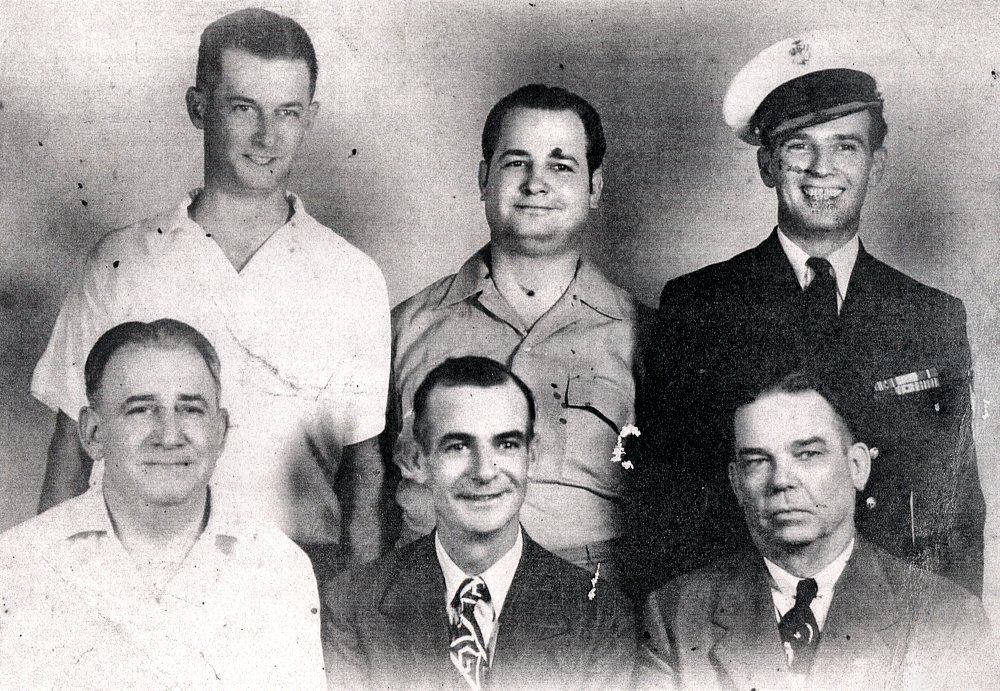
T.J. Soden family
[top. l-r: T.J. Soden Jr. (1912-ca 1951), Robert Soden (1914-1984) and James B. Soden (1914-1984)
[bottom. l-r: Ed Soden, Henry? Praytor, and Tom Praytor] Courtesy of Hydee T. Holland (1920-2005)
Theophile J. Soden
Theophile John Soden (1885-1934) married Mamie Praytor (1892-1965), an Alabama native. They reared three sons: Theophile J. Soden Jr. (1912-c. 1951), Robert Soden (1914-1984), and James B. Soden (1921-1996). Mamie Soden's father, Jeff Praytor (1861-1912), was a bridge building foreman for the L&N Railroad. Theo Soden worked for the L&N as a carpenter in New Orleans and in later life was the railroad bridge tender at Pascagoula. He died at NOLA on October 14, 1934 and his corporal remains were brought to Ocean Springs for burial in the Bellande Cemetery.
Edward J. Soden
Edward J. Soden (1887-1970) was born at Bay St. Louis. As a young man, Eddie Soden worked for the O'Keefes and baker, F.E. Schmidt, at Ocean Springs. He moved to Mobile. Soden married Essie Woolsey.
Gertrude Soden
Gertrude Soden (1893-1987) married Albert Flowers McGregor (1875-1945). McGregor was born at Covington, Tennessee, the son of Robert R. McGregor and Ada Martin. Albert McGregor worked as a linotype operator for the Jackson County Times at Ocean Springs. They had a daughter, Margaret Bolton.
JAMES SODEN
James Soden (1856-1910+) appears to have remained a bachelor. Before becoming employed as a railroad bridge carpenter in 1900, he and Caspar Vahle (1869-1922) in March 1899, opened a livery stable on the lot recently occupied by the old Soden and Illing stable on Robinson opposite the L&N Depot.
By 1910, James Soden was a merchant. The Soden store, known as the Big Pine Grocery, was located on the west side of Washington Avenue between Calhoun and the Knights of Columbus Hall. It was attached to a house, which may have belonged to Jacob Martin, on its northeast corner. James Soden's sister, Bridget, worked for him as a salesgirl in 1910. Soden may have died at Beaumont, Texas.
MARIE ANN SODEN
Marie Ann Soden (1857-1937), called Mollie, married Augustin von Rosambeau (1849-1912) in September 1879. von Rosambeau, a German immigrant from Schleswig-Holstein came to Ocean Springs to seek his fortune with Charles E. Pabst (1851-1920), a fellow countryman.
In March 1880, Mary Ann Rosambeau bought a tract of land on the southeast corner of Jackson and Calhoun from Margaret Foy (1840-1892), herself and Irish immigrant and the aunt of Ocean Springs merchant and schoolmaster, James Lynch (1852-1935). On this .70 acre tract, the Rosambeaus resided for the next ninety-two years.(JXCO, Ms. Land Deed Bk. 4, pp. 570-571)
The von Rosambeau family made their living in the mercantile and house rental business. In their store on Jackson Avenue, they sold groceries, boots, shoes, and hats. They owned two houses on Calhoun, and one on Jackson, which they rented to tourist and others. Nationally acclaimed sportswriter, Charles Dryden (1860-1931), was an annual visitor. He often wintered on Calhoun in his "Winter Rest". Dryden wrote a book, Off and On the Breadwagon, which featured the von Rosambeau children under fictitious names. The von Rosambeau children were: Amelia Clesi (1881-1958), Leonhard (1883-1931), Henrietta Margaret (1887-1972), and Blanche (1892-1982).
Margaret Soden
Margaret Soden (1860-1932) married John B. Honor (1856-1929) in June 1892. His parents were Thomas B. Honor (1821-1896), a native of Palermo, Sicily, and Bridget Lyons (1835-1924), an Irish immigrant who came to America in 1847.
John B. Honor was born at New Orleans and moved to Ocean Springs in 1909, after he and Mrs. Honor purchased "Many Oaks" (present day 315 Beach Drive) from Charles Stuart of Berrien County, Michigan.
Upon graduation from Soule Business College, Mr. Honor was employed by several companies involved in the coal bunkering business. He later got into stevedoring and built this enterprise into the largest on the New Orleans waterfront. The American Sugar Refinery and the United Fruit Company were his best contracts.
The Honors had an adopted daughter, Rita Brown Clark (1913-1985), who married Elwin R. Friar (1910-1970). They had a son, Robert Friar (b. 1932).
When John B. Honor bought "Many Oaks", it consisted of an estate of about thirteen acres fronting the beach just west of the Hotel Tract on Jackson Avenue. In 1915, there were five cottages, an artesian well, one hundred forty pecan trees and almost five hundred Satsuma orange trees on the property.
In the summer of 1918, local contractor, Fred Bradford (1878-1951) built a large, Dutch Colonial Revival home for Honor at "Many Oaks". This architectural masterpiece is now owned by Mary Zala Jensen.
John B. Honor died at "Many Oaks" in August 1929. He was survived by his wife, Margaret Soden, two sisters, Mrs. Rose Schully and Maria Honor (1865-1932), and daughter, Rita.
Bridget Soden
Bridget Soden (1864-1944), called Aunt "G" by the family, never married. She ran the Big Pine Grocery on Washington Avenue after her brother, James, died. The store was located on the west side of Washington between Joseph Street and Calhoun. A large white pine near the store gave it its name. Bridget Soden acquired the house and store which occupied the N/2 of Lot 15-Block 34 from Jacob Martin for $725 in July 1911.(JXCO, Ms. Land Deed Bk. 37, p. 114))
Miss Soden was a resident of the Edwards House at the time of her demise in April 1944. Her niece, Nell Benton, sold her Washington Avenue property to Alvin E. Loomis in May 1944.(JXCO, Ms. Land Deed Bk. 85, pp. 395-396)
__________________________________________________________________________________________________
STEELMAN GROCERY and FAMILY: "fenders, Fords, and food"
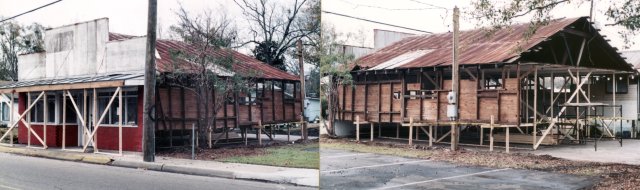
Steelman Grocery Building
[refurbished in 1996-1997 by Dr. Richard T. Furr, Sam Furr and Henry Furr, who managed the architectural, design, and construction details.]
[image by Ray L. Bellande Jan.-Feb. 1997]
The Young-Steelman building is located at 1210 Government Street in Lot 1 of Block 1 of the Kotzum Addition, Section 37, T7S-R8W. The Kotzum Addition land subdivision was plated from the Jean-Baptiste Seymour tract by Joseph Kotzum (1842-1915) and surveyed by Enoch N. Ramsay (1832-1916) in December 1894. Block No. 1 consists of nine lots and is bounded on the north by Government, east by the Duncan Minor Lot on Russell Avenue, south by Bowen Avenue, and west by the Joseph Bellande tract.(JXCO, Ms. Plat Bk.1, p. 3)
Joseph Kotzum
In the 1870s, Joseph Kotzum, a Bohemian immigrant, settled at Ocean Springs with his wife, Josephine Kotzum (1845-1920), and young son, Anton P. Kotzum (1871-1916). Anton, called Tony, was born at New Orleans. Mr. Kotzum made his livelihood initially as a blacksmith, but later acquired large real estate holdings and rental property throughout town. In the 1890s, Tony Kotzum, also a blacksmith, united with a young Canadian immigrant, Orey Alson Young (1868-1938), to form Young & Kotzum. This dynamic duo considered themselves “jacks of all trades" as they advertised possessing the following skills: machinists and plumbers, horseshoeing, and general blacksmithing, repairing of all kinds, makers of fine oyster knives.
In 1896, Orey A. Young went on his own and acquired the old Kotzum blacksmith shop on the southeast corner of Government and Kotzum. Here he built a building between 1915 and 1925, which later became the Marcus F. Shanteau garage and service station. Today, after a 1995 facelift and interior refurbishment by local contractor, Paul Campbell, for owner, Dr. Richard T. Furr and family, the old Young-Shanteau structure is called Palmetto Place. Artifacts, an upscale retailers of European antiques and eclectic home furnishings, operates here at 1201 Government Street.
In April 1915, shortly after her husbands demise, Josephine Kotzum sold Lot 1 of Block 1 and other properties at Ocean Springs to her son, Anton P. Kotzum. Tony Kotzum died shortly after this conveyance from his mother. His widow, Mrs. Julia Kotzum, sold her one-third interest in the lot to Orey A. Young Jr. (1892-1986) on July 1, 1919, for $215.(JXCO, Ms. Land Deed Bk. 41, pp. 383-385 and Bk. 47, p. 300)
Orey A. Young Jr. purchased the remaining interest in the tract for $650 from Alice Kotzum (1899-1919+) and Joseph F. Kotzum (1904-1925+), the children of Mrs. A.P. Kotzum. The sale was made to Mr. Young by Commissioner Fred Taylor in August 1919, following a forced heirship suit, Cause No. 3933, in the Jackson County Chancery Court. In the court hearing, Mrs. A.P. Kotzum deposed "that said land consists of a small tract of land or city lot with a small house or cabin situated thereon, which said house or cabin is out of repair because of a decayed roof which is leaking badly and decayed under-pinning and is therefore unfit for human habitation and is not now occupied".(JXCO, Ms. Land Deed Bk. 47, p. 143)
In the 1920s, Mrs. Julia Kotzum married W.W. Bryan and was residing at San Francisco. In 1918, Alice Kotzum was a ward of the East Mississippi Insane Hospital at Meridian. Joseph F. Kotzum moved to Fresno, California where he was a telegraph operator.
In the twilight years before her demise in June 1920, Josephine Kotzum was cared for at Ocean Springs, by her niece, the widow Anna Rott (1877-1947+), a New Orleans native and Chicago resident. Mrs. Rott inherited Josephine Kotzum's home at 1202 Bowen and other real estate, which consisted of several lots and rental homes in the city.
Orey A. Young Jr.
Orey A. Young Jr. (1892-1986) was a partner in the business Orey Young & Son. He and his father repaired automobiles and did blacksmithing, etc. at their County Road (Government Street) garage. They acquired the local Ford agency in November 1915, from W.B. Hollingworth of South Bend, Indiana. Circa December 1915, Orey A. Young, Jr. married Marinina Moran (1895-1973), a Biloxi girl, at the Back Bay home of her parents, Captain and Mrs. Francis D. Moran. Circa 1920, they erected a one-story, wood frame, bungaloid structure at present day 1212 Government, formerly the home of Mary Elizabeth "Sis" Steelman Hall (1918-2005), the spodue of Jack Schley Hall (1917-1989), but now a gift shop called “Chickadees”. Here the Young's reared their family: Audrey Y. Sterken (1918-2003?), Orey Alson Young III (1921-1921), Elaine Y. Miheve (1922-2008), Alan Young (1925-2001), Glenn Young (1925-2008), and Ethel Y. Robbins (1931-2010).
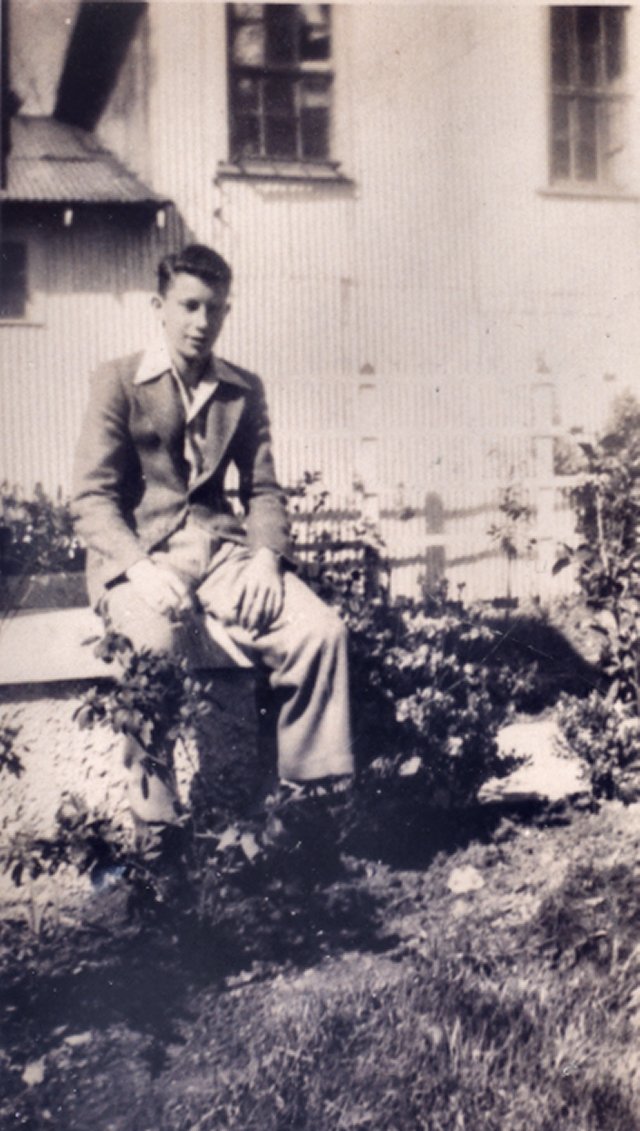
Young Building
[Ronald Steelman (1926-2002) with Orey Young's auto repair garage in background. Courtesy of Ronald Steelman-September 1997]
Young’s Garage
Between 1926 and 1933, Orey A. Young, Jr. built a 1400 square-foot, motorcar, repair garage just west of his home. The front of the structure had a second story. Orey A. Young Sr. maintained his living quarters here above the garage as well as a small workroom to analyze automotive electrical systems. Mr. Young took his meals at the venerable Ocean Springs Cafe of Marie E. Fayard (1884-1951) and Alex Fayard (1887-1958) across the street. The upper story of the Young Garage was removed after WW II. Otherwise, this is the basic building today on the Dr. Furr property, which has become known to later generations as the "Old Steelman Grocery" or "Salvation Army" building. The Orey A. Young, Jr. family lost their Government Street home and commercial garage for taxes ($141.77) in September 1933, during the Great Depression. They moved to Long Beach, California for a brief period before returning to Ocean Springs.
Upon returning from the West Coast, Orey A. Young Jr. opened a garage in the 600 block of Washington Avenue on a lot acquired by his sons, Alan and Glenn Young, in December 1945, from M.C. Sherman, a Biloxi realtor.
The Ocean Springs State Bank became the owner of the Kotzum Addition lot and improvements created by the Youngs on Government Street, and now posessed by the Furr family. The bank conveyed it to Charles J. Steelman, Viola M. Steelman, Charles Arnold Steelman, and Allan Steelman in March 1939 for $3307.(JXCO, Ms. Land Deed Bk. 72, pp. 249-25)
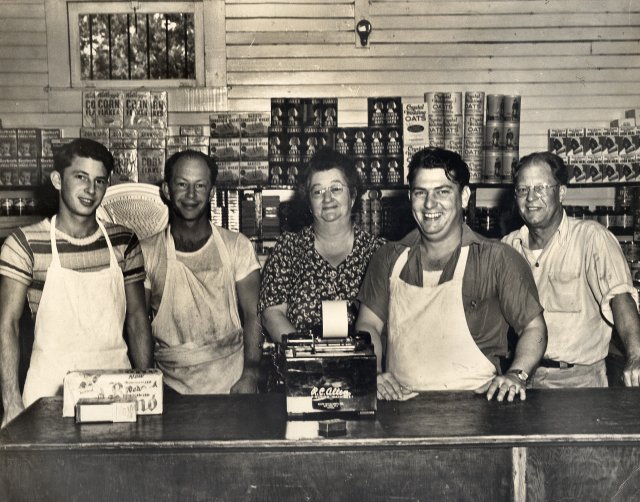
Steelman family in store circa 1941
[L-R: Ronald Steelman; Charles Arnold 'Pee Wee' Steelman; Viola McClellan Steelman; Ernest Steelman; and Charles J. Steelman. Courtesy of Ronald 'Bo' Hall]
The Steelmans
The family progenitor, Charles J. Steelman (1889- 1957), was born at Hattiesburg, Mississippi. He married Viola McLellan (1892-1966) of Geneva, Alabama circa 1912. She was the daughter of Peter and Jeanette McClellan. The children of Charles and Viola Steelman were: Charles Arnold "Pee Wee" Steelman (1914-1970); Allan B. Steelman (1915-1988); Emmett Steelman (1922-1975); Ernest Steelman (1922-1983); Peter Steelman; Mary Elizabeth "Sis" S. Hall (1918-2005) married Jack Schley Hall (1917-1989); Vivian “Shang” S. Moore Snyder Crysell (1920-2003) married Moore, Snyder, and Claude W. Crysell (1907-1995); Richard A. Steelman (1923-1987); and James Ronald Steelman (1926-2002). Before their arrival in Ocean Springs, the Steelman lived in the following locals:
Perry County, Mississippi
In 1900, Charlie J. Steelman worked as a farm laborer while his father worked in the timber industry in Beat 3, Perry County, Mississippi. Allen B. Steelman and Sarah Ezell Steelman, in addition to Charles J. Steelman, were the parents of: Ida Steelman (1886-1900+); Allen Steelman (1888-1900+); Ernest Steelman (1891-1900+); Ada Steelman (1893-1900+); Otis Steelman (1898-1900+); and Mollie Steelman (1899-1900+).(1900 Perry County, Mississippi Federal Census, T623 824, p. 10A, ED 91)
Florida
The Charles J. Steelman family lived for a brief time in Florida, as their first child, Charles A. Steelman, was born there in 1914. The remainder of the Steelman children were Mississippi natives.
Hattiesburg, Mississippi
In 1920, the Charles J. Steelman family lived on East 5th Street in Ward 4 of Hattiesburg, Mississippi. Mr. Steelman made his livelihood as a butcher.(1920 Forrest County, Mississippi Federal Census, T625_875, p. 3A, ED 13)
Lamar County, Mississippi
In 1930, the Charles J. Steelman family was residing on Sumrall Road in Beat 4 of Lamar County, Mississippi. Mr. C.J. Steelman made his livelihood as a farmer.(1930 Lamar County, Mississippi Federal Census, R1152, p. 17B, ED 6)
Ocean Springs
The Steelman family came to Ocean Spring in March 1938, from Birmingham, Alabama, at the request of a son, Charles Arnold Steelman (1914-1970), called "Pee Wee". Pee Wee Steelman worked in Biloxi, for Jaubert J. Viator (1905-1981), a grocer and himself a transplant from Erath, Louisiana in the heart of Acadiana. Depression times were difficult for everyone. The Steelmans, like many others, felt that an economic opportunity to better their lives lie here on the Mississippi Gulf Coast. The family progenitor, Charles J. Steelman (1889- 1957), was born at Hattiesburg, Mississippi. He married Viola McLellan (1892-1966) of Geneva, Alabama circa 1912. She was the daughter of Peter and Jeanette McClellan. The children of Charles and Viola Steelman were: Charles Arnold "Pee Wee" Steelman (1914-1970); Allan B. Steelman (1915-1988); Emmett Steelman (1922-1975); Ernest Steelman (1922-1983); Peter Steelman; Mary Elizabeth "Sis" S. Hall (1918-2005) married Jack Schley Hall (1917-1989); Vivian “Shang” S. Moore Snyder Crysell (1920-2003) married Moore, Snyder, and Claude W. Crysell (1907-1995); Richard A. Steelman (1923-1987); and James Ronald Steelman (1926-2002).
Before going into private business with only $37 in his pocket, Mr. Charles J. Steelman and several family members worked for J.J. Viator at the Black and White Store (formerly George Bradshaw's) on the northwest corner of Government and Handy. They lived in the old, two-story house adjacent to the market building. In April 1939, while his Government Street building was being readied, Charles J. Steelman temporarily opened the Steelman Meat Market on the east side of Washington Avenue, adjacent to McFarlands Variety Store, between Bowen and Government. This business was formerly the K.C. Meat Market.
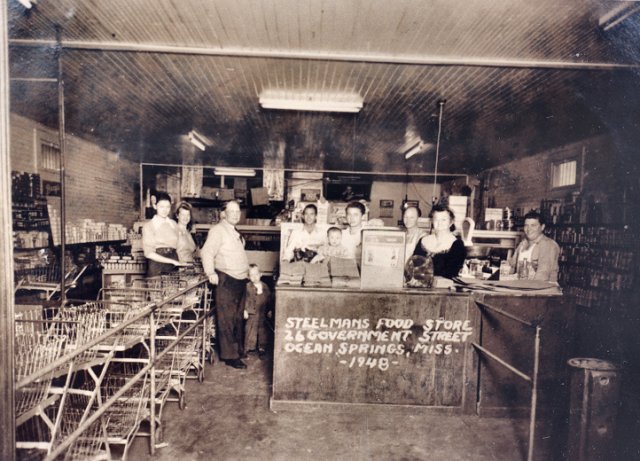
Steelman Grocery 1948
[Courtesy of Ronald Steelman -September 1997]
[L-R: unknown; Vivian 'Shang' Steelman; Charles J. Steelman; unknown child; Richard Steelman; unknown baby; Ronald Steelman; Charles A. 'Pee Wee' Steelman; Viola McClellan Steelman; and Ernest Steelman.
In May 1939, at 35 Government Street, in their refurbished structure, recently acquired from the Ocean Springs State Bank, the Steelman's Food Store and Meat Market commenced business. Market specials for the weekend of May 13, 1939, as advertised, in The Jackson County Times were: Veal Chops, $.15 per lb. Veal Rump Roast, $.16 per lb. Choice Beef Chuck Roast, $.16 per lb. Salt Meat Plate No. 1, $.10 per lb. Pure Lard, 2 lbs. for $.17
Mr. Steelman paid himself a salary of $12.50 per week. Other grocery store operators during the World War II years and post-War years at Ocean Springs were: Gottsche's Thrifty-Nifty on Washington at Desoto, Eglin's on Washington between Desoto and Porter, VanCleave's on Washington at Porter, Black & White of J.J. Viator, Jr. on Government, the Ocean Springs Fruit Market of Mr. and Mrs. C.C. McLellan on Washington at Bowen, and the Curb Market Grocery of Matthew "Motto" Talanich on US 90 and Vermont (now M.L. King, Jr.) which was the precursor to Broome's Foodland.
In September 1942, Allan B. Steelman sold his interest in the property for $1130 to the original Steelman group. He joined the military and later the Baptist ministry at Memphis, Tennessee. Peter and Ernest Steelman also became Baptist ministers. A self-effacing, family joke told by Pee Wee about himself and his brothers was: "my parents had seven son, three preachers and four crooks".(JXCO, Ms. Land Deed Bk. 77, p. 142 and Ronald Steelman)
In November 1943, Pee Wee and Virginia Steelman sold their interest to his parents, Charles J. Steelman and Viola Steelman for $3446. Pee Wee joined the Merchant Marines while younger brother, Ronald, went into the U.S. Navy. With the Steelman men off at war, the store closed for several years. An advertisement in The Jackson County Times on February 16, 1946, stated that Steelman's Food Store and Meat Market reopened for business on February 14, 1946.(JXCO, Ms. Land Deed Bk. 84, pp. 73-74)
The Steelman family removed the second story of the old Young Garage structure after WW II. Pigeons had taken it over as a roosting site. This change left the basic building, which has remained until the recent remodeling and construction. In June 1952, Mr. Charles J. Steelman sold an undivided 1/2 interest in the west thirty feet of Lot 1, Block 1 with "all improvements thereon and all fixtures and equipment in the building thereon said property being situated on the south side of Government Street and known as the Steelman Food Store" to his son, Pee Wee Steelman and daughter-in-law, Virginia Steelman.(JXCO, Ms. Land Deed Bk. 125, p. 82)
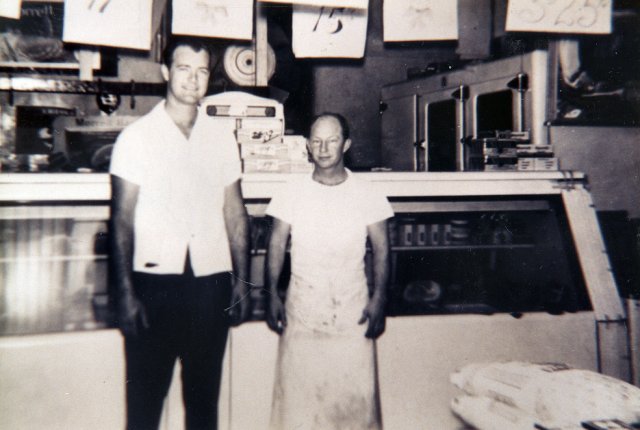
Charles A. 'Pee Wee' Steelman
[L-R-John Clifton and Pee Wee Steelman. Courtesy of Ronald Steelman-September 1997]
January 1958, after their father, Charles J. Steelman, had passed on, his heirs sold all their interest in the grocery store property to Pee Wee Steelman and Virginia Steelman. The consideration was that their mother, Viola M. Steelman, receive $260 per month for the remainder of her natural life. Ronald Steelman, the youngest of the seven Steelman lads, recalls that his first job at his father's Government Street store was to prepare live chickens for the meat market. The chickens were kept in a pen behind the store. Some customers preferred to buy them alive and slaughter and dress them at home. Later, Ronald Steelman took his years of experience as a grocery man to Butler, Alabama were he was the proprietor of a Jitney Jungle Store.(JXCO, Ms. Land Deed Bk. 178, pp. 387-388)
Richard Steelman once owned a small store on Highway 57 at Vancleave, competing unsuccessfully with C.L. Dees (1886-1963). Ronald Steelman remembers that to keep their grocery business operating efficiently, it had to be continuously supplied with produce, staple goods, fresh meat, and poultry. On Wednesday, Pee Wee Steelman would drive a two-ton truck to the French Market at New Orleans to purchase fresh vegetables. Hubert Mallette of the Fort Bayou community would also supply the shop with fresh garden produce from his fields. Local cattle and pigs could be purchased for $15-$20 and prepared for market at Byrd's, a slaughterhouse, on the Ocean Springs-Vancleve Road.
On some occasions, wholesale grocers from Mobile were employed to supply the Steelman Grocery. Beverly Dalgo (1917-2003), a native son, who represented the John Morrell meat packers from that city, often called on the Steelmans. Generally, the Steelman's handle seafood, but on occasions would purchase shrimp or fish from local boatmen. In former times, staples, such as sugar, beans, etc. came in 100-pound bags from the wholesaler, and had to be weighed and transferred into smaller containers for resale to customers. Candy came in 30-pound boxes and during the festive Christmas season, Mr. Steelman was especially generous as he told his children to indulge themselves in these sucrosic treats as they packaged the candy bags. In the early 1960s, Pee Wee Steelman closed the store and went to work for Curmis Broome. At the time of his demise, he was employed at Broome's in the meat market as a butcher.
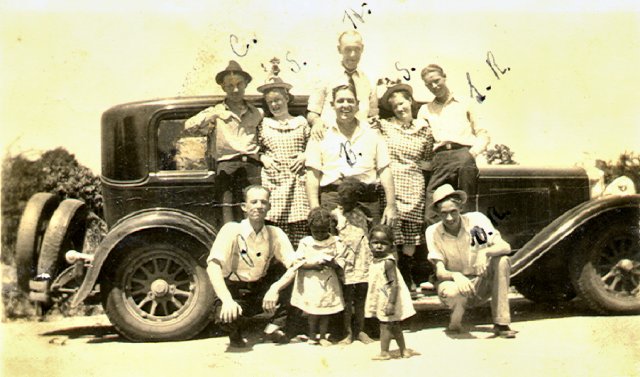
Touring car and band circa 1936
The Singing Steelman Sisters
In July 1936, Mary Elizabeth “Sis” Steelman (1918-2005) and her sister, Vivian “Shang” Avice Steelman (1920-2003), recorded “country” songs at Hattiesburg, Mississippi. H.C. Speir, a Jackson based talent scout, and W.R. Calaway, recording director, of the American and Brunswick Record Corporations established a temporary recording studio in the Hattiesburg Hotel at Mobile Street and Pine Street. Here Sis and Shang Steeleman made four, 78 rpm recordings on the Perfect recording label: I'm Drifting Back to Dreamland; Those Rambling Blues; Cowgirl's Prayer; and Lonesome Valley Sally. Others to record here at this time were: the Mississippi Jook Band, Roosevelt and Uaroy Graves, the Edgewater Crows, the Gold Star Quartette, Rev. R. H. Taylor, the Laurel Firemen's Quartette, the Madden Community Band, and several blues acts whose songs were never released: Sunny Spencer and Boy Pugh, Zeke Bingham and Monroe Chapman, Johnson and Lee, Rajah Evans (Jaybird), Benjamin Scott, and Shep and Cooney.(www.visitmississippi.org/press_news/20081014-RootsRockRoll.pdf and Walker, UNC, 1997)
On October 18, 2008, a Mississippi Blues Trail historical marker was placed at 614 Mobile Street in Hattiesburg, Mississippi commemorating the July 1936 recording session. It is considered a defining moment in the Birth of Rock and Roll music in America.(www.visitmississippi.org/press_news/20081014-RootsRockRoll.pdf )
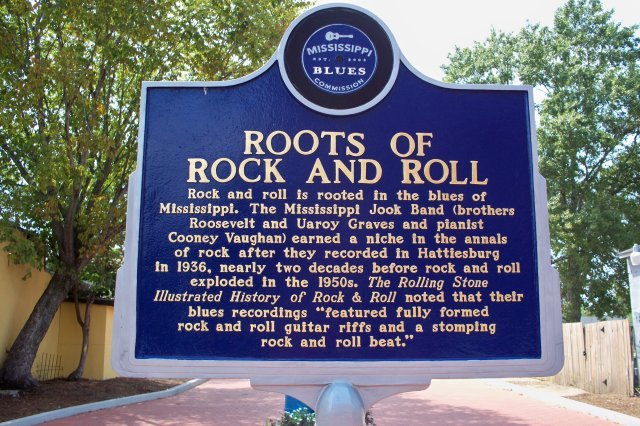
Sis Steelman [circa 1936] and Mississippi Blues Trail Marker at Hattiesburg.[Marker images by Ray L. Bellande, Sept. 2, 2009. Brooke Roberts Cruthirds, a contributor to the Blues marker is in the third image.]
Mary Elizabeth “Sis” Steelman
Mary Elizabeth "Sis" S. Hall (1918-2005) was born September 28, 1918 in Mississippi. She married Jack Schley Hall (1917-1989) on January 9, 1939 at Biloxi, Mississippi. Judge Dewey Lawrence presided at their nuptial ceremony held in his office at City Hall. Jack S. Hall made his livelihood as a house painter at the time of his marriage to Sis Steelman. Their children were: Jackie Steelman m. Robert Mitchell; Vivian Steelman m. and Joseph Wall; and Ronald McDonald Steeleman (b. 1940) m. Lorraine Gale Murphy (b. 1942).(The Jackson County Times, January 21, 1939, p. 3)
Mary Elizabeth (Sis) Hall [obituary]
Mrs. Mary Elizabeth (Sis) Hall, 87 of Ocean Springs died Wednesday, November 16, 2005 at the Driftwood Nursing Center in Gulfport. A lifelong resident of Ocean Springs, Sis was Past Worthy Matron of Adah Chapter No. 49. Serving on many committees, she was most proud to serve as Grand Matron of ? in 1980-1981. She attended general grand Chapters in Anaheim. California, Atlanta, Georgia, and St. Louis, Missouri and received the Eastern Star fifty year membership pin in 1991. Sis was appointed Grand Representative to the Province of Saskatchewan 1996-1998. As a past president of the Ocean Springs Garden Club, Sis was always eager to create many award winning flower arrangements and was happy to appear wearing her orchid ante-Bellum gown and big picture hat. Anyone who knew Sis, knew her heart and home were always filled with kindness and love for everyone as well as her love for singing and playing guitar.(The Sun Herald,
She was preceded in death by: her husband, Jack S. Hall; her parents, Charles and Viola Steelman; seven brothers, Charles (Pee Wee) Steelman, Reverend Allen Steelman, Reverend Ernest Steelman, Emmit Steelman, Richard Steelman, Ronald Steelman, and Reverend Pete Steelman; and a sister, Vivian (Shang) Crysell.
Survivors include: two daughters, Jackie (Bobby) Mitchell and Vivian (Joe) Wall; a son, Ronald “Bo” (Gale) Hall; six grandchildren, eleven great-grandchildren, and one great great grandchild. Visitation and services at the Ocean Springs chapel of Bradford-O’Keefe on November 19, 2005. Burial following at the Evergreen Cemetery, Ocean Springs, Mississippi.
Vivian 'Shang' Steelman ca. 1920
Vivian “Shang” A. Steelman
Vivian “Shang” Avice S. Moore Snyder Crysell (1920-2003) was born May 6, 1920 in Mississippi. On , 19 , she married Charles W. Moore, a Texan: one son, William “Billy” C. Moore (1942-2003) who married Juanita Walden; married Edward C. Snyder (1919-1982): one son, Dale Snyder; and Claude W. Crysell (1907-1995).(JXCO, Ms. Circuit Court Marriage Record Bk. 31, p. 176, Bk. 47, p. 18, and Bk. 135, p. 3)
Shang Steelman expired at Ocean Springs on October 9, 2003. Her corporal remains interred in the Crestlawn Cemetery at Ocean Springs, Mississippi.(The Sun Herald, October 11, 2003, p. A7)
Salvation Army
In May 1972, Virginia Steelman sold the former Steelman Food Store building to Margaret B. Chasteen (1917-1977). The next month, June 1972, Mrs. Chasteen conveyed the structure to her sister, Eleanor B. Lemon. The J.K. Lemon family maintained the property and allowed the Salavtion Army to operate here until December 1986, when Mr. and Mrs. J.K. Lemon conveyed the old Young- Steelman structure to The Salvation Army, a Georgia Corporation. The Salvation Army maintained a thrift store here for many years. In February 1996, The Salvation Army of Lawrenceville, Gwinnett County, Georgia sold the thrift shop to Richard T. Furr and Rosemary Furr. That benevolent Christian organization has relocated to the Buford Myrick Building at 2211 Government Street.(JXCO, Ms. Land Deed Bk. 429, p. 265, Bk. 606, p. 596, Bk. 877, p. 210. and Bk. 1084, p. 4)
Government Street revival
Since Lynn Ann Linenberger (formerly of San Mateo, California) and Marilyn Lunceford commenced the "Renaissance of Government Street" with their respective openings of the Old Blue House Restaurant (now The Todd Boswell Salon) in 1992, and Favorite's Book Store in 1993, the Richard T. Furr family has forged ahead with several avant garde projects along old Highway US 90. The Furrs' first execution was Magnolia Square, a modern, office-suite complex, at 1716 Government, adjacent to Dr. Furr's medical building. Palmetto Place at 1201 Government was completed in 1996, and in 1997, the "Old Steelman Grocery" complex was effected. Dr. Furr's structures are family affairs as sons, Sam Furr and Henry Furr, manage architectural, design, and construction details. Dr. Furr's building are complemented and characterized by the motif ceramic tiles of his daughter, Margaret F. Barnett, an accomplished artist, who resides at Branson, Missouri. Descendants of a pioneer Ocean Springs family that relocated to Biloxi years ago, the proprietors of the Stark Contracting Company, were engaged to refurbish the old Steelman Grocery and build a 2000 square-foot addition now consisting of two commercial office spaces. The first tenants of the new structures are attorneys, Sara Berry and Daphne L. Pattison, and an art conservator, Richard White.
Bayview Gourmet
[ceramic tiles by Margaret Furr Barnett]
[image by Ray L. Bellande September 1997]
Bayview Gourmet
The original Young-Steelman building is now leased to Mary Ratliff and Robert Murray. They operate The Bayview Gourmet, an eatery, coffee shop and catering business. Ms. Ratliff conducts her cafe business with the able assistance of her daughters, Tracy R. Stanley and Karrie R. Seymour. The Ratliff clan, an Air Force family with Pennsylvania roots, arrived here circa 1970. With her children grown, Mary Ratliff began a gourmet basket and catering enterprise at home. Immediately successful, she soon outgrew her domestic quarters. Mary realized the potential of a social cafe at Ocean Springs and decided to combine her other food enterprises under one roof at 1210 Government Street. Voici, the Bayview Gourmet!
The Bayview Gourmet kitchen is staffed by veteran chef, Chuck Fry, and culinary apprentice, Chris Back, a student at the USM Culinary Arts Academy at Long Beach. This combination of experience and youth produces appetizing soups, salads, and sandwiches from an interesting menu designed by Ms. Ratliff. There are desserts and also a breakfast. In addition to its local patrons, the Bayview Gourmet has developed a culinary rapport with food aficionados in the southeast region. Mary Ratliff welcomes and encourages local artists to utilize her yellow walls to exhibit their works.
Bayview Gourmet moved in mid-March 2003 to 1010 Robinson Street opposite the old L&B Depot. Building owned by Jack Stevens, proprietor of Salmagundi.
Chile Poblano
[image by Ray L. Bellande September 4, 2004]
Chile Poblano
Chef Demetrio Marquez, known as Chef D, opened in June 2003. Food based on those found in Southwestern states and Mexico. Twenty-four years of experience in the restaurant business and professional chef for eighteen years. Employed with the Beau Rivage Casino resort for four years as Banquet chef and garde manager.(The Ocean Springs Record, July 17, 2003, p. A4)
Chile Poblano closed it doors in early March 2005.
Government Street Grocery
In mid-March 2005, Patrick Sullivan, from Sullivan’s Hollow, Smith County, Mississippi began to refurbish the Furr building in preparation for opening his Government Street Grocery. Sullivan plans to vend daily specials of American eclectic food a’ la Henrietta’s, a legend in Ocean Springs eateries, which closed on May 20, 1995, after over fifty years of service. The Government Street Grocery opened in June 2005.(The Mississippi Press, June 29, 2005, p. 3)
Acknowledgements
Thanks to Ronald 'Bo' Hall, Shirley and Ronald Steelman, Elaine Y. Miheve, Charles A. Fayard, and Mr. and Mrs. J.K. Lemon for their kind assistance with this article.
REFERENCES:
Journals
The Daily Herald, "C.J. Steelman", December 28, 1957, p. 2.
The Daily Herald, "Mrs. Viola M. Steelman", October 10, 1966, p. 2.
The Mississippi Press, “Ocean Springs Press’, “Government Street Grocery Restaurant”, June 29, 2005, p. 3
The Jackson County Times, “Hall-Steelman”, January 21, 1939.
The Jackson County Times, "Steelman Grocery Ad", April 1, 1939, p. 4.
The Jackson County Times, "Steelman Grocery Ad", February 16, 1946, p. 4.
The Ocean Springs Record, "Pee Wee Steelman Dies", October 22, 1970, p. 1.
The Ocean Springs Record, “Edward C. Snyder”, July 29, 1982.
The Ocean Springs Record, “Chile Poblano brings new taste”, July 17, 2003, p. A4.
The Sun Herald, “Mrs. Vivian “Shang” Crysell”, October 11, 2003.
The Sun Herald, “Mrs. Mary Elizabeth (Sis) Steelman”, November 19, 2005, p. A11.
SWEDISH FAMILIES of OCEAN SPRINGS
At the turn of the 20th Century several Swedish families settled east of Ocean Springs, primarily on Government Street, the Old Spanish Trail, between present day Holcomb Boulevard and Hunter Road. Some of these Swedish tracts, particularly the Lindstrom and Nelson lands, extended as far north as Old Fort Bayou and are still in the possession of their descendants. The Swedes, who came to Ocean Springs at this time, were primarily professional people, engineers and medical men, who were recent immigrants and had made their livelihoods in Chicago. At Ocean Springs, they for the most part lived in semi-retirement as pecan farmers and citrus orchardist.
ALBERT B. ACKANDER (1858-1926) and “Oakess”
Albert B. Ackander (1858-1926) was a Swedish immigrant arriving on the shores of America in 1891. He was born April 3, 1858, at Wishy on the island of Gotland. A.B. Ackander went to Chicago in 1892, and was employed at the United States Engineer's office. He was married to Anna Maria Nilsson (1870-1950+), also a Swede, and the daughter of Olaf Nilsson and Fredericka Hanson. Failing health compelled Mr. Ackander to seek a milder climate in the southern United States.(The Jackson County Times, February 13, 1926, p. 1)
In March 1903, Mr. Ackander bought 18.5 acres of land east of Ocean Springs from F.M. Weed (1850-1926) and E.S. Davis (1859-1925). This tract was situated in the NE/4 and the SE/4 of the NW/4 of Section 28, T7S-R8W, south of the L&N right-of-way. The consideration was $570. More familiarly, the Ackander land was situated on Government Street between present day Hanley Road and Pine Hills Drive and going south about 900 feet.(JXCO, Ms. Land Deed Bk. 26, pp. 187-188)
Here, near the Jacques Bertuccini farm, Albert B. Ackander began a successful homestead, which he called “Oakess”. By January 1904, he had already plowed a large portion of his tract and had immediate aspirations to develop pe
can and citrus orchards. Although Mr. Ackander was not ready to retire from his lucrative government job in Chicago, he was planning to build a house and appropriate outbuildings on his Ocean Springs farm.(The Progress, January 30, 1904)
Among the Chicago friends of the Ackanders were Dr. Carl Lindstrom and spouse, who would later migrate to Ocean Springs. In mid-September 1910, the local journal related the following: Mrs. C. Lindstrom, of Chicago, who arrived in Ocean Springs last week for an extended stay with Mr. and Mrs. A.B. Ackander, was called home Thursday to the bedside of her brother who was probably fatally injured in a street car accident. Telegrams to Mrs. Lindstrom announced that he had sustained several fractures of the skull and was in an unconscious and dying condition.(The Ocean Springs News, September17, 1910)
Ackander’s orchards
With hard work, the Ackander farm flourished and the Swede annually shipped hundreds of pounds of nuts to Norway, Sweden, and domestic markets. Mr. Ackander also grew persimmons and by late 1910, he was shipping his Japanese persimmons to city markets. The printing department of The Ocean Springs News had an order to print about 3000 tissue wrappers for his fruit. Each persimmon was individually wrapped in a sheet of pink tissue paper on which was printed Mr. Akander’s name, address, the name of the fruit, and directions on when and how to eat the persimmons.(The Ocean Springs News, October 1, 1910)
During WW I, A.B. Ackander was employed as a concrete construction engineer at the Chickasaw Shipyard near Mobile, Alabama. He came home on weekends to be with Mrs. Ackander at Oakess, their country home.(The Jackson County Times, September 21, 1918, p. )
By 1922, A.B. Ackander’s pecan and citrus orchards were an economic success. In late November 1922, he sent four hundred pounds of paper shell pecan to his native land. This shipment was sent by parcel post and consisted of twenty, twenty-pound boxes. The Ackander delivery was the largest ever sent to a foreign shore from Ocean Springs. In the same context, J.C. Wright (1879-1941) had received an order from Africa for some pecan seedlings.(The Jackson County Times, December 2, 1922)
Albert B. Ackander also cultivated a most amazing Satsuma orange tree. It was sixteen-feet tall. In November 1922, over three thousand oranges were hanging on its branches. If Ackander sold these oranges for twenty cents a dozen, the crop from this one tree would bring him $150.00 (sic).(The Jackson County Times, November 11, 1922)
In September 1924, Mr. Ackander was vending Scuppernong grapes.(The Jackson County Times, September 20, 1924, p. 1)
In mid-October 1925, Albert B. Ackander and Theo Bechtel (1863-1931) went to Selma, Alabama to attend the National Pecan Growers convention. Prominent pecan orchardist from the southeastern United States were in attendance.(The Jackson County Times, October 10, 1925)
Sold the farm
Before his demise in February 1926, the Ackanders sold their and eighteen-acres of orchards to the Katherine Crandall Ver Nooy (1863-1953), a native of Courtland, New York and the widow of Charles B. Ver Nooy (1860-1921), the vice president and treasurer of the Illinois Brick Company of Chicago. Mrs. Ver Nooy had resided at present day 321 Cleveland Avenue at Ocean Springs since 1913. She later married Edward W. Van Alstyne (1875-1939).
The Ackander orchards were bounded on the north by Government Street, east by Hanley Road and included all that area encompassed by Lafayette Circle. In the May 1925, warranty deed to Mrs. Ver Nooy, the Ackander property was described as: twelve acres more or less in the W/2 of the S/2 of the NE/4 of the NW/4, south of and fronting on the right-of-way of the L&N Railroad and six acres in the W/2 of the N/2 of the SE/4 of the NW/4 of section 28, T7S-R8W.(JXCO, Ms. Land Deed Bk. 55, pp. 302-303)
The Ackanders retained their home and ten acres east of their orchards. Today this site would have a 600-foot frontage on Government Street and about 800 feet on Pine Hills Drive.
A.B. Ackander passes
In the winter of 1925, A.B. Ackander became ill. His sickness progressed steadily and he met death on February 11, 1926, at his residence on the Old Spanish Trail. Harry Randolph Lee (1903-1951), editor of The Jackson County Times, eulogized the old Swede as: “a citizen of the highest type, honest and fair in his dealings with his fellow man, progressive in thought and a warm supporter of any movement for the betterment of this section.” His corporal remains were brought from the Ackander home to the Evergreen Cemetery on Old Fort Bayou for burial. The Reverend Lowndes A. Darsey (1849-1929) ministered at his funeral. Ackander’s pall bearer’s were: Gus Nelson (1896-1970), Otto Gustafson, J.T. Thompson, Frank Gillespie, E.W. Illing Sr. (1870-1947), and J.C. Ackley.(The Jackson County Times, February 13, 1926, p. 1)
Mr. Ackander wrote his last will and testament at Chicago in January 1901. He designated his wife as his sole legatee and executrix. Mrs. Ackander’s inheritance was valued at approximately $12,000.(JXCO, Ms. Chancery Court Cause No. 4661-March 1926)
Return to Sweden
In June 1927, Mrs. Ackander and her sister, Miss Emma Nilsson took a five-month holiday to Sweden and other European countries were they visited relative and friends. They returned to Ocean Springs in October 1927 in good health and spirits.(The Jackson County Times, October 8, 1927, p. 2)
L&N collision
In January 1944, Anna Maria Ackander was hit by an L&N Railroad freight train as she attempted to cross the tracks at Dr. Lindstrom’s crossing in her motorcar. Mrs. Ackander’s car was pushed by the L&N locomotive for a distance of about 200 feet. Miraculously, she escaped from the accident with slight bruises. Her car was badly damaged.(The Jackson County Times, January 22, 1944, p. 1)
Ben F. Drake-Ed Barq Jr.
In June 1944, several months after the demise of her sister, Emma Nilsson, Mrs. Anna M. Ackander conveyed her home and land on the northeast corner of Government Street and Pine Hills Drive to Benjamin F. Drake (1868-1957) and his wife, Blanche Robinson Drake (1872-1972). The consideration was $5100.(JXCO, Ms. Land Deed Bk. 85, p. 501)
B.F. Drake was born at Nashville, Tennessee. He and his family came to reside in Ocean Springs in 1942. Mr. Drake had been a railroad foreman, probably with the L&N. Blanche Robinson Drake was a native of Pulaski, Tennessee. The Drakes both expired at Ocean Springs and their corporal remains rest eternally at Crestlawn Memorial Park cemetery, east of Ocean Springs.(The Ocean Springs Record, August 24, 1972)
The Drakes including their son, Ben F. Drake Jr. (1896-1962) and spouse, Eva T. Drake (1908-1974), sold the east half of the Ackander place to Ed Barq Jr. in January 1951, for $9700.(JXCO, Ms. Land Deed Bk. 115, pp. 333-335)
AGNES H. NILSSON (1854-1936) and EMMA NILSSON (1855-1944)
Agnes Helen Nilsson (1854-1936) and Emma Nilsson (1855-1944) were born at Ystad, Sweden, the daughters of Olaf Nillson and Frederika Hanson. They were the sisters of Anna Maria Nillson, the spouse of Albert B. Ackander. In July 1904, Frederick Mason Weed (1850-1926) and Elias S. Davis (1859-1925) conveyed to Miss Agnes H. Nilsson 25.13 acres in Section 28, T7S-R8W described as: the W/2 of the SW/4 of the NE/4 and the W/2 of the NW/4 of the NE/4 lying south of the L&N Railroad right of way. (JXCO, Ms. Land Deed Bk. 28, p. 387)
Agnes Helen Nilsson settled at Ocean Springs in 1912. She was an invalid. Agnes expired at the home of Anna Maria Ackander on September 12, 1936. Her corporal remains interred in the Evergreen Cemetery under the auspices of the Methodist Church, the Reverend A.B. Barry, presiding.(The Jackson County Times, September 16, 1936)
Prior to her demise, Miss Agnes H. Nilsson had conveyed her land in May 1925, to George and R.H. Seymour of Meridian, Mississippi.(JXCO, Ms. Land Deed Bk. 56, p. 288)
In March 1903, Albert B. Ackander sold his sister-in-law, Emma Nilsson 8.48 acres in Section 28, T7S-R8W, described as: 5.81 acres in the W/2 of the S/2 of the NE/4 of the NW/4, south of the L&N right-of-way and 2.67 acres in the W/2 of the N/2 of the SE/4 of the NW/4.(JXCO, Ms. Land Deed Bk. 36, p. 531)
Emma Nilsson passed on January 16, 1944, at the home of her sister, Anna Maria Ackander, her only surviving relative. Her remains were passed through the Methodist Church with burial in the Evergreen Cemetery.(The Jackson County Times, January 22, 1944, p. 4)
DR. ALFRED HAKANSON (1866-1920+)
The Hakanson-Strale-Harvey Farm
In April 1906, Dr. Alfred Hakanson (1866-1920+) and spouse, Bertha Wilhelmina Lindberg Hakenson (1870-1920+) of Chicago bought 18.5 acres in the N/2 of the NE/4 of the NW/4 of Section 28, T7S-R8W from Frederick Mason Weed (1850-1926) and Elias S. Davis (1859-1925) for $185.(JXCO, Ms. Land Deed Bk. 31, pp. 130-131)
Alfred Hakanson was born on May 12, 1866 at Geneseo, Illinois, the son of John Hakanson (1817-1866+) and Hannah Pearson (1823-1891). Dr. Hakanson’s parents were born in Sweden and had immigrated to America in 1860. John Hakanson and Hannah Pearson married in Sweden in December 1847. Two of their five children were born in Sweden before their settling in Henry County, Illinois.(Album of Genealogy and Biography-Cook County, Ill., p. 407)
John Hakanson moved his family from Illinois to Iowa before settling permanently in 1874, on Government land situated in Clay County, Nebraska. Alfred Hakanson grew up on farms and was educated at Oakland and Wahoo, Nebraska before matriculating to Augustana College in Rock Island, Illinois. In 1886, he began to study medicine. Hakanson apprenticed himself to two medical men in Omaha, Nebraska before graduating from the Medical Department of the University of Omaha in 1890. After a year at Rockford, Illinois, Dr. Hakanson moved his practice to South Chicago. Here he met and in May 1892, married Bertha W. Lindberg, a native of Chicago and the daughter of Martin A. Lindberg (1836-1920+), an 1864 Swedish immigrant, and Mary C. Olson, also a Swedish immigrant. At Chicago, the Hakanson family resided on Wilson Avenue [1910] and Bryn Mawr [1920]. They had a daughter, Evelyn Hakanson (1906-1920+).(Ibid., p. 407 and 1920 Cook Co., Illinois Federal Census T625_341, p. 4B, ED 1433)
Dr. Alfred Hakanson was a member of the South Chicago Medical Society and the American Medical Association. In 1895, he studied clinical medicine and gynecology at the New York Post-Graduate Medical School. Politically, he was a Republican.(Ibid., p. 407)
Dr. Hakanson’s land at Ocean Springs was directly north of the Ackander parcel on Government Street.
ALLAN STRAHLE (1860-1915)
In March 1913, Alfred Hakanson sold his farm to Allan Strale (1860-1915) of Chicago. Mr. Strale was a construction engineer for Inland Steel Company at Chicago. He had been educated in Sweden and was a graduate of the University of Stockholm. One of Strale’s engineering projects was to assist in the layout of Gary, Indiana. Mr. Strale’s son, Nels Strale, was also an engineer who resided in at St. Louis. The Strale’s called their home and pecan orchard at Ocean Springs "Allandale". Allandale consisted of eighteen and one-half acres situated in the N/2 of the NE/4 of the NW/4 of Section 28, T7S-R8W. Mr. Strale died at Ocean Springs on August 6, 1915.(JXCO, Ms. Land Deed Bk. 39, pp. 167-169 and The Ocean Springs News, August 1915, p. 3.)
In January 1924, Nels and Anna Strale of Chicago conveyed their father's farm to Robert T. Harvey and Marjorie Dusette Harvey. This then became known as the Harvey Farm. Greyhound Stadium, the playing field for the Ocean Springs High School soccer and football teams, occupies a portion of the old Hakanson-Strale-Harvey farms today.(JXCO, Ms. Land Deed Bk. 57, pp. 512-513)
Although she sold her property at Ocean Springs, Mrs. Strale was an annual visitor to Ocean Springs as she enjoyed the winters here as compared to those of Chicago. In 1936, she spent the winter at the Eglin House on Washington Avenue and enjoyed the company of the Nelson family. Mrs. Strale went to Europe that summer. (The Jackson County Times, January 25, 1936 and April 4, 1936)
Robert T. Harvey
The Harvey farm became a local dairy. Robert T. Harvey, the proprietor, was married to Marjorie Dusette. She was the daughter of Fred Dusette (1866-1934), a native of New Haven, Michigan, a small hamlet near Detroit, and Clara Moore (1866-1933), a New Hampshire born lady. In 1923, the Dusettes had retired to Ocean Springs from Bad Axe, Huron County, Michigan. At Ocean Springs, they settled on the Pabst farm on Calhoun Avenue. Here they raised chickens, sold eggs and pecans from the land. In September 1934, Mr. Dusette accidentally shot and killed himself while preparing his musket for trap shooting. He legated his Calhoun Avenue property to his daughter, Marjorie D. Harvey.(The Daily Herald, September 22, 1934, p. 1 and JXCO, Ms. Chancery Court Will Book 3, pp. 238-239)
The Lindstrom Brothers:
The Lindstroms brothers, Axel Reinhold Lindstrom (1858-1938) and Carl Swartz Lindstrom (1873-1951) were born at Stockholm, Sweden. They were the sons of Per Herman Lindstrom II (1826-1884) and Elizabeth E.A. Nyberg (1833-1901).(J.F. Lindstrom, Minneapolis, Minnesota, March 1996)
Family lore relates that Per Herman Lindstrom II owned a large estate on Gotland, the Swedish island in the Baltic Sea. He was an addicted gambler and lost his lands and fortune to this vice. Mrs. Lindstrom had to support the family with her sewing skills. In his youth, Axel R. Lindstrom was employed by the family that acquired their Gotland mansion. One day, while plowing a field for cultivation he discovered an ancient chest pregnant with Viking artifacts. Axel sold them to wealthy collectors and with this new wealth migrated to the Union of South Africa. Here he built a railroad across the country, but unfortunately it was destroyed by a typhoon. The adventurous Axel then tried diamond mining, but ran afoul against the large DeBeers mining syndicate. Undaunted, he found work and was able to support his younger sibling, Carl S. Lindstrom, in his pursuit of a medical career at Chicago, Illinois.(Carlana L. Lane, February 11, 2002)
Dr. CARL S. LINDSTROM (1873-1951)
Carl Swartz Lindstrom (1873-1951) was born on the Pavals Estate near Visby on the Swedish island of Gotland, on July 25, 1873. His parents were Per Herman Lindstrom II (1826-1884) and Elizabeth E.A. Nyberg (1833-1901). Carl S. Lindstrom came from a large family. Prior to his 1855 marriage to Miss Elizabeth E.A. Nybereg, Per H. Lindstrom II had wedded Emilie M.G. Nyberg (1830-1853), probably a sister of Elizabeth E.A. Nyberg. She gave birth to two children: Emilie H. Lindstrom (1850-1906) and Per Herman G. Lindstrom (1852-1926). Carl’s mother gave birth to eight children: Ludwig-Theodor Lindstrom (1855-1914?), Emilie L. Blom (1857-1940), Axel Reinhold Lindstrom (1858-1938), Knut A. Lindstrom (1860-1943), Jacob F. Lindstrom (1862-1935), Fredrika L. Ehrenholtz (1866-1946), Carl S. Lindstrom (1873-1953), and Magnus Gunnar Lindstrom (1875-1953).(History of JXCO, Ms., 1989, p. 267 and J.F. Lindstrom, April 1, 1996)
In 1889, Carl S. Lindstrom arrived in Chicago from Sweden. He attended dental school at the Chicago Dental College, now the Northwestern University Dental School, graduating with the Class of 1895. Dr. Carl S. Lindstrom married, Anna Lindholm (1878-1958), also a native of Stockholm, Sweden. She arrived into the world on February 23, 1878, the daughter of August Lindholm and Anna Lindholm. Carl and Anna Lindstrom had two sons born in Chicago, Dr. Carl Lindstrom, a dentist, of Chicago and Robert Lindstrom of New Orleans. Robert Lindstrom (1906-1983) married Beatrice Nils Houg (1906-1993) from Bogalusa, Louisiana. He was educated at the Gulf Coast Military Academy and Northwestern University and made his livelihood in New Orleans as the proprietor of Business Controls Incorporated. A daughter, Carlana L. Lane (b. 1938), the spouse of Dr. Dewey Hobson Lane, resides in Pascagoula where she is growing exponentially as an artist.(The History of JXCO, Ms., 1989, p. 267)
The English Plantation-Carlana Acres
Carlana Acres was the estate name chosen by Dr. Carl S. Lindstrom and his wife, Anna Lindholm, for their real estate east of Ocean Springs. Carlana is the combination of Carl plus Anna their proper names. While still active in dentistry at Chicago, he purchased 132 acres of land at Ocean Springs in July 1913, from Frank and Jessie English. The Lindstrom tract is located in the SE/4 of Section 20, T7S-R8W, at present day 2503 Bienville Boulevard.(JXCO, Ms. Land Deed Bk. 39, pp. 357-358)
In 1929, Dr. Lindstrom retired from his Chicago dental practice and went to South Africa to visit his brother, Axel R. Lindstrom. He returned to Ocean Springs and in retirement became a gentleman farmer. Dr. Lindstrom had a large pecan orchard and marketed his nuts throughout the nation.( History of JXCO, Ms., 1989, p. 267)
Dr. Carl S. Lindstrom expired at Ocean Springs on September 6, 1951. The Reverend Albert d’Orlando of the First Unitarian Church of New Orleans held services for him at the O’Keefe Funeral Parlor. Mrs. Anna Lindholm Lindstrom followed him in death on August 29, 1958. Their corporal remains were interred in the Evergreen Cemetery at Ocean Springs.(The Gulf Coast Times, September 13, 1951, p. 1)
In 1990, Carlana Acres was placed in a company, L&L Investments, owned by members of the family of Dewey H. Lane and Carlana Lindstrom Lane. Renown artist, Grady Byrd, currently resides at Carlana Acres in the 1930s home erected by Dr. Carl S. Lindstrom.
AXEL LINDSTROM (1858-1938)
The adventurous Axel Lindstrom moved to Ocean Springs in 1895-1896 from Manistee, Michigan. He apparently left after a short tenure, but in April 1915, acquired the 61.63 acres west of Carlana Acres from his brother, Dr. Carl Lindstrom.(JXCO, Ms. Land Deed Bk. 53, pp. 613-614)
The Ocean Springs News reported in early April 1915, that Axel Lindstrom, an enthusiastic orchard owner at Ocean Springs, was en route to Africa via London. He was expected to be gone for several months. Axel returned to Ocean Springs in mid May 1915, and planned to remain at Ocean Springs until fall. If conditions allowed he would return to South Africa.(The Ocean Springs News, April 8, 1915, p. 3 and May 20, 1915, p. 3)
In 1918, Axel R. Lindstrom founded a fish and lobster canning company near Cape Town, South Africa. The plant still operates at Lambert’s Bay and is owned by Oceana Fishing Group, Ltd. In 1905, Axel had married Jane McFadyen Drysdale and had three children: Karin (b. 1907), Knute, and Joan Lindstrom.(Letter of John F. Lindstrom, Minneapolis, Minnesota-April 1996)
In July 1926, Axel visited his brother at Ocean Springs. He had been in Europe and Africa for several months. (The Jackson County Times, July 24, 1926)
Axel R. Lindstrom expired in 1938. In April 1941, his widow, Jane McFadden Lindstrom, sold their 61.63 acres to Eunice Lyle Swetman Bonge. Almost immediately, Mrs. Bonge conveyed the acreage to Fred Perkins Moreton (1906-1961) and Ann DePriest Moreton (1910-2002). Here the Moretons founded their Chinquapin Farm.(JXCO, Ms. Land Deed Bk. 77, pp. 545-547 and JXCO, Ms. Land Deed Bk. 77, p. 547-548)
Chinquapin Farm
With the acquisition of the 62-acre Axel Lindstrom tract in 1941, Frederick Perkins Moreton (1906-1961) founded the Chinquapin Farm on Old Fort Bayou, between his two Swedish neighbors, Gustav R. Nelson and Dr. Carl S. Lindstrom. Mr. Moreton was a native of Brookhaven, Mississippi and a graduate of the Georgia Institute of Technology. Prior to his arrival on the Mississippi Gulf Coast, he resided at Washington D.C. where he was division traffic manger for Eastern Airlines. At Eastern, he met and married Ann De Priest (1910-2002), a native of Shelby, North Carolina. She was among the first of the airhostesses hired by Eastern Airlines. Fred and Ann Moreton were the parents of a daughter, Judith M. Howell, who married Biloxi businessman and civic leader, Alfred G. Howell (1926-1994) in July 1957.(The Daily Herald, March 27, 1961, p. 2 and The Sun Herald, October 8, 2002, p. A-5)
In July 1944, Mrs. Moreton’s sister, Madeline Beatrice DePriest (1905-1944), a native of Polkville, North Carolina expired at New Orleans. Her corporal remains were sent to Ocean Springs for internment in the Evergreen Cemetery.(The Jackson County Times, July 22, 1944, p. 1)
Fred P. Moreton was active in business at Biloxi and Ocean Springs. He was president of Home Milk Products and a director and vice president of Ferson Optical Company. Mr. Moreton expired at Jackson, Mississippi on March 25, 1961. His corporal remains were sent to Brookhaven for burial in the Rose Hill Cemetery.(The Daily Herald, March 27, 1961, p. 2)
Ann DePriest Morteton
In late 1951, Ann DePriest Moreton (1910-2002) began her long love of photography as she studied this visual art media with Ralph Samuels of the New York Institute of Photography. She had begun her study of writing in 1946, at the Huckleberry Mountain Camp, Hendersonville, North Carolina and later taught there. During her very productive life, Mrs. Moreton published hundred of articles and stories. In 1961, Ann began her passion for arachnids. She learned to photograph them and in the early 1970s, lectured on spiders at various educational institutions in the northwest and Midwest. In 1974, she opened a spider museum at Powhatan, Virginia. In her travels throughout North and South America, Mrs. Moreton collected arachnid specimens for Harvard University and the American Museum of Natural History at New York City. Her spider images have appeared in National Wildlife, Smithsonian, Ranger Rick, Audubon, and the National Geographic World publication. Ann D. Moreton certainly earned her moniker, “The Spider Woman”.( The Gulf Coast Times, May 8, 1952, p. 1, July 10, 1952, p. 8 and The Ocean Springs Record, June 21, 1990, p. 2)
Mrs. Ann D. Moreton expired at Biloxi, Mississippi on October 6, 2002. Her corporal remains were sent to the Rose Hill Cemetery in Brookhaven, Mississippi for interment.(The Sun Herald, October 8, 2002, p. A-5)
ERIC LINDHOLM (1875-1955)
Eric Lindholm (1875-1955) was born in Sweden on March 22, 1875. Circa 1880, he came to America as a small child. Like his brother-in-law, Dr. Carl Lindstrom, Eric Lindholm became a Chicago dentist. Dr. Eric Lindholm was married to Ada C. Holter (1881-1956), a native of Chicago, and the daughter of Carl Holter and Elizabeth Johnson. They had a son, Dr. Eric R. Lindstrom (1908-1983), who resided at 7643 Oglesby Avenue in Chicago, with his wife and two daughters.(Bradford O’Keefe Burial Bk. 37, pp. 30 and 258)
In 1912, Eric Lindholm acquired about 24 acres south of Albert B. Ackander, the W/2 of the NW/4 of the SE/4 and that portion of the W/2 of the SW/4 of the SE/4, west of Starks Bayou in Section 28, T7S-R8W, from H.F. Russell (1858-1940) and John Duncan Minor (1863-1920). Here he developed pecan orchards.(JXCO, Ms. Land Deed Bk. 38, pp. 109-110)
The Lindholms sold their pecan orchards in the SW/4 of the SE/4 of Section 28, T7S-R8W to R.L. Dicks in July 1925 for $8000.(JXCO, Ms. Land Deed Bk. 56, pp. 110-111)
In February 1939, Dr. Lindholm and spouse retired to Ocean Springs where they bought three lots in Block 3 of the Ocean Springs Hotel Tract on the west side of Jackson Avenue. The Lindstroms paid the Ocean Springs State Bank $450 for the property.(JXCO, Ms. Land Deed Bk. 72, p. 76)
Here at 23 Jackson Avenue the Lindholms lived a quite life. In September 1943, Dr. Lindholm came out of retirement and opened a dental clinic in the Ocean Springs State Bank building. The town had been without a resident dentist for two years.(The Jackson County Times, September 18, 1943, p. 4)
On February 10, 1955, Dr. Linholm expired at his Ocean Springs residence. Shortly thereafter, Mrs. Ada C. Linholm sold her Jackson Avenue home to her son. In November 1956, Dr. Eric R. Lindholm conveyed his parents residence to James L. Clark and spouse, Ellen Scharr Clark, of Redondo Beach, California.(The Daily Herald, February 11, 1955, p. 2 and JXCO, Ms. Land Deed Bk. 157, p. 259 and Bk.162, pp. 184-185)
Mrs. Ada C. Lindholm died at her Jackson Avenue residence on March 6, 1956. She received the final rites of the First Presbyterian Church of Ocean Springs. The corporal remains of Dr. Eric Lindholm and spouse were sent to the Ray Duffy Funeral Home at Chicago for burial services.(The Daily Herald, March 7, 1956, p. 2)
GUSTAV R. NELSON (1886-1970)
Gustav R. “Gus” Nilsson (1886-1970), anglicized to Nelson, was a native of Uppsala, Sweden. Before he came to the United States through New York in 1911, settling in Montana, Nelson was trained as a forester in his native land. He later relocated to Anderson, Indiana, where he was employed with the Nyberg Car Company. Henry Nyberg (1872-1951), the company’s founder, was a native of Hellvi on the island of Gotland. He graduated from the Technical School at Malmo, Sweden and in 1896, came to America. Nyberg built his first automobile in 1898. He settled at Chicago in 1903, where he toiled on South Michigan Avenue, known as “Automobile Row”, repairing and vending used cars and building the Nyberg. (The Jackson County Times, December 20, 1919, p. 1 and http://clubs.hemmings.com/Nyberg/history.html)
In March 1911, Henry Nyberg began production of his popular motorcar at Anderson, Indiana. The Nyberg was a very labor-intensive machine to build and Mr. Nyberg’s employees were extremely proud of their product. The 1913 Nyberg was a seven-passenger motorcar powered by a 60 hp Rutember gasoline engine with electric ignition and lights. It sold for $2100. Production at the Nyberg factory was discontinued in 1914. Henry Nyberg retuned to Sweden and expired there in December 1951. He was buried on Gotland. (www.and.lib.in.us/community/andersonauto.htm)
At Anderson, Indiana in 1914, Gus Nelson married Karin Georgii (1888-1962), a native of Eksjo, Sweden, and a 1909 immigrant. She was the daughter of Gustave Georgii and Sophia Karlson. The Nelsons relocated to Ocean Springs in March 1915, to be the caretakers of Carlana Acres, the Dr. Carl S. Lindstrom Place. They were the parents of two children: Clifford G. Nelson (b. 1918) and Dorothea S. Nelson (b. 1922).
Clifford G. Nelson and Dorothea S. Nelson were 1937 and 1939 graduates of the Ocean Springs Public School respectively. Dorothea was class valedictorian and Clifford joined the US Army Air Corps before the commencement of WW II to study photography. Although he spent most of the conflict in French Morocco assembling fighter planes for the war effort in North Africa and Italy, he did realize his goal to become a photographer, which became his avocation.(The Sun Herald, March 6, 1994, p. E-3)
In June 1920, a young Gustav Nilsson came to Biloxi with F.O. Johnson (1851-1938), himself a Dane, and Frank Joachim (1882-1970) to file his petition for naturalization in the U.S. Federal Court. At this time, Gus Nelson was already recognized as an orchardist.(The Daily Herald, June 20, 1920, p. 3)
Nelson's Tropical Gardens
In January 1923, Gus Nelson entered into an agreement with H.F. Russell (1858-1940), local entrepreneur, to acquire eighty-five acres more or less, in Section 20, T7S-R8W, for $7500. This land was situated in Section 20, T7S-R8W, between the J.C. Wright and Carl Lindstrom farms and described as the NE/4 of the SW/4; part of the W/2 of the SE/4; part of the SE/4 of the SW/4, except a north-south strip one hundred two feet, east and west and five-hundred feet, north and south in the SE/4 of the SW/4, north and east of the Roger Smith lot. Mr. Russell received an initial payment from Mr. Nelson of $500 and financed the balance at 6% per annum for five years.(JXCO, Ms. Land Deed Bk. 53, pp. 263-264)
After years of toiling to establish himself at Ocean Springs, Mr. Nelson planned an extended holiday for August –September 1924. His itinerary included stops at Chicago to visit relatives and friends and a fishing trip to Wisconsin.(The Jackson County Times, August 16, 1924, p. 5)
In May 1926, H.F. Russell issued a warranty deed to Gus Nelson on his eighty-five acres in Section 20, T7S-R8W, and the title was quieted and confirmed by the Chancery Court of Jackson County, Mississippi in December 1926.(JXCO, Ms. Land Deed Bk. 58, pp. 486-488 and JXCO, Ms. Chancery Court Cause No. 4845)
Here between the south bank of Old Fort Bayou and the L&N Railroad right-of-way, Gus Nelson cultivated oranges, satsumas, kumquats, lemons, grapefruit, pecans, figs, and limes. He also raised poultry, livestock, and had fishponds. In addition, Gus Nelson operated Nelson's Tropical Gardens, which consisted of azaleas, camellias, palms, giant bamboo, live oaks, and a fountain pool.
In 1937, Mississippi Governor, Hugh White, and his Adjutant General, John W. A. O’Keefe (1891-1986) of Ocean Springs, visited the Nelson orchards and tropical gardens to review the citrus fruit tree experimentations that Mr. Nelson had conducted through the years. His work with lemons and limes was especially impressive.(The Daily Herald, September 15, 1937, p. 6)
In mid-March 1939, Nelson’s Tropical Gardens were a feature stop for tourists and visitors participating in the Gulf Coast Pageant.(The Jackson County Times, March 11, 1939, p. 1)
Nelson Grove
In April 1927, Gus R. Nelson platted his land into twenty-four lots as the Nelson Grove Subdivision. It was re-platted in April 1959 with twenty-three lots. Nelson Annex, another subdivision, was platted in July 1960. Carrol B. Ishee (1921-1982), the nature builder, purchased nine lots here between June 1971 and July 1973. Ishee’s home line both sides of Nelson Drive streetscape. (JXCO, Ms. Land Deed Bk. 403, p. 380 and Bk. 470, p. 326)
In May 1927, Mr. Nelson donated Lot 1 of his Nelson Grove subdivision to the Ocean Springs Municipal Separate School District for the specific purpose of erecting and maintaining a school for children of the Negro race. The lot was 3.68 acres. The colored school was built from materials furnished from the demolished white public school, known as the Ocean Springs High School, on Dewey and Porter Avenues. In 1928, Gus Nelson was appointed as a trustee of the Ocean Springs Municipal Separate School District. He served twenty-three years holding the offices of president and secretary during his tenure.(JXCO, Ms. Land Deed Bk. 60, pp. 367-368)
In 1939, Gus R. Nelson grew a lemon that weighed 2.75 pounds. It was .50 pounds heavier than the one listed as the largest in the world by Robert Ripley's "Believe It or Not". In 1924, Mr. Nelson had developed the technique for protecting delicate plants from freezing by spraying the fruit and tree with water during a cold wave. The water froze over the trees and created a protective coating of ice, which protected the plant from more severe frigid weather.(The Daily Herald, April 28, 1939, p. 7 and January 23, 1937, p. 10)
In August 1964, Gus R. Nelson sold eleven acres to the Treasure Oaks Country Club.(JXCO, Ms. Land Deed Bk. 265, p. 232)
In addition to his horticultural and landscaping activities, Mr. Nelson had once been in charge of landscaping Beauvoir, he taught the Red Cross life saving course to the local youth. His Swedish neighbors, the Lindstroms had a tall pier and diving platform situated on Old Fort Bayou. Naturally, these attractions made it one of the favorite local swimming holes on the waterway.(Carlana L. Lane, February 11, 2002 and The Ocean Springs Record, December 22, 1970, p. 2)
Gus R. Nelson expired on December 19, 1970. Mrs. Karin G. Nelson had preceded him in death, expiring on March 18, 1962. Both are interred in the Southern Memorial Park Cemetery in Biloxi.(The Daily Herald, December 19, 1970, p. 2 and March 19, 1962, p. 2)
REFERENCES:
Nola Nance Oliver, The Gulf Coast of Mississippi, (Hastings House: New York-1941)
Album of Genealogy and Biography Cook County, Illinois, “Alfred Hakanson, M.D.”, (Calumet Book & Engraving Company: Chicago-1897).
The History of Jackson County, Mississippi, “Carl Lindstrom”, (Jackson County, Mississippi Genealogical Society: Pascagoula, Mississippi-1989).
Chancery Court
Jackson County Chancery Court Cause No. 4661, "Last Will of Albert B. Ackander", March 1926.
Jackson County Chancery Court Cause No. 4845, "Gustav R. Nelson v. Samuel N. Barlow, et al", December 1926.
Jackson County Chancery Court Cause No. 6197, "Last Will of Axel Lindstrom", November 1939.
Jackson County, Mississippi Chancery Court Cause No. 11521, "Estate of Dr. Carl Lindstrom", September 1951.
Journals
The Daily Herald, “Swedish Orchardist Files Second Papers”, June 25, 1920.
The Daily Herald, "Man Killed At Ocean Springs", September 22, 1934.
The Daily Herald, “Frozen Artesian Water Protects Fruit and Trees From Freezing”, January 23, 1937.
The Daily Herald, “Inspects Citrus Farm”, September 15, 1937.
The Daily Herald, “Lemon Grown In Ocean Springs Larger Than World’s Largest”, April 28, 1939.
The Daily Herald, "Retired Dentist of Ocean Springs is Taken by Death", September 7, 1951.
The Daily Herald, "Dr. Eric Lindholm", February 11, 1955.
The Daily Herald, "Mrs. Ada C. Lindholm", March 7, 1956.
The Daily Herald, “Moreton Rites In Brookhaven This Afternoon”, March 27, 1961.
The Daily Herald, “Mrs. Karin Nelson”, March 19, 1962.
The Daily Herald, “Gus Nelson”, December 19, 1970.
The Gulf Coast Times, “Funeral Services For Late Dr. C. Lindstrom”, September 13, 1951.
The Gulf Coast Times, “Another Cover Pic For Ann Moreton”, May 8,1952.
The Gulf Coast Times, “Ann Moreton’s Photographic Work On Exhibition At Lavendoone Tuesday”, July 10, 1952.
The Jackson County Times, “Local News Items”, September 21, 1918.
The Jackson County Times, "Local News Items", July 26, 1919.
The Jackson County Times, “Swedish Forester Talks of Trees”, December 20, 1919.
The Jackson County Times, “Local and Personal”, November 11, 1922.
The Jackson County Times, “Local and Personal”, August 16, 1924.
The Jackson County Times, “Local and Personal”, December 2, 1922.
The Jackson County Times, “For Sale”, September 20, 1924.
The Jackson County Times, “Local and Personal”, October 10, 1925.
The Jackson County Times, “Alb. B. Ackander Dies After Long Illness”, February 13, 1926.
The Jackson County Times, "Local and Personal", July 24, 1926.
The Jackson County Times, October 8, 1927.
The Jackson County Times, Local and Personal”, November 18, 1933.
The Jackson County Times, “Local and Personal", January 25, 1936.
The Jackson County Times, “Local and Personal”, April 4, 1936.
The Jackson County Times, “Miss Agnes Nelsson (sic)”, September 16, 1936.
The Jackson County Times, “Nelson’s Tropical Garden”, March 11, 1939.
The Jackson County Times, “Nelson’s Tropical Gardens Will Help Advertise Vicinity”, December 30, 1939.
The Jackson County Times, “Announcement”, September 18, 1943.
The Jackson County Times, “Miss Emma Nilsson”, January 22, 1944.
The Jackson County Times, “Mrs. Ackander in Wreck”, January 22, 1944.
The Jackson County Times, “Miss DuPriest (sic) Dies”, July 22, 1944.
The Ocean Springs News, "Local News", September 17, 1910.
The Ocean Springs News, “Local News”, October 1, 1910.
The Ocean Springs News, "Local News", April 8, 1915.
The Ocean Springs News, "Local News", May 20, 1915.
The Ocean Springs News, "Allan Strale dies", August 1915, p. 3.
The Ocean Springs News, “Letter Box”, July 10, 1958.
The Ocean Springs News, "Albert B. Akander", March 2, 1967, p. 1.
The Ocean Springs Record, “Mrs. Blanche M. Drake”, August 24, 1972.
The Ocean Springs Record, “Gus Nelson, long-time resident dies”, December 22, 1970, p. 2.
The Ocean Springs Record, “Ocean Springs Woman Finds Wonder in Spiders”, June 21, 1990.
The Ocean Springs Record, "Sous Les Chenes", November 16, 1995, p.
The Ocean Springs Record, "Sous Les Chenes", November 23,1995, p.
The Ocean Springs Record, “Kettle-Lane”, February 24, 2005, p. A6.
The Progress, “Local News Interest”, January 30, 1904.
The Sun Herald, “Nelson’s photographs take close look at Coast”, March 6, 1994.
The Sun Herald, “Ann Moreton”, October 8, 2002.
The Sun Herald, “Alfred Gordon Howell”, March 17, 1994.
PERSONAL COMMUNICATION:
Dorothea Nelson-February 1996.
Letters of John F. Lindstrom-Minneapolis, Minnesota. January, February, March 1996
Liz L. Roberts-1995
Carlana Lindstrom Lane, February 11, 2002.
__________________________________________________________________________________________________________________________________________________
THE EARLY TALTAVULL FAMILY
of
The Mississippi Gulf Coast
The family name Taltavull has been spelled many ways in the Federal Census and the Roman Catholic Church records of the Mississippi Gulf Coast. Among them are: Tantabouille, Tartavle, Tartavull, Tataole, Taltabull, Tartarie, Taltavel, Taltavaul, Taltaral, Taltevae, Sartain, Taltavout, Taltavully, Tartavole, Tartabou, and Taltuval. Today, the name is generally spelled Taltavull in this region.
In the 1850 Federal Census of Harrison County, Mississippi, there were two Spanish immigrants, Nicholas Tataole and Bernard Tartarie, living at Back Bay, which is now called D'Iberville. They were ship carpenters employed in the small shipbuilding industry located where Bill Holland's wooden boat yard is today on the east side of the old Back Bay bridge. These men were probably brothers, Nicholas Taltavull and Bernard Taltavull, who immigrated here from the island of Menorca in the Balearic group off the southern coast of Spain in the Mediterranean Sea. It is known with a high degree of certitude that the Catchot brothers, Jose Catchot (1823-1900), Antonio Catchot (1828-1885), and Arnaud Catchot (1836-1912), of Ocean Springs arrived on the Mississippi coast from Menorca about the same time.
The genealogy of the Catchot family extracted from the Catholic Church records of the Archives of the Diocese of Menorca at Ciudadela, Menorca by archivist, Father Fernando Marti, for Ray L. Bellande in September 1991, indicate that Antonio Catchot Morla, the half-brother of Jose Catchot Neto, who was the father of the Catchot brothers of Ocean Springs, married Magdalena Taltavull Guivernau in 1819. Her parents were Jose Taltavull and Apolonia Guivernau.
The appearance of the names Taltavull and Catchot on the Mississippi coast at about the same time in the mid-19th Century also indicates that some familial relationship between these two families may exist. An argument against this postulation is that at Roman Catholic marriages and baptisms, neither family is a witness or sponsor for the other, except when Elisa Catchot witnessed the 1868 marriage of Mary A. Taltavull and Antony Manent in Ocean Springs. This fact may or may not indicate a familial relationship.(Lepre, Vol. I, 1991, p. 333)
NICHOLAS TALTAVULL (1830-1900+)
Nicholas Taltavull was born in January 1830, probably at Menorca in the Spanish Balearic Islands. He immigrated to the United States in 1848. Nicholas Taltavull married Adelaide Carco (1829-1904) on December 20, 1849. She was the daughter of Jean Baptiste Carco Jr. and Gertrude Fournier. Their children were: Marie T. Balius (1850-1911), Margaret T. Seymour (1852-1880+), Francis Taltavull (1853-1920), Josephine T. Fayard (1856-1923+), Elizabeth Taltavull (1857-1926), Cecele Taltavull (1860-1874+), Rosa Taltavull (b. 1861), Peter Taltavull (1864-1884+), Clara Taltavull (1868-1874+), Nicholas Taltavull (1869-1931), and Pauline Taltavull (b. 1873).
In November 1867, Nicholas Taltavull bought a 5.2-acre tract in Biloxi from John and Mary Colley for $200. The land had 120 feet on Back Bay and was bounded on the west by Reynoir Street along which it ran south for 1900 feet. Most of this tract was sold off by the turn of the century.(Harrison County, Ms. Land Deed Book 10, p. 333)
As early as April 1878, Nicholas Taltavull was associated with Rafael Sancho in the bakery business at Biloxi. They advertised in May 1878, in The Pascagoula Democrat-Star as follows:
In October 1902, C. Taltavull filed a law suit, Cause No. 1494, in the Harrison County Chancery Court against her husband because he had sold their homestead, which was described as a lot with 120 feet on Back Bay Avenue and 250 feet on Reynoir Street, to Bernard Marigny of Mandeville, Louisiana for $800. The suit alleges that Mrs. Taltavull did not sign the deed, Mr. Taltavull was not supporting her finacially, and that the property was valued between $3,000 and $5,000.
The judge awarded Adelle C. Taltavull $250 in back alimony, $50 for attorney fees, and a monthly alimony of $20. Mrs. Nicholas Taltavull died at Long Beach, Mississippi on September 14, 1914. Her corporal remains were interred in the Biloxi Cemetery.
REFERENCES:
Harrison County Chancery Court Cause No. 1494, "Adelle Taltavull v. Nicholas Taltavull", October 1902.
Nap L. Cassibry II, The Ladner Odyssey, (Miss. Coast Historical & Genealogical Society: Biloxi,
Mississippi-1987, p. 587 .
The Daily Herald, "Former Biloxi Lady Died at Long Beach” (Adelaide Taltavull Obit), October 2, 1914, p. 2, c. 2.
The Pascagoula Democrat-Star, “Sancho & Taltavull”, May 31, 1878.
US CENSUS (1880)-Harrison County, Mississippi.
THE CHILDREN of NICHOLAS TALTAVULL and ADELAIDE CARCO
1. MARIE TALTAVULL (1850-1911) married Ramon T. Balius (1845-1912) on August 16, 1869. He was the son of Ramon Balius and Cecile Fayard. Balius served with Company E, 3rd Mississippi Infantry from September 1863 until February 1865. Their children were: Mrs. R. Pickett, Mrs. C.C. Holliman, Mrs. Seymour Desporte, Ernest Balius, Herman Balius, and John Balius. The family resided on Thomas Street in Biloxi.
REFERENCE:
Nap L. Cassibry, The Ladner Odyssey, (Miss. Coast Historical & Genealogical Society: Biloxi, Mississippi-1987), p. 672.
2. MARGARET TALTAVULL (1852-1880+) married Edmond Seymour (1848-1925) on May 19, 1874. They parented two children: Regina Seymour (1874-1880+) and Selina Seymour (1879-1880+). Margaret worked as a seamstress in 1880. They probably divorced as he married Virginia Young on May 18, 1875. Edmond Seymour and Virginia Young had a large family at Back Bay. Edmond Seymour was a butcher in 1910.
REFERENCES:
Nap Cassibry II, The Ladner Odyssey, (Mississippi Coast Historical & Genealogical Society: Biloxi, Mississippi-1987), p. 805.
3. FRANCIS TALTAVULL (1853-1920) married on June 5, 1900, Anna Stiglets (1867-1941), the daughter of ship carpenter, Vincent Stiglets (1805-1893) and Felicite Ladner (1824-1896), of Stonewall, Harrison County, Missisippi. Francis Taltavull died at Lorraine, Harrison County, on November 25, 1920. He and Anna are interred in the St. James Cemetery at Handsboro, Mississippi.
REFERENCE:
The Daily Herald, "Frank Taltavull Was A Respected Citizen", November 29, 1920, p. 3, c. 2.
4. ELIZABETH TALTAVULL (1857-1926) was born at Biloxi. She never married and was a resident of New Orleans where she died on December 4, 1926. She was survived by a brother, Nick Taltavull, and sisters, Mrs. F. Fayard and Mrs. A. Menuier.
REFERENCES:
The Daily Herald, "Elizabeth Taltavull Obit", December 6, 1926, p. 2, c. 3.
Bradford O'Keefe Burial Book 15, "Elizabeth Taltavull", p. 27.
5. CECILE TALTAVULL (1860-1874+) was baptized on March 27, 1874, at the Nativity of the BVM at Biloxi. No further information.
REFERENCES:
Brother Jerome Lepre, Catholic Church Records Diocese of Biloxi, Mississippi, Vol. 1, (Diocese of Biloxi: Biloxi, Mississippi-1991), p. 333.
6. ROSA TALTAVULL (b. 1861) was born January 7, 1861? She was baptized at the Nativity of the BVM at Biloxi on May 25, 1861. No further information.
REFERENCE:
Brother Jerome Lepre, Catholic Church Records Diocese of Biloxi, Mississippi, Volume 1, (Diocese of Biloxi: Biloxi, Mississippi-1991), p. 334.
7. PETER TALTAVULL (1868-1884) was born on February 15, 1864. He bought a lot on the east side of Reynoir Street on April 19, 1884, from Mary Bellande (1840-1894). The tract was 220 feet long and 120 feet deep. Nicholas Taltavull owned the lot to the north and P. Harvey was to
the south.(Harrison County, Ms. Land Deed Book 20, p. 101)
No further information.
REFERENCES:
Brother Jerome Lepre, Catholic Church Records Diocese of Biloxi, Mississippi, Vol. 1, (Diocese of Biloxi: Biloxi, Mississippi-1991), p. 333.
8. JOSEPHINE TALTAVULL (1856-1923+) married Celestine Fayard Jr. (1859-1923), son of Celestine Fayard and Euphemie Ladner on September 18, 1883. They resided at 850 Fayard Street in Biloxi. They had six children: John Fayard (1881-1901+) married Angelina Hill on December 25, 1901; Therese Fayard; Frederick Fayard married Pinky Smith on October 6, 1907, then Clara Roland on April 12, 1925; Sydney Joseph Fayard married Mamie Reed on May 11, 1912, then Alice McGill on June 27, 1921; George Fayard (1892-1968); Jefferson Fayard married Louvine Gericevich on October 8, 1922. Celestine Fayard Jr. expired on July 18, 1923. Buried at Biloxi Cemetery.
REFERENCES:
Brother Jerome Lepre, Catholic Church Records Diocese of Biloxi, Mississippi, (Diocese of Biloxi: Biloxi, Mississippi-1991, p. 333.
Nap Cassibry, The Ladner Odyssey, (Miss. Coast Historical & Genealogical Society: Biloxi, Mississippi-1987), p. 365.
The Daily Herald, "Biloxi Resident Dead", July 18, 1923, p. 3.
Personal Communication:
Tracy B. McDonald-November 1996.
9. CLARA TALTAVULL (1868-1889+) was born on May 1, 1868. She was baptized on February 21, 1882 at the Nativity of the BVM in Biloxi. She married Phillip Wagner on March 15, 1889. No further information.
REFERENCE:
Brother Jerome Lepre, Catholic Church Records Diocese of Biloxi, Mississippi, Volume 1, (Diocese of Biloxi: Biloxi, Mississippi-1991), p. 334.
10. NICHOLAS TALTAVULL (1869-1931) was born at Biloxi on February 7, 1869. He resided at 947 Main Street and appears to have remained a bachelor. Nick worked at factories and restaurants and was well known, especially in the Back Bay section of Biloxi. He expired on March 6, 1931, and was survived by Mrs. C. Meunier (New Orleans), Mrs. Fayard (Long Beach), and a brother, Tom Taltavull (may be Peter?) (New Orleans).
REFERENCES:
Brother Jerome Lepre, Catholic Church Records Diocese of Biloxi, Mississippi, Volume 1, (Diocese of Biloxi: Biloxi, Mississippi-1991), p. 333.
The Daily Herald, "Nick Taltavull Dies", March 6, 1931, p. 3.
11. PAULINE N. TALTAVULL was born February 15, 1873 and baptized on June 12, 1873
at the Nativity of the BVM in Biloxi. No further information.
REFERENCE:
Brother Jerome Lepre, Catholic Church Records Diocese of Biloxi, Mississippi, Volume 1, (Diocese of Biloxi: Biloxi, Mississippi-1991), p. 333.
BERNARD TALTAVULL
(1829-1870+)
Bernard Taltavull (1829-1870+) married Marie Louise Moran (1834-died before 1873), the daughter of Joseph Moran III and Virginia Fayard, on April 12, 1850. Children: Mary T. Rousseau (b. 1853) and Francis Taltavull (1851-1930). Family lore says that he brought the family to Cuba during the Civil War. He was a ship carpenter at Back Bay in 1850.
REFERENCES:
Nap L. Cassibry II, The Ladner Odyssey, (Mississippi Coast Historical and Genealogical Society: Biloxi, Mississippi-1987), p. 142, and p. 667.
Personal Communication:
Jane T. Smith-November 1996.
THE CHILDREN of BERNARD TALTAVULL and MARIE LOUISE MORAN
1. MARY LOUISE TALTAVULL was born on October 1, 1853. She married Daniel Rousseau (b. 1842) on July 31, 1873. He was the son of Joseph Rousseau and Arthemise Ladner. Their
children were: Frederick Daniel Rousseau (b. 1875) who married Laura Ryan in December 1895, Joseph Bernard Rousseau (b. 1876), and Charles Francis Rousseau (b. 1878).
REFERENCES:
Nap L. Cassibry II, The Ladner Odyssey, (Mississippi Coast Historical and Genealogical Society: Biloxi, Mississippi-1987), pp. 666-667, and p. 847.
Brother Jerome Lepre, Catholic Church Records Diocese of Biloxi, Mississippi, Volume III, (Diocese of Biloxi: Biloxi, Mississippi-1995), p. 349.
2. FRANCIS A. TALTAVULL (1851-1930) married Mary Margaret Bertheaud (1860-1904) on March 19, 1879. She was the daughter of Benjamin Bertheaud (d. pre 1866) and Anna Marie
Abbley (1842-1917). The Bertheauds were married by Justice of the Peace, Berry Wells (1812-1876), on October 23, 1858, in Harrison County. Their other children were Rosalie Bertheaud (b.1862), and Mary Victorine Bertheaud (b. 1865). After the death of Benjamin Bertheaud, Anna Marie married Joseph Santa Cruz (1809-1886) on July 10, 1866. Anecdotal history relates that there were eight children born to this union, but only four sons survived: Fritz Santa Cruz (1870-1952), Rudolph Santa Cruz (1872-1932), Adolph Santa Cruz (1881-1972), and Randolph Santa Cruz (1882-1971). Joseph Santa Cruz was born at Palma on the island of Majorca.
In 1880, Francis and Margaret Taltavull were residing at Back Bay (now D'Iberville) next to her mother, Mrs. Joseph Santa Cruz. Both men are ship carpenters. The children of Francis A. Taltavull and Marie Marguerite Bertheaud were: Mary “Maggie” T. Moran (1880-1948), wife of W.E. Moran; William Bernard Taltavull (1882-1948), Francis A. Taltavull (1883-1950), Alphonsine Taltavull (1885-1885?), and Margaret T. Venus (1888-1966), wife of Joseph Venus.
Frank Taltavull learned the Spanish language and the art of shipbuilding from his father, Bernard, on the shores of North Biloxi. His father took him to Cuba during the Civil War and he later worked for the Brooklyn Boat Works at New York City where he learned large shipbuilding methods.
In March 1880, Frank Taltavull bought a tract of land in a State tax sale for $3.20. It was formerly owned by William Sylvester. The land was located on the north shore of Back Bay and had one arpent (192 feet) on the water and was one mile deep. Pierre Quave was to the east and Joseph Moran to the west. There is a high degree of certitude that Taltavull located a shipyard here. This is corroborated by The Biloxi Herald of March 19, 1892. The journal announced that the new schooner, Emma R. Clemens, owned by John Moran was launched from Frank Taltavull's
shipyard. Home belles who attended the ceremony were: Laura Quave, Coline Harvey, Virginia and Theresa Moran, Edna Studebaker, Lena and Josephine Newman, and Melissa and
Viola Seymour.(Harrison County, Ms. Land Deed Book 17, p. 370)
Frank Taltavull advertised his business in The Biloxi Herald of October 5, 1893 as follows:
|
BACK BAY SHIP YARD F. Taltavull practical Ship Carpenter and Boat Builder
Vessels built, hauled out and repaired on short notice and at reasonable prices. The yard is supplied with all the modern appliances necessary to do first class work, and vessels also hauled out by steam. (p. 4, c. 3)
|
|
|
The October 1893 Hurricane washed away Taltavull's shipyard on Back Bay. Probably as a result of losing his business and to locate closer to the seafood canneries on the south shore of Back Bay, Frank Taltavull moved to Biloxi in 1894, and resided on Reynoir Street. By 1895, he
was operating a shipyard on Back Bay. Mr. Taltavull was known for constructing fast sailboats, schooners, steam launches, and tugs.
In May 1894, the new, 18-foot catboat, Rosina, built by Mr. Taltavull was for sale by Wallace Montross of the Montross Hotel. Asking price $65.(The Biloxi Herald, May 26, 1894, p. 8)
Two Frank Taltavull built vessels, the schooner, A. Gerdes and Brother, and the steam tug, Julius Elbert, became involved on May 29, 1901. Captain Antoine V. Bellande (1829-1918) was in command of the schooner in the Mississippi Sound en route to Ocean Springs. The seven-man crew was below preparing for bed with a green sailor at the helm. The weather roughened and his inexperienced allowed the vessel to capsize. Captain Bellande and his crew were found by the Julius Elbert clinging to their stricken ship. They were rescued and having lost all their possession to the sea.(The Biloxi Daily Herald, May 29, 1901)
In 1905, the Taltavull & Rerecich Shipyard is in operation at 402 East Back Bay Avenue. It was sold by Bernard Taltavull to George Melvin in August 1908. Casimero Rerecish (1858-1918) was an 1896 Austrian (probably Croatian) immigrant.(HARCO, Ms. Chattel Bk. 10, p. 216.)
Frank Taltavull was beset with eye disease in his old age. Described as “paralysis of the eye”, he visited an eye specialist at New Orleans in March 1928 with some relief.(The Daily Herald, March 26, 1928, p. 2)
Mrs. Taltavull died on July 12, 1904. Mr. Frank Taltavull passed on January 6, 1930. Remains of both are interred at the Biloxi Cemetery.
REFERENCES:
Charles Dyer, Along The Gulf, "Biloxi", (reprinted by the Women of Trinity Episcopal Church: Pass Christian, Mississippi-1971).
Brother Jerome Lepre, The Santa Cruz Family, (Lepre: New Orleans, Louisiana-1990), pp. 49-52 and p. 59.
The Biloxi City Directory, Volume 1-1905, (The Biloxi Daily Herald Printery: Biloxi, Mississippi-1905), p. 49 and p. 138.
Biloxi Cemetery Records Book E, "Francis Taltavull Sr.", (microfilm: Biloxi Public Library), p. 214.
The Biloxi Herald, "Launching of the new schooner, Emma R. Clemens", March 19, 1892, p. 4.
The Biloxi Herald, "Terrific Gale", October 5, 1893, p. 1.
The Biloxi Herald, “Local Happenings”, May 26, 1894.
The Biloxi Daily Herald, May 29, 1901.
The Biloxi Daily Herald, "Moran-Taltavull", January 26, 1905, p. 5.
The Biloxi Daily Herald, “Venus-Taltavull”, November 26, 1908, p. 1.
The Daily Herald, "Casimero Reresich Obit", February 8, 1918, p. 3.
The Daily Herald, “Returns From New Orleans”, March 26, 1928.
Personal Communication:
Rusty Barnes-November 1996.
Jane Taltavull Smith-November 1996.
2A. MARY AGNES TALTAVULL (1880-1966) was born at North Biloxi on October 14, 1880. She married William Ernest Moran (1880-1930) on January 25, 1905, at the residence of
her parents. His parents were Ernest Moran and Catherine Kornman. The Moran-Taltavull nuptials were a small quite ceremony performed by Judge Z.T. Champlin (1847-1924).
Only relations and intimate friends were in attendance.
Captain William Ernest Moran, called Naneece, and his family resided at 1002 Lameuse Street. He made his livelihood as a carpenter and the captain of the pleasure boat, Iona Louise, which he had operated since 1905. Captain Moran took tourist primarily for the Midwest to Ship Island and up the Tchoutacabouffa River for $1.00 per day. He was well known at the Biloxi Yacht Club.
The Moran children were: Voyle Moran (1905-1997), Margaret M. Bullard (1907-1995), Naomi M. Porter (b. ?-1992), Nita M. Saucier (1912-1996+), and Iona L. Moran (1918-1996+). Iona L. Moran resides in the old family home on Lameuse Street today. She was a telephone operator for Southern Bell for many years. Margaret lived at Pensacola where she is buried.
Captain Moran died on June 27, 1930. Mrs. Moran expired on October 14, 1966. Both are interred at the Biloxi City Cemetery.
REFERENCES:
Bradford-O'Keefe Burial Records Book 19, "Captain Wm.Ernest Moran", p. 56.
Bradford-O'Keefe Burial Records Book 50, "Mary Agnes Moran", p. 62.
Brother Jerome Lepre, Catholic Church Records Diocese of Biloxi, Mississippi, Volume 1, (Diocese of Biloxi: Biloxi, Mississippi-1991), p. 333.
The Biloxi Daily Herald, January 26, 1905, p. 5, c. 4.
The Daily Herald, "Captain Moran Dies After Short Illness", June 28, 1930, p. 1, c. 3.
The Daily Herald, "Mrs. Mary A. Moran", October 19, 1966, p. 2, c. 3.
The Daily Herald, "Voyle Moran", September 28, 1997, p.
Personal Communication:
Iona L. Moran-November 1996
Tessie M. Tootle-November 1996
2B. WILLIAM BERNARD TALTAVULL (1882-1948) was born February 6, 1882 at Lorraine, Harrison County, Mississippi. He married Elsie Lyle Maxwell (1886-1962) on August 6, 1910. She was the daughter of John Lyle Maxwell (1845-1889) and Mary Scott (1864-1938). Mr. Maxwell was born at Canton, Illinois. He married Mary Scott, the daughter of Alexander C. Scott (1848-1878) and Jane Sheppard (1842-1905), on January 31, 1884 in Biloxi.
The Scotts were English. Mrs. Scott was born Jane Sheppard in 1842, at South Shields, England. South Shields is located in the county of Tyne and Wear on the North Sea at the mouth of the Tyne River, ten miles east of Newcastle upon Tyne. She married Alexander C. Scott in the Anglican Church at South Shields in 1862. They immigrated to the United States in 1871, arriving at New Orleans. The Scotts came to Biloxi circa 1872. Mr. Scott died as a result of yellow fever during the epidemic of 1878. Mrs. Scott expired on January 4, 1905 at Biloxi. Her surviving children were: Mrs. Fred Dorhauer, Mrs. Mary Scott Maxwell, Alexander C. Scott Jr. and Edna F. Scott. In addition, Jane Sheppard Scott left two sisters at South Shields, England: Mrs. Burns and Mrs. Forest.
From the union of William Bernard Taltavull and Elsie L. Maxwell, two daughters were born: Jane T. Smith (b. 1911) and Mary Edna T. Gillis (1919-1996).
Ship carpenter
William Bernard Taltavull was known as Bernard. He was educated in the Biloxi school system. Bernard learned the shipbuilding business from his father, Frank Taltavull. In August 1901, young Taltavull while using the circular saw at his father’s shipyard severely cut his thumb and forefinger. Dr. Bolton (1859-1923) was called to the Back Bay boatyard to attend to Bernard’s hand. Bolton opined that his lacerated hand would recover from the accident.(The Biloxi Daily Herald, August 7, 1901, p. 8)
During the September 1906 Hurricane, Bernard Taltavull’s shipyard on Back Bay suffered $400 damage.(The Daily Herald,, September 28, 1906, p. 2)
Seafood
In 1912, Bernard Taltavull announced that he would open an oyster business on the beach at Biloxi. By 1917, Bernard had become active in the seafood packing industry at Biloxi. Taltavull operated the Bay View Packing Company (formerly Henry Diaz Fish and Oyster Packers) until May 1924, when he bought the Biloxi Canning Company, which was located at the head of Reynoir Street on Back Bay across the street from his Bayview Packing Company. The vendor was the Maritime Food Products Company, an Illinois corporation, and the price $10,000. Dr. Charles Albert Babendreer (1867-1938) who resided at Ocean Springs was the president of Maritime Food Products. Taltavull merged the two canning operations.( (The Daily Herald, October 15, 1912, p. 8 and Harrison County, Ms. Land Deed Book 142, p. 129)
Biloxi Canning Company
In February 1925, the Biloxi Canning Company was chartered. The incorporators were: Elsie Taltavull, Bernard Taltavull, and W.J. Wadlington. In 1934, the factory had forty boats of which two-thirds were utilized for oystering and the remainder to catch shrimp. At the height of the packing season, the Biloxi Canning Company employed 200 boatmen and 300 factory workers. Some employees were furnished free housing and water. This custom was phased out in the late 1930s. (Harrison County, Ms. Charters of Corps. Book 36, p. 133)
In 1934, the Taltavull family resided at 525 East Howard Avenue. Mr. Taltavull's hobby was racing the champion schooner of the Gulf Coast, the Mary Margaret.
In May 1943, Bernard Taltavull sold the Biloxi Canning Company to Roy Rosalis (1909-1984) and Virgilio dos Santos for $60,000. Taltavull conveyed the factory, buildings, warehouses, machine shops, grinding mills, wharfs, and houses located on the property. It also included all the machinery fixtures, and personal property used by the Biloxi Canning and Packing Company and the Bay View Crushing Company.(Harrison County, Ms. Land Deed Book 255, pp. 112-115)
In addition, the act of sale included the following power boats and schooners: Bride, H.E. Gumbel, Geraldine F., Zenia, Winnie Davis, Galle-Kelly, Golden Hope, Kanuga, Anais, Ida T., Lucky Lindy, Coca Cola Girl, Hulda Velma, Gertrude B., Ferda, Dauntless, I. Heidenheim, Anna Eve, Oxalis, Silver Pearl, Knox, and Teddy F.
Bernard Taltavull Shrimp and Oyster Company
In September 1944, Mr. Taltavull commenced a modern packing operation on Back Bay known as the B. Taltavull Shrimp and Oyster Company. It was located on the waterfront just east of Lameuse Street on property that he bought from Mrs. Lillie Cruso for $3500. Clell Dildy was the manager. Mr. Taltavull had seventeen boats and employed a maximum of 150 people, which included pickers, weighers, inspectors, and handlers. Production capacity was thirty barrels per hour. A conveyor belt carried the shrimp directly from the vessels to the plant. Additional land was added to the Taltavull operation in December 1945, when a tract east of the factory was acquired from A.T. Cvitanovich for $1400.(Harrison County, Ms. Land Deed Book 259, p. 270 and Book 281, p. 101)
After WW II, the health of Bernard Taltavull began to fail. At this time, the management of the factory was assumed by his daughter, Jane T. Smith, and son-in-law, W.W. "Buddy" Gillis. The September 1947 Hurricane brought five feet of water into the Taltavull factory. Ironically, three of Taltavull boats, Bobby C., Jeanne, and Mary Ann Gillis were blown westward onto the roadway of the Biloxi Canning Company, formerly owned by Bernard Taltavull.
Mr. Taltavull expired on January 22, 1948. His wife passed on March 20, 1962. Both are buried at the Biloxi Cemetery.
The Bernard Taltavull factory was sold to Precision Drawn Steel of Camden County, New Jersey on August 21, 1968, by Jane T. Smith and Edna May T. Gillis for $116,000.(Harrison County, Ms. Deed of Trust Book 530, p. 331)
2B1. Jane Margaret Taltavull was born at Biloxi on August 16, 1911, and was named for her great grandmother, Jane Sheppard Scott. She received her education in Biloxi and matriculated to Newcomb College at New Orleans where she graduated in 1932. In 1934, Miss Taltavull was employed as the secretary for the Biloxi Canning Company. Jane married Robert A. Smith, a native of Oakland, Tennessee, on April 12, 1942 at Biloxi. They divorced with no children. Upon the death of her father in January 1948, she assumed the management of the B. Taltavull Shrimp and Oyster Company on Back Bay. Jane retired in 1968. She traveled extensively and took an exclusive "around the world flight" stopping at twenty countries in the 1980s. Mrs. Smith resided in the Seashore Personal Care, a Methodist retirement community, at 1450 West Beach Boulevard in Biloxi, until she relocated to a similar situation at Gulfport in 2000.
2B2. Mary Edna Taltavull was born at Biloxi on March 31, 1919. Circa 1940, she married William Warren "Buddy" Gillis. He was born at Biloxi on September 19, 1919. A young Buddy Gillis matriculated to the University of Mississippi where he studied chemical engineering. With this education, he was employed by Monsanto and worked at the nuclear research facility at Oak Ridge, Tennessee during WW II. It was here that "Fat Boy", the first atomic bomb to be used in warfare, was constructed. When Bernard Taltavull became ill circa 1946, Buddy Gillis left Monsanto and joined Jane T. Smith at the B. Taltavull Shrimp and Oyster Company. He remained here until the sale in of the factory in 1
The Gillis children were: Mary Ann McDougall (c. 1942), Pam Gillis Snyder (b. May 21, 1947), and Jane P. Gillis (1947-1947). Jane, named for her aunt, Jane T. Smith, expired a week after her birth on May 21, 1947. Mary Edna T. Gillis died February 7, 1996. Buried at the
Biloxi Cemetery.
REFERENCES:
Bradford-O'Keefe Burial Book 32C, "Bernard Taltavull", p. 492.
Webster's New Geographical Dictionary, "South Shields", (Merriam-Webster Inc.: Springfield, Massachusetts-1988), p. 1143.
Golden Jubilee Number, The Daily Herald, (1884-1934)- Fiftieth Anniversary Souvenir, "Biloxi Canning Company", (The Daily Herald: Gulfport, Mississippi-1934), p. 82.
The Biloxi Daily Herald, “City News”, August 7, 1901.
The Biloxi Daily Herald, "Mrs. Jane Sheppard Scott", January 4, 1905, p. 5.
The Daily Herald,, "Aftermath of Great Storm", September 28, 1906, p. 2.
The Daily Herald, “Bernard Taltavul (sic) To Engage In Oyster Business”, October 15, 1912.
The Daily Herald, "Taltavull Plant Starts Operations", September 15, 1944, p. 7.
The Daily Herald, "One Life Lost, Heavy Damage Done at Biloxi", September 20, 1947, p. 1 and p. 2.
Personal Communication:
Jane T. Smith-November 1996
2C. FRANCIS ALPHONSE TALTAVULL (1883-1950) was born on July 19, 1883 at North Biloxi. He married Ida May Brander (1897-1953) on August 18, 1909, at the home of her parents
in Biloxi. She was born on April 9, 1897 at Houston, Texas, the daughter of John C. Brander (1840-1913) and Emma Sandow (1863-1925). Mr. Brander was born at Nova Scotia while his wife, Emma, was a native of New York. The Branders came to Pascagoula, Mississippi in 1885. They relocated to Biloxi in 1906. Mr. Brander was a master boat builder and constructed sailing vessels for canneries at both cities. He was the proprietor of the Brander Shipyard on Back Bay. His son, Francis A. Brander (1885-1965), the husband of Margaret Fayard (1895-1981), later was in business with his father as J.C. Brander & Son. F.A. Brander born at Galveston, Texas.
It was appropriate that Francis A. Taltavull marry the daughter of a ship carpenter as that was the profession linked with the Taltavull family since Bernard Taltavull arrived at Back Bay (D'Iberville), probably from Menorca, in the 1840s.
In the 1920s, Frank was the proprietor of a grocery store at 101 East Bayview Avenue. The family resided at 942 Main Street. His father, Frank Sr., lived with them. By 1940, Frank was building boats and he and Ida May had relocated to 510 Bohn Street. Francis A. Talatvull passed on January 6, 1950. Mrs. Taltavull died on February 15, 1953. Both buried at the Biloxi Cemetery.
REFERENCES:
The Biloxi Daily Herald, "Pretty Home Wedding", August 19, 1909, p. 1, c. 4.
The Daily Herald, "Brander Funeral This Afternoon", June 16, 1913, p. 8, c. 4.
The Daily Herald, "Death Claims Mrs. Brander", March 18, 1925, p. 1, c. 8.
2D. ALPHONSINE TALTAVULL (1885-1885?)-was born on February 16, 1885 at North Biloxi. She appears to have died as a child. No further information.
REFERENCE:
Brother Jerome Lepre, Catholic Church Records Diocese of Biloxi, Mississippi, Volume 1-(1843-1900), (Catholic Diocese of Biloxi: Biloxi, Mississippi-1991), p. 332.
2E. MARGARET PAMELA TALTAVULL (1887-1948) was born on August 20, 1887 at Biloxi. She married Joseph Venus (1883-1948), the son of German immigrant, Charles Venus,
and Elodie Landry of St. James Parish, Louisiana. Joseph Venus was born at Convent, Louisiana on September 1, 1883. The young couple were married on November 25, 1908, at the
Church of the Nativity of the BVM. Father Finley officiated with Willie Collins and Miss Victoria Venus standing for the couple. They spent a short honeymoon at New Orleans.
Mr. and Mrs. Joseph Venus had two sons born at Biloxi. They were: Joe Venus Jr. (1909-1965) born December 27, 1909 and Bernard Venus born on July 8, 1911.
Joe and Margaret Taltavull moved to New Orleans circa 1918 and resided at 2206 Second Street. She expired there on January 19, 1948, and was interred in the Biloxi Cemetery. He passed on November 5, 1948 also at New Orleans. Remains of both were interred in the Biloxi Cemetery.
REFERENCES:
Bradford-O'Keefe Burial Book 32C, "Margaret T. Venus", p. 498.
Bradford-O'Keefe Burial Book 32C, "Joseph Venus", p. 41.
Brother Jerome Lepre, Catholic Church Records Diocese of Biloxi, Mississippi, Volume 1-(1843-1900), (Catholic Diocese of Biloxi: Biloxi, Mississippi-1991), p. 333.
The Daily Herald, "Venus-Taltavull", November 26, 1908, p. 1, c. 6.
The Daily Herald, "Joe Venus, Jr. Birth", December 27, 1909, p. 8. c. 3.
The Daily Herald, "Venus Male Birth", July 8, 1911, p. 8, c. 1.
JAMES TALTAVULL
James Taltavull (ca 1832-1881+) lived at Ocean Springs. He was probably a brother or cousin of Nicholas and Bernard Taltavull. He was married to Anna Vaguevizas. Their children were: Mary T. Manent (b. circa 1850-1868+) and Antonia Taltavull (1862-?).
There are several land transactions at Ocean Springs in July 1881, concerning this family.
In July 1881, James Taltaral (sic) et al bought land from Antoine Ryan.(JXCO Land Deed Bk. 5, pp. 209-210)
In July 1881, James and Anna Taltavull sold a tract of land in Section 37, T7S-R8W to Francisco Coyle (1813-1891), a Spanish immigrant. Francisco Coyle was married to Magdalene Ougatte Pons (1813-1904). She immigrated to the US in 1866. In 1874, their daughter, Laura Coyle (1857-1931), married Charles Ernest Schmidt (1851-1886), the grandfather of Dr. Frank O. Schmidt, Charles Ernest “Uncle Ernie” Schmidt (1904-1988), and Harry J. Schmidt (1905-1997). C. Ernest Schmidt was a mechanical engineer who invented the hydrolevel and other technical devices. He also wrote the only comprehensive history of Ocean Springs, Ocean Springs French Beachhead, which he published in 1972.(JXCO, Ms. Land Deed Bk. 5, pp. 207-209)
Mr. Coyle owned a restaurant at Ocean Springs in 1857.(The New Orleans Daily Crescent, June 2, 1857, p. 1)
A. MARY A. TALTAVULL (c. 1850-1868+) married Anthony Manent, son of Vincent Manent and Mary Prats, at the St. Alphonsus Catholic Church at Ocean Springs on May 2, 1868. No further information.(Lepre, Vol. I, 1991, pp. 332-333)
B. ANTONIA TALTAVULL born October 6, 1862. No further information. Interestingly, there is an Antonia Tartabou, daughter of Antonio Tartabou and Pamela Cajechas, who married Albert Tournier at the Church of the Annunciation in Kiln, Mississippi on September 20, 1892.(Lepre, Vol. II, 1991, p. 248)
One Antonio Tartavole married to Pamela Calagias/Callagas has two children, Estelle Tartavole (b. 1877) and Michael Stephen Tartavole (b. 1884), baptized at Our Lady of the Gulf in Bay St. Louis, Mississippi.(Lepre, Vol. III, 1991, p. 349)
REFERENCES:
Jerome Lepre, Catholic Church Records Diocese of Biloxi, Mississippi, Volume I, (Diocese of Biloxi: Biloxi, Mississippi-1991), p. 332 and p. 333.
Jerome Lepre, Catholic Church Records Diocese of Biloxi, Mississippi, Volume II, (Diocese of Biloxi: Biloxi, Mississippi-1995), p. 248.
Jerome Jerome, Catholic Church Records Diocese of Biloxi, Mississippi, Volume III, (Diocese of Biloxi: Biloxi, Mississippi-1995), p. 349.
The New Orleans Daily Crescent, June 2, 1857.
Ray L. Bellande
PO BOX 617
Ocean Springs, Mississippi 39566-0617
<228> 424-6041
rbellande@cableone.net
_______________________________________________________________________________________________________________
TILLINGHAST
The Tillinghast family of Jackson County, Mississippi began in November 1865, when Georgia E. Hollingsworth (1845-1930), a native of Mississippi, married Joseph Whitney Tillinghast (1843-1909), a printer who was born at Anderson, South Carolina. Joseph W. Tillinghast served with Company B of the 36th Alabama Infantry at Chickamauga, Crow valley, Rocky Face, Resaca, New Hope, Atlanta, Nashville, and Spanish Fort. He was cited for distinguished service at the Battle of Chickamauga. His field officer there reported that "J.W. Tillinghast, of Company B, carried the colors both days, and always to the front; he is a cool, brave man and deserves special attention". Ensign Tillinghast was wounded during the Atlanta campaign, and at Nashville in December 1864.(The Daily Herald, July 29, 1970, p. 17)
Georgia E. Hollingsworth was the daughter of John M. Hollingsworth (1814-1891) and Euphemia Cunningham (1815-1900+). They married on October 3, 1833. John and Euphemia were the parents of thirteen children: John Newberry Hollingsworth (1834-1854), Mariah Blanton Hollingsworth (1836-1837), James Blanton Hollingsworth (1838-1873), Robert Cunningham Hollingsworth (1839-1877), Ada Lucilla Hollingsworth (1843-1919), Georgia H. Tillinghast (1845-1930), George Wyatt Hollingsworth (1847-1877), Elizabeth N. Hollingsworth (1848-1910+), Caroline Bower Hollingsworth (1850-1873), Phillip Wallace Hollingsworth (1852-1914), Edward Bower Hollingsworth (1855-1863), and Willis Hogan Hollingsworth (1857-1886).
Marriage and family
Georgia E. Hollingsworth and John W. Tillinghast had twelve children, but only the following are known: John H. Tillinghast (1869-1924), Mittie E. Aram (b. 1871), Ada L. Tillinghast (1873-1876), Nena L. Longly (1877-1919+); Hermia T. Provost (1883-1971) m. Sterling Wood Provost (1885-1973); Joseph W. Tillinghast (1887-1919+), and William O. Tillinghast (1890-1919+).
In 1900, the John W. Tillinghast family was domiciled on Mill Street at Atlanta, Georgia where he made his livelihood as a printer. In March 1909, Mr. Tillinghast was residing at Atlanta, when he came to Ocean Springs to visit Phil Hollingsworth (1854-1914), his brother-in-law. Mr. Tillinghast was a veteran of the Civil War and had worked for the Picayune, Times Democrat, and Mobile Register before linotype had been invented.(1900 Fulton Co., Georgia Federal Census T623 200, p. 7B, ED 80 and The Ocean Springs News, March 6, 1909)
When Ada Lucilla Hollingsworth, the sister of Georgia Hollingsworth Tillighast died on July 3, 1919, she left the following heirs: Georgia Tillinghast; Ada Bilbo, a minor under the guardianship of E.S. Davis; Joseph Tillinghast; W.O. Tillinghast; Hermia Tillinghast Provost (1883-1971) of Cardiff, Alabama; Nena Louise Longly; Carrie Williams; and John Tillinghast.(JXCO, Ms. Cause No. 3934-1918)
John Henry Tillinghast (1869-1924) was married three times. In 1910, he was a resident of Mobile, Alabama and married to Cornelia Tillinghast (1888-1910+). They had wedded circa 1907. Bertha Tillinghast (1903-1920+), his first child, was from his marriage to a Miss Wallace of Mobile. Bertha was living with them in 1910 when John H. Tillinghast made his livelihood as a marine engineer. By 1920, Bertha Tillinghast had moved in with Stephen and Catherine Wallace, her uncle and aunt, domiciled on St. Emmanuel Street at Mobile.(1910 Mobile Co., Alabama Federal Census T624_27, p. 1A, ED 92 and T625_35, p. 13A, ED 104)

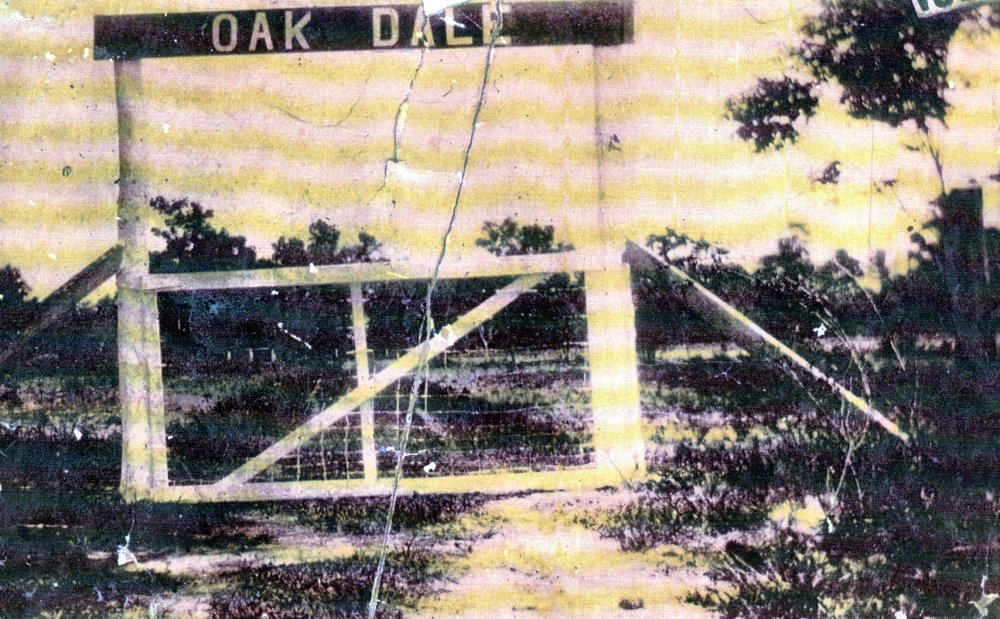
Oakdale
[The John H. Tillinghast homestead off Old Spanish Trail in the Fontainebleau community east of Ocean Springs, Mississippi]
John H. Tillinghast expired at "Oakdale", his homestead east of Ocean Springs, on April 25, 1924. His third wife was Cammie Maud Bilbo (1893-1978). Cammie Bilbo was the daughter of Samuel Bilbo (1862-1914) and Laura Havens (1873-1907). They were married at Mobile, Alabama on March 10, 1920. Their children were: Laura Georgia T. Pavolini (1920-2007), Eula Mae Patridge (1922-1997), and John O. Tillinghast (1924-2000). Mrs. Cammie B. Tillinghast and Laura Georgia T. Pavolini are buried at Crestlawn Memorial Park cemetery in Ocean Springs, Mississippi.
It appears that John and Cammie B. Tillinghast reared their three children in Jackson County, Mississippi. After his demise, the family resided on Old Spanish Trail with her bachelor brother, Ray Bilbo.(1930 Jackson Co., Mississippi Federal Census R1150, p. 12B, ED 14)
Laura Georgia Tillinghast Pavolini (1920-2007) was born December 9, 1920 at Biloxi, Mississippi. On May 16, 1939, she married Harvey J. Pavolini (1921-1982), the son of Gaspar Pavolini, at Gulfport, Mississippi. Their children were: Ronny Pavolini and Michael Pavolini. Laura was an Inhalation Therapist. She expired at Baytown, Texas on December 12, 2007. Her corporal remains were interred in the Crestlawn Memorial Park cemetery at Ocean Springs, Mississippi.(The Sun Herald, December 17, 2007, p. A4 and The Jackson County Times, June 3, 1939, p. 4)
Eula Mae Tillinghast Patridge (1923-1997) was born July 18, 1922. She died at Mobile, Alabama on June 21, 1997. No further information.
John Oran Tillinghast (1924-2000) married Bertie ? and divorced in November 1943. He then married Mary A. Brumbaugh Tillinghast (b. September 12, 1924). John was named for Oran Bilbo (b. 1895), probably his uncle. He worked for forty years at Ingalls Shipbuilding in Pascagoula, Mississippi and was a member of Boiler Makers Union No. 693. John O. Tillinghast was the father of: Alice T. Smith; JoAnn T. Thompson; Susan L. Tillinghast m. Irwin E. Garlotte Jr.; Steven Oran Tillinghast m. Carolyn Lee (b. 1958); and Stanley Tillinghast. John expired at Ocean Springs, Mississippi on April 21, 2000. His corporal remains were interred in the Evergreen Cemetery on Old Fort Bayou.(The Sun Herald, April 23, 2000, p. A12)
REFERENCES:
Jackson County, Mississippi Chancery Court Cause No. 3934, "Will of Ada Lucilla Hollingsworth", July 29, 1918.
The Daily Herald, "Mysterious Nostalgic Discovery Reveals Confederate War Hero", July 29, 1970, p. 17.
The Daily Herald, “Mrs. Cammie Bilbo Tillinghast”, February 21, 1978, p. A2.
The Daily Herald, “John O. Tillinghast”, April 23, 2000, p. A12.
The Jackson County Times, “John H. Tillinghast”, May 10, 1924, p. 5.
The Jackson County Times, “Pavolini-Tillinghast”, June 3, 1939, p. 4.
The Ocean Springs News, "Local News", March 6, 1909.
The Ocean Springs News, "Deaths of the Past Week", March 1914.
The Ocean Springs Record, "Sterling Wood Provost", January 1, 1973.
The Ocean Springs Record, "Cammie Tillinghast", March 8, 1978.
The Sun Herald, “Laura Georgia Pavolini”, December 17, 2007.
_____________________________________________________________________________________
TOCHE FAMILY
JOHN C. TOCHE
Born at Mobile between 1828 and 1840.(Act 844, p. 223)
WILLIAM F. TOCHE (1862-1937)
Born in Mississippi, the son of Joseph P. Toche of France, and Mary Anderson of Alabama. W.F. Toche married Mary Toche (1858-1934), a native of Mississippi. Parents Alabama and North Carolina. Children: Victor Toche (1887-1962) and Alvin A. Toche (1916-1983).
Victor Toche (1887-1962), a house painter and violin player married Norma Rapon (1885-1918), a Louisiana native. Widowed in 1920: Children: Irma B. Toche (1910-1929), Alvin A. Toche (1916-1983), and Norma Toche (b. 1918)
Alvin A. Toche (1916-1983)-born at Ocean Springs on January 15, 1916. Worked as a public school maintenance man. Married Josephine H. Toche (1925-). Children: Shirley F. Toche m. Bill Parker and had three children - Linda K. Parker, Susanne Parker and Charolette Parker; Alvin J. Toche (1947-1984) m. Genevieve R. Bullock and had three children: Tonya M. Toche (b. 1974) m. Jason A. Howard (b. 1972); Jeremy L. Toche and Kimberly Toche (b. 1978); Frederick M. Toche m. Virginia G. 'Trudy' Newman and had two children: Trudy Toche Jr. and Jennifer Toche; Charles M. "Peanut" Toche m. Linda Jo Taranto and had three children: Charles Toche Jr., Billy Wayne Toche and Samantha Toche; Bufford Walter Toche m. Cecelia 'Cindy' Dollene Driver and had two children: Brandee L. Toche and Leslee J. Toche.
CAPTAIN JOSEPH A. TOCHE (1848-1908)
Joseph A. Toche, a sailor, was born at Mobile, Alabama and baptized at the Cathedral of the Immaculate Conception(Act. 464, p. 154). His father was from France and mother an Alabamian. Circa 1869, he married Caroline Mathieu ((1830-1895), the widow of John ? Westbrook. She was born on February 25, 1830 at Louisville, Kentucky. Her parents were from Italy and France respectively. Niece of Joseph Tosso, the well-known composer. At Ocean Springs, a midwife, and mother of seven children. Died February 13, 1895 at home of her son, Edwin M. Westbrook. Buried Bellande Cemetery.(The Pascagoula Democrat-Star, February 13, 1895)
Caroline Mathieu's children with John Westbrook were: Martha Westbrook (1851-1919) who married Leonard Fayard (1847-1923); Edwin M. Westbrook (1858-1913) who married Hattie Clark; Henry R. Westbrook (1860-1938) who married Francis J. Hadley (b. 1860); and Viola Westbrook (b. 1865) who married John Bourgeois. Her children with Captain Joseph A. Toche were: Mary Adele Toche (b. 1870 at NOLA) and Joseph A. Toche Jr. (1872-1960).
The Joseph A. Toche family moved to Biloxi in 1879. They were residing at 211 Myrtle Street in Biloxi, when Mr. Toche passed on January 19, 1908. He had been a foreman at the Barataria Canning Company until July 1907, when he was forced to retire because of illness.(The Biloxi Daily Herald, January 20, 1908, p. 1)
CHILDREN:
Mary A. Toche
Mary Adele Toche was born February 26, 1870, at New Orleans, Louisiana. No further information.
Joseph A. Toche II
Joseph A. Toche II (1872-1960) married Angelina Labash (1878-1893+) in August 1893. Married Olivia Ryan (1872-1953), the daughter of Calvin Ryan and Pauline Anderson in 1895. Children: Lillie Agnes Toche Ellzey Cruso (1896), Wesley Joseph Toche (1898-1971), Caroline Pauline Toche (1899-pre 1910), John Adolphe Toche (1900-1988), Mary Olivia Toche (1902-1917), Henry Marcellas Toche (1904-1985), Calvin Toche (1907-1984), Tabitha T. James (1913-1993), and Joseph Toche (1917). Died February 29, 1960.
Children
Lillie Agnes Toche (1896-1968) was born on March 14, 1896, at New Orleans. Married John Samuel Ellzey (ca 1893-1969) at Biloxi in August 1914. One child: Eugene Ellzey (b. 1915). Divorced Mr. Ellzey and married William Charles Cruso (1893-1975) in March 1919. Nine children.
Joseph Wesley Toche (1897-1971) was born on November 23, 1897, at New Orleans. Married Anita Sonnier (1906-1949), the daughter of Julian Sonnier and Amee’ Hebert. Married Doris Maxine Fletcher (1910-1971), native of Nashville, Tennessee. Shop foreman for Cruso Canning Company. Seven children: J. Wesley Toche Jr., John Wallace Toche (1926-1976), Curtis Anthony Toche (1931-2006), J. Eugene Toche (1937-1998), Robert Conner (stepson?), Anita T. Ferrill, Ruby T. Buchanan, Mrs. Elston Johnson. J. Wesley Toche died May 1, 1971 and Doris Fletcher Toche on October 21, 1971. J. Wesley Toche and Doris Fletcher Toche buried Southern Memorial Park at Biloxi.(The Daily Herald, May 2, 1971, p. A-2 and The Ocean Springs Record, October 28, 1971, p. 2)
Anita Sonnier Toche died June 24, 1949.
J. Wesley Toche Jr. married Bernice Marie Thibodeaux (1922-2006), a native of Erath, Louisiana in 1945. She was the daughter of Cestia and Emily Thibodeaux. They were the parents of: Gary James Toche married Judy Breaux; Wesley Toche III married Susan Cochran; and Kathleen Toche married Thomas E. Roberts.(The Sun Herald, February 23, 2006, p. A6)
Joseph Wesley Toche III married Susan Cochran, the daughter of Edward Henry Cochran Sr. and Mary Fountain Cochran. Kathryn Emiline Toche, their daughter, married Michael Sean O'Grady, the son of Thomas L. O'Grady and Bernadette Cavalier O'Grady, on November 24, 2007 at Nativity B.V.M. Cathedral at Biloxi. Aimee Rebecca Toche , another daughter, married Robert Benjamin Jordan on June 13, 2009 at Nativity B.V.M. Cathedral in Biloxi.(The Sun Herald, November 4, 2007, p. F12 and May 24, 2009, p. F11)
Curtis Anthony Toche (1931-12/3/2006) married Phyllis Fay Strong (1933-8/2-2008), the daughter of Rupert Strong (1901-1989) and Clara Griffin (1908-1990), circa 1950. Children: Curtis 'Bo' Anthony Toche Jr. married Patricia ?; Paulette Toche married Paul Baudry; Perry Stephen Toche Sr. married Janis Lynn Baldwin and Beverly McKee; Donna Toche married Buck Neel; Gayle Toche married Pat Gray; Danny Ray Toche Sr. married Melina Sue Moss; Anne Michele Barhanovich; and Julie Lynn Clark; and Terri Toche married Kenny Hollomon.(The Sun Herald, December 5, 2006, p. A9 and The Biloxi-D'Iberville Press, August 14, 2008, p. A5)
Caroline Pauline Toche (1899-pre-1910)-the daughter of Joseph A. Toche and Olevia Ryan was born July 13, 1899. No further information.
John Adaulph Toche (1900-1988) was born at Biloxi on October 9, 1900, the son of Joseph A. Toche (1872-1960) and Olevia Ryan (1872-1953). In November 1922, he married Mary Martinez (1905-1977), the daughter of William Martinez (1877-1930), a Spanish immigrant and Theresa E. Stevens (1889-1965) of St. Bernard Parish, Louisiana. Made his livelihood as a boat builder. Children: Marie Cecile Toche (1924-1925), Pauline T. Alfonso, Iona T. Couture, Theresa T. Fountain, Joseph Adolphe Toche, John Anthony Toche, William Rogers Toche (1932-1982). Died October 16, 1988. Buried at Biloxi City Cemetery. (The Ocean Springs Record, November 22, 1972, p. 7 and The Ocean Springs Record, October 20, 1988, p. 3)
Mary Olivia Toche (1902-1917)-was born at Biloxi. Died on July 28, 1917, at 211 Myrtle Street in Biloxi. Buried in the Biloxi Cemetery.(The Daily Herald, July 28, 1917, p. 3)
Henry Marcellas Toche (1904-1985) was born March 19, 1904, at Biloxi. Married Dorothy "Dimples" Elizabeth Terry (1912-1968). Three children: H.M. Toche Jr.; Dorothy T. Fink (1938-2006) married Irvin Fink; and Mena O. Andrews. M. Marcellas Toche died April 3, 1985. Buried Southern Memorial Park at Biloxi.(The Sun Herald, March 17, 2006, p. A8)
Calvin Toche (1905-1984)-Born December 23, 1905, at Biloxi. Married Alma Leola Weldon (d. 3-18-1980) on June 15, 1930. Cavin Toche lived at Crockett, California where he was a boat builder at the Mare Island Naval Yard. Died on March 13, 1984. Buried at Biloxi Cemetery.(The Daily Herald, June 16, 1930, p. 2)
Tabitha Ione Toche James (1913-1993)-Married Richard E. James in August 1941. Three children. Died October 7, 1993.
Joseph A. Toche III (1917-)-Married Bernice Marie Thibodeaux in March 1944 at Biloxi. Three children: Joseph A. Toche.
The Toche Subdivision
Location: Sections 14 and 23, T7S-R8W
Platted
Replatted-November 1956, Bk. 162, pp. 197-198.
The Toche Family (Catholic Records)
Mrs. Toche-died February 13, 1895.(SA)
Caroline Pauline Toche-born July 13, 1899. Father Joseph Toche, mother Olivia Ryan.(BVM)
John Adolphe Toche-born November 9, 1900. Father Joseph Toche, mother, Olevia Ryan.(BVM)
Joseph Toche married Angelina Labash (1878-1893+), the daughter of John Labash (1848-1915) and Adeline Labash (1857-1900+) on August 9, 1893.(BVM)
Lillie Elizabeth Toche-born March 5, 1897. Father, Joseph A. Toche, mother Sarah E. Daley.(BVM)
Mary Adele Toche-born February 26, 1870. Father Joseph Toche, mother Caroline Mathew (sic).(SA)
John C. Toche (Baptism 1828-1840)-CIC-Mobile.
Joseph A. Toche (Baptism 1847-1851)-CIC-Mobile.
The Toche Family (Social Security Death Index)
Alvin Toche (1916-1983)-born January 5, 1916, died April 1983. OS
Alvin Toche (1947-1984)-born October 20, 1947, died June 1984.
Doris Toche (1920-1989)-born October 23, 1920, died May 29, 1989. OS (Biloxi Cemetery)
Henry Toche (1904-1985)-born March 19, 1904, died April 1985. Biloxi
John Toche (1900-1988)-born November 9, 1900, died October 16, 1988. OS
John Toche (1926-1976)-born August 13, 1926, died August 1976. Biloxi
Joseph Toche (1937-1998)-born January 24, 1937, died March 15, 1998.
Mary Toche (1905-1977)-born June 3, 1905, died April 1977. OS
Mildred Toche (1929-1993)-born April 25, 1929, died August 14, 1993. Biloxi
Wesley Toche (1897-1971)-born November 23, 1897, died May 1971. Biloxi
William Toche (1932-1982)-born April 1, 1932, died May 1982. OS
Harrison County Marriages
Joseph Toche married Angelina LaBash on 8-9-1893.
Joseph Toche married Georgie Swing on 11-22-1895.
Mary Torche married Frank Tucker on 11-19-1893.
Margaret Mary Toche married James Albert Parker on November 24, 1973.
Bradford-O’Keefe Books
Anita Toche (1906-1949)-born November 22,1906, the daughter of Jullian Sonnier and Amee’ Hebert. Died June 24, 1949. Bk. 0, p. 0.
Irma Toche (?-1929)-born ?. Died May 29, 1929. Bk. 15, p. 298.
Joseph A. Toche (1872-1960)-born August 27, 1872, the son of Joseph Toche and Caroline Mathieu. Died February 29, 1960. Bk. 42, p. 325.
Mary Toche (1856-1934)-born 1856, the daughter of Adner Gary and Martha McClendon. Died August 3, 1934. Bk. 21, p. 266.
Mary Olivia Toche (1902-1917)-born September 16, 1902, daughter of Joseph Toche and Mary Olivia Ryan. Died July 28, 1917. Bk. 7, p. 36.
Olivia Ryan Toche (1872-1953)-born November 29, 1872, the daughter of Calvin Ryan and Pauline Anderson. Died February 20, 1953. Bk. 35, p. 33.
William F. Toche (1857-1937)-born 1857, the son of Joseph P. Toche and Mary Anderson. Died November 18, 1937. Bk. 25, p. 163.
Evergreen Cemetery
Alvin A. Toche 1-5-1916 to 4-12-1983
Irma Toche 1910 to 5-27-1929
Josephine H. Toche 8-8-1925 to
Kimberly Toche 4-13-1960 to 4-13-1960
Mary Toche 1858 to 8-3-1934
Norma Toche 1885 to 1918
Victor Toche 1887 to 1962
William Toche 1862 to 11-19-1937
The Toche Shipyard
Location: 18. 54 acres + located on Old Fort Bayou in SE/4 of section 14 and the NE/4 of Section 23, T7S-R8W
1944
In June 1944, Florence Sauer of Wayne County, Michigan, the widow of Lorenz Sauer Jr., et al to Stanford and Jessie S. Williams.(JXCO, Ms. Land Deed Bk. 87, pp. 50-51)
1955
In August 1955, Stanford A. Williams to J. Adaulph Toche (1900-1988) two parcels for $10,500,(JXCO, Ms. Land Deed Bk. 151, p. 332).
Parcel One
All of the SE/4,SE/4 of Section 14, T7S-R8W south of Old Fort Bayou.
Parcel Two
Irregular shaped tract in the NE/4 of Section 23, T7S-R8W, containing 18.957 acres bounded on the southeast by the OS-Vancleave road.
Toche Subdivision-platted on August 20, 1955, JXCO, Ms. Plat Book 2, p. 90 and November 25,1955, Plat Book 2, p. 93.
1956
Toche Boat Builders and Repair Yard, Inc. chartered in Jackson County, Mississippi in June 1956. Four hundred shares of stock with a par value of $100 per share. Incorporators: John Adaulph Toche; Joseph Adaulph Toche; William Rogers Toche; and John Anthony Toche.(JXCO, Ms. Charter Bk. 3, pp. 93-98)
Toche Subdivision replatted on November 5, 1956. Owners listed as: John Adolph Toche, John Anthony Toche, William Rogers Toche, Elsie Seymour Toche, Arlene Seymour Toche, Joseph Adolph Toche, Aline Ryan Toche, Pauline Toche Alfonso, and Walter T. Alfonso.(JXCO, Ms. Land Deed Bk. 162, pp. 197-198)
1958
In December 1958, Toche Boat Builders borrowed money from P.M. Bank.(JXCO, Ms. Deed of Trust Bk. 119, pp. 380-384).
John Duncan Moran of Jardel Inc. acquired for taxes in September 1958. Conveyed in September 1965 to J.A. Toche, John Anthony Toche, Joseph A. Toche, and William Rogers Toche.(Bk. 280, p. 334)
1960s
Toche Enterprises, Inc. formed. Consisted of Toche Boat Builders, Toche Hardware, Toche Variety Center, and Toche Lumber & Supply Company.
1965
In September 1965, Jardel Inc. to J.A. Toche, John Anthony Toche, Joseph A. Toche, and William Rogers Toche.(Bk. 280, p. 334)
1968
1968 payroll was approximately $275,000 with about 80 employees (75% residents of Jxco).(letter march 17, 1969, to Eddie Khayat from William R. Toche Sr.)
1969
In March 1969, Toche Boat Builders had the following vessels under construction: ten steel shrimp trawlers; one steel lugger-type supply boat; 2 wooden shrimp trawlers; and one wooden party boat-Coast Guard approved. At this time, vice-president of the company, William Rogers Toche Sr., wrote an appeal to Edward Khayat, president of the JXCO, Mississippi Board of Supervisors to have the mouth of Old Fort Bayou and particular sections of the water course deepened to accommodate vessels with a draft of 10.5 to 11 feet. Toche indicated that larger vessels could be built on Old Fort Bayou and potential industries might develop here if a permanent marked channel was constructed.(letter dated March 17, 1969, to Eddie Khayat from William R. Toche Sr.)
1975
In July 1975, Toche Enterprises delivered five steel-hulled refrigerated fishing boats to the Venezuelan government. The vessels were 75-feet long and of 100 tons displacement. A Swedish consultant, Captain Sten Sylvander, hired by the Venezuelans lauded the Toche boats as “the best fishing boats ever bought by Venezuela.”(The Daily Herald, July 23, 1975, p. B-!)
1978
Jim Vickers running Toche Industries. The company had been in bankruptcy court, since April 1978. In the summer of 1978, Vickers defied an order by the US Corps of Engineers to cease and desist from dredging Old Fort Bayou in order to launch, Lady Elda, a 121-foot vessel. He defied the Corps order and pulled the boat through the bayou, which caused environmental damage. Vickers also dumped the spoil on the banks of the pristine stream. He was fined for his actions. Avondale Shipyard of New Orleans sued Toche Industries for payment of $606,000 for materials that it had furnished Vickers. The Wholesale Supply Company also sued in the amount of $34,890 for unsatisfied liens on four boats under construction at the boatyard. Toche was never fined by the Corps of Engineers.(The Ocean Springs Record, September 14, 1978, p. 3 and October 26, 1978, p. 1)
1979
Bankruptcy judge sold Toche Industries to Coastal Shipbuilding in March 1979, for $611,000.(JXCO, Ms. Land Deed Bk. 643, p. 284)
1983
In October 1983, Albert Prevot of Coastal Shipbuilding to 1st Mississippi National Bank for $450,000.(JXCO, Ms. Land Deed Bk. 774, p. 452)
1984
In May 1984, 1st Mississippi National Bank to Galmer Inc.(JXCO, Ms. Land Deed Bk. 791, p. 327)
1985
In April 1985, Trustee to 1st Mississippi National Bank for $400,000.(JXCO, Ms. Land Deed Bk. 821, p. 518)
1986
In December 1986, 1st Mississippi National Bank to Warren L. Strayham et ux.(JXCO, Ms. Land Deed Bk. 875, p. 436)
1994
In November 1994, Special Commissioner’s Deed to Warren L. Strayham on Lots 3,4,5,7,8,11,12,13,14,15,16,17,18,19,20,21,22,23,24,25,28,29,30,31, and 32.(JXCO, Ms. Land Deed Bk. 1052, pp. 300-301).
REFERENCES:
The Daily Herald, Purchase of fishing vessels may open relations with Venezuela”, July 23, 1975.
The Ocean Springs Record, “Toche (Vickers) Industries in Bankruptcy Court”, September 14, 1978.
The Ocean Springs Record, “Toche never fined by Corps of Engineers", October 26, 1978, p. 1.
_________________________________________________________________________________________________
VAN CLEAVE FAMILY
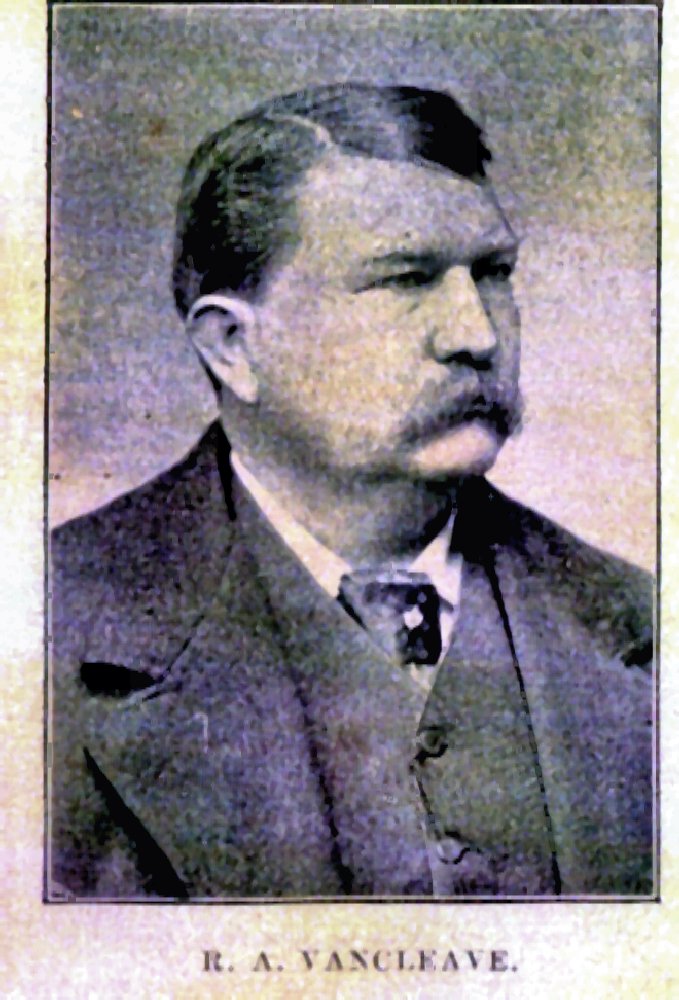
Robert Adrian Van Cleave (1840-1908)
Born in Hinds County, Mississippi, R.A. Van Cleave arrived at Ocean Springs in 1867 with his bride. He operated a store on Paige Bayou and after his departure and return to Ocean Springs, the rural US Post Office in this region was called Vancleave’s. Mr. Van Cleave became a very successful merchant at Ocean Springs and served at its Postmaster from 1872-1882. He was active in politics and energetic in the incorporation of Ocean Springs in September 1892.
[From T.H. Glenn’s “The Mexican Gulf Coast on Mobile Bay and Mississippi Sound, Illustrated”-1893, p. 51]
Robert A. Van Cleave
Robert Adrian Van Cleave (1840-1908) assumed the role of Postmaster at Ocean Springs on January 15, 1872. He was born on June 9, 1840 in Hinds County, Mississippi the son of Jonathan Van Cleave (1800-1885) and Elizabeth Rowland (1806-1870+), natives of Tennessee and Kentucky respectively. R.A. Van Cleave known siblings are two brothers, Nathaniel Van Cleave (1842-1860+) and Daniel VanCleave (1844-1860+). In 1854, Jonathan Van Cleave moved his family to Yazoo County, Mississippi. Here he was a planter and had a net worth of $6200 in 1860.(1860 Yazoo Co., Mississippi Federal Census, M653_594)
Civil War
In 1861, Robert A. Van Cleave enlisted in the 1st Cavalry Battalion of State Troops commanded by Captain William F. Gartly of the Confederate States Army. Gartly’s men united with the army of General Sterling Price (1809-1967) in the Ozark Mountains of Missouri. After this campaign, Van Cleave joined the 1st Mississippi Light Artillery commanded by Colonel William T. Withers. At the Siege of Vicksburg (May-July 1863), the 1st Mississippi Light Artillery was integrated into Moore’s Brigade led by Brigadier General John C. Moore. R.A. Van Cleave was taken prisoner on July 3, 1863, when the Confederate Army surrendered to General U.S. Grant (1822-1885) and his Union forces. He was later paroled.(The Pascagoula Democrat-Star, March 22, 1895, p. 2 and The History of JXCO, Ms., 1989, p. 376)
Van Cleave and Cox
R.A. Van Cleave married Elizabeth Rebecca Sheppard (1842-1912) in Yazoo County, Mississippi in 1865. She was the daughter of William Sheppard (1817-1850) and Sarah Ann Sheppard (1821-1880+). After William Sheppard had expired, her mother married George Allen Cox (1812-1887), a native of Tennessee.
George A. Cox, who was an early pioneer and entrepreneur at Ocean Springs, arriving here in the early 1850s. He was active in commerce and real estate. R.A. Van Cleave, his step-son-in-law, arrived at Ocean Springs in 1867 from Yazoo County, Mississippi. In 1868, Mr. Van Cleave established a store on Paige Bayou. This commercial venture didn't last long, but R.A. Van Cleave was so respected in this rural area that when a U.S. Post Office was established in the area in June 1870, it was called Vancleave's. The name stuck and today, Vancleave is the general geographic term used for that region of west central Jackson County within T6S-R7W and T5S-R7W. This is an area of approximately seventy-two square miles. Specifically, Vancleave is a rapidly developing unincorporated village in Sections 9 and 16 of T6S-R7W, flanked by Highway 57. Historically within the “Vancleave area”, there have been many smaller settlements around public schools and churches, such as: Mount Pleasant, Greenhead, Ebenezer, Evergreen, Live Oak Pond, Dead Lake, and Fort Bayou.
R.A. Van Cleave returned to Ocean Springs to begin an entrepreneurial career that would span nearly twenty-five years.
Postmaster Van Cleave
R.A. Van Cleave, a staunch Democrat, began his ten year appointment as US Postmaster at Ocean Springs in January 1872, during the administration of President Ulysses S. Grant (1822-1885), a Republican. Although a Democrat, Mr. Van Cleave received this office by virtue of a petition by the local populous averring that there was not a Republican in Ocean Springs capable of meeting the requirements of a Postmaster. R.A. Van Cleave also served during the term of Rutherford B. Hayes (1822-1893), another Republican President. Postmaster Van Cleave retired from his office in June 1882, when Emile Engbarth (1855-ca 1905), a well-known Republican from Rodney, Mississippi, was placed in office by President Chester A. Arthur (1829-1886), himself a Republican.(The Pascagoula Democrat-Star, March 22, 1895, p. 2)
Postal robbery
In late April 1881, the R.A. Van Cleave store, also which served as the local U.S. Post Office and situated on Washington Avenue was violated by burglars and robbed. Mr. Van Cleave described the incident as follows:
The robbers effected an entrance by boring through the front door of the store, and then proceeded to help themselves. They broke down the alarm drawer which contained the postage stamps and registered letters, and carried off postage stamps of the denominations of one, three, and five cents to the amount of $157.58. They broke open registered package No. 62, mailed at Lake Charles, La., April 26th, addressed to Vancleave post office, which is about fourteen miles north of Ocean Springs, the latter office being the distributing point for that office, and also rifled registered letter No. 152. Next morning Mr. Van Cleave found scattered over the floor with many other letters, a registered package and a registered envelope which corresponded with the above numbers, and also a letter and land deed signed by John Havens, from Calcasieu Parish, La. These papers are supported by Mr. Van Cleave to have been the contents of the registered package.(The Pascagoula Democrat-Star, May 6, 1881, p. 3)
The Van Cleave store and postal robbery was foiled as the intruders awoke a store clerk who had been asleep in a room isolated from the main sales room of the mercantile establishment. The dazed clerk fired a pistol at one of the crooks who with lantern in hand was securing small change of five and ten cents pieces and Mexican dollars at the time. The intruder fled though the front portal after being spared his life by the misaimed shot of the clerk. Equally frightened, the shaken clerk left through the rear door to cry the alarm and seek assistance. During the investigation following the crime, it was discovered that the carpenter tools utilized in the heist belonged to J.B. Simmons (1824-1886) and the lamp was the property of Thomas Cochran (1852-1883). The lantern had been stolen from Cochran’s saloon the same night.(The Pascagoula Democrat-Star, May 6, 1881, p. 3)
Capture
Shortly after the burglary, John Thomas, a Black man, was captured. The detective ability of Mr. Van Cleave was credited with the observation and incarceration of John Thomas. In December 1883, Mr. Thomas was convicted of stealing several thousand postage stamps from the U.S. Post Office in the Van Cleave mercantile store on Washington Avenue. He was sentenced in the Federal District Court at Jackson, Mississippi to four years in the penitentiary situated at Chester, Illinois.(The Pascagoula Democrat Star, December 7, 1883, p. 3)
Postmaster R.A. Van Cleave
In June 1880, when a weekly mail route was established between Ocean Springs and Vancleave, R.A. Vancleave was postmaster at Ocean Springs. He was described as, “clever and good-humored”. William Seymour (1837-1908) carried the mail from Ocean Springs to the store of George W. Davis (1842-1914) at Vancleave. As previously mentioned, the post office and area were named for R.A. Van Cleave.(The Pascagoula Democrat-Star, June 18, 1880, p. 3)
During R.A. Van Cleave’s over ten year tenure as local Postmaster, the following developments happened in the US Postal System: 1872- Congress enacts Mail Fraud Statute;1873- Penny postal card; 1874- General Postal Union (later Universal Postal Union); 1879- Domestic mail divided into four classes; and 1880- Congress establishes title of Chief Post Office Inspector.
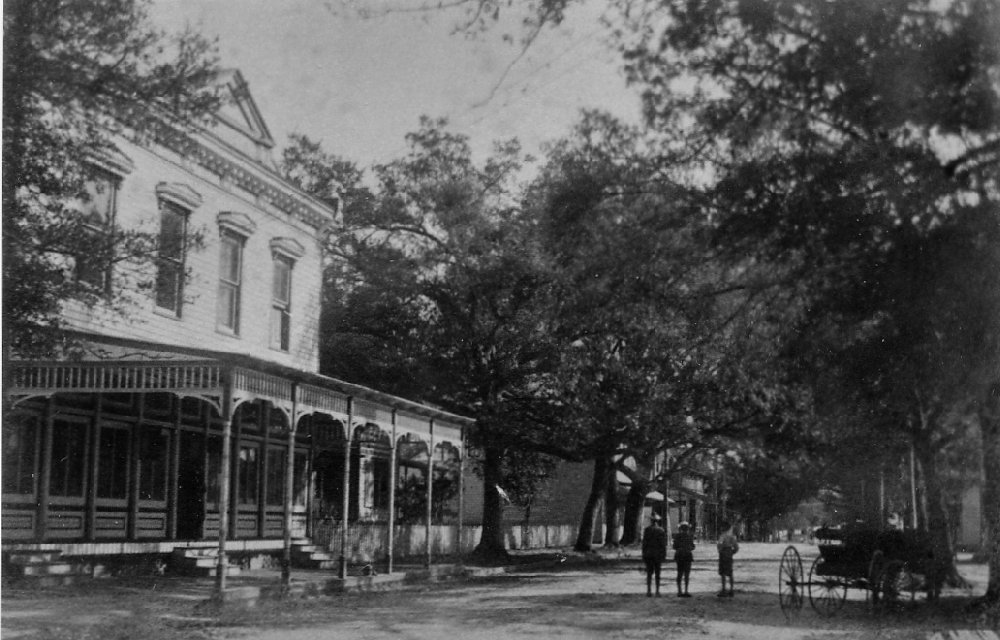
R.A. Van Cleave Mercantile Store
Located on the east side of Washington Avenue midway between Robinson and Desoto, this impressive, two-story, frame structure was erected in 1894 by Charles E. Pabst (1850-1920), Adolph Wieder (1879-1931), and George Wilson. It replaced Mr. Van Cleave’s original and smaller, one-story. frame building built in the 1870s. R.A. Van Cleave and spouse sold this property to Schmidt & Ziegler, a large wholesale grocery establishment in New Orleans. In 1903, William S. Van Cleave (1871-1938) and Junius Poitevent Van Cleave (1878-1945+), two sons of R.A. Van Cleave and Elizabeth Sheppard Van Cleave (1842-1912), owned their father’s former store property. On October 11, 1926, the former Van Cleave store building burned to the ground. At this time, it was owned by H.F. Russell (1858-1940) and occupied by Mrs. A.O. Bourdin and the local Social Club.
R.A. Van Cleave merchant and entrepreneur
In November 1872, Robert A. Van Cleave began acquiring commercial property at Ocean Springs, primarily in proximity to the new railroad depot. On October 29, 1870, the New Orleans, Mobile, & Chattanooga Railroad, which had been chartered in1866, completed its rail connection between Mobile and New Orleans. Train service commenced on November 21, 1870. The N.O.M. & C. was reorganized on April 18, 1871 and became the New Orleans, Mobile & Texas Railroad. The L&N Railroad leased the property of the N.O.M. & T. on May 8, 1880. On October 5, 1881, the L&N Railroad purchased all the assets of the reorganized New Orleans, Mobile, & Texas Railroad for $6,000,000.(JXCO, Ms. Land Deed Bk. 5, p. 299)
R.A. Van Cleave had the vision to see that rail commerce would soon displace the steam packet service to Ocean Springs and that the business district would relocate from lower Jackson Avenue and the steamboat wharf to Washington Avenue near the passenger and freight depot. Van Cleave’s initial purchase was a lot situated in the Andre Fournier Tract, Section 19, T7S-R8W in Block 24-Culsmeig Map of 1854, on the east side of Washington Avenue midway between Desoto and Robinson. Here Mr. Van Cleave erected his mercantile store building and residence. R.A. Van Cleave through his agent, George A. Cox, bought this tract with a ninety-four foot front on Washington Avenue from Edward Chase and Elizabeth W. Chase of St. Louis, Missouri. The original deed was stolen in the April 1881 Van Cleave store robbery and a replacement warranty deed was recorded in the Jackson County Chancery Court in January 1886.(JXCO, Ms. Land Deed Bk. 8, p. 461)
By the early 1870s, Edward Chase and Elizabeth W. Chase of St. Louis, Missouri were in possession of large tracts of land at Ocean Springs probably through the efforts of local land speculator George A. Cox (1811- 1887) who was also their agent. Block 24 was a small apart of what was then called the Martin and Shortridge Tracts. It consisted of twelve lots bounded by Washington Avenue, Desoto, Cash Alley, and a point about 100 feet north of the L&N Railroad tracks. Before 1890, R.A. Van Cleave would possess all the land bounded by Robinson, Cash Alley, Desoto, and Washington Avenue, as well as the lot on Washington and Government where the Ocean Springs State Bank was erected in 1910.(JXCO, Ms. Land Deed Bk. 6, pp. 30-31)
The R.A. Van Cleave store was a single story structure with an area of 2300 square-feet. The family domicile was thirty feet south of the store building was a single story dwelling with an L-shaped gallery and living area of 1500 square-feet. A single story building which served as a warehouse and stable was situated east of the R.A. Van Cleave store. It had an area of about 1000 square feet.(1893 Sanborn Map-Sheet 1)
Van Cleave Children
Here on Washington Avenue, Robert Adrian Van Cleave and souse reared their seven children: Fannie B. Van Cleave Covington (1866-1893), George A. VanCleave (1868-1897), Robert A. Van Cleave Jr. (1869-1930+), William S. Van Cleave (1871-1938), Richard S. Van Cleave (1875-1930+), Sarah “Sallie” Van Cleave Reid Westbrook (1874-1934), and Junius P. Van Cleave (1878-1945+).
New Van Cleave home
In the winter of 1891, R.A. Van Cleave announced that he would soon have a new family home erected. As Mr. Van Cleave was known for his sophistication, it was anticipated that this new domicile would be a town jewel. The Van Cleave home was built on the northeast corner of Washington Avenue and Desoto about 100 feet south of the R.A. Van Cleave Mercantile Store. The Van Cleave residence was a two-story, frame edifice with a cross-gabled roof.(The Biloxi Herald, February 7, 1891, p. 1 and 1893 Sanborn Map-Sheet 1)
New Van Cleave store
In April 1894, R.A. Van Cleave completed the foundation for his new mercantile store on Washington Avenue. It was a 4275 square-foot, two-story, frame building and situated north of the new R.A. Van Cleave residence. Mr. Van Cleave contracted with Adolph Wieder (1879-1931), George Wilson, and Charles E. Pabst (1850-1920) to erect his new store. In time, the Van Cleave business changed its name to R.A. Van Cleave & Son. Their slogan was "Best Quality and Honest Quantity".(The Pascagoula Democrat-Star, February 23, 1894, April 6, 1894, and May 11, 1894 and The Gulf Coast Times, October 28, 1949)
Sale-Schmidt & Ziegler
Robert A. Van Cleave in his mid-fifties decided to retire from his business career. He and spouse, Elizabeth R. Van Cleave conveyed their mercantile store to Schmidt & Ziegler in December 1896. The consideration was $4000 and the sale included the store counters, shelves, stable, and a one-half interest in the picket fence on the northern perimeter of the store lot.(JXCO, Ms. Land Deed Bk. 17, p. 621)
Schmidt & Ziegler, the new proprietors, were no strangers to Ocean Springs. William B. Schmidt (1823-1901) and Frances M. Ziegler (1818-1901) were wholesale grocers and liquor importers from New Orleans. Mr. Schmidt was born at Schwieberdingen, Baden-Wurttemberg, Germany on April 10, 1823. His parents settled initially at St. Louis, Missouri and Lexington, Kentucky before establishing permanent residence at New Orleans in 1838. In 1845, at the age of twenty-two, Schmidt commenced a business relationship with Francis M. Ziegler, a native of Oberndorf-Am-Nekar, Baden-Wurttemberg in southwestern Germany. Their firm, Schmidt & Ziegler, began as a small wholesale grocery business on Old Levee Street in the Vieux Carre. It later located at 428-436 on South Peters. By 1900, Schmidt & Ziegler had expanded to eleven stores. The firm was the pioneer in New Orleans international trade initiating commerce between South and Central America.
In January 1849, W.B. Schmidt married Virginia A. Jackson (1835-1912) who was born at Philadelphia of Cuban parentage. Francis M. Ziegler married, Adrianna Weissenburger (1831-1886) on the same day at the Third Presbyterian Church in New Orleans. She was a native of Lauterburg, Lower Alsace.
Of all the people who have been a part of the history of Ocean Springs, William B. Schmidt stands among the greatest. His transient tenure here during the final decades of the 19th Century, was marked by entrepreneurship, patriotism, and philanthropy. Schmidt although a resident of New Orleans, owned the Ocean Springs Hotel, the Seashore House, the Medical Lot at Marble Springs, a vacation residence and estate called “Summer Hill” on Biloxi Bay, and other real estate throughout the town. “Summer Hill” is extant at 231 Front Beach having survived Hurricane Katrina.
W.B. Schmidt was described as a quiet, thoughtful man with a will of iron and a heart of gold. He was a moving force assisting those less fortunate than himself. At various times, he sent German immigrants to Ocean Springs to work on his estate until they could get a start in life. Among those whom Schmidt guided to Ocean Springs were Adolph Joseph Schrieber (1835-1875) and Ferdinand W. Illing (1838-1884) who had escaped from Mexico in 1867 after the fall of Emperor Maximilian and his German and Austrian nationals.
F.W. Illing operated a hotel, the Illing House, on the northeast corner of Washington and Porter for many years. Adolph J. Schrieber died young, but two sons, Frederich Adolph “Dolph” Schrieber (1871-1944), Joseph Louis “Dode” Schrieber left their indelible mark in our local history. Dolph Schrieber, a lighthouse keeper, was instrumental in preserving the “Iberville Stone”, which has been in the Louisiana State Museum at New Orleans since 1937. Dode Schrieber was the local historian du jour and anecdotally preserved much of our local 19th and early 20th Century history.(Schmidt, 1972, pp. 8-9)
Schmidt & Ziegler Ltd.
Upon the demise of W.B. Schmidt (1823-1901) and Francis M. Ziegler (1823-1901), the surviving company became Schmidt & Ziegler Ltd. under the aegis of Charles W. Ziegler, the son of Francis M. Ziegler. They acquired the former Van Cleave store property for $350 in February 1902, at a public auction held at 311 Baronne Street in the Crescent City.(JXCO, Ms. Land Deed Bk. 24, pp. 273-275)
Charles W. Ziegler (1865-1936), a son of F.M. Ziegler and president of Schmidt & Ziegler Ltd. after the demise of the founders of the company, owned a home at Ocean Springs called "Lake View". It was located west of the Schmidt estate on Lots 17, 18, and 19 of Block 17 (Culmseig Map of 1854). The Ziegler residence acquired in May 1894, was modest in comparison to that of W.B. Schmidt. In 1895, Charles Dyer in Along The Gulf described it as:
an attractive little cottage, situated on a hill, with neatly laid out and well-kept lawn, with any number of massive moss-covered oaks and magnolias to shade it. The estate contains all the comforts it is possible for a complete seaside residence to have.
The Van Cleave Brothers Mercantile Company
In January 1903, two sons of R.A. Van Cleave, William Sheppard Van Cleave (1871-1938) and Junius Poitevent Van Cleave (1878-1945+), acquired their family mercantile store from Schmidt & Ziegler Ltd. for $1500. The sale was inclusive of store counters, shelving, the stable, and a one-half interest in the picket fence on the northern perimeter of the store lot. To finance the sale, the Van Cleave Brother were loaned $1000 by B.F. Parkinson (1859-1930) and Robert Parkinson (1864-1925), insurance executives domiciled at New Orleans. It appears that the Parkinson brothers eventually became partners with the Van Cleave brothers in this venture.(JXCO, Ms. Land Deed Bk. 25, p. 487 and Bk. 25, p. 488)
The Parkinson family had owned a summer home on Lovers Lane since June 1875, when the family matriarch, Eugenia Bodley Parkinson (1827-1898), acquired the Allison place. B.F. Parkinson, a bachelor, raised chickens on Lovers Lane as a hobby. This venture was called the Ocean Springs Poultry Farm. When he came over from New Orleans, the L&N train would stop where Porter Street intersected the railroad tracks and let him off. It was a short walk to his residence on Biloxi Bay.(JXCO Land Deed Bk. 1, pp. 479-481 and Thomas P. Crozat, November 6, 2004)
N.J. Francis
In May 1906, the Van Cleave Brothers Mercantile Company conveyed their store property on Washington Avenue to N.J. Francis for $3000. At this time, the store lot had a frontage on Washington Avenue of eight-feet. No further information on N.J. Francis. In September 1909, N.J. Francis sold the old R.A. Van Cleave store place to H.F. Russell (1858-1940). (JXCO, Ms. Land Deed Bk. 31, p. 175 and Bk. 35, p. 232)
H.F. Russell
Hiram F. Russell (1858-1940) was born at Yazoo City, Mississippi on March 10, 1858, the son of William Russell and Mrs. Russell. H.F. Russell arrived at Ocean Springs in 1880, and was associated with R.A. Van Cleave (1840-1908) in the mercantile business. In 1888, he commenced his own enterprises in real estate, insurance, furniture, stationary, and sewing machines. Like his mentor, Mr. Van Cleave, H.F. Russell was also the local postmaster serving the community from 1885-1889.(Dyer, “Ocean Springs”, 1895)
During his lifetime, Mr. Russell acquired large land holdings throughout Ocean Springs and Jackson County. Just after the October 1929 stock market crash, he sold thousands of acres of pinelands, and town lots in Ocean Springs, Biloxi, Long Beach, and Pascagoula. H.F. Russell was considered a powerful politico in Jackson County, once serving as chairman of the JXCO Democratic Executive Committee. He was an avid supporter of Governor James K. Vardaman (1861-1930) and Senator T.G. Bilbo (1877-1947).
H.F. Russell had two wives May Virginia Minor (1866-1910) and J. Lillian Miles (1890-1929). May V. Minor Russell bore him five children: Frederick R. Russell (1889-1889); Hazel May R. Robinson (1890-1920), the spouse of Pomeroy Robinson; Hiram Minor Russell (1892-1940) who married Ethel Duffie; Harry Turner Russell (1898-1899); and Ethel R. Moran (1899-1957), the wife of A.P. “Fred” Moran (1897-1967).
Before Mr. Russell’s demise on May 5, 1940, his daughter, Ethel R. Moran (1899-1957) was running Russell’s Ocean Springs Insurance Agency, which became the Moran Agency in 1942. Her husband, A.P. “Fred” Moran (1897-1967), began the Ocean Springs Lumber Company in 1924, and was a member of the JXCO Board of Supervisors from 1929 until 1967. At the height of the Depression, Mrs. Moran won $2500 in a contest sponsored by The Item-Tribune of New Orleans. Some of the money was used to pay taxes and probably saved some of her father’s real estate holdings and preserved the future fortunes of the present Moran generation.(The Jackson County Times, September 21, 1935, p. 1)
Mr. Russell expired on May 5, 1940. He was interred in the Russell family area of the Evergreen Cemetery
Van Cleave store demise
On October 11, 1926, the former Van Cleave store building burned to the ground. At this time, it was owned by H.F. Russell (1858-1940) and occupied by Mrs. A.O. Bourdin and the local Social Club. Mr. Russell estimated the loss at $10,000. Although H.F. Russell carried no insurance, Mrs. Bourdin’s stock and equipment were insured for $2000.(The Jackson County Times, October 16, 1926, p. 1)
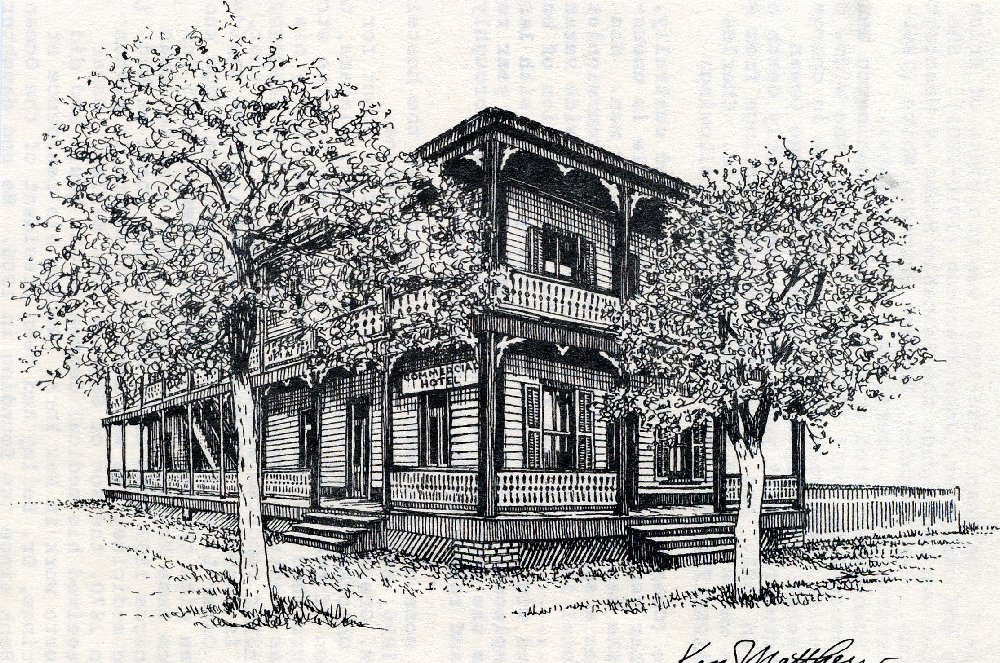
Van Cleave Hotel-Commercial Hotel
This structure was situated on the southeast corner of Washington Avenue and Robinson. It was built by R.A. Van Cleave and opened in 1880. This hostelry was known for its excellent food and sanitary state. Mr. Van Cleave quit the hotel business in December 1891 when he sold this edifice to Emma Arndt Meyer (1866-1924+) for $3000. Before it was destroyed in a large conflagration in October 1920, the former Van Cleave Hotel had been known as: The Meyer Hotel, Gillum-City Hotel, Frye Hotel, City Hotel, The Inn Hotel, Iberville Hotel, Commercial Hotel, and Commercial House. Salmagundi Gift Shop at 922 Washington Avenue occupies the former site of the Van Cleave Hotel in a building, which was erected in 1953-1954 by Wendell Palfrey and leased to the U.S. Postal Service as a post office. Credit: A Ken Matthew, pen and ink drawing commissioned in 1994 by Ray L. Bellande.
Van Cleave Hotel-R.A. Van Cleave entrepreneur
In addition to being a successful Washington Avenue merchant, R.A. Van Cleave invested heavily in local real estate and was the builder of the Van Cleave Hotel. The Van Cleave Hotel was a two-story, wood frame structure with an area under roof of 5450 square feet which included a 9-foot wide gallery on the front (west) and depot side (north). The living area was approximately 4300 square feet.
Although initially called the Van Cleave Hotel, this hotel had the distinction of being the hotel at Ocean Springs with the most name changes through its lifetime. At various times, it was known as the: Meyer Hotel (1891), Gillum Hotel-City Hotel (1893), Frye Hotel (1895), City Hotel (1898), The Inn Hotel (1897), Iberville Hotel (1905), Commercial Hotel (1906-1915), Commercial House (1915), and once again the Commercial Hotel (1915-1920).
R.A. Van Cleave purchased the hotel site from E.W. Clark and Mary T. Clark of Philadelphia, Pennsylvania on February 1, 1877. In the conveyance deed, the lot was described as commencing from the northwest corner of the Van Cleave Store lot on Washington Avenue thence north 150 feet, east along Robinson Avenue 120', thence south 150' to the northeast corner of the said store lot.(JXCO, Ms. Land Deed Bk. 8, p. 460)
Mr. Van Cleave must have commenced operation on his hotel in late 1879 as evidenced by the following:
Van Cleave's new hotel on the depot grounds is going steadily forward to a speedy completion and gives employment to a number of workmen. He seems to believe in the right way of doing things - that is employing home folks when he has work to be done.(The Pascagoula Democrat-Star, January 16, 1880, p. 3).
By mid-April 1880, two-carloads of furniture for the new lodge had arrived at Ocean Springs. R.A. Van Cleave was diligently engaged in preparations for his May opening.(The Pascagoula Democrat-Star, April 30, 1880, p. 3)
The Van leave Hotel opened on May 1, 1880. The Pascagoula Democrat-Star of May 7, 1880 revealed:
This entirely new and comfortable hotel opened on the 1st of May, 1880, and will remain open all the year round for the accommodation of regular and transient boarders. This hotel being entirely new and elegantly fitted up, and with large, well ventilated rooms lighted by gas, boarders will find every comfort desired. Special arrangements made for family. Rates moderate.
Jefferson Davis Visits
On September 9, 1882, probably the most memorable event to take place at the hotel and possibly in Ocean Springs occurred. This special occasion was the military review by Jefferson Davis (1808-1889), former President of the Confederate States of America, of the Reichard Battalion and German Guards of New Orleans under the command of Major Maximilian Hermann. The troops were accompanied to Ocean Springs by Wolf's band. The train, which carried the military personnel, stopped at Beauvoir for Mr. Davis and his daughter with the band playing the "Bonnie Blue Flag". When they arrived at Ocean Springs, the uniformed Ocean Springs Fire Company greeted them in a heavy rain at the depot. The honored troops marched to the splendidly decorated Van Cleave Hotel where they were welcomed by R.A. Van Cleave, President of the Ocean Springs Fire Company. After a review by Jefferson Davis, a reception with champagne punch sponsored by W.B. Schmidt (1823-1900) was held in the parlor of the hotel. The festivities of the day were concluded with a grand military ball at Schmidt's Ocean Springs Hotel.(The Pascagoula Democrat-Star, September 8, 1882, and September 15, 1882)
By the spring of 1884, the Van Cleave Hotel was open year round and was known for its fine food and sanitary conditions.(The Pascagoula Democrat-Star, May 2, 1884, p. 3)
The Liberty Bell
In January 1885, the Liberty Bell was being transported by rail back to Philadelphia from its exhibition at the 1884-1885 World’s Industrial and Cotton Centennial Exposition, which was held at New Orleans. Robert A. Van Cleave used his influence to have the train make a brief stop at Ocean Springs. He donned a paper hat and wooden sword and led a small contingent of veterans in firing a derelict cannon. Political speeches were made.(Ellison, 1991, pp. 11-12)
Politics
In addition to his business acumen, Robert A. Van Cleave (1840-1908) was a well-respected, citizen, who helped to establish a local government at Ocean Springs. Prior to its December 1892 charter from Governor John M. Stone and subsequent incorporation as a town, Ocean Springs had failed in three attempts to form a municipal government. In the spring of 1892, a citizen’s committee chaired by James J. Garrard (1828-1902) was completing their plans to obtain a Charter for the Town of Ocean Springs, Mississippi. Thirty-four citizens worked to determine the city limits and the four ward boundaries. At a meeting held at the Fireman’s Hall in mid-June 1892, R.A. Van Cleave was unanimously elected Mayor. Councilman elected were: Joseph J. Garrard-Ward I; Jeremiah J. O’Keefe (1859-1911)-Ward II; Charles E. Pabst (1851-1920)-Ward III; D.D. Cowan (1850-1929)-Ward IV; and Judge J.B. Wigginton (1823-1895)-Councilman-at-Large.(Ellison, 1991, p.p. 19-23 and The Biloxi Herald, June 18, 1892, p. 1)
The first municipal election at Ocean Springs was held on December 13, 1892. Professor Decatur Dwight “D.D.” Cowan (1850-1929), a public school teacher and principal, was elected Mayor of Ocean Springs. Robert A. Van Cleave elected not to seek the Mayoral office. Others elected to our first city government were: Joseph Kotzum (1842-1915), Ward I; Jeremiah J. O’Keefe (1859-1911), Ward II; Benjamin .F. Joachim (1847-1925), Ward III; Louis L. “Tune” Ryan (1837-1909), Ward IV; E.S. Davis (1859-1925), Treasurer; and George Tardy (1839-1902), Marshal.(Schmidt, 1972, p. 133)
Children of R.A. Van Cleave and Elizabeth R. Sheppard
Fannie B. Van Cleave
Fannie B. Van Cleave (1866-1893) was born on August 26, 1866 at Yazoo County, Mississippi. She married Walter Hearn Covington (1863-1898), a native of Sylvarena, Smith County, Mississippi, in October 1886. Walter H. Covington was born July 23, 1863, the son of William Covington (1834-1880+) and Martha Rose Barnes (1844-1880+). In 1880, William and Walter H. Covington were farming in the Dry Creek Precinct, Hinds County, Mississippi.(1880 Hinds Co., Mississippi Federal Census, T9_649, p. 397, ED 13)
A son, Walter H. Covington Jr., and two daughters, Irma Covington Tate (1887-1907+) and Ora Mead Covington (b. 1893), were born of this union.
Fannie and Walter H. Covington lived in Paria, Mexico and Terry, Mississippi. In July 1891, Mrs. Covington brought her young children to Ocean Springs to visit their grandparents. The Covingtons were at Victoria, Mexico at this time.(The Pascagoula Democrat-Star, July 18, 1891, p. 1)
Fannie Van Cleave Covington expired on December 5, 1893. Her corporal remains were interred in the George A. Cox Family Cemetery, which was situated north of U.S. Highway 90 between the present day Oak Cove condominiums and the PFG Optical plant, formerly the Coca Cola plant. When this cemetery was removed by the Public Works Administration during the Depression the following members of the Cox-Van Cleave families were reburied in the Evergreen Cemetery on Old Fort Bayou: George A. Cox, Sarah Ann Sheppard Cox, Henry Van Cleave, Walter H. Covington and spouse and their infants, Walter H. Covington and Ora Mead Covington.(Verta Lee Bradford VanCleave-1995, The History of JXCO, Ms., (1989), p. 376, The Pascagoula Democrat-Star, December 8, 1893, p. 3)
George A. VanCleave
George A. Van Cleave (1868-1897) was born at Ocean Springs. He married Emma Catherine Noll (1872-1904), the daughter of Albert P. Noll from Pennsylvania and Augustine J. Stein, a native of New Orleans, in the Grace Church in the Crescent City on December 9, 1891. They were the parents of two sons born at New Orleans: Noll A. Van Cleave (1893-1930+) and George Emmet Van Cleave (b. 1894).(The Biloxi Daily Herald, December 12, 1891, p. 4 and The Pascagoula Democrat-Star, October 23, 1891, p. 3) )
George A. VanCleave expired at New Orleans on March 24, 1897.(The Pascagoula Democrat-Star, April 2, 1897, p. 3)
After the demise of George A. Van Cleave, Emma Noll Van Cleave married Thomas Peter Graham (1871-1955) on November 3, 1898. They had a son, Thomas P. Graham Jr. (1900-1973) born May 1900. Thomas P. Graham was born at New Orleans of Peter Graham (b. 1846), a school teacher, and Mary Murphy (b. 1842), both Irish immigrants. In 1900, Thomas Peter Graham made his livelihood as a “drummer” selling groceries for a wholesale grocer. They resided on Canal Street.(1900 Orleans Parish, Louisiana Federal Census, T623 571, p. 7B, ED 42)
Children of George A. Van Cleave and Emma Catherine Noll
Noll A. Van Cleave
Noll Allen Van Cleave (1893-ca 1937) was born at New Orleans on March 14, 1893. As a young man, Noll was a rafter on the Pascagoula River floating saw logs to the sawmills at Moss Point. Circa 1922, he married Georgia Ernest, probably at Mobile where he made his livelihood as a bookkeeper. They were the parents of two sons: Noll Van Cleave (1925-1930+) and Alfred Kent Van Cleave (1927-1999).(1930 Mobile County, Alabama Federal Census-R42, p. 4B, ED 76 and Christopher Van Cleave, December 2005)
George E. VanCleave
George Emmet Van Cleave (1894-1930+), called Emmet, was born at New Orleans on February 1, 1894. In 1916, he married Astazie ? , a native of Louisiana. They were the parents of Bettie Ann Van Cleave (1919-1930+) and Emmet L. Van Cleave (1922-1922). In 1920, Emmet Van Cleave made his livelihood as a shipping clerk in a factory. By 1930, he was the proprietor of a radio repair shop in the Crescent City. The family resided on North Miro. No further information.(1930 Orleans Parish Federal Census, R805, p. 3B, ED107)
Robert A. VanCleave Jr.
Robert Adrian VanCleave Jr. (1869-1930+) was born at Ocean Springs. Circa 1888, he left Ocean Springs for New Orleans where he became involved in cornice construction. Richard S. VanCleave (1876-1930+), his younger brother, joined him there in August 1895.(The Pascagoula Democrat-Star, August 23, 1895, p. 3)
In the Crescent City, Robert A. Van Cleave Jr. married Isabella Edwards (1871-1940) on January 8, 1890. They were the parents of two children: Adrian Edwards Van Cleave (1894-1959) and Richard Van Cleave.(The Pascagoula Democratic-Star, December 1895)
Circa 1900, Robert A. Van Cleave relocated from New Orleans to Philadelphia, Pennsylvania to become a building contractor. Circa 1903, Robert A. Van Cleave Jr. married Mabel Russell (1879-1930+), a native of Pennsylvania. They had a child, Richard A. Van Cleave (1908-1930+), born at Philadelphia in July 1908. In 1920, they were living on 13th Street in Philadelphia. By 1930, Robert and Mabel Van Cleave and son had relocated to Upper Darby Township, Delaware County, Pennsylvania, just west of Philadelphia. He continued in the building industry in the Philadelphia region. No further information.(1910 Philadelphia Co., Pennsylvania Federal Census, T624R1410, pt. 2, p. 115A; 1920 Philadelphia Co., Pennsylvania Federal Census, T625_1616, p. 5A, ED 463; and 1930 Upper Darby Township, Pennsylvania Federal Census, R2034, p. 37A, ED 161)
William S. Van Cleave
William “Will” Sheppard Van Cleave (1871-1938) married Eudora “Dora” Pearl Casey (1876-1950), the daughter of John F. Casey and Mary Flynn. Their nuptials took place on December 28, 1897, at the Ocean Springs Methodist Church, now St. Paul's United Methodist Church on Porter. Mr. Van Cleave' s sister, Sarah "Sallie" Van Cleave Reid Westbrook (1876-1934), married Dunklin F. Reid (1871-circa 1906) at the same time.(The Pascagoula Democrat-Star, January 7, 1898, p. 3)
“The Little Store”
In March 1897, after Schmidt & Ziegler acquired the R.A. Van Cleave mercantile business in December 1896, W.S. “Will” Van Cleave erected a small, one-story, frame, store building juxtaposed to the family home and situated on the northeast corner of Washington Avenue and Desoto. This 750 square-foot, general store building was razed in March 1903, after he had formed a partnership with Junius P. Van Cleave, his brother.(JXCO, Ms. Land Deed Bk. 17, p. 621 and The Pascagoula Democrat Star, March 5, 1897, p. 3 and January 27, 1903, p. 3)
Van Cleave Brothers Store
On September 16, 1902, William S. Van Cleave and Junius “June” P. Van Cleave (1878-1945+) formed a partnership and firm, “Van Cleave Brothers”. In January 1903, the Van Cleave brothers acquired their former family mercantile store from Schmidt & Ziegler Ltd. for $1500. The sale was inclusive of store counters, shelving, the stable, and a one-half interest in the picket fence on the northern perimeter of the store lot. To finance the sale, the Van Cleave Brother were loaned $1000 by B.F. Parkinson (1859-1930) and Robert Parkinson (1864-1925), insurance executives domiciled at New Orleans.(JXCO, Ms. Land Deed Bk. 25, p. 487 and Bk. 25, p. 488 and The Pascagoula Democrat Star, September 12, 1902, p. 3 and The Pascagoula Democrat Star, January 16, 1903, p. 3)
In March 1904, the Parkinson brothers of New Orleans and the Van Cleave brothers chartered, “The Van Cleave Bros. Mercantile Company”. This stock corporation was capitalized with $15,000. The Van Cleave Brothers’ enterprise planned to immediately enlarge it stock and occupy both floors of their father’s former mercantile edifice on the east side of Washington Avenue. In late August 1904, the Van Cleave Brothers Mercantile Company sent a box of preserved figs to Belfast. Ireland. This fig shipment was considered the first of this product from Ocean Springs.(The Progress, March 12, 1904, p. 4 and September 3, 1904, p. 5)
Apparently, the Van Cleave brothers’ joint venture with B.F. and Robert Parkinson was not successful. In May 1906, the Van Cleave Brothers Mercantile Company conveyed their store property on the east side of Washington Avenue to N.J. Francis for $3000. (JXCO, Ms. Land Deed Bk. 31, p. 175)
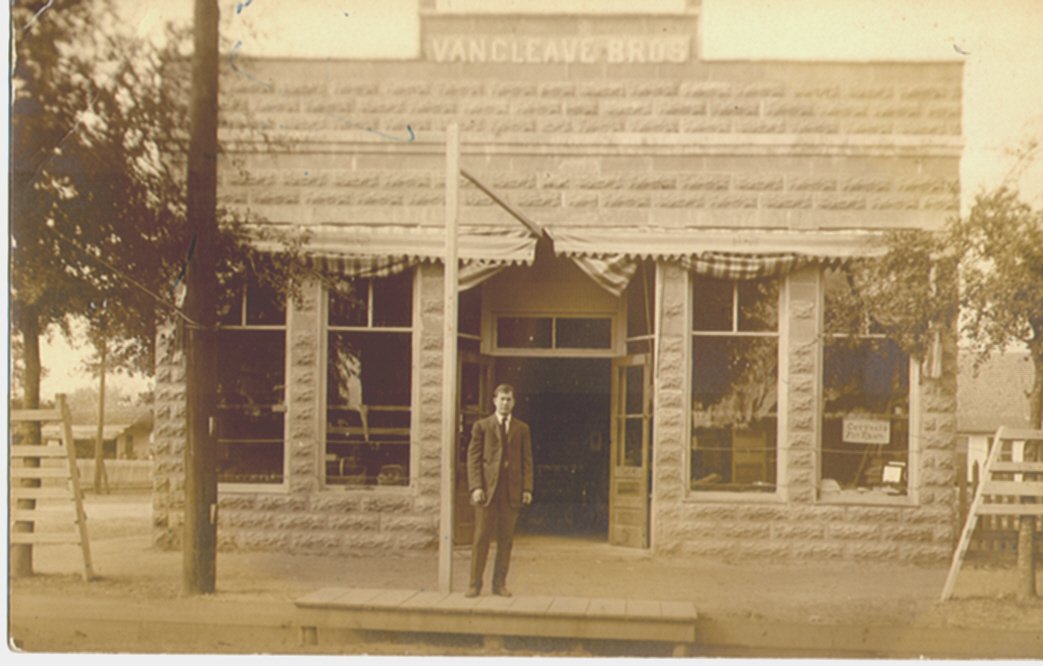
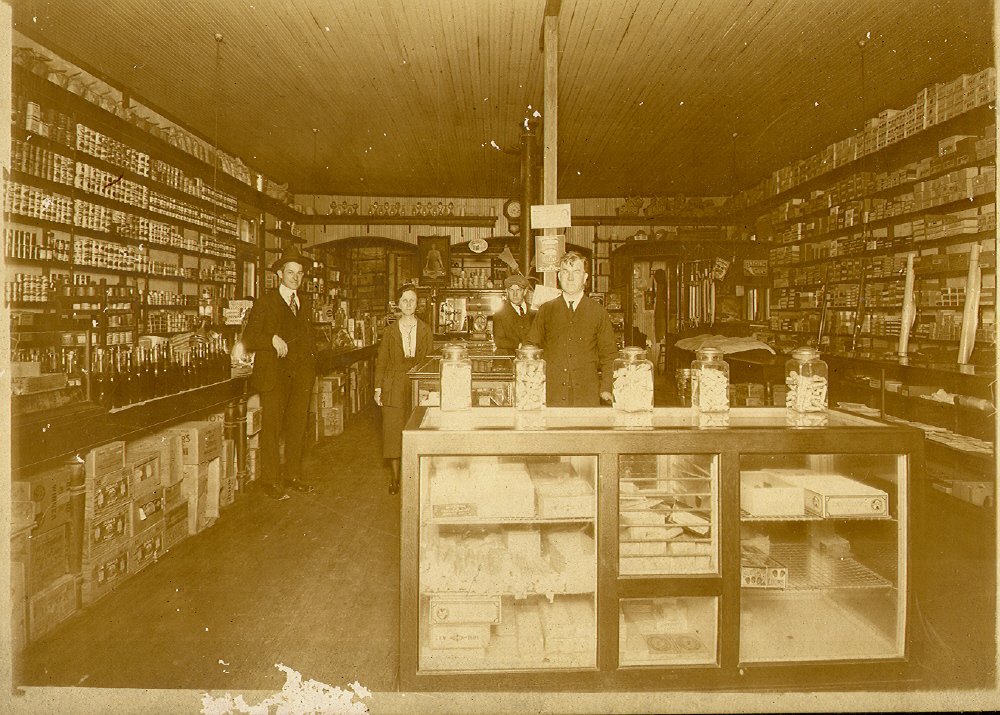
The Van Cleave Brothers Store
This store building was erected in 1906 on the northwest corner of Washington Avenue and Porter by W.S. “Will” Van Cleave (1871-1938) and J.P. “June” Van Cleave (1878-1945+), the sons of Postmaster R.A. Van Cleave and Elizabeth R. Sheppard Van Cleave. The old landmark was removed from the streetscape on July 22, 1967 and replaced with a convenience store. Mr. Will Van Cleave is standing in front of his new building in this 1906 image. In the interior view of the Van Cleave Brothers building (l-r): unknown; Eudora “Dora” Casey Van Cleave (1876-1950); unknown; and Will Van Cleave. Image made pre-1938. Courtesy of: The Verta Lee Bradford Van Cleave (1916-2004) Family Collection courtesy of Joseph B. Garrard II and Sandra Van Cleave Garrard (1943-2005).
The new Van Cleave Brothers Store
In January 1906, the Van Cleave Brothers liquidated their stock. Will S. Van Cleave and June P. Van Cleave then acquired the former the Herman Nill Drugstore lot, for $1900 from Frank Marquez (1840-1914) in May 1906. The Nill pharmacy, which had occupied this commercially strategic parcel on the northwest corner of Washington Avenue and Porter had been destroyed in a fire in December 1900.(The Pascagoula Democrat-Star, January19 , 1906, p. 3, JXCO, Ms. Record of Deeds Bk. 31, p. 260, and The Pascagoula Democrat-Star, December 7, 1900, p. 3)
Burk & Shaw began construction of the Van Cleave Brothers store building in August 1906. It was erected from concrete blocks manufactured on the site. This enterprise lasted for over sixty years.(The Pascagoula Democrat-Star, August 3, 1906, p. 3)
The J.P. Van Cleave Store
In May 1906, June P. Van Cleave purchased the Switzer Cash Store on the southeast corner of Washington and Porter from Owen Switzer (1837-1910+), a Canadian immigrant. He remained here until February 1909, when he moved to Philadelphia, Pennsylvania to work with his brothers, Richard and Robert A. Van Cleave Jr. They were building contractors there.(JXCO, Ms. Land Deed Bk. Book 31, p. 260 and The Ocean Springs News, February 20, 1909 , p. 5)
A sidewalk
In September 1915, Will Van Cleave contracted to have 275 feet of Schillinger pavement laid from Porter Avenue north to the Bertuccini property, which is now divided and owned by Courtney Cook Blossman and Attorney-at-Law, Hayden Dent.(The Ocean Springs New, September 30, 1915, p.1)
Robberies
In less than year in a period in 1915-1916, the property of Will Van Cleave, was robbed. The initial illegal entry occurred at his home, followed by his store being violated, and finally in January 1916, the thieves struck his Washington Avenue place of business. They took money and jewelry, but overlooked a money bag containing several hundred dollars.(The Ocean Springs News, January 20, 1916, p. 1)
In June 1929, the Van Cleave Brothers store was victimized by “local talent” when they illegally entered the building after dark. Will Van Cleave had left nothing in the store safe, except a sack of pennies and some personal papers. The perpetrators did escape with cigarettes, cigars, candy and several watermelons.(The Jackson County Times, June 15, 1929)
Another publicized burglary of the Van Cleave store occurred in January 1953, when a juvenile gang not only robbed the store, but fired at the local law enforcement during their felony.(The Gulf Coast Times, January 22, 1953, p. 1)
Will Van Cleave dies
After her husband’s demise on February 22, 1938, Will Van Cleave’s spouse, Eudora Casey Van Cleave (1876-1950), inherited the business, which was a grocery and mercantile enterprise. She legated it to her son, Gordon R. Van Cleave (1906-1964), and grandchildren. After Gordon Van Cleave’s death, the old block building, which had been a family run business for over sixty years, was sold to the City Ice Delivery Company, a Georgia corporation in June 1967. It was demolished on July 22, 1967, and construction of a new building commenced immediately.(The Ocean Springs Record, August 3, 1967, p. 2)
In recent years, Curmis Broome (b. 1928) owned the property, which he called Aileen’s Corner, for his spouse, Aileen Grady Broome (1934-1987). Here the Broome family operated a quick shop and eatery. In late 1991, Jan Gallaspy Walker and Paul Ballard acquired the former Van Cleave Brothers site from Mr. Broome. Here they commenced “Five Seasons”, a holistic center, catering to individuals and groups interested in high quality and organic food products, vitamins, and other salubrious appurtenances. The “Five Seasons” building maintains the convenience store, architectural style of the late 1960s.
W.S. Van Cleave home
The W.S. Van Cleave home is extant at 605 Porter Street. It is a one and one-half story, wood frame Queen Anne cottage with a cruciform gable roof, on high brick piers. This lovely edifice was built in November 1895 by Henry H. Richardson (1833-1906), a prominent Chicagoan.(The Pascagoula Democrat-Star, November 22, 1895)
By January 1896, the Richardson-Ornstein Cottage was completed as signaled by this article in The Pascagoula Democrat-Star, of January 10, 1896.
Among the handsome residences recently erected in this delightful Gulf Coast resort, the cottage built for Major H.H. Richardson of Chicago, situated corner of Porter and Martin Avenues deserves special attention. Southern lumber was used exclusively in the construction. The frame, floors, and interior works are of yellow pine, the latter furnished by the Farnsworth Lumber Company of Scranton (Pascagoula), being entirely free of knots and finished in oil. The building is one and one-half stories high, is of modern style and was designed by the well-known architect and builder, Gregor Wieder. There are four commodious rooms on the main floor with closets and three air porticos set off the building to good advantage. A neat and well-arranged stable occupies the rear. The grounds surrounding the residence are tastefully laid out in landscape style, embellished by numerous shade and fruit trees. Mr. Richardson and his charming wife took possession of this elegant place January 1, 1896 and will continue to occupy same as their winter home in the South.
Henry H. Richardson
Henry H. Richardson (1833-1906) and his spouse, Julia E. Richardson (1836-1906+), were both natives of Connecticut. They married on February 18, 1857. In February 1895, the loving couple celebrated their thirty-eight anniversary of their nuptial at Ocean Springs.(The Pascagoula Democrat-Star, February 22, 1895, p. 3)
From 1860 until pre-1880, the Richardson family was at home in Springfield, Illinois. Here Henry H. Richardson made his livelihood as the proprietor of a boot and shoe retail business. Alice Richardson (1861-1880+) their only child was born at Springfield, the State capital.(1860 Sangamon Co., Illinois Federal Census, M653_226, p. 119 and 1870 Sangamon Co., Illinois Federal Census, M593_82, p. 245)
Before 1880, the Richardson clan had relocated to Minneapolis, Minnesota were Henry worked as a railroad inspector. The family residence was situated on University Avenue.(1880 Hennepin Co., Federal Census, T9_621, p. 15, RD 230)
Winter tourists
Like many affluent Midwesterners, the Richardsons were frequent winter visitor to the area. When Mr. Richardson left Ocean Springs in March 1894, he related that when he returned next year, that he would erect a cottage.(The Pascagoula Democrat-Star, March 23, 1894)
In December 1894, Frederick Mason Weed (1850-1926), the "Yankee Mayor", who served the people of Ocean Springs in that civic office from 1899-1911, and James Ira Ford (1862-1915), a Pascagoula attorney, sold a lot on Porter Avenue to Julia E. Richardson for $350. The Richardson lot was described in the warranty deed as being situated on the northeast corner of Porter Street and Martin Avenue with a frontage of 120 feet on Porter and running north 180 feet on Martin Avenue. David Baker owned the lot to the east of the Richardson parcel.(JXCO Land Deed Bk. 16, p. 186)
Lot 7
The Richardson-Ornstein Cottage is located in the western portion of Lot 7 of the Jerome Ryan Tract in Section 37, T7S-R8W. In November 1853, Lot 7 was given to Pierre Ryan (b. 1839) by his father, Jerome Ryan (1793-1870+), after the death of his mother, Euphrosine LaFontaine (1802-c 1852).(JXCO, Ms. Land Deed Bk. Book 4, pp. 546-547)
Guillaume “William” Ladnier (1829-1875) acquired Lot 7 of the Jerome Ryan Tract for $34.40 in a State tax sale in June 1871. In April 1893, F.M. Weed purchased Lot 7 from: George W. Ladnier (1851-1893+), Lavinia L. Taggert (1855-1893+), William H. Ladnier (1863-1893+), and James R. Ladnier, the heirs at law of William Ladnier, for $400. Mr. Weed immediately sold J.I. Ford a ½ interest in Lot 7 for $500.(JXCO, Ms. Land Deed Bk. 7, pp. 313-314, Bk. 14, p. 518, and Bk. 14, p. 519 and Cassibry, 1988, p. 795)
On his town lot on Porter Street, which at this time was on the edge of town, Henry H. Richardson, a prominent Chicagoan, commenced a house in November 1895, after hiring Gregoire Wieder (1849-1899), a local building contractor, to erect his edifice. Less than a year later, Martin Avenue was completed from Porter to the front beach.(/ The Pascagoula Democrat-Star, November 22, 1895 and July 24, 1896)
The Pascagoula Democrat-Star announced on June 11, 1897, that "H.H. Richardson and wife have left their delightful home on Porter for their usual summer trip to Chicago, St. Paul, and other sections of the north".
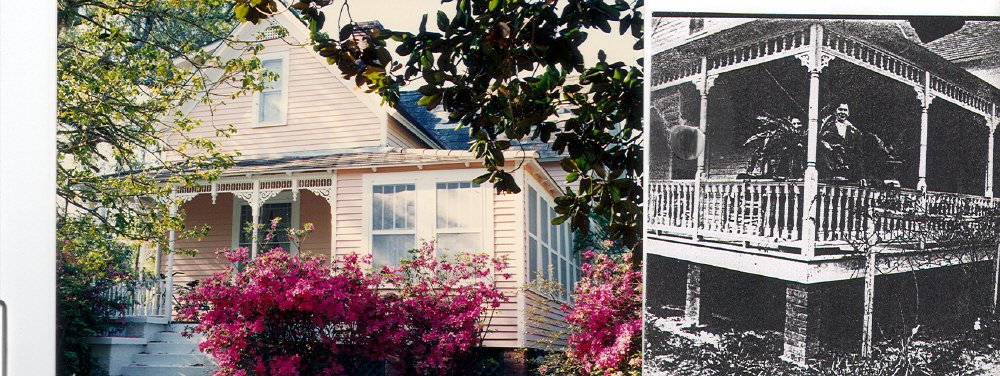
Richardson-Ornstein Cottage
Situated at 605 Porter, this Queen Anne cottage was built for Henry H. Richardson (1833-1906), a Midwestern boot and shoe merchant, by local contractor, Gregoire Wieder (1849-1899), in 1895. The Will Van Cleave family and descendants lived here for over seventy-five years. Note that in the pre-1938 image, the L-shaped gallery is extant. It was later boxed-in to create an additional room on the southeast corner of the house as seen in the March 1994 image.
Credit: March 1994 image by Ray L. Bellande. Pre-1938 image courtesy of Verta Lee Bradford Van Cleave (1916-2004).
Sale
In May 1898, H.H. Richardson of Chicago conveyed his Porter Street cottage to Belle Caraway Sauls (1877-pre-1920+). After leaving Ocean Springs, the Richardsons relocated to Grand Rapids, Michigan. They returned to Ocean Springs for the winter season in November 1898, and were the guest of the Sauls family until they settled in at “Three Oaks”, the H.B. Powell domicile on Front Beach.(JXCO, Ms. Land Deed Bk. 19, p. 75, The Pascagoula Democrat-Star, November 25, 1898, p. 3 and December 2, 1898, p. 3)
The Richardsons continued to winter at Ocean Springs until the winter of 1903-1904. Mr. Richardson wrote the editor of /The Progress /bemoaning this fact. His words follow: We are in cold country-the coldest in years-where it snows five days a week. It is a grand sight to look upon Mother Nature, if one likes snow and ice. I don’t like it. Gosh, how I would appreciate being in Ocean Springs about this time. We are quite well, however, and Mrs. Richardson joins me in sending our best wishes for a Happy New Year to all our friends in Ocean Springs.
By April 1904, H.H. Richardson had moved to Dolton Station, Cook County, Illinois. He planned to return to Ocean Springs in the winter of 1905. H.H. Richardson spent some time at St. Petersburg, Florida in the spring of 1906, before returning to Chicago. His health was reported to be failing rapidly by mid-April. Richardson passed at his Chicago residence on April 25, 1906. He was survived by his wife.(The Progress, April 2, 1904, p. 4, The Pascagoula Democrat-Star, April 20, 1906, p. 3 and April 27, 1906, p. 3)
Quilla D. Sauls
Belle Carraway Sauls the new owner of the H.H. Richardson cottage, was the spouse of Quilla D. Sauls (1870-1930+). They married in 1897, the year that Mr. Sauls came to Ocean Springs to teach school. The Pascagoula Democrat-Star/ reported on June 4, 1897, "Professor L.D. Sauls, Superintendent of Purvis High, is visiting our town this week". Q.D. Sauls taught school at Ocean Springs and Biloxi. He succeeded D.D. Cowan (1850-1929) who came to Ocean Springs in 1892, to teach school. Decatur Douglas Cowan was the first elected Mayor of Ocean Springs serving in that capacity from 1893 to 1894. He was elected the Superintendent of Education for Jackson County and managed the county school system from 1896 to 1906.
The Pascagoula Democrat-Star of late 1898 had several mentions of Professor Sauls untiring efforts to improve the educational environment at the Ocean Springs High School. At this time, the school consisted of a two-story red frame building located at the rear of the Ocean Springs Fire Company No. 2 Hall on the east side of Washington Avenue between Porter and Joseph Street. C.E. Schmidt in Ocean Springs French Beachhead (1972), wrote that "Q.D. Sauls was a man of vision, possibly far ahead of his time. He had a broad concept of a city high school and looked beyond horizons for the student body. He announced arrangements for boarding young ladies at the Beach Hotel, and young men at the Artesia House for $10 per month".
In November 1900, Professor Sauls lived at the Artesian House, which was located on the southwest corner of Porter Street and Jackson Avenue, probably as a chaperon for his male boarding students. An attestation to Saul's efforts to promote education at Ocean Springs beyond the three Rs is evidenced by the Fourth Annual Catalogue of Officers, Teachers, and Students (1900-1901). It lists the following special courses: Commercial, teacher's training, music and art, stenography, elocution, and physical culture.
When the Sauls were selling the house in 1904, it was advertised in The Progress as follows:
FOR SALEThe Richardson CottageQ.D. Sauls-Arcola, LouisianaOne of the neatest and best built cottages in town, on a large lot bounded by Porter and Martin Avenue in a desirable locality of Ocean Springs.
William “Will” Sheppard Van Cleave purchased the Richardson Cottage from the Q.D. Sauls in May 1904. The Sauls family relocated to Arcola, Louisiana in Tangipahoa Parish. By 1909, Q.D. Sauls was in the long leaf yellow pine business as a manufacturer and dealer. He was located at Saw Mill, Old Camp on the N.C. & M. R.R. near Norfield, Lincoln County, Mississippi.(JXCO, Ms. Land Deed Bk. 28, pp. 115-116)
In 1910, Q.D. Sauls and family had relocated to Lawrence County, Mississippi. He was a retail merchant in Beat 3. (1910 Lawrence Co., Mississippi Federal Census, T624R747, p. 200A, ED 97)
By 1920, Q.D. and Belle C. Sauls had settled at Tylertown, Mississippi. Their family had grown to six children: Lucille Sauls (1897-1920+), Norma Sauls (1906-1920+), Dorothy Sauls (1908-1930+), William Sauls (1915-1930+), and Berkley Sauls (1918-1930+). One Sauls child had died at infancy. At Tylertown, Q.D. Sauls owned a saw mill and lumberyard.(1920 and 1930 Walthall Co., Mississippi Federal Census, and T625_896, p. 10A, ED 137 and R1169, p. 5A, ED 2)
Van Cleave occupancy
Will Van Cleave (1871-1938) and his legatees remained at 605 Porter until January 1981, when Vertalee Bradford Vancleave (1917-2004), widow of his son, Gordon R. VanCleave (1906-1964), sold the 1895 Richardson cottage to Stephen F. Collins and Gloria “CoCo” C. Collins. The Collins were in residence here until July 1993, when they sold to Marvin A. Ornstein. The Ornstein family had come to Ocean Springs from Philadelphia, Pennsylvania.(JXCO, Ms. Land Deed Bk. 697, 453 and JXCO, Ms. Land Deed Bk. 1019, p. 825)
In the fall and winter of 1993 and 1994, the Ornsteins refurbished the interior and exterior of the Richardson Cottage. Large dormers were added to the west and north elevations under the auspices of the OS Historic Preservation Commission. Marvin A. Ornstein, a gaming consultant and president of MAO Inc. and MAO Gaming and the father of the “STREAK” bet, a patented side bet based on a player’s predictable winning streak, resides here today.
Will Van Cleave’s children
W.S. “Will” Van Cleave (1871-1938) and Eudora “Dora” Pearl Casey Van Cleave (1876-1950) were the parents of William “Sheppard” S. Van Cleave Jr. (1899-1947); Henry Dryden Van Cleave (1901-1946); and Richard Gordon Van Cleave (1906-1964).
William S. Van Cleave Jr.
William Sheppard Van Cleave Jr. (1899-1947), called Sheppard, was born at Ocean Springs on June 2, 1899. He received his education in the local public school. Returning from military service during WW I, Sheppard Van Cleave in August 1920, opened a vulcanizing plant in the rear of the Mobile Pressing Club, which occupied a building owned by Will Van Cleave, his father. Here, Shepard repaired old tires and tubes. By January 1922, J.L. O’Neil of New Orleans opened a pool hall in the space vacated by Sheppard Van Cleave who had relocated his tire and automobile company to 406 Reynoir Street in Biloxi./(The Jackson County Times, January 28, 1922)
In his later life, Sheppard Van Cleave worked as a clerk in his father's store on the northwest corner of Washington Avenue and Porter. He was a Mason and member of the local American Legion Post. Sheppard Van Cleave expired at Ocean Springs in late February 1947. His corporal remains were interred in the Evergreen Cemetery on Old Fort Bayou.(The Daily Herald, February 28, 1947, p. 9)
Little Children’s Park
In the 1940s, Sheppard Van Cleave acquired the old Shanahan House resort property, 1.84-acres, situated on the northeast corner of Washington Avenue and Calhoun. In November 13, 1941, he and E.F. Shanks of Taylorsville, Mississippi paid the back taxes, which were less than $400. They were both issued forfeited land tax patent deeds by the Secretary of State.(JXCO, Ms. Land Deed Bk. 78, pp. 424-425 and Bk. 78, p. 503)
Naturally, this action initiated litigation. Mr. Shanks sued Sheppard Van Cleave in the Chancery Court of Jackson County, Mississippi as Cause No. 6883, filed May 31, 1943. In the complaint, E.F. Shanks alleged that Van Cleave, in addition to not having clear title to the land, had also collected rents from D.R. Gillon, who was occupying a house on the property. Shanks wanted the rent money and clear title to the Shanahan tract. This Chancery Court matter was not settled until after Sheppard Van Cleave's demise in February 1947. The Chancery Court ruled in favor of William Sheppard Van Cleave Jr. and his heirs, Eudora Casey Van Cleave, his mother; Richard Gordon Van Cleave, his brother; and the children of his deceased brother, Dryden Van Cleave (1901-1946).
In April 1954, the surviving heirs of Sheppard Van Cleave conveyed the property to David Neely Powers (1890-1983) and Katherine Crane Powers (1891-1961). The Powers donated the large tract to the City of Ocean Springs in February 1959. Little Children’s Park was created by the city for the utility of families and their young children.(JXCO, Ms. Land Deed Bk. 138, pp. 349-352 and Bk. 186, pp. 435-436)
H. Dryden Van Cleave
Henry Dryden Van Cleave (1901-1946), called Dryden, was born August 27, 1901. H. Dryden Van Cleave married* Emma Lee Stewart (1903-1973) on February 15, 1926, at Biloxi. She was the daughter of Alfred Dyer Stewart and Elizabeth McCarty Major. They were natives of Kentucky. Emma Lee Stewart was born at Opelousas, Louisiana on July 25, 1903. She attended the Sophie Wright School for Girls at New Orleans and was a graduate of Belhaven College at Jackson, Mississippi. While a resident of Ocean Springs, she served as a special correspondent for several New Orleans journals. The Stewart family relocated to New Orleans in 1929.(The Jackson County Times, February 20, 1926, p. 4 and The Daily Herald, July 18, 1973, p. 2)
Dryden and Emma Lee Van Cleave were the parents of two children: Dixie “Mitzie” Lindon Van Cleave Rabeneck (1926-1990), who married Frederick C. Rabeneck (1916-1992), the son of Mr. and Mrs. James Rabeneck of New Orleans; and Henry Dryden Van Cleave Jr. who married Coleen King. In August 1931, Emma Lee Van Cleave’s sister, Sarah Chappell Stewart married Hugh Oliver Jones at the Stewart home on Marengo Street in New Orleans. Her sister, Florence Stewart, was her only attendant.(The Daily Herald, August 11, 1931, p. 2)
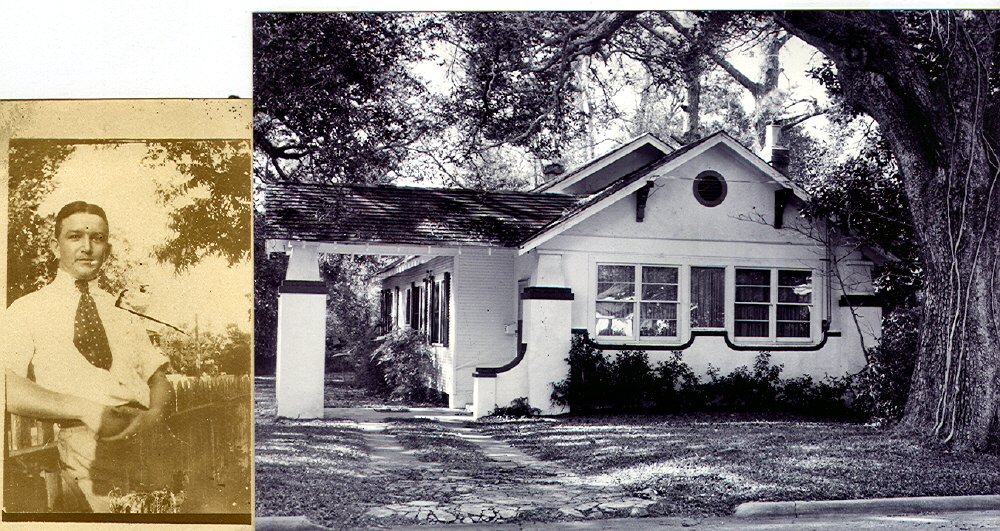
517 Jackson Avenue
H. Dryden Van Cleave and bungalow-situated at 517 Jackson Avenue, H. Dryden Van Cleave (1901-1946), the eldest son of W.S. “Will” Van Cleave (1871-1938) and Dora Casey Van Cleave (1876-1950), had this bungalow built in 1926. Dryden made his livelihood at the Ingalls Shipyard in Pascagoula, where he was employed in the electrical department. Dryden was active in the McLeod Masonic Lodge. He was elected Worshipful Master in January 1946. In this image, Dryden is depicted as he looked in 1917. Courtesy of Joseph B. Garrard II from the Verta Lee Bradford Van Cleave (1916-2004) Van Cleave family collection.
Van Cleave bungalow
In the spring of 1926, Dryden Van Cleave (1910-1946) contracted with Joseph A. Wieder (1877-1960) to erect a California style bungalow on his Jackson Avenue lot. He had acquired a lot in April 1925 on the west side of Jackson Avenue between Porter and Cleveland from H.F. Russell (1858-1940). The Van Cleave home is extant at present day 517 Jackson Avenue and owned by Walter E. Mullen, a retired English professor, formerly of the MGCCC-Jackson County campus. Walter was born at Chicago of Mississippi parentage. He was educated at the University of Mississippi and Auburn.(JXCO, Ms. Land Deed Bk. 55, p. 86 and Walter E. Mullen, May 16, 2006)
By mid-June 1926, the Van Cleave residence was nearing completion. In early August 1926, a multitude of friends of the young Van Cleaves gave them a surprise housewarming and shower. The walk-in guests brought as gifts many useful domestic items. Refreshments were served and dancing was enjoyed by the partygoers. At this time, Mr. Van Cleave worked at the post office.(The Jackson County Times, June 19, 1926, p. 3 and August 7, 1926, p. 3)
In September 1955, nearly a decade after the demise of Dryden Van Cleave, The Van Cleave bungalow was conveyed to James “Bob” Robert Murray (1891-1982) and Bessie Ross Murray (1895-pre-1981) by the heirs of Dryden Van Cleave in September 1955. The Murrays may have originally been from Silver Creek, Lawrence County, Mississippi and arrived on the Mississippi Gulf Coast during WW II. They married circa 1920 and were the parents of two children: Nell Murray Henry (1921-1995) and James R. Murray Jr. (b. 1923). Before his demise in December 1982, Bob Murray had been employed at Ingalls Shipbuilding for many years.(JXCO, Ms. Land Deed Bk. 152, p. 182, Walter E. Mullin, May 12, 2006, and The Ocean Springs Record, December 23, 1982, p. 9)
Prior to their arrival on the Coast, the Murrays lived at Columbia and Prentiss, Mississippi. Here Bob Murray made his livelihood in the wholesale grocery business. At Columbia, he was initially a traveling salesman and later manager of a wholesale grocery at Prentiss.(1920 Marion Co., Mississippi, Federal Census, T625_886, p. 13B, ED 118 and 1930 Jeff Davis Co., Mississippi, R1150, p. 2A, ED 1)
Dryden’s demise
In later years, Dryden Van Cleave made his livelihood at the Ingalls Shipyard in Pascagoula. Here he was employed in the electrical department. Dryden worshiped at St. John’s Episcopal and was active in the McLeod Masonic Lodge. He was elected Worshipful Master in January 1946. Dryden was also a Shriner, Knight Templar, and Royal Arch Mason. He expired at his home on Jackson Avenue on February 8, 1946. His corporal remains were interred in the Evergreen Cemetery on Old Fort Bayou. Emma Stewart Van Cleave relocated to New Orleans after the demise of her spouse. She passed on there on July 16, 1973. Her remains were laid to rest next to Dryden’s in Ocean Springs.(The Jackson County Times, February 9, 1946, p. 1 and The Daily Herald, July 18, 1973, p. 2)
Dixie L. Van Cleave
Dixie “Mitzie” Lindon Van Cleave (1926-1990) was born October 13, 1926 at Ocean Springs. On August 11, 1950 she married Frederick Charles Rabeneck, the son of Mr. and Mrs. James Rabeneck, of New Orleans. Their nuptials were solemnized at the Parker Memorial Methodist Church in New Orleans. The Rabeneck wedding reception was held at the home of Mrs. James Weshe, the aunt of Dixie L. Van Cleave Rabeneck. The young couple made their home in New Orleans./(The Gulf Coast Times, August 25, 1950, p. 5)
Dixie L. Van Cleave Rabeneck expired in January 1990. Fred C. Rabeneck followed her in death passing on July 15, 1992. They were at home in Gretna, Jefferson Parish, Louisiana.
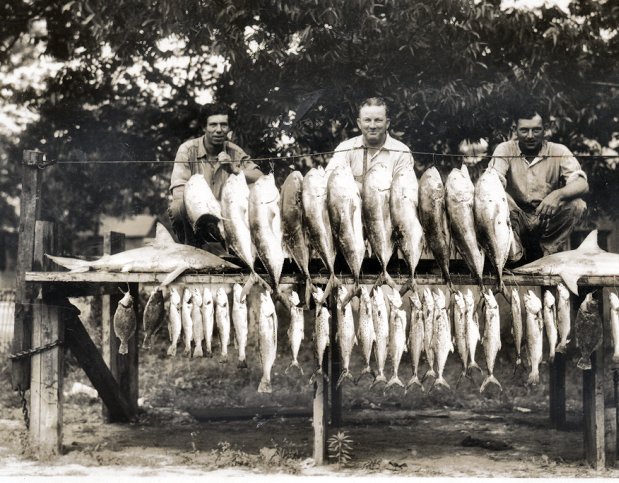
R. Gordon Van Cleave
[R. Gordon Van Cleave (1906-1964) is the middle man]
Richard Gordon Van Cleave
Richard Gordon Van Cleave (1906-1964), called Gordon, was born at Ocean Springs on May 24, 1906. He attended local public schools and later matriculated to the Perkinston Agricultural High School at Perkinston, Mississippi. Gordon worked in his parent’s grocery and mercantile store on the northwest corner of Washington Avenue and Porter. During WW II, he enlisted in the U.S. Navy. R. Gordon Van Cleave married Verta Lee Bradford (1916-2004), the daughter of Frederick Semmes Bradford (1878-1951) and Letecia Carver (1881-1968). They were the parents of Sandra Van Cleave Garrard, the spouse of Joseph B. Garrard II. R. Gordon Van Cleave expired at Ocean Springs on November 9, 1964. His corporal remains interred Evergreen Cemetery on Old Fort Bayou.(Joseph B. Garrard II and The Daily Herald, November 10, 1964, p. 2)
Gordon Van Cleave home
In November 1946, Alcena Casey (1885-1961), the sister-in-law of W.S. “Will“ Van Cleave, was awarded a deed to the former Shanahan House lot by the Chancery Clerk for paying the delinquent taxes on the property. Thereafter, R. Gordon Van Cleave (1906-1964) and his family moved into the six-room cottage on the large vacant lot. They remained here until 1950, when they moved to 605 Porter. Alcena Casey gave R. Gordon Van Cleave a quitclaim deed on the old Shanahan tract in May 1950. The structure was later purchased by Charles Adam Westbrook (1918-1999) and relocated to 1912 Kensington Avenue. Mr. Westbrook subsequently remodeled the building.(JXCO, Ms. Land Deed Bk. 95, pp. 278-279 and Bk. 112, p. 435)
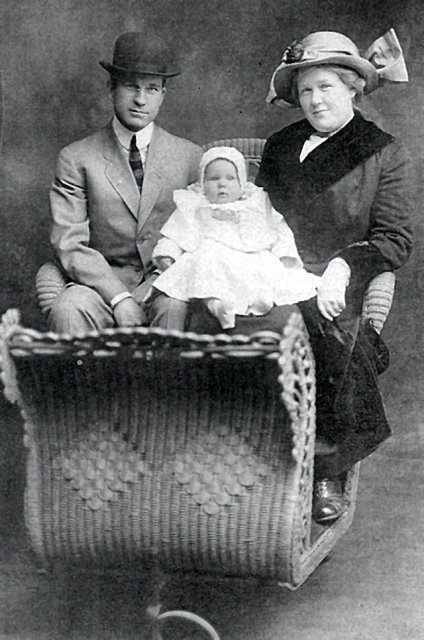
Richard S. Van Cleave and family
[L-R: Richard S. Van Cleave; Betty Jane Van Cleave Hecht (1912-1987); and Anna Tiedemann Van Cleave (1889-1960+). Image made April 1913]
Richard S. Van Cleave
Richard S. “Dick” Van Cleave (1876-1930+) was born at Ocean Springs. He left the Mississippi coast as a young man to seek his fortune in New Orleans where Robert A. Van Cleave Jr. (1869-1930+), an older brother, had settled and was employed as a tradesman involved in cornice construction.(The Pascagoula Democrat-Star, August 23, 1895, p. 3)
Circa 1900, Dick Van Cleave and Robert A. Van Cleave Jr., left New Orleans for Philadelphia, Pennsylvania to enter the contracting business. They were very successful in domestic and commercial construction on the Eastern seaboard. In 1910, Dick was residing with Robert A. Van Cleave Jr. and his family at Philadelphia.(1910 Philadelphia Co., Pennsylvania Federal Census, T624R1410, pt. 2, p. 115A)
Circa 1911, Dick Van Cleave married Anna Henrietta Tiedemann (1889-1960+). She was a Camden, New Jersey native and the daughter of Henry Tiedemann (1850-1930), an 1859 German immigrant, and Mary Jane Baird Tiedemann. Henry Tiedemann served in the Royal Navy and made several circumnavigation of the earth. He made a model of his ship and donated it to the Cape May, New Jersey Court House museum. Henry was a furniture and cabinet maker. Some of his cabinets were used on the main floor of Wanamaker’s Department store at Philadelphia, Pennsylvania.(1910 Camden Co., New Jersey Census T624_874, p. 4A, ED 79 and Nancy H. Fitzpatrick, January 2008)
Anna and Dick Van Cleave were the parents of two children born at Philadelphia: Betty J. Van Cleave (1912-1987) and Richard S. Van Cleave (1914-1982). By 1920, the Dick Van Cleave family had relocated to West Dayton Street in Flint, Michigan where he was a building engineer. Dick had studied architecture in Chicago.(1920 Genesse Co., Michigan Federal Census, T625_765, p. 8B, ED 53 and Nancy H. Fitzpatrick, Granville, New York, January 2008)
By 1930, Dick Van Cleave had divorced Anna H. Tiedemann Van Cleave and married Irene A. Van Cleave. She appears to have had a daughter, Irene G. Van Cleave (1912-1930+), from a prior marriage. Dick Van Cleave and family had returned to Pennsylvania from Michigan and were domiciled on Burmont Street in the unincorporated village of Oak View in the Upper Darby Township on the west side of Philadelphia. Here Dick Van Cleave remained in construction. Anna H. Van Cleave remarried to Francis X. King.(1930 Delaware Co., Pennsylvania Federal Census, R 2034, p. 4B, ED 167 and Nancy H. Fitzpatrick-January 2008)
After the divorce, Bettie Jane Van Cleave was sent to Ocean Springs to live with William and Dora Casey Van Cleave and Will Casey on West Porter Street. Betty later lived with relatives at Birmingham, Alabama. Nancy H. Fitzpatrick, Betty's daughter and a resident of Granville, New York, grew up listening to Betty Jane’s stories of the time she spent in Ocean Springs and Gulfport and tales of her Van Cleave and Casey families of the Mississippi Gulf Coast.(Nancy H. Fitzpatrick, January 2008)
In 1934, Betty Jane Van Cleave (1912-1987) married Richard Roy Gribben Jr., (1907-1974) the son of Allan Roy Gribben (1883-1965) and Nan Gribben. Allan R. Gribben was president of the Cord Motor Car Company and the newly weds lived at Roynancroft, the Gribben estate, at Morristown, New Jersey. Betty Jane and Richard R. Gribben Jr. divorced in September 1940. Betty Jane found employment at Drew University at Madison, New Jersey. Here she met and married Ira Young Hecht Jr. in January 1941. After graduation from Drew University, Ira found employment as a reporter for the Morristown Daily Record. Betty Jane and Ira Youngwood Hecht Jr. were the parents of: Robert Seldon Hecht (b. 1941) and Nancy Anne Hecht Fitzpatrick Gervais (b. 1942). Nancy Anne Hecht married Alan Fitzpatrick (1941-1998) and Thomas Gervais. Betty Jane Van Cleave Hecht expired on October 13, 1978. Her corporal remains were interred in the Blue Mountain Cemetery at Saugerties, New York.(Nancy H. Fitzpatrick, January 2008)
Captain Johnson’s 1897 Jackson Avenue store
In late May 1897, The Ocean Springs Progress announced that:
Captain John Johnson who kept the Press bar in Biloxi has purchased lots opposite the Artesian House [southwest corner of Porter and Jackson], and will shortly commence the erection of a large store and dwelling thereon. The store we learn will be a one-story affair 30x60 feet in dimensions, and the residence 40x40 feet with an L [shaped porch] 25x30 feet. Immediately on completion of the store room Mr. Johnson will open up a large stock of general merchandise.(The Biloxi Daily Herald, May 29, 1897)
Captain Johnson’s 1897 Jackson Avenue house
Friar and DeBourgh were the contractors for the John E. Johnson store and house. In May 1897, the foundation was laid for Captain Johnson’s house adjoining his store on Porter and Jackson.(The Pascagoula Democrat-Star, April 16, 1897 and May 14, 1897)
Captain Johnson’s house is extant at 526 Jackson Avenue. It is a one-story, frame Queen Anne cottage with a cross gable roof, L-shaped plan with a two bay porch within arms of the “L”. There are imbricate shingles in the gable. The Captain Johnson cottage was restored in 2003-2004 by current owner, Joan Ladnier.
Captain John E. Johnson
In February 1897, Captain John E. Johnson (1859-1921) had acquired these lots for $900, from Lilli Franco Geiger (1863-1905) and Peter Geiger (1858-1923), who were domiciled at Stewart County, Georgia.(JXCO, Ms. Land Deed Bk. 18, pp. 123-124)
John E. Johnson, called "Cap", was the son of Norwegian immigrant, Nels Johnson (1814-1895) and German immigrant, Caroline Lunderman (1828-1911). Cap Johnson was born at Biloxi were his father was a prominent boat builder. He went to sea in 1877, piloting a trading schooner into ports from Florida to Texas. From 1890-1897 at Biloxi, he owned the Press Saloon on the front beach between Lameuse Street and Main Street. Johnson also had a wholesale shipping business in fish, oysters, and shrimp employing sixty men during the seafood season.(Dyer, 1895, “Biloxi”)
In August 1897, Johnson took a lease from Mayor Thomas W. Grayson (1825-1904) of the City of Ocean Springs at the south end of Martin Avenue. The lease granted Johnson the right to operate and conduct "the business of opening, selling or shipping fish, oysters and shrimp, provided the same shall be conducted in such a manner as to not create a nuisance in said neighborhood". Johnson was required to build "a wharf not less than six hundred feet in length from the shore, and not less than five feet wide, to be used by the public in landing and receiving passengers ....erect and maintain bath houses as may be necessary for the accommodation of the public".
Captain John E. Johnson married Felicia Pons (1868-1910), who was called Ella. They had two sons, John L. Johnson (1885-1917) and Joseph E. Johnson (1886-1887), and a daughter, Mrs. Joseph (Edna) Longinotti (1881-1927), who lived at Hot Springs, Arkansas. Her father-in-law, Joseph Longinotti, Sr. (d. 1923) once was the proprietor of the Hotel Pullman at Hot Springs. Her husband ran hotel when she was murdered in 1927, at Hot Springs. Son, John L. Johnson, also died tragically when he choked to death after leaving Schmidt's Premium Bakery on Washington Avenue.(The Jackson County Times, August 20, 1927)
At the foot of Martin Avenue, Cap Johnson also operated an oyster shucking shed. On February 13, 1899, the mercury fell to one degree Fahrenheit on the Mississippi Coast. An announcement was made in The Biloxi Daily Herald concerning some of the property loss at Ocean Springs:
Captain John Johnson was probably the heaviest loser of anyone in town from the cold. A few days previous he had purchased 700 barrels of oysters at fancy prices, all of which froze, entailing a loss of nearly $800. To make matters worse, orders for oysters have been pouring in all week which cannot be filled.(The Biloxi Daily Herald, February 21, 1899, p. 8)
This natural disaster put Captain John E. Johnson out of business at Ocean Springs. The Pascagoula Democratic-Star of September 1, 1899, related that: Captain John Johnson is auctioning goods at his store. He is going out of business.(The Pascagoula Democrat-Star, September 1, 1899)
Cap Johnson sold his store property on the northeast corner of Jackson Avenue and Porter Street to Sidney J. Anderson (1867-1917) of New Orleans in December 1899, for $750. Mr. Anderson, who owned charcoal schooners and operated a mercantile store at Vancleave, also bought the Artesian House, a small hostel, on the southwest corner of Porter and Jackson, opposite the Johnson store, in February 1900.(JXCO, Ms. Land Deed Bk. 20, p. 586 and Bk. 21, pp. 150-151)
Captain Johnson moved to Biloxi where he may have gotten in the bar business again. He became ill about 1910, probably with cancer. Cap Johnson died on April 18, 1921 at 879 East Beach, the home of his sister, Louise Johnson Dorries (1863-1953) and the widow of August Dorries (1842-1909). All of the John E. Johnson family members are buried at the Bellande Cemetery on Dewey Avenue.(The Daily Herald, April 18, 1921, p. 3)
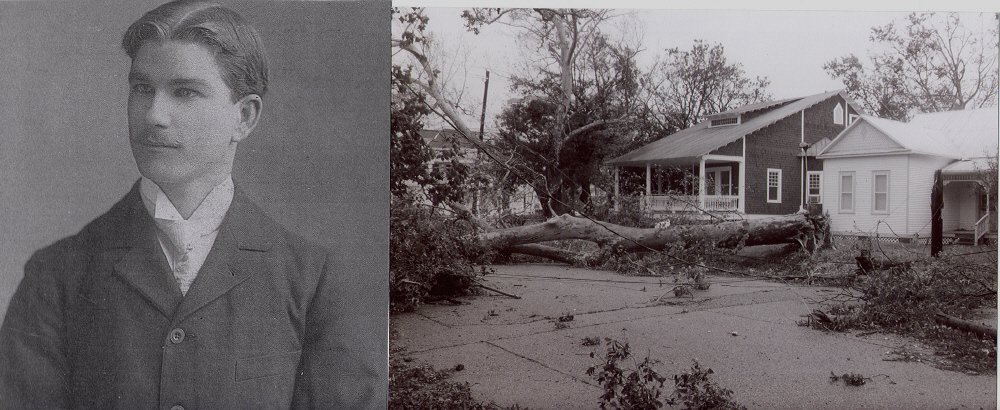
Richard S. Van Cleave and 528 Jackson Avenue
Situated at present day 528 Jackson Avenue, the Van Cleave cottage was built in 1908 by Richard S. “Dick” Van Cleave (1876-1930+) for his aging parents, Robert A. Van Cleave (1840-1908) and Eliza R. Sheppard Van Cleave (1842-1912). Dick Van Cleave left Ocean Springs in the late 19th Century to make his fortune and became a successful building contractor at Philadelphia, Pennsylvania. R.A. Van Cleave expired at Ocean Springs in September 1908 while his new home on the southeast corner of Porter and Jackson Avenue was under construction. Postmaster Mayon F. Johnson (1919-1988) owned the Van Cleave cottage from 1942 until 1968. USMC veteran, Robert C. Smith, expired here in 2004. The domicile is now owned by Richard and Jennifer Benz of New York. The 1897 Captain John E. Johnson-Ladnier cottage is to the right. Left image courtesy of Joseph B. Garrard II from the Verta Lee Bradford Van Cleave image collection. Right image made August 30, 2005 by Ray L. Bellande.
Van Cleave Cottage-528 Jackson Avenue
By November 1904, the John E. Johnson store building on the southeast corner of Jackson Avenue and Porter Street was gone. Its demise was probably due to fire.(1904 Sanborn, “Ocean Springs”, Sheet 2)
In July 1904, Sidney J. Anderson sold the vacant lot to Dr. O.L. Bailey (1870-1938). Here circa 1908, Dick Van Cleave had a one-and-one-half story, frame, side-gable home erected for his aged father, Robert A. Van Cleave (1840-1908), the patriarch of the local Van Cleave family, The Van Cleave home, which is extant, has a small dormer on the south elevation and is uniquely covered with imbricate “fish scale” shingles and has an undercut, L-shaped wrap-around gallery on the west and a portion of the north elevation. The rafter ends were sawn with a decorative profile and there is a small polygonal projecting bay on the south elevation.(JXCO, Ms. Land Deed Bk. 28, pp. 380-381 and Nat. Reg. of Historic. Places Inv.-Nom. Form, “Old Ocean Springs Historic Dist.”, p. 10, 1986 and The Gulf Coast Times, October 28, 1949, p. 6)
Will Van Cleave (1871-1938) had acquired the well-situated corner lot, which is a part of Lot 1-Block 34 of the 1854 Culmseig Map, in November 1907, from Dr. O.L. Bailey. The price was $300. In May 1908, Will sold the small parcel to brother Dick Van Cleave, a resident of Philadelphia, for $400.(JXCO, Ms. Land Deed Bk. 33, p 46 and pp. 386-387)
In March 1912, Dick Van Cleave sold the Van Cleave cottage at 528 Jackson Avenue back to Will Van Cleave for $1700. The home remained in the Will Van Cleave family until August 1942, when Dora Casey Van Cleave (1876-1950), the widow of Will Van Cleave, conveyed it to Mary Alice McEwen Johnson (1918-2002), the spouse of Mayon F. Johnson (1919-1988). Coincidentally, Mayon F. Johnson became Postmaster at Ocean Springs in June 1971. He retired from this post November 1981.(JXCO, Ms. Land Deed Bk. 80, p. 484-485)
After the Mayon Johnson family sold the Van Cleave cottage in September 1968 to Oris H. Troyer (1902-1970) and heirs, it has been owned by: Stella Hann Richardson (1890-1972) and heirs from 1971 until 1973; Robert C. Smith (d. 2004) and heirs from 1973 to 2005. The current owner is Richard and Jennifer B. Benz.(JXCO, Ms. Land Deed Bk. 340, p. 246; Bk. 396, p. 144; Bk. 484, p. 405; and Bk. 1376, p. 188-192)
Pre-Katrina, Richard W. “Dick” Benz (b. 1964) and spouse, Jennifer “Jenny” Becker Benz (b. 1969), formerly of the Crescent City owned and operated a widely acclaimed Uptown New Orleans eatery appropriately called Dick and Jenny’s. It is situated at 4501 Tchoupitoulas Street near Napoleon Avenue and the Mississippi River. At Ocean Springs, the Benz family possessed the 1908 von Rosambeau-Bryan home at present day 410 Jackson Avenue, which was destroyed in late August 2005 by Katrina. Post-Katrina, the Benz family relocated to Buffalo, New York, but still own the Van Cleave cottage at 528 Jackson Avenue.
Sarah Van Cleave
Sarah “Sallie” Van Cleave (1874-1934) married Dunklin Felix Reid (1872-circa 1906) on December 28, 1897, in Jackson County, Mississippi. He was probably a native of Greenville, Butler County, Alabama. In 1880, D.F. Reid was living with James A. Reid (1852-1880+), his uncle, who was a hardware dealer. In 1900, the D.F. Reid family was domiciled at Hammac, Escambia County, Alabama, a small sawmilling community west of Brewton, where they had a mercantile business. The D.F. Reids had two children, Van Cleave Reid (1899-1972) and Audrey E. Reid (1900-1914).(1880 Butler Co., Alabama Federal Census, T9_4, p. 317, ED 36 and 1900 Escambia Co., Alabama, T623 15, p. 19A, ED 152)
Circa 1909, Sallie Van Cleave Reid, a widow, married George L. Westbrook (1888-1935), a telegraph operator and ticket agent at the local L&N Depot. He was the son of Edward M. Westbrook (1858-1913) and Harriet Clark (1857-1927). Sallie expired on May 14, 1934. Her corporal remains were interred in the Evergreen Cemetery.
On December 15, 1934, George L. Westbrook married Ina Towle Baker (1881-1947) at Gulfport. She was the daughter of James Towle, a Scotsman, and an Irish lady named Daily. Ina T. Westbrook had previously resided at Wausau, Wisconsin. She had two sons, Frederick Otis Baker and William John Baker, from her first marriage to F.W. Baker. Mrs. Westbrook was president of the Ocean Springs Demonstration Club and a recognized landscape authority. She died on September 23, 1947. Her remains were interred at Memphis.(The Daily Herald, September 26, 1947, p. 6)
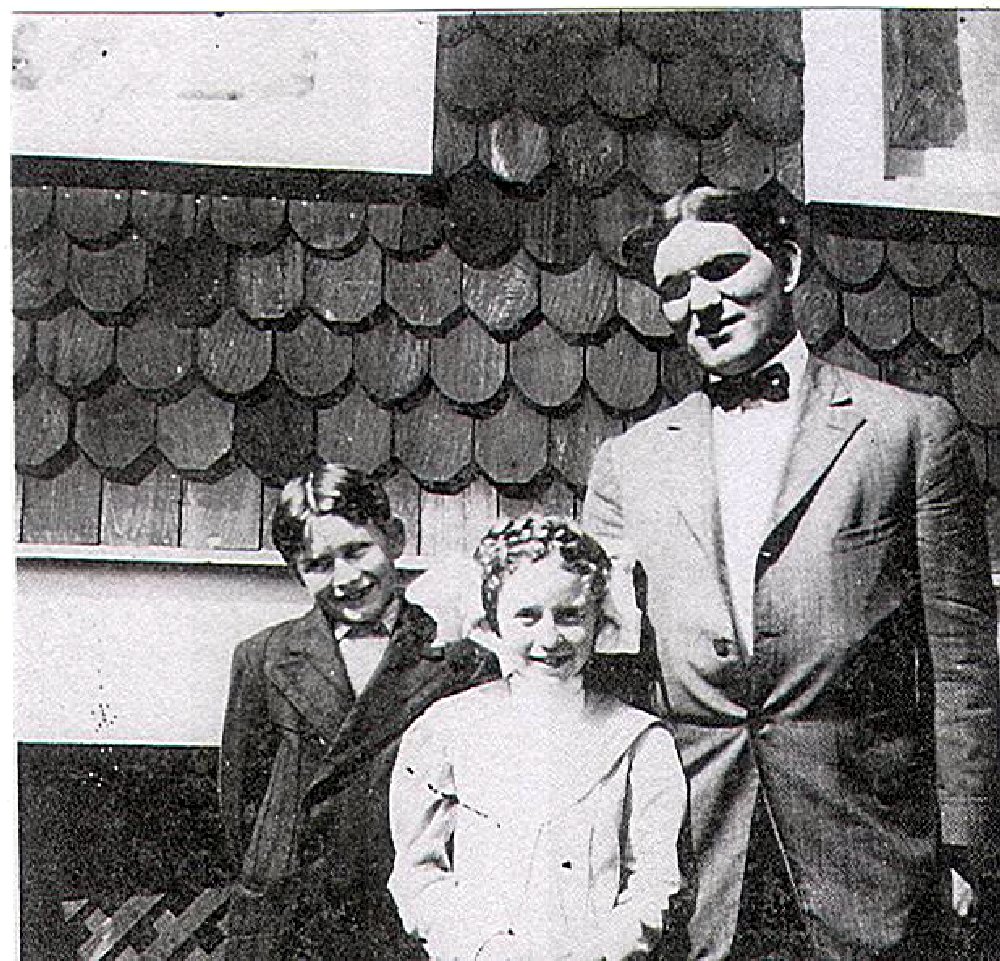
This vintage image was made circa 1910 on the south elevation of the Richard S. Van Cleave cottage at present day 528 Jackson Avenue. L-R: Van Cleave Reid (1899-1972), Audrey E. Reid (1900-1914), and George L. Westbrook (1888-1935), their step-father, and a L&N Railroad employee. The Reid children were born of Sarah “Sallie” Van Cleave (1874-1934) and Dunklin Felix Reid (1872-circa 1906) who was a merchant in Escambia County, Alabama until his untimely demise circa 1906. The Widow Reid and children returned to Ocean Springs and Sallie married George L. Westbrook. After her demise, he wedded Ina Towle Baker (1881-1947), a former resident of Wausau, Wisconsin.
Courtesy of Joseph B. Garrard II from the Verta Lee Bradford Van Cleave (1916-2004) family collection.
Van Cleave Reid
Van Cleave Reid (1899-1972) was born at Ocean Springs. He married Gertrude Augusta Carson (1899-1996) at Chicago in late November 1922. She was the granddaughter of M. Hausler of Chicago. She met Van Cleave Reid as she spent several winters at Ocean Springs with her grandparents. Gertie Carson Reid expired on January 9, 1996. Their corporal remains were interred in the Evergreen Cemetery in Ocean Springs.(The Jackson County Times, December 2, 1922)
Audrey E. Reid
Audrey Elizabeth Reid (1900-1914) was born at Escambia County, Alabama in May 1900. She expired on January 20, 1914. Her corporal remains were interred in the Evergreen Cemetery on Old Fort Bayou. No further information.
Junius Poitevent VanCleave
June Poitevent VanCleave (1878-1945+) was born at Ocean Springs on December 6, 1878. He was named for Captain Junius “June” Poitevent (1837-1919). Captain Poitevent was of Huguenot descent being born at Gainesville on the Pearl River in Hancock County. He was active in the lumber trade, ran steamboats, speculated in land in Texas and Florida, and farmed in Mexico and Florida. June Poitevent settled his family at Ocean Springs in 1877, building a Victorian Italianate home of unusual design on the Bay of Biloxi. The Lover's Lane location of the Poitevent home is believed by some historian to be the site of Fort Maurepas (1699-1702), the French beachhead in the Lower Mississippi Valley. R.A. Van Cleave held Captain Poitevent in deep respect, and honored him by naming his youngest son, Junius Poitevent Van Cleave.
After a childhood and adolescence at Ocean Springs, June Van Cleave left Ocean Springs circa 1898, for Hammac, Alabama where his sister, Sallie Van Cleave Reid, lived. She had married Dunkin Felix Reid in December 1897. Here he worked in the mercantile business with his brother-in-law.
In May 1900, June Van Cleave returned to Ocean Springs and on September 16, 1902, created a partnership with his brother, W.S. Van Cleave (1871-1938) to form the Van Cleave Brothers, a mercantile business, adjoining the residence of their father on Washington Avenue near Desoto.(The Pascagoula Democrat-Star, September 12, 1902)
Minnie C. Richardson
Junius Poitevent Van Cleave married Minnie Clayton Richardson (1879-1952+), a native of Tennessee, at the Methodist Church at Ocean Springs in August 1904. She was the daughter of William Richardson (d. 1883?) and Mary Witt Richardson (1849-1927). The Van Cleave-Richardson union created two daughters: Mary Witt Van Cleave (1909-1930+) and Mildred Van Cleave (1916-1930+).
Mary Witt Richardson
Mary Witt Richardson, a native of Lynville, Giles County, Tennessee, and the wife of William Richardson who was postmaster at the Fort Bayou community from 1882-1888, owned over one thousand acres of land southwest of Vancleave. Mrs. Richardson succeeded her husband as postmaster until 1891, when she was replaced by Mary Senter Hill (1827-1916), the mother of Mrs. Sardin G. Ramsay, Lula Hill Ramsay (1861-1949).(Miss. Coast History & Genealogical Society, Vol. 13, No. 1, June 1977, p. 19)
Mrs. Richardson’s acreage was primarily in Sections 19, 30, and 31 of T6S-R7W. In August 1877, she began procuring tracts from Napoleon Davis in this area. Mrs. Richardson farmed her lands and orchards with the assistance of Henry Webb (1829-1900+) and probably the advice of Theo Bechtel (1863-1931), the well known, pecan nurseryman, who resided at Ocean Springs.(JXCO Land Deed Bk. 13, p. 47)
In the harvest season of 1891, Mrs. Richardson sold for $500, most of her Le Conte pear crop to Parker Earle (1831-1917) of Ocean Springs. Mr. Earle was the proprietor of the Earle Farm and Parker Earle & Sons, growers and packers of selected fruit.(Glenn, 1893, p. 47)
A May 1892, guest of Mrs. Richardson noted her Le Conte and Kiefer pear orchards, young peach orchard, and hundreds of two year old trees for the next year market.(The Pascagoula Democrat-Star, May 20, 1892, p. 2)
In May 1906, Mary W. Richardson acquired the Oren Switzer (1837-1921) home on the southeast corner of Washington Avenue and Porter for $1700. At the same time, her daughter, Mrs. J.P. Van Cleave, bought the south half of Mr. Switzer’s lot on Washington Avenue for $1400. Both structures were destroyed in the Big Fire of 1916.(JXCO, Ms. Land Deed Bk. 31, pp. 260-261)
Mrs. Richardson later relocated to Philadelphia, Pennsylvania to be with the Junius P. Van Cleave family. She expired on April 3, 1927, at Philadelphia. Her remains were sent to the family burial ground at Lynville, Tennessee.(The Daily Herald, April 28, 1927, p. 7, c. 3)
In January 1906, the Van Cleave Brothers liquidated their stock. They then purchased land on the northeast corner of Washington and Porter, and built a store, the Van Cleave Brothers Store, in August 1906, which lasted for fifty-eight years.
J.P. Van Cleave store
J.P. Van Cleave purchased the Switzer Cash Store on the southeast corner of Washington and Porter in May 1906, from Owen Switzer. He remained here until February 1909, when he moved to Philadelphia to work with his brothers, Richard S. Van Cleave and Robert A. Van Cleave Jr. They were building contractors in the City of Brotherly Love. June Van Cleave returned to Ocean Springs about a year later in poor health. He had lost over fifty pounds of weight in the east.(JXCO, Ms. Land Deed Bk. 31, p. 260, The Ocean Springs News, February 20, 1909, and December 24, 1910)
Mr. and Mrs. Van Cleaves’s first daughter, Mary Witt Van Cleave, was born at Philadelphia in October 1909.(1910 Philadelphia, Pennsylvania Federal Census, T624R1405, ED 820, pt. 2, p. 108A)
The spring of 1914 saw vast changes in the life of the J.P. Van Cleave family. In March, Van Cleave leased his J.P. Van Cleave Store on Washington Avenue to Charles B. Morrison (1868-1938) and sold his interest in the Van Cleave Brothers Store diagonally across the street to W.S. Van Cleave.
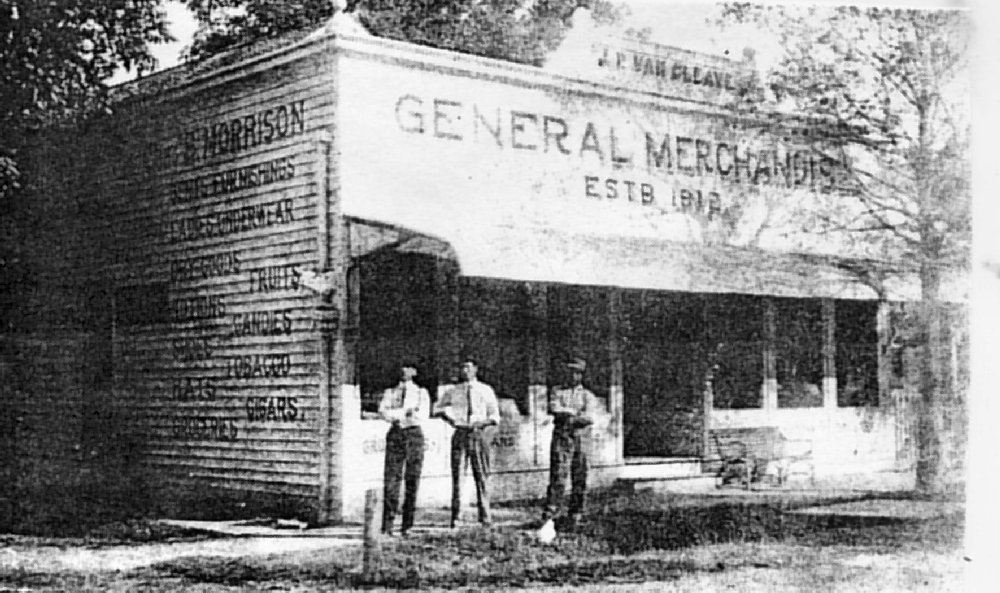
J.P. Van Cleave Store
This mercantile store was situated on the southeast corner of Washington Avenue and Porter, now Robert Mohler’s Corner. Junius P. Van Cleave (1879-1945+), who was a partner with W.S. Van Cleave (1871-1938) in the Van Cleave Brothers Store, which was located diagonally across the street on the northwest corner of Washington Avenue and Porter, acquired this excellent commercial parcel in May 1906 from Oren Switzer (1837-1921), a Canadian immigrant, who operated the Switzer Cash Store here prior to his sale to Mr. Van Cleave. J.P. Van Cleave remained here until February 1909, when he moved to Philadelphia, Pennsylvania to work with his brothers, Richard Van Cleave and Robert A. Van Cleave Jr. J.P. Van Cleave let the store to Charles B. Morrison (1868-1938) in 1914. In November 1916, “The Great Fire” commenced in the kitchen of the empty J.P. Van Cleave Store building. It raced south down Washington Avenue borne by a howling gale destroying many homes and several buildings including the firehouse and the Vahle House, an inn.
Charles B. Morrison
Charles Bickham Morrison (1868-1938), a native of Assumption Parish, Louisiana, was the son of Dr. John Morrison (b. 1832) and Mary Ellen Thomasson (b. 1844) and the nephew of Amanda Chick Shaffer (1841-1923), a wealthy plantation owner of Terrebonne Parish, Louisiana. Mrs. Shaffer was the widow of William Lafayette Shaffer (1834-1895), the founder of Cedar Grove Plantation, near Chacahoula, Terrebonne Parish, Louisiana. At Ocean Springs, she owned “White House Hill” from March 1909 until November 1922. This Greek Revival structure is one of our oldest, if not the oldest home, and situated at present day 214 Washington Avenue.(Terrebonne Life Lines, Spring 1995, p. 5)
Charles B. Morrison had arrived at Ocean Springs from Flora, Illinois, in February 1911. In early September 1911, The Ocean Springs News announced that C.E. (sic) Morrison, a gentleman of sufficient means to enter commerce, and a recent arrival to Ocean Springs from Flora, Illinois, was contemplating opening a variety store. A building for Mr. Morrison was erected on the H.F. Russell lot located on the southeast corner of Bowen and Washington next to the Picture Palace run by Mr. Illing. Work was commenced by carpenters on the structure on September 8, 1911.(The Ocean Springs News, September 2, 1911)
Economy Variety Store
Charles B. Morrison opened the Economy Variety Store in October 1911. It vended a general line of five and ten cent goods and other low priced articles. Morrison establishment was juxtaposed to the Picture Palace. He let a residence on Bowen Avenue from Albert C. Gottsche (1873-1949) in November 1911.(The Ocean Springs News, October 14, 1911, p. 5 and November 25, 1911)
J.P. Van Cleave Store
Charles B. Morrison took a lease from Junius P. Van Cleave (1878-1945+) in March 1914, on Mr. Van Cleave’s building and mercantile business on the southeast corner of Porter and Washington Avenue. J.P. Van Cleave and family were moving to Laurel, Mississippi where he was erecting a new structure to house his mercantile business, Van Cleave & Green.(The Ocean Springs News, March 28, 1914, p.1)
Circa 1915, Mr. Charles B. Morrison the following information was related in a local pamphlet:
Charles B. Morrison conducts one of the most prosperous stores at Ocean Springs. He has on hand a full line of fresh groceries, dry goods, shoes, notions, and a complete line of candies, cigars, etc. Mr. Morrison formerly resided in Terrebonne Parish. His boyhood days were spent on one of the large sugar plantations of that parish. For some years he was engaged in sugar planting, and removed to Battle Creek, Michigan to engage in the grocery business, in which venture he was highly successful. In connection with his Ocean Springs store, he has a large warehouse in the rear, which contains heavy staples in his line. Mr. Morrison has developed not only a large trade, but has a growing business in the interior of Jackson County. (Ocean Springs 1915, p. 32 )
On January 27, 1915, Charles B. Morrison had to liquidate the merchandise in his Ocean Springs store. Ill health had prevented him from giving proper attention to his business, which resulted in an unstable credit line. Morrison had started here in March 1914, when he bought out J.P. Van Cleave who moved to Laurel, Mississippi.(The Ocean Springs News, January 21, 1915, p. 1)
Biloxi
Circa 1929, Charles B. Morrison moved to Biloxi to be with his sister, Virginia M. Shanahan (1862-1943), the widow of Thomas B. Shanahan (1872-1932) of Ocean Springs. Thomas B. Shanahan, a carpenter, was the son of Irish immigrants, John J. Shanahan (1810-1892) and Maria Torney (1826-1909), who founded the Shanahan House, a popular hostelry on Washington Avenue. Thomas ran the Shanahan House after his mother’s demise and until it was destroyed by fire on Christmas Eve 1919.
At Biloxi, Charles B. Morrison and Virginia M. Shanahan resided at 143 Fayard Street. Mr. Morrison took care of the Pines Hotel on Washington Avenue in 1929, when ownership was transferred from Frank J. Raymond (1883-1952) to Mrs. Victor Levy.(The Jackson County Times, June 8, 1929, p. 1)
Mr. Morrison also worked for the WPA before his demise. He had been married to Pearl Walker (b. 1879) and they appear to have had a son. Upon their demise in 1938 and 1943 respectively, the corporal remains of Charles B. Morrison and his sister were buried in the Biloxi Cemetery.(Bradford-O’Keefe Book 25, p. 273, The Daily Herald, August 27, 1938, p. 6 and Bradford-O’Keefe Book 29, p. 185)
The "Big Fire"
The "Big Fire" of November 1916 at Ocean Springs commenced in the kitchen of the J.P. Van Cleave Store building. It had been vacant for a few months before the conflagration. Ocean Springs was fortunate as the great fire started at the leeward end of the business district on the southeast corner of Porter and Washington where the Mohler Service Station and Café are now located. A gale force wind blew out of the north and the flames and burning embers were sent south towards the beach with great celerity. The Richardson Cottage and the Firemen's Hall both near the fire's origin were rapidly consumed by the fast moving conflagration. People on Washington Avenue were on their roofs with buckets of water and brooms to sweep away the fire and burning particles. Suddenly the cry went out that the Vahle House, a local hostelry on the northwest corner of Washington and Calhoun, was ablaze. This tall, two-story house made the burning shingle roof impossible to reach and contain. Soon the flames leaped to the Armstrong and McFarland Cottages on the west side of Washington Avenue just south of the Vahle House. They were also destroyed. In these times, devastation by fire was complete as buildings were composed almost entirely of wood, a very combustible material. Only the yeoman efforts of the Ocean Springs Fire Company No. 1, the Hook and Ladder Company, and volunteer citizens saved other structure in the direct path of the conflagration. The Vahle House was valued at $2500.(The Jackson County Times, November 18, 1916, p. 1)
Sale
After the Great Fire, J.P. Van Cleave sold his vacant lot on the southeast corner of Washington And Porter to his brother, W.S. Van Cleave, on October 15, 1923. W.S. Van Cleave kept the property for a number of years before he conveyed it to the Texas Company in June 1930. There has been an automobile service station at this location continuously since Texaco acquired the lot. The Robert Mohler family operates here today selling petrol, food and beverages.(Jackson County, Ms. Land Deed Bk. 53, pp. 354 and Bk. 63, p. 479)
Laurel, Mississippi
In April 1914, Junius P. Van Cleave had moved his family to Laurel, Mississippi where he went into business as Van Cleave & Green. By November 1915, June Van Cleave was purchasing additional property north of his Laurel store on First Avenue. He planned to erect three cottages on them.(The Ocean Springs News, November 18, 1915)
In 1918, J.P. Van Cleave and family were still in Laurel as he registered for the WW I draft (1917-1918) at Jones County, Mississippi. January 1920 found the June Van Cleave family still at Laurel and in the grocery business. Mrs. Mary Witt Richardson, his mother-in-law, was with them as they resided on 4th Avenue.(1920 Jones Co., Mississippi Federal Census, T625_881, p. 5A, ED 87)
In 1923, J.P. Van Cleave joined his brother, Robert S. Van Cleave, in the construction business. They had a contract to build one thousand houses for the DuPont Engineering Company at Winston-Salem, North Carolina.
By 1930, the J.P. Van Cleaves were living in Philadelphia, Pennsylvania in the Allen Lane Apartments. They later relocated to Richmond, Virginia. Vertalee Bradford Van Cleave (1916-2004) met Junius P. Van Cleave at Ocean Springs in the late 1940s, when he visited here from Virginia. Mrs. Minnie Van Cleave was still living in 1952. No further information.(Vertalee Bradford Van Cleave-1995 and 1930 Philadelphia Co., Pennsylvania Federal Census, R2104, p. 47A, ED 622)
R.A. Van Cleave recap
Among the many accomplishments earned during his life time, Robert A. Van Cleave (1840-1908) was appointed the first provisional Mayor of Ocean Springs in 1892, served as Postmaster here from 1872-1882, and was appointed from 1885-1889 as Special Agent of the U.S. Land Office to protect public timberlands. Vancleave, Mississippi was also named for him.(The Gulf Coast Times, October 28, 1949, p. 6)
During his tenure as Postmaster at Ocean Springs (1872-1882), Congress enacted the Mail Fraud Statue (1872); the Penny postal card was initiated (1873); the General Postal Union was formed (1874), which was later known as the Universal Postal Union; and the Office of Chief Postal Inspector was created by Congress (1880).
__________________________________________________________________________________________________
WARD
Julia McConnell Ward (1830-1894+) was an Irish immigrant who settled at Ocean Springs probably in the middle of the 1860s. She was married to John Nicolas Ward. The Wards probably came to Ocean Springs from New Orleans as some of their children were born in Louisiana.
In the early 1870s, Mrs. Ward acquired land in Section 25, T7S-R9W on the front beach at Ocean Springs from George A. Cox. Here on Lots 17, 18, and 19 of Block 17 (Culmseig Map of 1854), she operated a family boarding house called the Oak Cottage.
A correspondent for The Star of Pascagoula reported in June 1874, that the Oak Cottage was "a perfect gem of a place, delightfully situated, and elegant surroundings". Mrs. Ward was described as hospitable and kind. She had spared no expense or inconvenience to prepare her home on the bay front for her guests. The grounds of the Oak Cottage were well done, the dining room clean, and the food and drink suitable for both sexes.
The Wards had three children: Albert (b. 1862), Ida L. Franco (1864-1906), and Charles (b. 1869). In December 1891, Ida Ward married John Franco (1859-1935), the son of Antonio Franco (1834-1891) and Jane Rodriguez (1844-1915). She died while returning from Mineral Springs, Texas in 1906.
In May 1894, the Ward family sold their Oak Cottage grounds to Charles W. Ziegler (1865-1936) of New Orleans.Ziegler established a residence here called "Lake View".
__________________________________________________________________________________________________
THE EDWIN M. WESTBROOK HOUSE and FAMILY
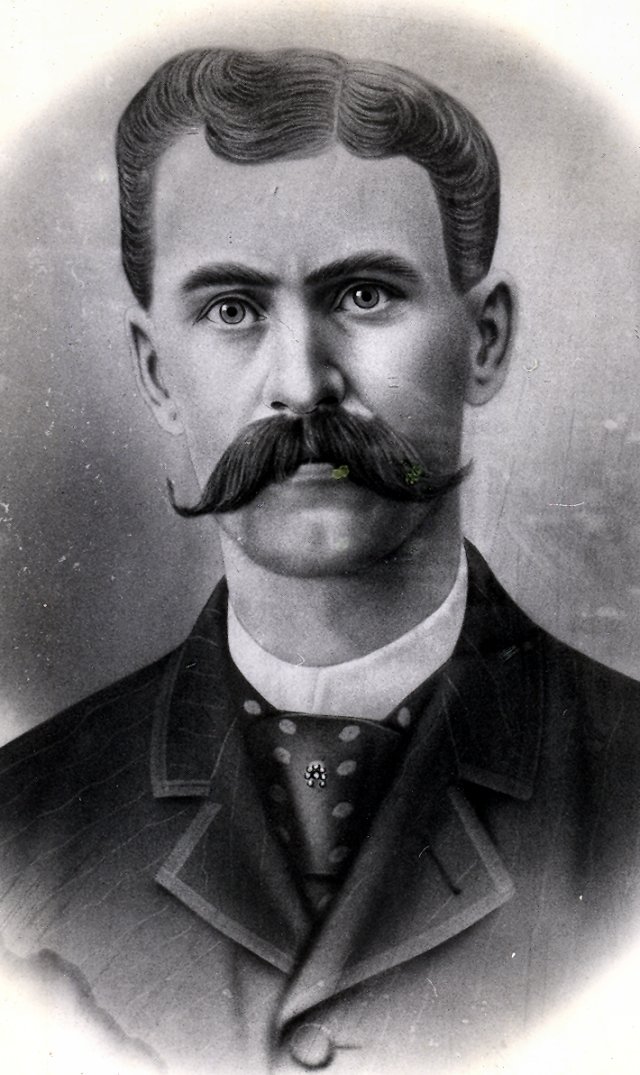
Edward M. Westbrook (1858-1913)
The Edwin Martin Westbrook House was located on the west side of Washington Avenue between the present day Lovelace Drug Store and the Blossman Building. Older citizens get nostalgic recalling when this lovely Queen Anne cottage was neighbored by the A.C. Gottsche Store and the Bailey Drug Store.
The Westbrook family is certainly one of the oldest at Ocean Springs. John Westbrook, possibly from England, married Felicite LaFontaine, the daughter of Louis Auguste LaFontaine and Catherine Bourgeois, the founding family of Ocean Springs. Some of John Westbrook's progeny were Lucian Westbrook (1842-1896) who married Cecelia Kendall (1848-1913), the daughter of Celestine Ryan (1828-1864+) and Louis Kendall (c. 1830-1894), and Louise Felicite Westbrook (b. circa 1836) who married Rene' Ryan in August 1850.
Edwin Martin Westbrook (1858-1913), who built his home on Washington Avenue, circa 1897, was born at Louisiana, probably New Orleans. His relationship to John Westbrook and Felicity LaFontaine is not presently known to this researcher, but they appear to be disputably unrelated. Information on E.M. Westbrook's father is sparse, but his name is believed to have been John Westbrook. His mother, Caroline Mathieu (1830-1895), a native of Louisville, Kentucky, and a midwife at Ocean Springs, was widowed circa 1870. She remarried Captain Joseph Toche (b. 1848), who was probably born at Dauphin Island, Alabama. Toche's father was a French immigrant. Caroline's children with John Westbrook were: Louis Charles Westbrook (1847-1921)* m. Henrietta Alvarez (1861-1895); William Westbrook*; Martha Westbrook (1851-1919) who married Leonard Fayard (1847-1923); Edwin M. Westbrook (1858-1913); Henry R. Westbrook (1860-1938) who married Francis J. Hadley (b. 1860); and Viola Westbrook (b. 1865) who married John Bourgeois. Her children with Joseph Toche were Adele Toche (b. 1870) and Joseph Toche, Jr. (1873-1960).
* e-mail to Ray L. Bellande from Dawna Graham Westbrook on January 20, 2010:
Louis Charles Westbrook (Aug. 9, 1847 - Nov. 6, 1921). This is my husbands great grandfather. I have a copy of his death certificate showing John and Caroline as his parents. There are numerous newspaper articles mentioning his daughters visiting their cousins (Edwin Westbrook family) in Ocean Springs. He was married 3 times but all of his children were born to his 2nd wife Henrietta Alvarez (1861 - Oct 31, 1895) of New Orleans. As a young man he moved to New Orleans. He eventually moved to Bay St. Louis and then Biloxi. Six of his 8 children died in early adulthood from TB and one daughter from malaria. They are all buried in the Biloxi Cemetery. His only child that lived out a full life was Henrietta (1893 - 1985). Henrietta married Herman Francis Kelly (1888 - 1946). The Westbrook descendants of Louis were through his daughter Theresa (1887- 1919). She had 2 illegitimate children, Margaret (1911 - 1993) and Charles (1913 - 1974). Charles F. "Charlie" Westbrook raised his family first on Elmer St. in Biloxi and then 1607 Porter Ave., OS. Charlie had 7 sons and 1 daughter so our branch of the Westbrook dynasty is strong and expanding. Caroline and John's 2nd child was William. I haven't actually done any research on William and what I've seen of others work looks to be in error. I can only say he existed.
E.M. Westbrook made his livelihood in Ocean Springs as a barber. He was practicing this tonsorial art as early as the age of twenty-two. On December 16, 1880, Westbrook married Harriet Clark (1857-1927), a Mississippian and native of Green County. Her family arrived in Jackson County after the Civil War and her sister married John Ryan. The E.M. Westbrook family probably lived in the Jerome Ryan tract on or near Porter Avenue, before acquiring their Washington Avenue tract in March 1897, from the widow, Josephine Pferffle (1837-1904), an 1840, Bavarian immigrant. Her husband, Rudolph Pferffle (1829-1880+) also Bavarian, was a local house carpenter and building contractor. This is corroborated by The Pascagoula Democrat-Star of June 4, 1897, "our enterprising Alderman Westbrook has moved from his Porter Avenue residence to his new purchase on Washington Avenue adjoining the Post Office". By late June, he was upgrading his newly acquired Washington Avenue lot.(JXCO, Ms. Land Deed Bk. 18, pp. 167-168 and The Pascagoula Democrat-Star, July 2, 1897, p. 3 and The Jackson County Times, April 23, 1927, p. 1.)
E.W. Davis purchased the Westbrook home near Porter for $1700 in April 1897. Mrs. Pferrfle built a cottage on Bienville Avenue in April 1897.
The E.M. Westbrook tract was located in Lot 14 of Block 19 (Culmseig Map of 1854). It was L-shaped and fronted on three streets. The .72 acre lot had a front on Washington Avenue of fifty-four feet, a front on Desoto of two hundred and thirteen feet, and on Jackson Avenue, a front of one hundred feet. At the time of the March 1897 purchase, the Westbrook lot was located between the home of Mayor Thomas W. Grayson (1825-1904) and the U.S. Post Office which was situated on the southwest corner of Washington and Desoto. The large Davis Brothers mercantile store was south of Mayor Grayson. It can be determined with a high degree of certitude from Sanborn insurance maps of 1893 and 1898, that the E.M. Westbrook edifice was erected in the period between these years.
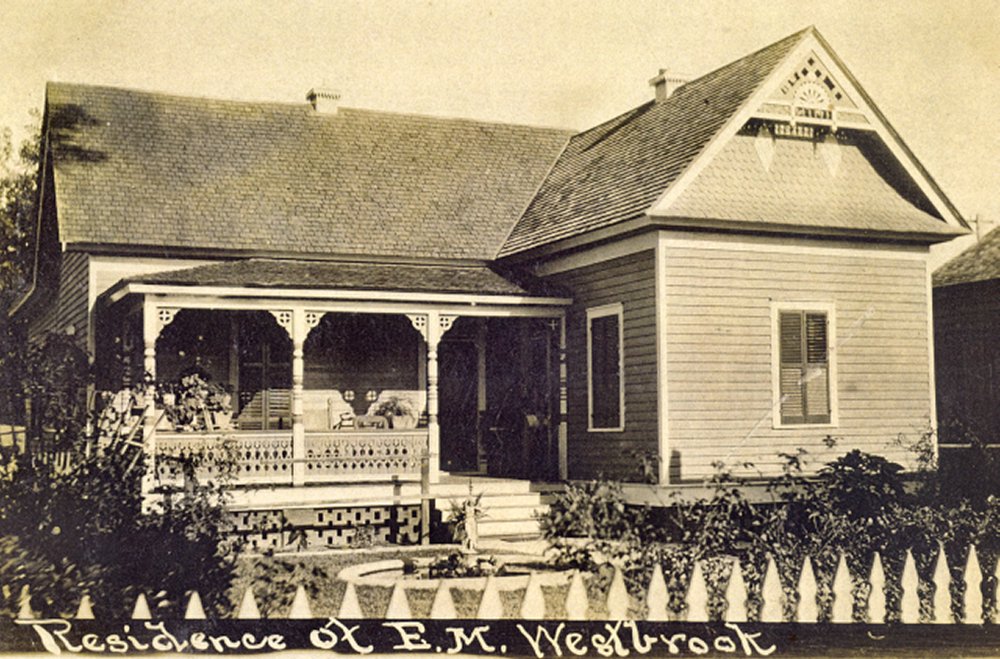
E.M. Westbrook House
[west side of Washington Avenue between Government and Desoto]
The original Queen Anne structure with cross-gabled roof, had a three bay porch featuring turned posts, brackets, and a highly ornamented balustrade. A projecting gabled bay on the north side of the cottage was accentuated by imbricated shingles and ornate barge board in the gable. The windows were shuttered. The Westbrook's' exquisitely landscaped front yard featured a fountain with a small Muse like statuette. The Westbrook cottage had a living area of 1325 square-feet. The front gallery had an area of 120 square-feet and the south side porch consisted of 150 square-feet of operative space.
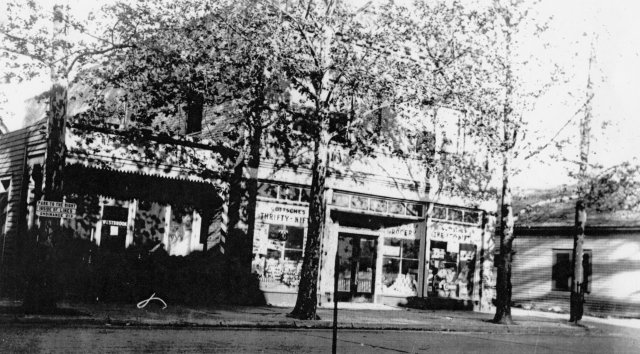
E.M. and Arthur E. Westbrook Barbershop
[situated on the west side of Washington Avenue south of Desoto. Note the A.C. Gottsche store, which is now the Blossman Gas Company building]
Barbershop
In 1894, E.M. Westbrook also erected a barbershop about ten feet northeast of his house. It was a one-story, wood-framed building of 225 square feet. At this business establishment, Mr. Westbrook was also the agent for the Peerless Steam Laundry of Mobile, and handled cigars and chewing tobacco. His son, Arthur, joined him as a barber about 1898.
In September 1929, the Westbrook barbershop was moved to line up with the other structures on Washington Avenue. Its timbers were generally found to be in good condition. The iron fence, which graced the Westbrook cottage was also relocated at this time.(The Jackson County Times, September 14, 1929, p. 2)
The E.M. Westbrooks reared a large family at Ocean Springs. Their children were: Edmund James Westbrook (1881-1943), Henry Charles Westbrook (1883-1883), Arthur Efferis Westbrook (1884-1945), William Joseph Westbrook (1886-1913), George Lamar Westbrook (1888-1935), Frederick Louis Westbrook (1889-1963), Alonzo Sheldon Westbrook (1892-1919), Harry Ferdinand Westbrook (1894-1933), Hattie Adele Westbrook (1898-1919), and Albert Sidney Westbrook (1900-1980).
The Westbrook boys grew up when the L&N Railroad was an important and prestigious employer at Ocean Springs. It was only natural that they would seek livelihoods in the rail transportation industry. Only Arthur E. Westbrook followed the tonsorial trade of his father. A biographical sketch of the lives of the Westbrook men who pursued careers with the L&N Railroad follows:
Edmund [Edwin?] J. Westbrook (1881-1943) began his career as a telegraph operator with the L&N at Ocean Springs. He met and married Adele M. Krebs (1883-1966) of Pascagoula. She was the daughter of Alfred E. Krebs (1847-1898) and Hanna Herminia Ellison (1852-1938). Her brother-in-law was Willie P. Ramsay (1870-1963) of Vancleave and Latimer who served as Sheriff of Jackson County from 1904-1908. In January 1903, the young couple married at Our Lady of Victories Roman Catholic Church at Pascagoula. They initially resided at Ocean Springs with Mrs. G.H. Tardy (1840-1917). The E.J. Westbrooks had a daughter, Ione Westbrook (1905-1990). She worked as a clerk in the Jackson County Chancery Court. The Westbrook family later relocated to Pascagoula where they resided at 410 Jackson Avenue adjacent to the Jackson-George Regional public library building. E.J. Westbrook and his family were interred in the Krebs family plot at the Greenwood Cemetery in Pascagoula.
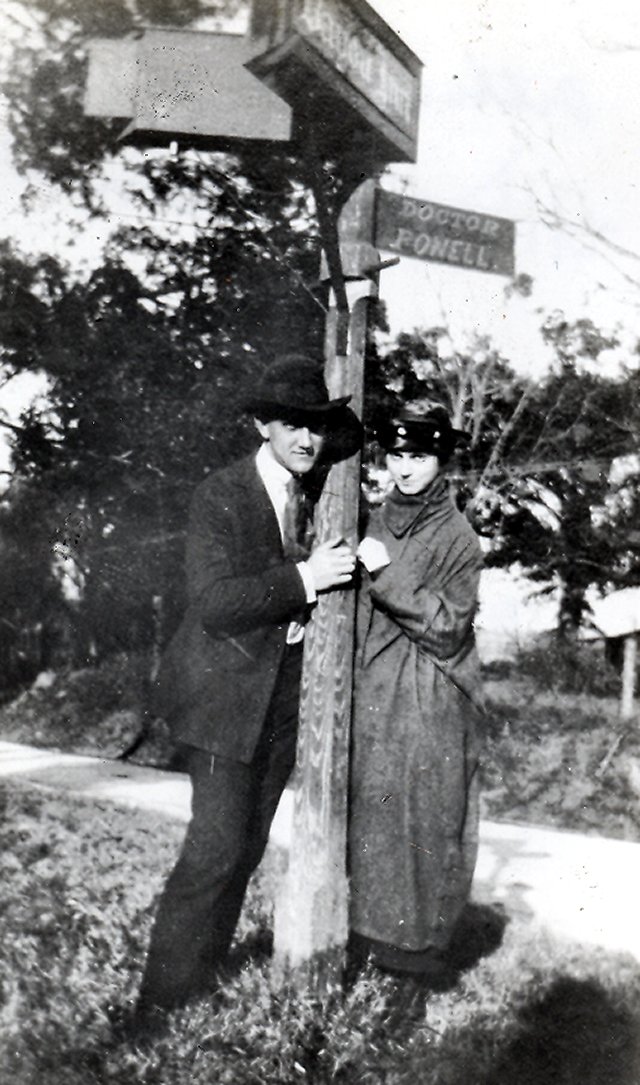
Arthur Efferis Westbrook (1884-1945) and spouse? on Washington Avenue near Old Fort Bayou circa 1924.
[courtesy of J.K. Lemon (1914-1998)]
Arthur E. Westbrook (1884-1945) was born March 14, 1884 at Ocean Springs. he followed his father's vocation and became a barber. E.M. Westbrook had established the business in 1879. Arthur started as apprentice barber with his father circa 1898. Upon Edward M. Westbrook's demise in 1913, he became sole proprietor of what was the best barber shop in the city. It was characterized by cleanliness and high sanitary practices. In addition to his barbering, Arthur E. Westbrook was the local agent for The Times-Picayune of New Orleans and the Ideal Steam Laundry of Pascagoula.(Ocean Springs-1915, p. 29)
On October 16, 1907, Arthur E. Westbrook married Louise A. Ernst (1881-1962) of New Orleans. She was the daughter of Felix Ernst Jr. (1853-1906) and Josephine Faessel (1858-1915). Louise, called Lula, was reared on 3rd Street in the Crescent City where her father was a merchant. She had a brother, Andrew Ernst (1879-1900+).(1900 Orleans Parish, Louisiana Federal Census T623 574, p. 27B, ED 112)
Lula and Arthur E. Westbrook were the parents of two children: Marion Westbrook (1909-1926+) married Burke Poe and Andrew Westbrook (1915-1986). Arthur E. Westbrook was a good story teller and preserved and passed on many anecdotal tales told to him by his father and others who frequented the Westbrook Barbershop on Washington Avenue near Desoto. Arthur expired on February 21, 1945. Louise Ernst Westbrook lived until 1962.(J.K. Lemon (1914-1998)
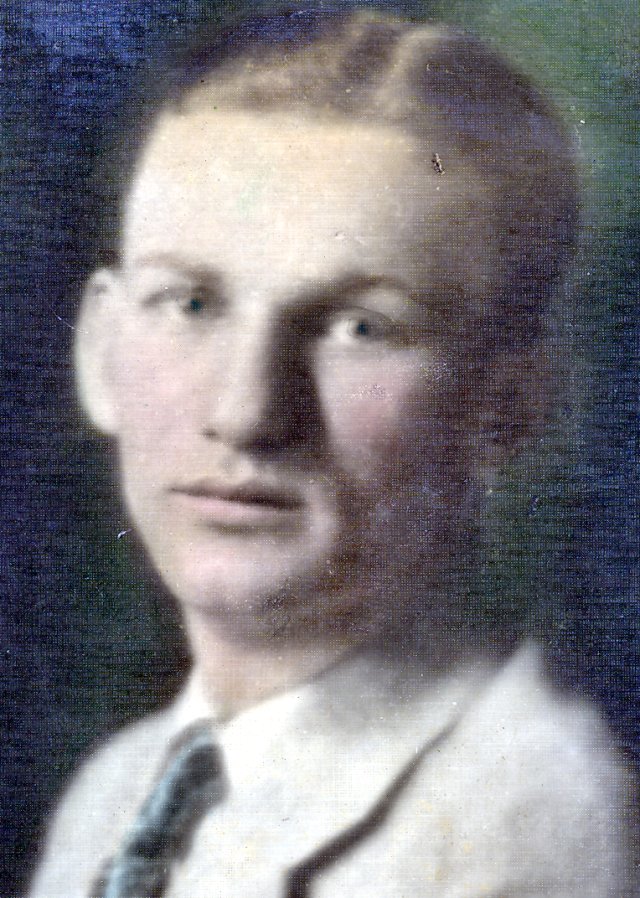
Leroy Westbrook (1908-pre-1980)
[F.L. Westbrook Jr. Collection]
William J. Westbrook (1886-1913) was killed in a railroad accident at Grand Bay, Alabama on February 23, 1913. While attempting to catch the caboose of a freight train, young Westbrook lost his footing and fell beneath the rolling wheels of a freight car. He was the L&N station agent at the time of his demise. W.J. Westbrook probably had three children born in Alabama: W.J. Westbrook, Jr., Leroy Westbrook (b. 1908- pre 1980) and Lillian Westbrook (b. 1911). The two younger children lived at Ocean Springs with their grandmother, Hattie Westbrook, in 1920.
In the settlement of Mrs. Harriet Westbrook's Estate, Jackson County Chancery Court Cause No. 4920-April 1927, her sons, Arthur and Fred L. Westbrook, were appointed administrators by the court. By this time, W.J. Westbrook's wife had remarried and was known as Mrs. Mamie E. Fields. She resided with her minor children at 56 South Conception Street, Mobile, Alabama. Mrs. Fields children as well Alonzo Westbrook, Jr. were inheritors in their grandmother's estate and were compensated through Jackson County Chancery Court Cause No. 5004.
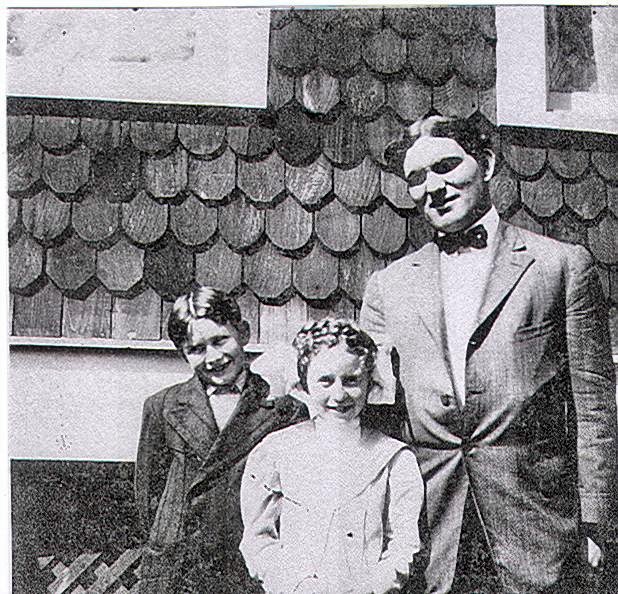
George L. Westbrook (1888-1935)
[G.L. Westbrook with Van Cleave Reid (1899-1972) and Audrey Reid (1900-1914. image made at 528 Jackson Avenue circa 1908)
George L. Westbrook (1888-1935) became associated with the L&N Railroad circa 1905. He was a telegraph operator and ticket agent at the Ocean Springs depot. Circa 1909, G.L. Westbrook married Sarah “Sallie” Van Cleave (1876-1934), the widow of Dunklin Felix Reid (1872-circa 1906). Mrs. Reid was the daughter of Robert A. Van Cleave (1840-1908) and Elizabeth R. Sheppard (1842-1912). She had two children, Van Cleave Reid (1899-1972) and Audrey E. Reid (1900-1914).
On December 15, 1934, George L. Westbrook married Ina Towle Baker (1881-1947) at Gulfport. She was the daughter of of James Towle, a Scotsman, and an Irish lady named Daily. Ina T. Westbrook previously resided at Wausau, Wisconsin. She had two sons, Frederick Otis Baker and William John Baker, from her first marriage to F.W. Baker. Mrs. Westbrook was president of the Ocean Springs Demonstration Club and a recognized landscape authority. She died on September 23, 1947. Her remains were interred at Memphis.
G.L. Westbrook was found dead at his home with acute indigestion on July 26, 1935. Mrs. Ina Westbrook was in Milwaukee visiting relatives at the time.
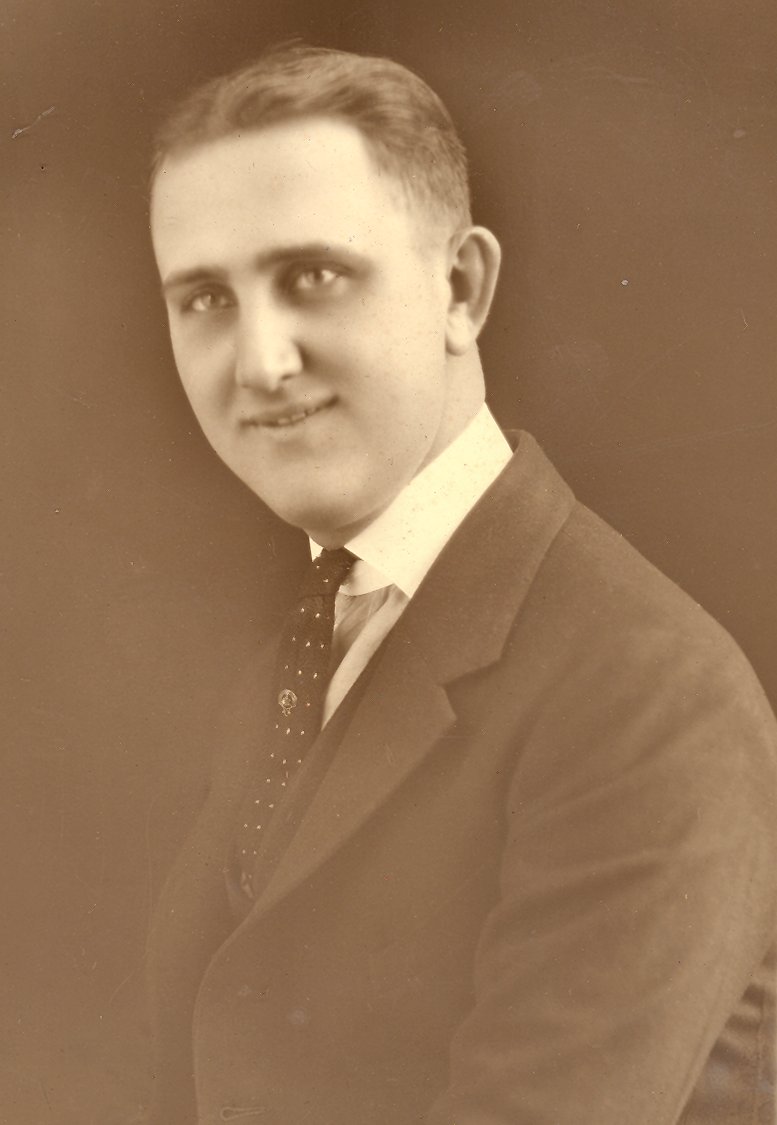
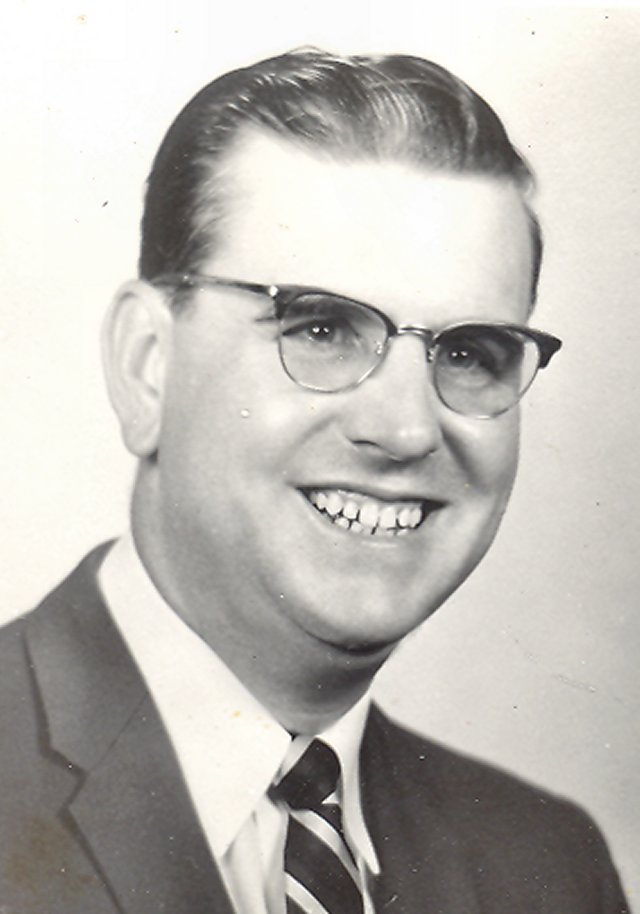
Frederick L. Westbrook Sr. (1889-1963) and Frederick L. Westbrook Jr. (1919-2001)
[F.L. Westbrook Jr. Collection]
Frederick L. Westbrook, Sr. (1889-1963) was the day operator for the L&N Railroad at the Biloxi station in 1913. He later worked for the U.S. Postal Service as a mail carrier. Westbrook married Seraphine Tucei (1882-1977) of Biloxi in June 1916. They had one son, Frederick L. Westbrook, Jr. (1919-2001) and resided at 709 Church Street in Ocean Springs.
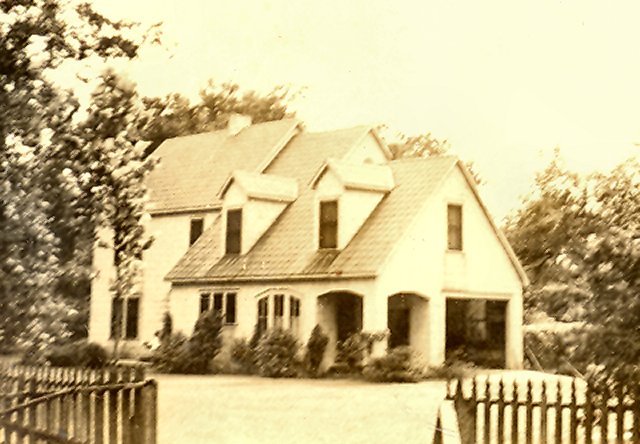
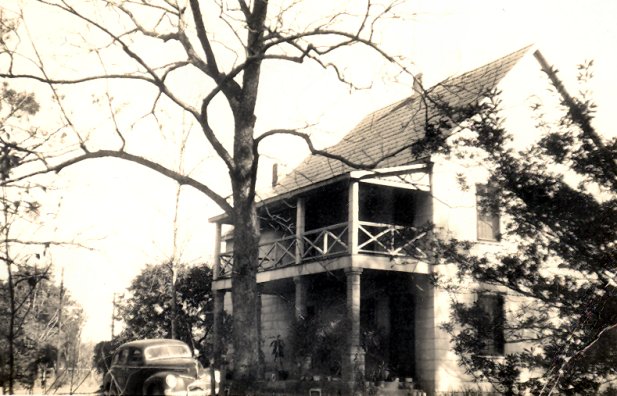
709 Church Street
[L-R: east elevation and west elevation]
[F.L. Westbrook Jr. Collection]
In June 1915, Rural Route 2, a new rural postal route was announced by the Ocean Springs Post Office. There were one hundred-fifty families on the circuit with the number soon expected by Postmaster McClure to increase to two hundred. In July 1915, twenty-nine people applied for the Rural Route 2 position at testing sites in Biloxi and Pascagoula. Locals from Vancleave and Ocean Springs who took this postal exam were Charles H. Mr. Bransford (1868-1947), the former Postmaster; John B. Bransford; George T. Rehage (1878-1937); Ralph M. Spaulding (1876-1959); Fred Lewis (1862-1933); Fred L. Westbrook (1889-1963); Tim Regan; Billy Mitchell; John Wadlow; and Paul Bertuccini (b. 1893).( The Ocean Springs News, June 17, 1915, p. 1, July 1, 1915, p. 1, and July 29, 1915, p. 1)
Fred L. Westbrook Sr. won the position scoring 87.1 on the postal examination. His appointment as a carrier on R.F.D. No. 2 was announced publicly in early February 1916. Fred started the job in late January. In the fall of 1917, The Jackson County Times announced that F.L. Westbrook, Route 2 carrier, increased his daily delivery schedule to six days each week. Prior to this, he delivered only three days per week.(The Ocean Springs News, February 3, 1916, p. 1 and The Jackson County Times, October 20, 1917)
Fred L. Westbrook Sr. retired from the US Postal Service on in early December 1959 after 43 years and ten months of service as a rural mail carrier. He related that he traveled over 30,000 miles each year. His longest route was about 95 miles. It began in Ocean Springs went to East Beach, Fontainebleau, Vancleave and thirty-five miles further. This route was split in 1952, but still required seventy miles of driving because of the increased population in rural areas. (The Daily Herald, December 2, 1959, p. 2)
Fred L. Westbrook, Sr. was very active at the St. Alphonsus Catholic Church where he served as president of the Holy Name Society and on the building committee. He was a member of the Order of the Alhambra, Knights of Columbus (third and fourth degree), and Sacred Heart League. After Mr. Westbrook's demise, the local Knights of Columbus chapter, which was commenced by his son, Fred, was named the Fred L. Westbrook, Sr. Council No. 5654. Their building is located at 621 Washington Avenue.
Alonzo S. Westbrook (1892-1918) was employed by the L&N Railroad at Biloxi, when he died from tuberculosis at the young age of twenty-six years. He was the cashier at the freight depot. Alonzo Westbrook was probably named for Alonzo D. Sheldon (1832-1904), a native of New York who was the railroad agent at Ocean Springs in 1880.
In 1914, A.S. Westbrook was residing at Mobile where he was a cashier for the L&N. He married Margarite Van Cleave (1895-1977) at Vicksburg, on March 19, 1914. She was a native of Yazoo City and the daughter of Mr. and Mrs. Thomas M. Van Cleave. Margarite V. Westbrook was also the niece of Mrs. George L. Westbrook, the brother of R.A. Van Cleave (1840-1908). Mr. T.M. Van Cleave was on the police force and a Justice of the Peace at Vicksburg.(The Ocean Springs News, March 28, 1914, p. 1)
Alonzo S. Westbrook Jr. (1915-2002) was born on March 4, 1915, at Ocean Springs. After his father's demise in March 1918, Mrs. Westbrook relocated to Jackson, Mississippi and reared her son there. He was valedictorian of Jackson Central High School and graduated from the University of Mississippi law school in 1939. Alonzo S. Westbrook Jr. practiced law at Jackson until he was employed by the Civil Service at KAFB at Biloxi in 1967. Mr. Westbrook expired at Biloxi on January 12, 2002.
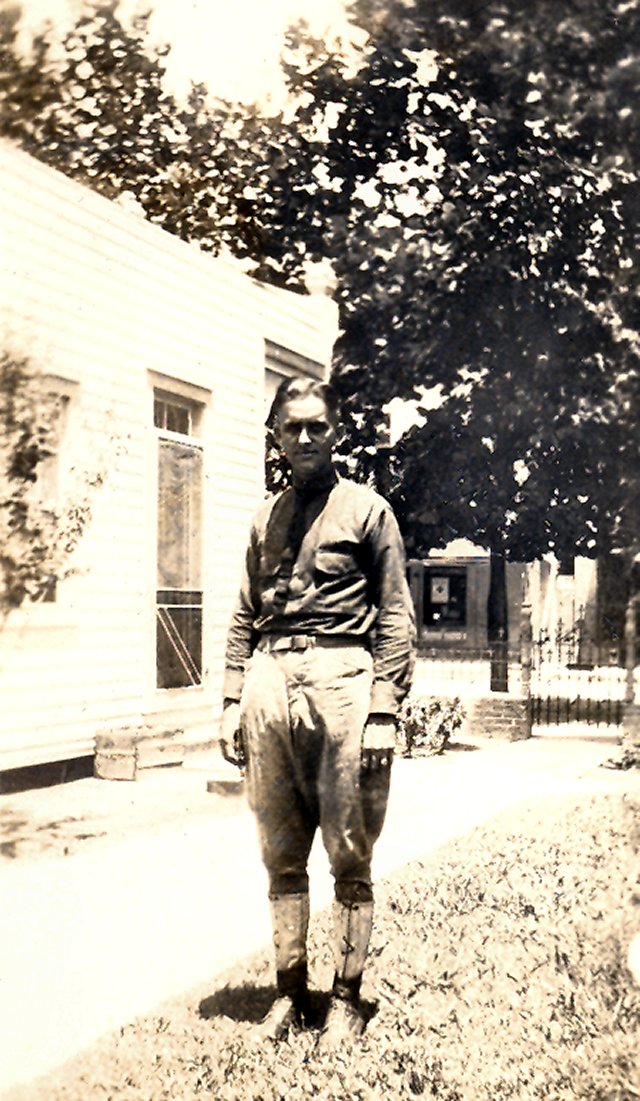
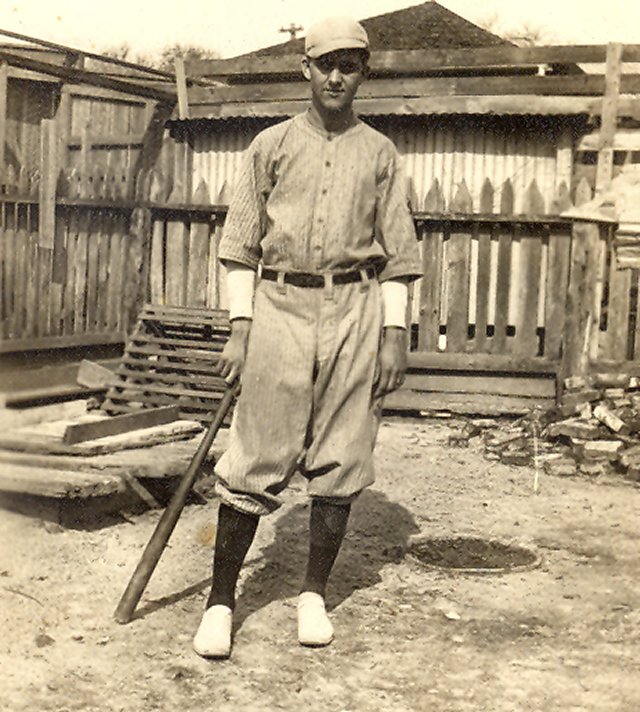
Harry Westbrook (1893-1933)
[F.L. Westbrook Jr. Collection]
Harry F. Westbrook (1893-1933) joined the L&N Railroad at Biloxi circa 1921, as a telegraph operator. After returning from WW I, having served in the European Theater with the 29th Infantry Division, he had been employed as a moulder in a shipyard. Harry Westbrook also worked at several coast cities during his tenure with the railroad. He was an athlete and excelled at baseball. In 1920, Harry Westbrook played catcher for the Biloxi nine. He was the hero of a game at Biloxi on August 29, 1920, when he cracked a double in the bottom of the ninth and drove in two runs, which beat the New Orleans Lookouts. Westbrook managed the 1928 Ocean Springs team which won the Gulf Coast League championship. Harry Westbrook married Lorraine Whitfield of Gulfport on December 20, 1924. They had a daughter, Betty W. Hampton (b. 1925). Harry F. Westbrook passed on April 26, 1933, at the VA Hospital in Outwood, Kentucky after a long illness which may have been related to his military career.
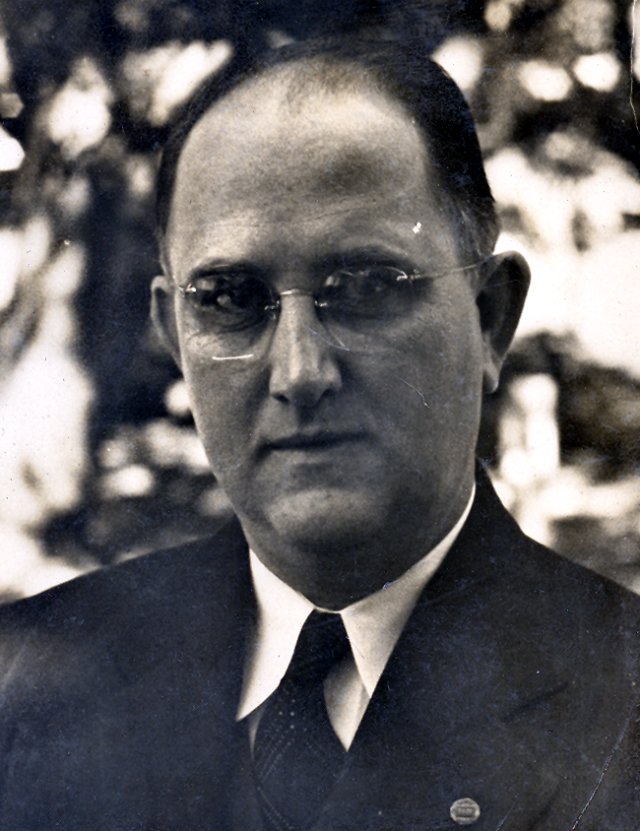
Albert Westbrook (1900-1980)
[F.L. Westbrook Jr. Collection]
Albert S. Westbrook (1900-1980) joined the L&N Railroad in 1917. Although his career took him to Biloxi (chief clerk), Pascagoula, and Bay St. Louis, he always resided at Ocean Springs commuting daily to his post by rail. In August 1931, Albert was transferred to Biloxi as Freight Agent as his position in Ocean Springs as freight agent was eliminated. He retired from the L&N in 1963.(The Daily Herald, August 11, 1931, p.2)
In 1923, Albert Westbrook married Lucille Theresa Tonnelier (1901-1973) of Biloxi. They had a daughter, Margie W. Edwards (1927-2008), who married Bruce Edwards (1925-2003), resided at Ocean Springs. Margie expired at Ocean Springs on January 17, 2008. Margie and Bruce had three children: Jeanne Edwards m. Bobbie Lewis; Jan Edwards m. Mr. Roberts; and Bruce Edwards Jr. Her corporal remains were interred in Crestlawn Memorial Park on U.S. Highway 90 in Ocean Springs.(The Sun Herald, March 24, 2003, p. A6 and January 20, 2008, p. A12)
Like his father, Albert Westbrook was involved in local politics. He was elected mayor of Ocean Springs in 1943, and acted in this civic capacity until 1950. Mr. Westbrook was also elected alderman of Ward One several times. He served his constituents faithfully during his years in that office, which were: 1931-1932, 1939-1940, and 1969-1973. Albert Westbrook passed on October 8, 1980. His remains were interred at the Biloxi City Cemetery.
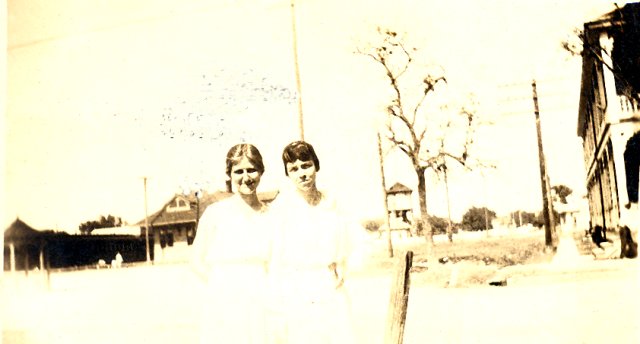
Hattie Westbrook
[L-R: Hattie Westbrook and friend on Washington Avenue circa 1918. L&N Depot on left and Commercial Hotel on right]
[F.L. Westbrook Jr. Collection]
Hattie Westbrook (1898-1919), the only girl, died on August 23, 1919, from tuberculosis. She had attended one year of college at the Industrial Institute & College at Columbus, Mississippi. Anecdotal history relates that Miss Westbrook rode her bicycle to the country school north of Fort Bayou, where she taught.
Edwin M. Westbrook also dealt in real estate. The Progress of July 23, 1904, described him as "our popular real estate agent". On August 27, 1904, he advertised on page four in The Progress as:
E.M. WESTBROOK
Dealer in
REAL ESTATE
General real estate business transacted.
Houses and Lots sold, rented or leased, and a
LIST YOUR PROPERTY WITH ME
Your Patronage is Solicited
The Jackson County Land Roll for 1906 indicates that E.M. Westbrook owned four houses in the Iberville Drive area north of the L&N tracks. One of these, the Century21K Realty office, which was erected in 1904, is extant today at 1201 Washington Avenue.
Edwin M. Westbrook was active in the social and political scene at Ocean Springs. He was a member of the Ocean Springs Fire Company No. 1 and officiated as the Grand Marshall of the 1893 Firemen’s Day Parade. Mr. Westbrook served his fellow citizens as alderman of Ward Four in the years of 1895-1898. After E.M. Westbrook's death in September 1913, Arthur Westbrook became the proprietor of the barbershop which was now adjacent to the new A.C. Gottshe grocery store.
Arthur E. Westbrook (1884-1945) married Louise Anna Ernst (1881-1962) of New Orleans in October 1907. They had two children, Marion W. Poe (1909-1962+) and Andrew Westbrook (1915-1962+). Marion had met her husband Burke Poe, in the late 1920s, when he had come to town to pave Washington Avenue and other thoroughfares. The Poes resided at Ponchatoula, Louisiana in 1962. Andrew Westbrook was a Captain in the U.S. Army and served in Italy during WW II. He later resided at Glen Burnie, Maryland.
Arthur Westbrook was a great story teller and passed on to his generation many anecdotal tales that he had learned in his father's barbershop as a child and as a hair dresser. He helped preserve much of our local history through these oral recitations. Westbrook retired from barbering in 1943 due to health reasons.After Mrs. Harriet C. Westbrook died on April 16, 1927, her estate was settled by Commissioner Fred Taylor in a forced heirship suit, Jackson County Chancery Court Cause
No. 5004. In February 1928, Arthur Westbrook paid $18,400 to the court for the Westbrook property.(2) On February 23, 1928, he conveyed an undivided 1/6th interest in these properties to his brothers, Fred, Harry, Edmund, George, and Albert.(3) The Westbrook brothers in turn conveyed the small barbershop tract, 19 feet by 200 feet, to Arthur E. Westbrook in March 1928.(4)
The E.M. Westbrook home was rented intermittently through the years. Minnie Mason who worked at the Ocean Springs High School cafeteria rented the house in the early 1940
In December 1945, the Westbrook heirs, Mrs. Arthur E. Westbrook, Mrs. Harry F. Westbrook, Adele K. Westbrook, Fred L. Westbrook, Albert S. Westbrook, Ione Westbrook, and Ina B. Westbrook sold the house and property on Washington Avenue to Roland Lovelace (1889-1967) for $3500.(5)
Lovelace bought the adjacent Bailey Building (now Lovelace Drug Store) tract from Beryl Bailey Parker Wood (1896-1986) in May 1948, for $5000. It is believed that Roland Lovelace had the E.M. Westbrook home demolished in 1946.
The old Westbrook barbershop was sold by Mrs. Arthur E. Westbrook to Tone and Eleanor Herman in May 1955.(6) Tone Herman conveyed the structure to Eula Quave Noyes for $6000 on August 3, 1959.(7) Mrs. Noyes operated a flower shop here for several years. Blossman Gas Inc. acquired the tract circa 1965. The corporation had previously purchased the old A.C. Gottsche store from A. Lynd Gottsche (1902-1974) in November 1962.(8) The Gottsche building (circa 1913) was refurbished and redesigned by architects, Slaughter & Smith, of Pascagoula.
The corporal remains of E.M. Westbrook and Harriet Clark Westbrook were both interred in the Bellande Cemetery on Dewey Avenue at Ocean Springs.
The old Westbrook barbershop collapsed when it was being moved to another area of the Blossman property, thus terminating the E.M. Westbrook family history in the heart of old Ocean Springs.
A sincere thanks to Margie W. Edwards, Darlene J. Krohn, J.K. Lemon, Mary Bess Welch, and Alonzo S. Westbrook, Jr. for their assistance with this historical essay.
REFERENCES:
1. Jackson County Land Deed Book 18, pp. 167-168.
2. ------------------------ Book 61, pp. 227-229.
3. ------------------------ Book 61, pp. 231-233.
4. ------------------------ Book 61, pp. 250-251.
5. ------------------------ Book 91, p. 515.
6. ------------------------ Book 148, p. 481.
7. ------------------------ Book 190, pp. 348-350.
8. ------------------------ Book 232, p. 382.
The Daily Herald, “Ocean Springs”, August 11, 1931.
The Daily Herald, "Westbrook ends long career as rural mailman", December 2, 1959, p. 2.
The Daily Herald, "Margarite V. Westbrook", May 2, 1977, p. A-2.
The Jackson County Times, "Alonzo S. Westbrook Obit", March 30, 1918, p. 4.
The Jackson County Times , "Miss Hattie Westbrook Passed Away Saturday", August 30, 1919, p. 5.
The Jackson County Times, "Local News Interest", August 14, 1920.
The Jackson County Times, "Local News Interest", September 4, 1920.
The Jackson County Times, "Mrs. E.M. Westbrook", April 23, 1927, p. 1.
The Jackson County Times, "Local News Interest", September 14, 1929.
The Jackson County Times, "Local and Personal", June 9, 1934.
The Jackson County Times, "Local and Personal", December 15, 1934.
The Jackson County Times, "George L. Westbrook Obit", August 3, 1935.
The Mississippi Press, "No Place on horse for tag, says oldster, new deputy", circa 1961.
The Pascagoula Democrat-Star, "Ocean Springs Locals", April 2, 1897.
The Pascagoula Democrat-Star, "Ocean Springs Locals", April 16, 1897.
The Pascagoula Democrat-Star, "Ocean Springs Locals", May 28, 1897.
The Pascagoula Democrat-Star, "Ocean Springs Locals", June 4, 1897.
The Pascagoula Democrat-Star, "Ocean Springs Locals", July 2, 1897.
The Ocean Springs News, "Westbrook-Van Cleave", March 28, 1914, p. 1.
The Sun Herald, "Bruce Edwards Sr.", March 24, 2003.
The Sun Herald, "Edwards had love for critters of all kind", March 24, 2003.
The Sun Herald, "Margie Westbrook Edwards", January 20, 2008.