- 4749 views
BRIEF CHURCH HISTORIES
Roman Catholic
SAINT ALPHONSUS PARISH 1699-1972
by C. Ernest Schmidt (1904-1988)
[edited and supplemented by Ray L. Bellande in December 2006]
Colonial days-19th Century
In the vast wilderness of Lower Louisiana, claimed by France, the Roman Catholic religion was first practiced in a colonial settlement on Biloxi Bay, which later became Saint Alphonsus Parish. Here in 1699, according to the journal of the Iberville expedition, daily Mass was offered, and the sacraments were administered for several years to French-Canadian explorers, preparing to establish colonies at Mobile, New Orleans and Natchez. When this was accomplished, Biloxi Bay returned to the wilderness, and French settlers who remained, reverted to a primitive existence for a hundred years, much like that of the native Indians. Because of distance and travel difficulty, they were served only occasionally by missioners from Mobile and New Orleans. Marriages and births were recorded, but it is doubtful that there were any sacraments for the dying or liturgy for the dead. When paddlewheel steamboats came out of New Orleans in the 1820 s, Coast towns began to develop Bay St. Louis, Pass Christian, Mississippi City, Biloxi, Ocean Springs and Pascagoula. As they grew, parishes were established and pastors appointed by the Bishops at Natchez. The village of Ocean Springs, where the Holy Mass was first offered, now depended on occasional visits by neighboring priests.
In 1857 Father Grignon who is on vacation at Pass Christian, writes to Bishop Elder: "I am going today to Ocean Springs, a place I am told which has not been visited since last year. I shall stay there only a few days." Later he wrote to the Bishop: "I said Mass twice at Ocean Springs. There were seven persons at Holy Communion. Some four or five men came to confession, but were not fasting. I baptised two children: It is a pity to see those Catholics so neglected by want of a priest. A small church is greatly wanted, as some queer Catholics will not go to Mass at their neighbor's homes in consequence of some personal dislike. People are poor, but with the assistance of friends and the exertion of a zealous priest, a church could be easily built." Shortly after, the Bishop urged Father Pont, pastor at East Pascagoula to take on Ocean Springs as a mission, and he quoted Father Georget of Biloxi as saying: " ... there are about one hundred Catholics there and they are willing to give work and money too." Father Pont was perhaps either unwilling or unable, and it was really Father Georget of Biloxi who got things going at Ocean Springs. In a letter to Father Holton of Pass Christian Bishop Elder said: "I have just now written to Father Georget, putting Ocean Springs under his immediate care. I will be thankful to you if you will give them an English sermon whenever you can." This suggests that most of the early Catholics on Biloxi Bay still used colonial French.
First church
In 1859, two years before the Civil War, Bishop Elder of Natchez reported: "Father Georget has bought the lumber for the church at Ocean Springs. It is to measure 50 ft. x 25 ft. very plain." In this same year Joseph Bellande (1817-1904) and his wife Rosaline LaFauce Bellande (1825-1895) made a warranty deed to Bishop William H. Elder for a lot on the South side of Porter St. West of Dewey, measuring 192 feet by 100 feet deep, for $100. This lot is now occupied by the City Hall. Further correspondence indicated that Father Georget continued to serve this church as a visiting priest. Before the Porter Street church was built, the visiting priests would say Mass in the home of Mrs. Sophia Hubbard, which is still standing at 509 Washington Avenue.
Civil War
During the Civil War, the village of Ocean Springs came under Federal blockade. Simple things like coffee, tobacco, gingham and pepper were sorely missed. With the need for chaplains in the Confederate Army, it is doubtful that regular Sunday Mass was said at the Porter Street church.
Reconstruction
In March of 1871, writing to F.W. IIling, proprietor of the IIling House at Ocean Springs, Bishop Elder says: "It pleases me very much to learn that you find yourselves numerous enough to need the services of a resident priest. It will require some little time to consider whether I can make arrangements to comply with your request just now, because the number of our priests is not large. I will proceed at once to inquire about it."
In August 1871, Father J.T. Finn was named the first resident priest at Ocean Springs and its missions, but with a damaged church and no rectory. In the next year he reported buying a lot for a new church, but does not describe it. It was purchased from Mrs. Shannon for $300 and was probably the lot on Jackson, north of Calhoun. Without further reference to Father Finn, the record indicated that the parish is again without a priest in November of 1872.
In August 1873, Father Chevalier of Biloxi appears on the local scene and the new church building project moves ahead. By October he has sold the old church for about $300 and is ready to start building the new church on Jackson Ave. February 25, 1874 Father Chevalier, writing to Bishop Elder, says that the new church at Ocean Springs was dedicated last Sunday. All the priests of the Coast were present. The sermon was preached by Father Wise. The church at Ocean Springs has cost over $1,500.
Just one month and twelve days later, Father Chevalier reported on April 9th, that he has finished paying the debt on the church, and said with obvious pride: "There is some change in that place now. Many, and especially young men, who never were seen at Mass, come now regularly. I have been preaching there every Sunday night and some good has been done. Rev. Father Oberti (the new pastor) seems to be pleased to be there. I am very much pleased with him. He was, I think, the man we needed." But something went wrong, because in less than four months, on August 29, 1874 he returned to Ocean Springs to introduce a new pastor, Father Meerschaert who remained until 1881, at which time the parish was again without a pastor.
Yellow Fever
In the summer of 1878 there was a yellow fever epidemic at Ocean Springs, and Father Charles Louis Van Queckelberge (1835-1878) again came to the assistance of the people. He administered heroically to the sick and assisted at burials until he himself was a victim. He died at the Shanahan Hotel on September 10, 1878 and his body was interred in the St. Alphonsus Cemetery.
1880-1889
Father John C. Ahern
In early March 1881, a confrontation occurred on the street at Ocean Springs between Father John C. Ahern, the local Catholic priest, and Mr. C.F. Emery. In a duel-like scenario, Emery and Ahern, each armed with pistols, met and a single shot was fired by the Reverend Ahern. Sheriff John E. Clark was summoned from Pascagoula to bring peace. Professor Emery surrendered to the Justice of the Peace, Harry H. Minor (1837-1884), and was released on his own recognizance. Father Ahern was not as docile. His belligerent behavior before Judge Minor’s court resulted in his incarceration and a $35 fine. Professor Emery and family left the Pascagoula public school system for Fort Smith, Arkansas at the close of the school term in May 1881. He planned to practice law in Arkansas.(The Pascagoula Democrat-Star, March 11, 1881, p. 3 and May 20, 1881, p. 3)
Catholic Cemetery
From 1883 to 1885 Father Peters was the pastor, at which time the St. Alphonsus Cemetery on Fort Bayou was established. Bishop Jannsens paid Eliza Ames $25 for a lot 190 ft. x 140 ft. lying South of a public burial ground which later became the City Cemetery.(JXCO, Ms. Land Deed Bk.
In 1884, Francis Janssens, the Roman Catholic Bishop of Natchez, bought a lot from Miss Eliza Ames (1845-1917) south of the Evergreen Cemetery. This lot was described as: A lot in the Ames Tract 190 feet by 140 feet wide. Starting from a point 140 feet South of the cemetery fence opposite the graves of the Ames Family, thence running North 140 feet up to said fence, thence east along said fence 190 feet, thence South 140 feet, thence West to the point of beginning and is bounded as follows: On the North by the Public Cemetery (Evergreen), on the South by the Ames property and a coulee plated roadway 30 feet wide, more or less, East by the Ames property, and on the West by the same Ames property.(Jackson County Deed Book 7, pp. 415-416.)
This cemetery lot became known as the St. Alphonsus Cemetery or "Catholic Cemetery", and became the site for many Catholic burials at Ocean Springs. Eliza Ames who sold the land to the Catholic Church was the daughter of John Ames (1797-1852+) and Helen or Ellen Ames (1814-1874), both Irish immigrants. John Ames received a patent from the US Government on 120 acres of land in the SE/4 of Section 19 T7S-R8W in 1847 and 1848. Here the Ames homesteaded and reared four children: Thomas Ames (1843- 1906)), Elizabeth Ames (1845-1917), William Ames (1848-1922), and Jeremiah Ames (1852-pre 1922).
The Church cemetery was later enlarged and over the years it has provided moderately priced burial lots to parishioners and to the public, regardless of creed. These two cemeteries together on a beautiful bayou knoll are now generally known as Evergreen Cemetery.
Father John C. Ahern
In early March 1881, a confrontation occurred on the street at Ocean Springs between Father John C. Ahern, the local Catholic priest, and Charles F. Emery (1855-1943). Circa 1890, C.F. Emery became a Christian minister. He served as the pastor of Methodist Episcopal parishes at in the Mississippi towns of: Columbia, Biloxi, Ocean Springs, Brandon, Meridian, Vicksburg, Natchez, Hattiesburg, Waynesboro, Tylertown, and Fayette. In a duel-like scenario, Emery and Ahern, each armed with pistols, met and a single shot was fired by the Reverend Ahern. Sheriff John E. Clark was summoned from Pascagoula to bring peace. Professor Emery surrendered to the Justice of the Peace, Harry H. Minor (1837-1884), and was released on his own recognizance. Father Ahern was not as docile. His belligerent behavior before Judge Minor’s court resulted in his incarceration and a $35 fine. Professor Emery and family left the Pascagoula public school system for Fort Smith, Arkansas at the close of the school term in May 1881. He planned to practice law in Arkansas.(The Pascagoula Democrat-Star, March 11, 1881, p. 3 and May 20, 1881, p. 3)
Father F.C. Bohmert
F. Charles Bohmert (1847-1890) was born in Alsace, France in 1841. He took his own life at Ocean Springs on June 24, 1890 with a revolver. His corporal remains were interred in the Evergreen Cemetery on Old Fort Bayou.
School opens
Father Oberfield, after serving as pastor for one year, was succeeded in 1887 by Father F.C. Bohmert, at which time the Parish was first served by the Marianite Sisters of the Holy Cross. In a two-room white-washed building on Calhoun St., where the rectory now stands, St. Alphonsus school was first opened on October 17, 1887 with 32 pupils present; the boys in one room and the girls in the other. Those in charge of the school and the convent on the beach at the foot of Jackson Ave. were Sister Patrick, Sister Anthony, Sister Cesaria, and Mother Magdalen.
About 1900 this school was moved to a converted residence on Jackson Avenue located at the north end of the present school building. This house had been the rectory for many years, and it was here that Father Bohmert died violently and mysteriously in 1890. Although the records are incomplete, it can be estimated that the three-room St. Alphonsus School on Jackson Avenue was discontinued about 1905.
1890-1899
1890 Confirmation
In June 1890, Bishop Janssen confirmed a large class of children that had been instructed in the sacrament by Father Bohmert.(The Biloxi Herald, June 21, 1890, p. 1)
Aloise Van Waesberge
After a vacancy of more than a year, Father Aloise Van Waesberge was the pastor from 1892 to 1896. Because of the continued growth of the town and parish, he enlarged the church building by extending it to the East.
Henry Mortimer
From 1897 to 1903 the parish was served by Father H. Mortier, a Frenchman who is affectionately remembered as Father Henry. He lived simply and close to his people. He never owned a horse or buggy and was often seen walking for miles on his pastoral visitations. He was always received as a member of the family and stayed on at least for the next meal, and often was urged to spend the night. On one occasion a good bed was' prepared for him, but in the morning the bed was found unruffled. Father Henry had slept on the floor, possibly as a penance for having enjoyed a good supper of fried oysters and gallets.
1900-1909
1910-1919
Peter de Gruyter
The next pastor was Father Peter de Gruyter, a Belgian who brought with him old-world pastoral ideas which were not acceptable on the Mississippi frontier. He was removed in 1914 under unpleasant circumstances. A parishioner who visited years later in California reported that he had been successful as a philatelist, which may explain why he had not been successful a pastor. Just to add to the international flavor of St. Alphonsus, the administrator who succeeded the Belgian was an Italian, Father Gabriel.
William S. Irwin
Father William S. Irwin (1880-1930+), the son of John Irwin, was born in Ireland on August 15, 1880. He disembarked the Emerald Isle for America from Queenstown, now called Cobh, Cork County, in September 1905. Here he settled at Natchez, Mississippi.(Passport Applications 1906-1925, M1490)
Father Irwin arrived at Ocean Springs in 1915. C. Ernest Schmidt, local historian, describes his short tenure here as follows: Father W.S. Irwin, who flashed like a meteor across the parish history. He must have brought money with him, because he could not have lived as he did on the nickels and dimes that trickled into the basket at St. Alphonsus. He modernized the rectory and after tiring of his motorcycle, he bought a good automobile when there were only about twenty automobiles in town. He entertained his altar boys by playing Irish tenor records on his Edison Diamond Point phonograph, which was the ultimate at the time. To one boy he confided that he was studying "short hand" so as to adequately record his flow of ideas.(The History of Jackson County, Mississippi, 1989, p. 60-61)
Father Irwin had several misadventures during his tenure at St. Alphonsus. In August 1915, while sailing in Biloxi Bay in a small catboat with Master Sloan, a lad, the good Father jibed the boat rather than tack it and this manuver sent them into the water. Father Irwin was wearing heavy clothing and struggled to reach the shore of Deer Island which was about 300 yards from where the boat was swamped. Young Sloan was an expert swimmer and easily reached the beach. At Biloxi in early December 1916, Father Irwin hit Ross Harris (b. 1905), a lad, and the collision broke his jaw and collar bone. Ftaher Irwin took the injuried youngster to Dr. James E. Wallace who sent him to the infirmary.(The Daily Herald, August 12, 1915, p. 1 and December 6, 1916, p. 2)
In early November 1918, the US Army requested that Father Irwin become a regimental chaplain. As the Armistice ending World War I was signed by the Allies and Germany in the Compiegne Forest on November 11, 1918, it is not known if Father Irwin actually went to his chaplains post.(The Daily Herald, November 6, 1918, p. 3)
By 1919 his flow of ideas became unacceptable to the Bishop, and when he left here he left the Diocese. When last heard of he had subsided into a religious society in New York City. To his credit however, it must be recorded that it was Father Irwin who brought back the Marianite Sisters in September 1915 and reopened the three-room school on Jackson Avenue. Modern desks and blackboards were installed in the two larger rooms and in September the sturdy hand bell silenced playful hilarity and mustered the pupils for more serious business. In one room Sister Attracta patiently managed the first, second, third and forth grades, while in the other room, Sister Henry bravely exerted her influence simultaneously on the fifth, sixth, seventh and eighth grades. Sister Benedict had it easy; she gave music lessons one at a time in the smaller rear room. This school operated for the last three years of World War I, but for unknown reasons, when peace and prosperity were at hand, it was discontinued.(The History of Jackson County, Mississippi, 1989, p. 61)
1919-
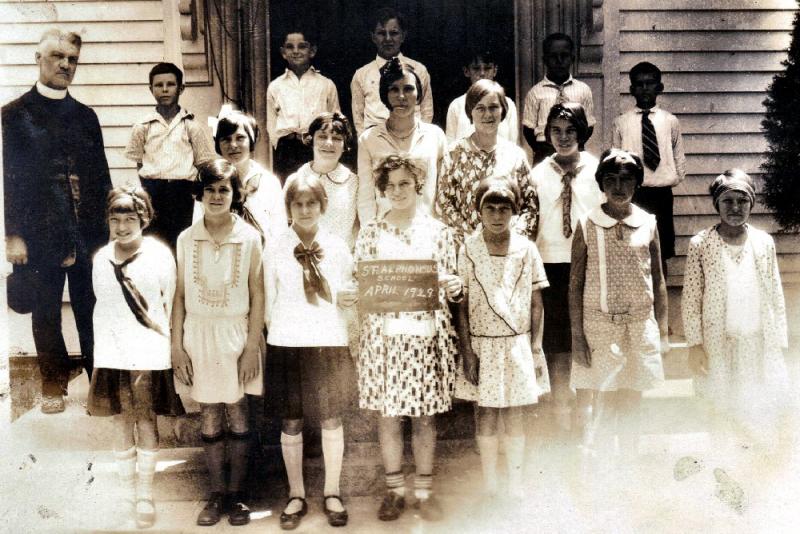
Joseph H. Chauvin
[image made April 1929]
On April 18, 1919, St. Alphonsus Parish became the responsibility of Father Joseph Hormisdas Chauvin (1887-1959), a native of St. Cesaire, Quebec, Canada. He had spent his first priestly years at Kiln, Hancock County, Mississippi. Father Chauvin was born December 24, 1868 and studied for the priesthood in his native Canada and was ordained on March 11, 1900 at St. Hyancinthe. He was assigned to the Diocese of Natchez on April 17, 1900.(The Daily Herald, April 21, 1944, p. 8)
During his long stay here, he saw both prosperity and depression, both of which he faced calmly. He clung to his old-world heritage; it never occurred to him to have an automobile. He walked, and often chatted with those he met, whether parishioners or not. He may have told humorously that the name Chauvin means "hot wine", or may have been reminded of some funny incident which he enjoyed as much as his listener. Although Pere Chauvin was conservative, he did move the Parish ahead. He greatly improved the interior of the church, and incredible as it may seem, he was the first to introduce heat into the church. He installed a large coal burning heater, and as might be expected, on cold Sunday mornings, it was Pere Chauvin who arose early to build the fire. And for fear the fire might spread to the building, he continued his rest on a nearby pew until it was time to ring the first bell.
At a time when the liturgy was obscured by the use of Latin, Father Chauvin compensated by preaching fine sermons. It was obvious to some that he had spent hours in preparing his Sunday homily, which he delivered in a formal manner as though he were the principal speaker at a great event; which he was. In the fall of 1919, St. Alphonsus school closed and the Holy Cross Sister of New Orleans left.(The Jackson County Times, May 8, 1920, p. 1)
1920-1929
In May 1920, Father Chauvin invited Bishop John E. Gunn of the Catholic Diocese of Mississippi to Ocean Springs to discuss the possibility of erecting a convent.(The Jackson County Times, May 8, 1920, p.1)
The Rt. Rev. Richard Oliver Gerow (1885-1976) was consecrated Bishop of Natchez at Mobile on October 11, 1924,(The Jackson County Times, October 15, 1924, p. 4.
It was through his efforts that the Marianite Sisters returned here in 1928 to re-open the parochial school in the three room house on Jackson Avenue and they have remained ever since. But with the onset of the great depression, money and jobs became scarce. Although not of record, there is reason to believe that the sisters and Pere Chauvin, all made personal sacrifices to keep the school going through the hard times.
Lourdes Grotto
( see The Jackson County Times, “A treasure in Ocean Springs-Lourdes Grotto”, March 4, 1939, p. 1)
Canon Chauvin
On his retirement from St. Alphonsus in 1940, Father Chauvin served as chaplain at the retirement home of the Cabrini Sisters [Missionary Sister’s of the Sacred Heart] on Front Beach. In April 1944, he was named ‘Canon’, an honorary title bestowed on him by Bishop R.O. Gerow (1885-1976) in the Cathedral at Natchez, Mississippi for his long and very dedicated service to the Diocese. When Father Chauvin’s human faculties began to fail, he returned to his native Canada by air in August 1957, his first ever flight, and met with his brother for the first time in fifty years. Canon Chauvin expired in Canada in August 1959. (The Ocean Springs News, August 1, 1957, p. 1 and August 29, 1959, p. 11)
1940-1950
WW II
During World War II the parish was served briefly by Father Charles Hunter until the spring of 1941, when he was replaced by the Reverend Joseph Holland. Father Holland took a leave of absence in the March 1942 andFather Dennis O’Sullivan (1877-1942), who had retired from the priesthood circa 1939, came to St. Alphonsus as acting pastor from his retirement residence at Bay St. Louis. Father Sullivan died suddenly on April 2, 1942 in the church as he left the confessional.(The Jackson County Times, April 4, 1942, p. 1)
Father O’ Sullivan was Irish and had studied for the priesthood at St. Joseph’s in Cork, Ireland and at the African Missionary Seminary in Lyons, France. He was ordained on December 22, 1900 at Cairo, Egypt and arrived in Mississippi in October 1915. Before his retirement to Bay St. Louis, Father O’Sullivan had been parish priest at St. Paul’s in Vicksburg; Bassfield; and North Biloxi.(The Daily Herald, April 2, 1942, p. 1 and April 3, 1942, p. 1)
A funeral service for Father Dennis O’Sullivan was held at N.B.V.M. in Biloxi on April 3, 1942. It was well-attended by most Catholic priests on the Mississippi Coast and the Sisters of Mercy in Biloxi and the Missionary Sisters of the Sacred Heart at Ocean Springs and New Orleans. HIs corporal remains were sent to New York where he had a brother and two nieces.(The Daily Herald, April 3, 1942, p. 1)
The Reverend Joseph Holland may have returned to St. Alphonsus after the demise of Father O’Sullivan. Father Francis Deignan (1901-1965) was appointed pastor in May of 1944 and remained for more than twenty years, which was a time of post war prosperity and population expansion.
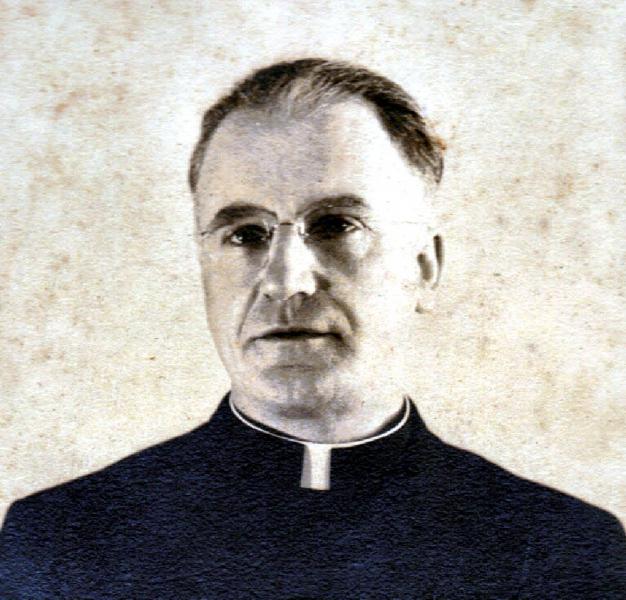
Father Francis Deignan (1901-1965)
Francis Deignan
Father Francis Deignan (1901-1965) arrived at St. Alphonsus on May 8, 1944. He came to Ocean Springs from the Holy Rosary church in Tucker, Mississippi where he had been since 1935 as Champlain Missionary to the Choctaw Indian Nation. Francis Deignan was born at Shinrone, County Offaly, Eire. His religious education commenced at Munret College, Limerick, Ireland. Novitiate Deignan’s road to sacramental ministry continued at St. Klerans College, Kilkenny, Ireland followed by a stint abroad at College of Birgnole-Sale at Genoa, Italy. His ordination as a Roman Catholic priest came on June 20, 1926 in Dublin, Ireland at All Hallows College.(The Ocean Springs News, August 1, 1957, p. 1)
Father Deignan departed the Emerald Isle as a foreign missionary to the Diocese of Natchez, Mississippi arriving at Natchez, Mississippi in October 1926. From Natchez, Father Deignan was ordered by the Bishop of Natchez to posts at Catholic parishes in Vicksburg, Biloxi, Bassfield, Pass Christian, Ocean Springs, McComb, Bay St. Louis, and St. Mary of the Pines Academy. Prior to his May 6, 1944 assignment as pastor of St. Alphonsus at Ocean Springs, Father Deignan had been Champlain Missionary to the Choctaw Indian Nation at Tucker, Mississippi.(The Ocean Springs News, August 1, 1957, p. 1)
1949 school
With modern methods of financing and greater cooperation by the laity, it was possible to rebuild the school, church and rectory. To make way for a modern school building in 1949, the old three-room house was moved back to serve as a parish hall. Then to make space for a four-room school annex in 1963, it was moved again, less one room, east to Washington A venue, where it served as the St. Alphonsus Kindergarten until it was demolished in August 2004 because of its age and deterioration. Many parishioners fondly remember this old building as their "little red school house", where they started out on the rocky road of life.
1949 school fair
On the weekend of May 28 and May 29, 1949, parishioners of St. Alphonsus held a fair for the financial benefit of the new school. Dinners were served on both days. For $1.00 a patron was offered the following food choices: baked ham with apple sauce, potato salad, sliced tomatoes, peaches with cake, and hot rolls and butter; chicken salad, potato chips, sliced tomatoes, peaches with cake, and hot rolls and butter; chicken spaghetti, cole slaw, peaches with cake, and garlic bread. Specials available were seafood gumbo at $.50, hot dogs for $.15, and stuffed crabs. In addition, Bingo, wheel games, cakes, candy, and beverages were available.(The Gulf Coast Times, May 27, 1949, p. 9)
1950-1960
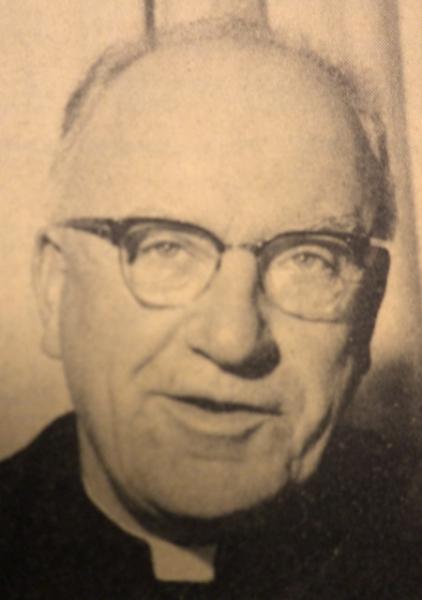
Father Francis Deignan
With the satisfaction of having contributed much to the modernization of St. Alphonsus Parish, Father Francis Deignan passed to his reward on February 20, 1965. His corporal remains were interred in Evergreen Cemetery on Old Fort Bayou.
1960-1970
In August of 1960 Father E.E. Michelin was named the first assistant pastor. To make way for the present church and rectory, the old church was moved northeasterly in 1961 to serve another ten years as the parish hall. Finally after 97 years of continuous service, it was demolished to make way for the new parish hall in 1972.
Knights of Columbus Council 5654 was established here in January of 1965 and was named in memory of Fred. L. Westbrook, Sr.
Camille
Reverend G. O’Neil killed by tempest in August 1969.
Msgr. Gregory R. Kennedy (1909-1986)
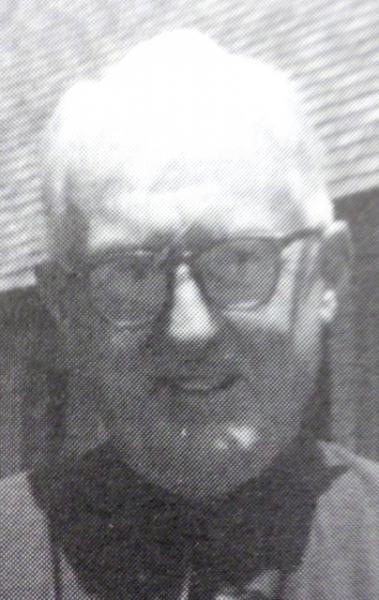
Gregory R. Kennedy
In April of 1965 Msgr. Gregory Regis Kennedy (1909-1986) was appointed pastor and was responsible for introducing the new liturgy and for greater lay participation in parish organization. Gregory R. Kennedy, as a young man was called Regis. He was born on November 1, 1909 near Remsen in rural Plymouth County, Iowa, the son of a farmer, John P. Kennedy (1888-1969?), and Eleanor V. Curran Kennedy (1889-1975), a native of Cedar Rapids, Iowa. Regis Kennedy was the eldest of four children. His siblings were: Kathleen V. Kennedy (1911-1974); Mary M. Kennedy Gibson (1914-1975+); and Eleanor Kennedy Buschman (1916-1975+). By 1930, the Kennedy clan had relocated to Omaha, Nebraska where John P. Kennedy made his livelihood as a candy salesman. The family was domiciled North 39th Street.(1910 Plymouth Co., Iowa Federal Census T624_418, p. 1B, ED 120 and Douglas Co., Nebraska Federal Census R1278, p. 3A, ED 116)
Shortly before his arrival April 3, 1965 at St. Alphonsus, Monsignor Kennedy had retired from the U.S. Army as a Colonel and Commandant of the U.S. Army Chaplain School at Fort Hamilton, New York, where had been since October 1962. Kennedy was given oak leaf cluster for the Legion of Merit medal at his retirement ceremonies. He had joined the U.S. Army in 1941 shortly after his March 9, 1940 ordination. Monsignor Kennedy had commenced his collegiate education at Omaha’s Creighton University. After post-graduate studies at St. Louis University, he entered seminaries in Cincinnati, Louisville, and Detroit. In April 1960, Pope John XXIII named him a Domestic Prelate, which portends the title, ‘right reverend monsignor’. On his retirement in March 1970, he was succeeded temporarily by the Reverend Thomas M. Boyce, a Pascagoula native, who was to report for active duty with the U.S. Army in the fall. Msgr. Eamon Mullen came to St. Alphonsus in July of 1970.(The Ocean Springs News, April 22, 1965, p. 1, The Daily Herald, March 8, 1970 and The Ocean Springs Record, March 29, 1970, p. 3)
East Beach residence
Monsignor Kennedy acquired the home of Louis Sullivan (1868-1925), renown Chicago architect, in March 1968 from the Estate of William G. Nichols through its executor, the 1st National Bank of Birmingham. William G. Nichols (1882-1966) was a native of Indiana and resided at Birmingham, Alabama were he was in the manufacturing business. Children: Henry Nichols (b. 1906); William G. Nichols Jr. (1907-1991); John C. Nichols (b. 1921); and Mary L. Nichols (b. 1922).(JXCO, Ms. Land Deed Bk. 332, p. 297)
Monsignor Kennedy sold to Paul S. Minor and Sylvia F. Minor in August 1986.(JXCO, Ms. Land Deed Bk. 867, p. 235)
Largest parish
In 1965, St. Alphonsus became the largest Roman Catholic parish in the State of Mississippi.
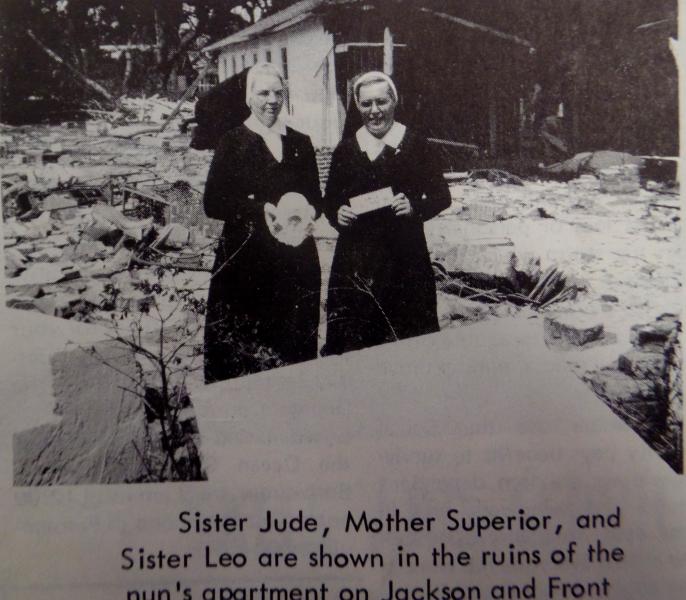
Camille
The old Convent of St. Theresa on the beach at Jackson Avenue was destroyed by Hurricane Camille on August 17, 1969. In the following year, a new convent was built on Jackson Avenue, just north of the school.
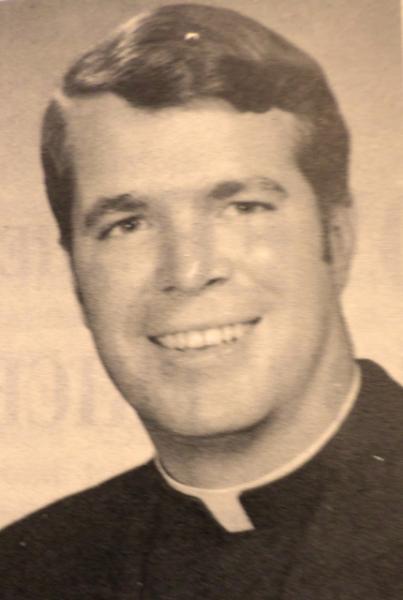
Father Michael Raff
Father Michael Raff replaced Reverend John Ryan as associate pastor at St. Alphonsus in early October. Father Ryan went to St. Peter's co-Cathedral at Jackson, Mississippi, which is where Raff came to Ocean Springs. Reverend Raff was the son of Mr. and Mrs. Earl Raff of Indianapolis, Indiana. He was a Notre Dame graduate and had attended General Theological Seminary at New York City and Immaculate Conception College in Kansas City, Missouri.(The Ocean Springs Record, October 9, 1969, p. 6)
1970-1980
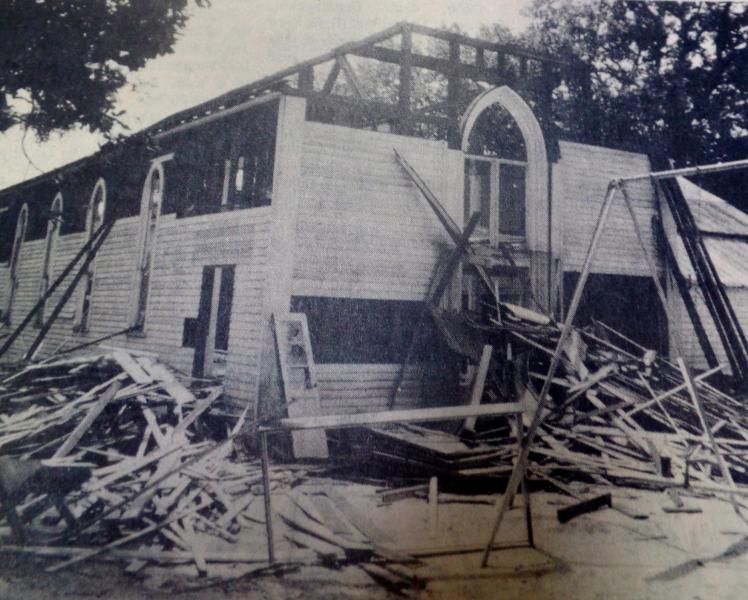
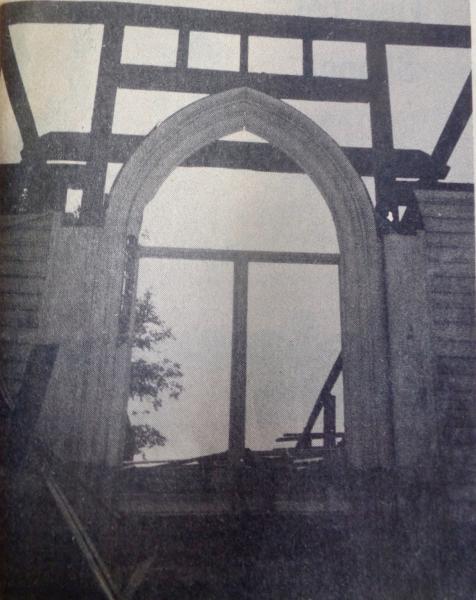
Demolition of the old St. Alphonsus Church in June-July 1971
[from The Ocean Springs Record, July 1, 1971, p. 1]
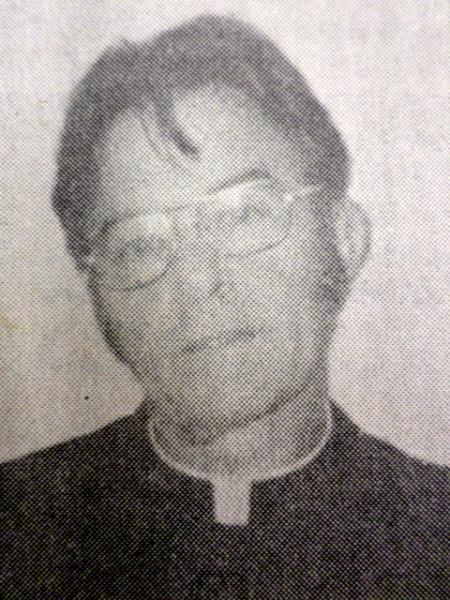
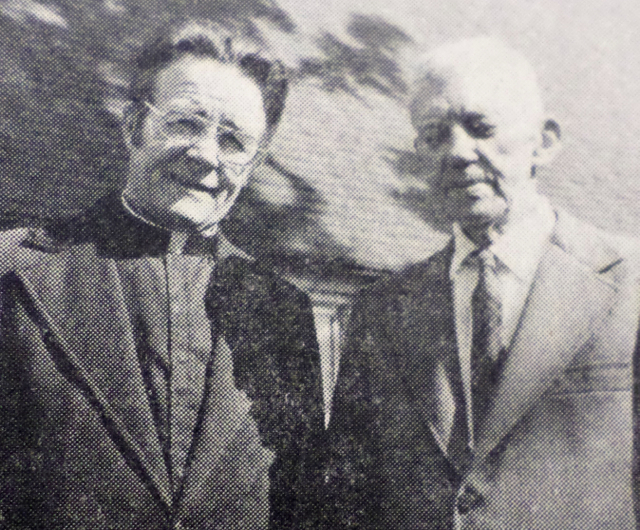
Monsignor Eamon J. Mullen and with General L.J. Stewart
Eamon J. Mullen (1918-1992) was born on August 19, 1918 in Canigans, Ballymote, County Sligo, Ireland. Ecclesiastical studies: St. Patrick's College in Carlow. He was ordained on June 7, 1942. Monsignor Mullen's appointments in the Diocese of Natchez-Jackson prior to Our Lady of Victories, included St. Peter's in Jackson and St. Joseph's at Greenville. He was named as Pastor to OLV on June 15, 1951. After leaving Cleveland, Monsignor Mullen served in many capacities throughout the Diocese including Mississippi City, Meridian, Indianola, Leland, Vicksburg and Ocean Springs. He was appointed Dean of East Central Deanery; Chairman, Sacred Music Commission; named Domestic Prelate by Holy See; Dean of North Central Deanery, Diocesan Consultor, Promotor of Justice, Diocesan Tribunal; Member of Board of Advisors to Liturgical Apostolate; member of Personnel Committee of Senate of Priests and served the Diocese of Biloxi following its establishment in 1977. Father E.J. Mullen expired on March 19, 1992 at Jackson, Mississippi.(The Sun Herald, March 22, 1992, p. A2)
Reverend Irwin Ordination-May 1970
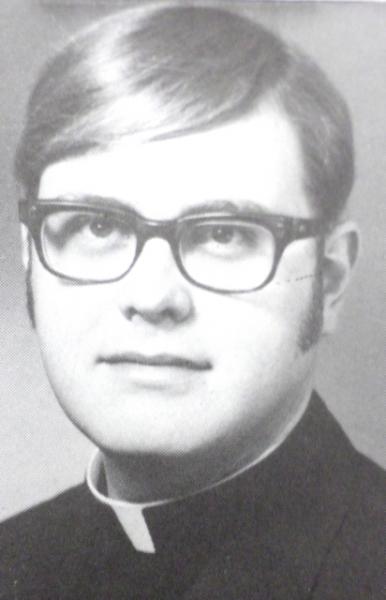
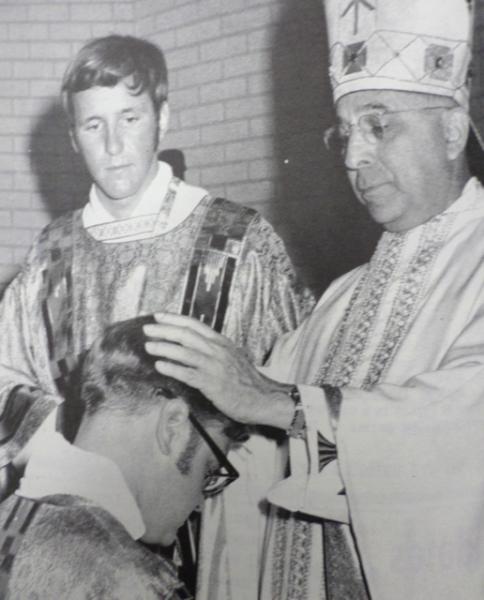
Father Michael Irwin and Bishop Joseph B. Brunini-May 1970
On May 24, 1970 in St. Alphonsus Catholic Church, Bishop Brunini ordained Michael Irwin (b. 1944) a Roman Catholic priest. Reverend irwin was a native of Des Moines, Iowa.(The Ocean Springs Record, May 21, 1970, p. 11)
New convent
On October 25, 1970, the newly erected convent of the Marianite Sisters of the Sacred Heart was blessed by Reverend Eamon J. Mullen (1918-1992). The structure is situated at Jackson Avenue, just north of the St. Alphonsus school. At this time, Sisters Leo, Antoinette, Eileen, and Nell were residents of the convent. James Neirynck may have built it. Others involved George Sliman, Olivia Sekul Sliman.(The Ocean Springs Record, October 22, 1970, p. 1 and October 29, 1970, p. 10)
Monsignor Kennedy retired in 1971. He expired at Daytona Beach, Florida on December 1, 1986.(The Ocean Springs Record, December 4, 1986, p. 4)
In 1972 the new parish hall-cafeteria and school library were built. In 1980 Msgr. James J. Hannon (1920-2008) became pastor of St. Alphonsus. He was succeeded by Father Bernard Farrell in 1989.
OBITUARY
James Joseph Hannon (1920-2008) died of a lengthy illness on March 16th at his home in Ocean Springs, MS. Monsignor was born In Galway County, Ireland on January 13, 1920 to Patrick and Mary Hannon and was the youngest of 5 children. He entered St. Jariath College, Tuam, Galway, in 1933. After graduation in 1939, he attended St. Patrick College, Carlow, until he was ordained for the Mississippi Diocese in June 1945. He came to the United States in 1945 and was assigned as the associate pastor at Nativity BVM, in Biloxi, MS. A year later he was transferred to Our Lady of Victories Parish in Pascagoula, MS. During the period from 1947 to 1950, he attended the Catholic University of America in Washington, D.C. receiving his doctorate in Canon Law. For the next twelve years, he served under Bishop Richard Gerow and Bishop Joseph Brunini in the Chancery Office for the Diocese of Natchez-Jackson where he was appointed Defender of the Bond on the Marriage Tribunal.\
Pope Pius XII named Father Hannon as a Papal Chamberlain in 1954. He was named Domestic Prelate with the title of Right Reverend Monsignor in August 1957. Monsignor had many assignments throughout Mississippi and was very much an active participant in communities along the Coast. He retired from his last Parish, St. Alphonsus in Ocean Springs in 1989. Msgr. Hannon continued to work throughout his retirement in spite of an injury and other health problems. He devoted much time to the Marriage Tribunal of the Diocese of Biloxi, celebrating daily Masses at the Villa Maria Retirement Home in Ocean Springs, assisting with Masses at St. Thomas in Long Beach, chaplain of the Knights of Columbus Council 5654, and serving as president and founding member of the St. Vincent de Paul Pharmacy and continued on its Board of Directors. His love for woodcraft benefited many churches and individuals. He built the St. James Chapel at St. Alphonsus as well as the altar, Tabernacle and chairs and choir benches for the main altar. He began Perpetual Adoration at St. Alphonsus. The Lord is My Help soup kitchen was the recipient of his administrative skill as well as his expertise in cabinetry. Habitat for Humanity also benefited from the talents and skill of Msgr. Hannon's woodworking. He was well known for distributing all the toys he made to needy children at Christmas.
He was recognized for his charitable and loving gifts to the community with numerous rewards including Outstanding Mississippi Knight of Columbus, WLOX Person of the Week, and in 2005 he was honored with the Mississippi Ageless Heroes Award. He has been featured in local and national publications. When he was no longer able to work in his shop, he taught several people his woodworking skills and continued to counsel and comfort anyone who needed help. On his 88th birthday this year, he was awarded the Key to the City of Ocean Springs by Mayor Connie Moran.
Monsignor Hannon faithfully served the Church and the people of Mississippi for most of his life. It is with thanks and appreciation that we acknowledge his loving service of sixty three years. People all along the Gulf Coast knew and loved him. He will be missed greatly but his many good works will live on to remind us of his living presence. He was preceded in death by his parents, Mary and Patrick Hannon, 4 brothers and sisters. He leaves behind many loving nieces and nephews at home in Ireland and in the United States, his devoted caregiver Joyce Wilson and many precious friends as well as families of which he became a treasured member. Mass of Christian Burial will be Wednesday, March 19, 2008 1:00 p.m. at St. Alphonsus Catholic Church. Friends may visit from 10:30 a.m. until 1:00 p.m. at the church. Interment is at Evergreen Cemetery, Ocean Springs, MS. Arrangements made by Bradford-O'Keefe Funeral Homes, Ocean Springs, MS. Family prefers memorials to St. Alphonsus Catholic Church, 502 Jackson Avenue, Ocean Springs, MS 39564. View and sign register book at www.bradfordokeefe.com.(The Sun Herald, March 18, 2008, p. A4)
1980-1990
In 1981 the school received AA Accreditation and Members in the Southern Association of Schools and Colleges. In 1983 the school celebrated its 100th anniversary. The following year, two new classrooms were added to accommodate increased enrollment which now stands at 290, with Sr. Mary Anne Peltier as principal. During this same period, a weekday chapel was added at the rear of the main church where parishioners come to pray at all hours of the day and night.
Nuns depart
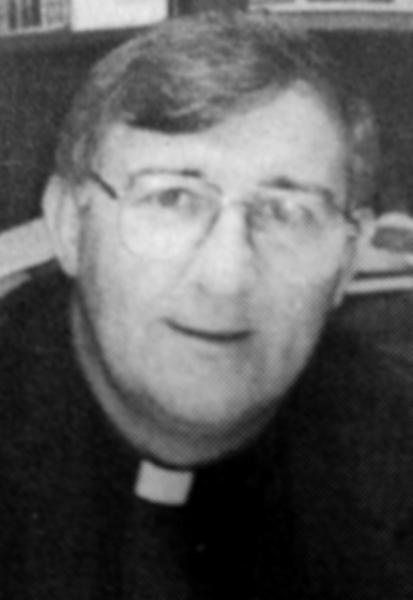
Bernard Farrell
Father Bernard ‘Bernie’ Farrell departed St. Alphonsus in February 2002 for St. Elizabeth Seton at Ocean Spring, Mississippi.
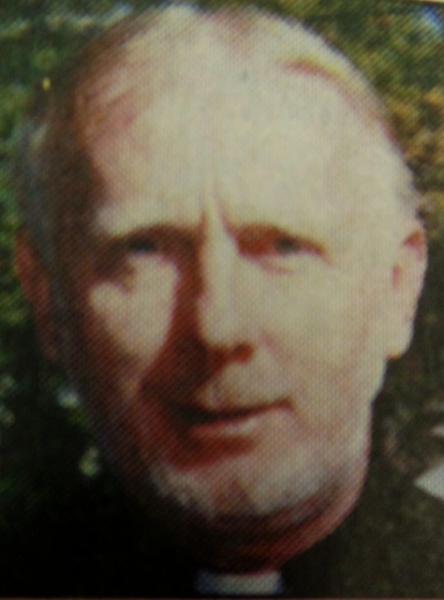
Henry McInerny
On February 2, 2002, Father Henry McInerny of the Annunciation Parish at Kiln, Hancock County, Mississippi replaced Father Bernard Farrell. Father Bernie left St. Alphonsus for St. Elizabeth Seton, which is situated in the eastern section of Ocean Springs. At this time, there were about 1400 families in the parish and the enrollment at St. Alphonsus elementary school was approximately four hundred students.(The Ocean Springs Record, March 14, 2002, p. 1)
In June 12, 2002, Father Henry celebrated his 25th anniversary as a Roman Catholic cleric with a Holy Mass at St. Alphonsus. His entire service to God has been with the people of the Diocese of Biloxi. Before he received his first parish at the Annunciation Church at Kiln, Hancock County, Mississippi in 1988, Father Henry McInerny was assistant pastor at Our Lady of Victory in Pascagoula; Bay St. Louis; and Sacred Heart Church in D’Iberville.(The Ocean Springs Record, June 13, 2002, p. B3)
Reverend Father Henry McInerny was ordained a Catholic priest in 1977 after attending St. Patrick’s College, the national seminary for Ireland. This Pontifical University is situated at Maynooth, County Kildare, about fifteen miles from Dublin. Father Henry is the only graduate of his St. Patrick’s College class that is serving in the Diocese of Biloxi.(The Sun Herald, July 31, 2010, p. A9)
Katrina
Water from the storm’s surge reached the threshold of the sanctuary. The gymnasium received feet of water and the rectory feet.
REFERENCES:
100 Years St. Alphonsus School Ocean Springs, Mississippi 1883-1983.
The History of Jackson County, Mississippi, "St. Alphonsus Parish 1699-1972", (Jackson County, Mississippi Geneaological Society: Pascagoula, Mississippi-1989), pp. 60-61.
Journals
The Jackson County Times, “Local and Personal”, October 15, 1924.
The Jackson County Times, “Father Lee Fahey delivers sermon at Blessing of Fleet”, August 24, 1940.
The Jackson County Times, “Local and Personal”, October 15, 1924.
The Sun Herald, “St. Alphonsus meets the needs of the masses”, July 31, 2010, p. A9.
CATHOLIC NUNS
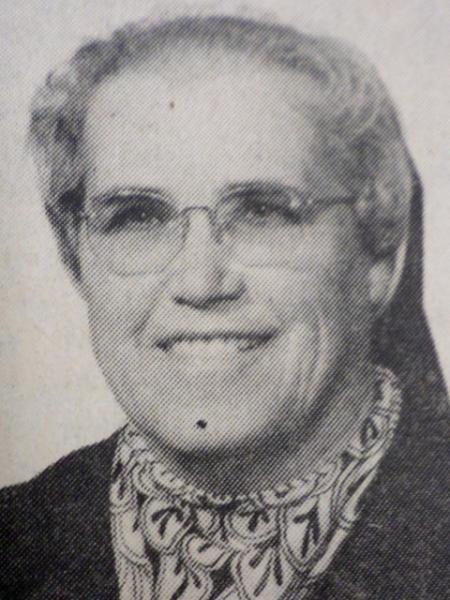
Sister Mary Leo Cavell (1914-1993)-Marianite Sister of the Holy Cross
Sister Mary Leo Cavell (1914-1993) was a native of New Orleans. She began her novitiate with the Marianite Sisters of the Holy Cross in June 1933 and graduated from Loyola University [NOLA] in June 1940. Sister Mary Leo served the Church in Pakistan. She died on April 9, 1993.
REFERENCES:
The Daily Herald,Section 2, “Running State’s largest Catholic parish simple task for Sister Leo”, March 9, 1970, p. 13.
The Jackson County Times, “To Build Sisters Convent in Ocean Springs”, May 8, 1920, p. 1.
The Ocean Springs News, "Local News”, February 6, 1909.
The Ocean Springs Record, "Ruins of Nun’s Apartment [photo]”, August 28, 1969, p. 1.
The Ocean Springs Record, "St. Alphonsus Sisters lose their home at Jackson and Front Beach [photo]”, September 4, 1969, p. 4.
The Ocean Springs Record, "New associate pastor [Father Michael Raff] at St. Alphonsis”, October 9, 1969, p. 6.
The Ocean Springs Record, "Convent house-warming scheduled Sunday”, October 22, 1970, p. 1.
The Ocean Springs Record, "Convent blessed Sunday”, October 29, 1970. p. 10.
The Ocean Springs Record, “A new camellia for Sister Mary Leo”, March 18, 1976, p. 6.
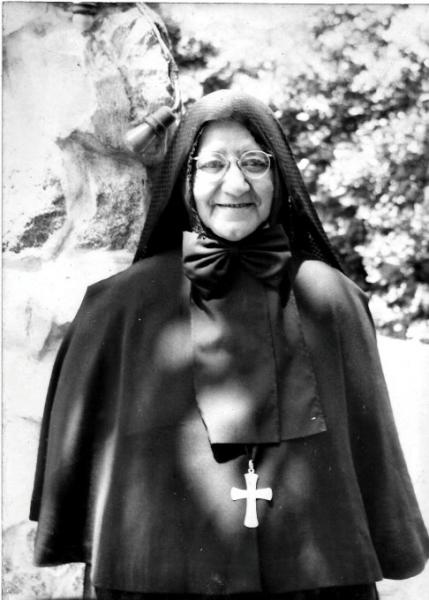
MISSIONARY SISTER of the SACRED HEART
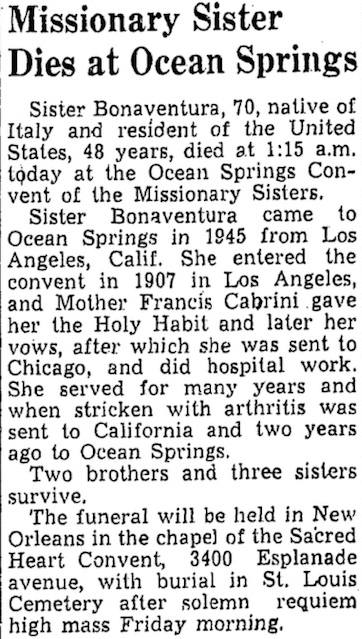
[The Daily Herald, October 2, 1947, p. 1]
The Daily Herald, “Ocean Springs Sister Dies”, July 13, 1935, p. 3. [Agape Ghisalderti (1866-1935), daughter of Anthony Ghisalderti and Nicolena Bigomani, and a native of Milano, Italy]
The Jackson County Times, “A treasure in Ocean Springs-Lourdes Grotto”, March 4, 1939, p. 1.
The Daily Herald, “Sister [Victoria Assunta] Cavalli (1873-1943) dies”, December 18, 1943, p. 3. [born Italy lived Biloxi forty years]
The Daily Herald, “Missionary Sister [Bonaventura] dies at Ocean Springs", October 2, 1947.
The Daily Herald, “Mother Matilda dies”, May 5, 1948, p. 8. [Virginia Rigo (1877-1948) [native of Brescia, Italy]
The Daily Herald, 'Sister John Barchi', September 6, 1960, p. 2. (native of Italy]
The Gulf Coast Times, “Mother Tranquilla Died Tuesday”, September 16, 1949, p. 1. [native of Milano, Italy]
The Gulf Coast Times, “Funeral for late Mother [Jerome] O'Brien”, November 13, 1952, p. 1. [native of Scotland]
The Daily Herald, “Peaceful beauty captured in Missionary Sisters’ Ocean Springs convent”, August 30, 1956.
The Ocean Springs News, “Mother Rita”, April 9, 1964, p. 1. [nee, Mamie Guida]
CATHOLIC PRIESTS
Father F. Charles Bohmert (1847-1890)
The Baltimore Sun, “A priest commits suicide”, June 26, 1890.
The Biloxi Herald, “Ocean Springs Notes”, June 21, 1890.
The Boston Journal, “”, October 9, 1878.
The Cincinnati Daily Gazette, “”, September 18, 1879.
The Interocean, “Suicide of priest”, June 26, 1890.
The Times Picayune, “An interview with Bishop LeRay”, October 12, 1878.
The Times Picayune, “Personal and General Notes”, September 12, 1888.
The Times Picayune, “The suicide of Rev. Charles Bohmert”, June 28, 1890.
The Times Picayune,
The Times Picayune,
Father John C. Ahern (1841-1881+)
The Pascagoula Democrat-Star, “Hostilities”, March 11, 1881.
Father W.S. Irwin (1880-1930+)
The Daily Herald, “Woman bather injured”, July 26, 1915.
The Daily Herald, “Escapes drowning off Deer Island”, August 12, 1915.
The Daily Herald, “New parochial school [Mother of Sorrows] dedicated”, September 7, 1916.
The Daily Herald, “Lad run over by automobile”, December 6, 1916.
The Daily Herald, “Father Irwin called", November 6, 1918, p. 3)
The Daily Herald, “
Father Joseph H. Chauvin (1867-1959)
The Daily Herald, “Two Coast priests are named Canons”, April 21, 1944.
The Jackson County Times, "Local News Interest", August 30, 1919.
The Ocean Springs News, "90 year old Reverend Canon J.H. Chauvin takes first air flight to meet brother for first time in fifty years", August 1, 1957, p. 1.
The Ocean Springs News, "The late very Reverend Canon J.H. Chauvin", August 29, 1959, p. 11.
Peter J. Ahern (1869-1933)
The Daily Herald, “Father P.J. Ahern dies in Ocean Springs”, September 26, 1933.
Father Francis Deignan (1901-1965)
The Gulf Coast Times, “Father Francis Deignan tells of trip to Europe”, September 1, 1950.
The Ocean Springs News, “Rev. Francis Deignan”, [photo], August 1, 1957.
The Ocean Springs News, “Rites for Rev, Deignan”, February 25, 1965, p. 1.
Monsigneur Gregory R. Kennedy (1909-1986)
The Daily Herald, “Pastor of largest State parish ending ministry of 30 years”, March 8, 1970.
The Ocean Springs News, "Mon. Gregory R. Kennedy welcomed to St. Alphonsus”, April 22, 1965, p. 1.
The Ocean Springs Record, "Msgr. Kennedy retires”, March 19, 1970, p. 3.
The Ocean Springs Record, "Elizabeth Kennedy”, November 6, 1975, p. 2.
The Ocean Springs Record, "Mgr. Kennedy rites”, December 4, 1986.
Eamon Mullen
The Sun Herald, "Monsignor Eamon Joseph Mullen", March 22, 1992, p. A2.
Father Michael Raff
The Ocean Springs Record, “St. Alphonsus Priests”,October 9, 1969, p. 6.
Monsignor James Joseph Hannon
The Ocean Springs Record,“Hannon’s 50-year tenure celebrated”, June 29, 1995, p. 1.
The Sun Herald, “Monsignor Hannon died Sunday at 88”, March 18, 2008, p. A2.
The Sun Herald, “Monsignor James Joseph Hannon”, March 18, 2008, p. A4.
The Sun Herald, “St. Vincent de Paul pharmacy rededicated”, April 23, 2008, p. A2.
Father Bernard Farrell
The Ocean Springs Record, “Rev. Farrell to celebrate 25 years in priesthood”, December 26, 1991, p. 1.
Father Henry McInerney
The Ocean Springs Record, “Accent the same, but face different”, March 14, 2002.
The Ocean Springs Record, “Priest celebrates 25th”, February 9, 2002.
ST. ALPHONSUS CHURCH
The Catholic Church in Mississippi (1837-1865), Catholic Action of the South, “St. Alphonsus-Ocean Springs”, ?
The Daily Herald, “Bishops will officiate at dedication of St. Alphonsus Church in Ocean Springs”, September 22, 1961, p. 6.
The Ocean Springs News, “St. Alphonsus Parish raises $86,000”, September 27, 1956, p. 1.
The Ocean Springs Record, "Michael Irwin ordained [photo] ”, May 21, 1970, p. 11.
The Ocean Springs Record, "St. Alphonsus parish hall demolition [photo] ”, July 1, 1971, p. 1.
The Sun Herald, “St. Alphonsus meets the needs of the masses”, July 31, 2010, p. A9.
ST. ALPHONSUS SCHOOL
The Daily Herald, "Complete new Ocean Springs Grade School", September 3, 1949, p. 10.
The Gulf Coast Times, “To the People of Ocean Springs”, May 27, 1949, p. 9.
The Gulf Coast Times, “St. Alphnsus School Fair”, May 27, 1949, p. 9.
The Jackson County Times, "Catholic School Here Next September", July 29, 1915, p. 1.
The Jackson County Times, “More progress-Alphonsus school bids are awarded”, December 31, 1947, p. 1.
The Jackson County Times, "Bids on New School are requested", November 24, 1948, p. 1.
The Ocean Springs Record, "History of St. Alphonsus School", October 13, 1983, p. 7.
The Ocean Springs Record, "St. Alphonsus School celebrates 100", October 20, 1983, p. .
The Ocean Springs Record, "St. Alphonsus to celebrate 125th anniversary April 5", March 27, 2008, p. A1.
The Ocean Springs Record, "Nuns say farewell", May 24, 1990, p. 1.
The Pascagoula Democrat-Star, "Ocean Springs Locals", July 15, 1898, p. 3.
The Sun Herald, “Church celebrates past, future”, JXCO Section, January 31, 1998, p. 3.
Priests of St. Alphonsus
Peter J. Ahern (1869-1933) was born December 15, 1869 at Wakefield, Middlesex County, Massachusetts, the son of Irish immigrants, John Ahern (1835-1880+) and Catherine Ahern (1845-1880+). He was the first of his family born in America. He had five older siblings who arrived in the world in Eire between 1861 and 1867. Expired on September 25, 1933. Buried Evergreen.
F. C. Bohmert (1847-1890) was born Alsace in 1847. In 1880, priest at Greenville, Washington County, Mississippi. ExpiredJune 24, 1890. Buried Evergreen Cemetery.(1880 Washington County, Mississippi Federal Census T9_668, p. 55, ED 91)
Joseph H. Chauvin (1867-1959) was born St. Cesaire, Quebec, Canada. Studied for the priesthood in Canada. Ordained March 11, 1900 at St. Hyacinthe. Named ‘Canon’ in April 1944 after his retirement. Returned to Canada and expired there in August 1959.
Gerard Cleary (1934-2015) was born on July 20, 1934 in Ballygar, County Galway, Ireland. He graduated from St. Patrick College in Carlow and was ordained for the Diocese of Natchez-Jackson on June 10, 1961 He arrived in the United States in September 1961. His first assignment was as associate pastor of Our Lady of the Gulf Parish in Bay St. Louis. Father Cleary also served as associate pastor of St. Patrick Parish, Meridian; St. Alphonsus Parish, Ocean Springs; and St. Mary Parish, Natchez. He served as pastor of All Saints Parish, Belzoni (1967-70); St. Mary Parish in Gautier (1970-80); Sacred Heart Parish in D’Iberville (1980-92) and Our Lady of Victories Parish in Pascagoula (1992-2005), after which time he was appointed parochial vicar of St. Thomas the Apostle Parish in Long Beach. Following Hurricane Katrina, Father Cleary was named senior priest at St. John the Evangelist Parish in Gulfport. He retired from active ministry in 2010. At the time of his death on March 9, 2015, in Gulfport, Father Cleary was living at Dunbar Village in Bay St. Louis. He was preceded in death by his parents, Gerard Michael and Rita McLoughlin Cleary and a sister, Eithne Tully. Father Cleary is survived by a sister, Maureen and two brothers, Seamus and Sean, all of Ireland.
Visitation will be on Friday, March 13, 2015, from 9:30 – 11 am at The Cathedral of the Nativity of the Blessed Virgin Mary. A Mass of Christian Burial will be celebrated at 11 am in the Cathedral. Additional services and burial will take place at St. Mary’s Church, Ballygar, County Galway, Ireland. The RIEMANN FAMILY FUNERAL HOME, Gulfport, is serving the family and an online tributes may be offered at www.riemannfamily
Gregory Regis Kennedy (1909-1986) born November 7, 1909 and expired December 1, 1986 at Daytona Beach, Florida. Buried Evergreen.
Dennis O’ Sullivan (1877-1942) was ordained on December 22, 1900 at Cairo, Egypt and arrived in Mississippi in October 1915. Before his retirement to Bay St. Louis, Father O’Sullivan had been parish priest at St. Paul’s in Vicksburg; Bassfield; and North Biloxi. He died on April 2, 1942 at St. Alphonsus after leaving the confessional.
Charles Louis Van Quekelberge (1835-1878) was born Belgium. Buried Evergreen.
______________________________________________________________________________________________
ST. ELIZABETH SETON
Ocean Springs got a new Catholic parish in September 1975, when the St. Elizabeth Seton Parish was organized for the people in the eastern section of the city. The Reverend Noel Fannon, a native of Ireland, was the first pastor and remained with the parish through the building of the new church in 1988.
In October 12, 1975, the first church services were held in a rented empty furniture store on Highway 90. A few months later, the parish moved to a former nightclub also on U.S. 90. A ten-acre site was purchased at 4900 Riley Road and by the summer of 1977, a new 8000 square-ft., multi-purpose building was under construction by McClendon Building Services at the cost of $205,000. Joseph A. Toche Jr., a parishoner and contractor, built the $58,000 rectory at this time from a Gerald Hopkins design.(The Daily Herald, October 25, 1978, p. A2 and The History of JXCO, Ms., 1989, p. 61-62)
The St. Elizabeth Seton santuary was dedicated on January 4, 1988. It was erected by the Polk Construction Company of Columbia, Mississipi from a Gerald Hopkins design.The History of JXCO, Ms., 1989, p. 62)
The Reverend George Kitchin became the second pastor of St. Elizabeth Seton in February 1988, and remained here until he was replaced by Father Bernie Farrell in February 2002.
REFERENCES:
The History of Jackson County, Mississippi, "St. Elizabeth Seton Church", (Jackson County, Mississippi Geneaological Society: Pascagoula, Mississippi-1989), pp. 61-62.
Journals
The Daily Herald, "St. Elizabeth Seton dedication set for December 3rd", October 25, 1978.
_________________________________________________________________________________________________
BAPTIST
TIDEWATER BAPTIST CHURCH
The First Baptist Church of Ocean Springs was organized in 1832, by Elder George Davis. It was called the Tidewater Baptist Church and was located on Davis Bayou. Because of the transitory nature of the settlers, the church disbanded circa 1840. In 1847, the Baptists in the area were strongly reunited by Elder Philip P. Bowen.
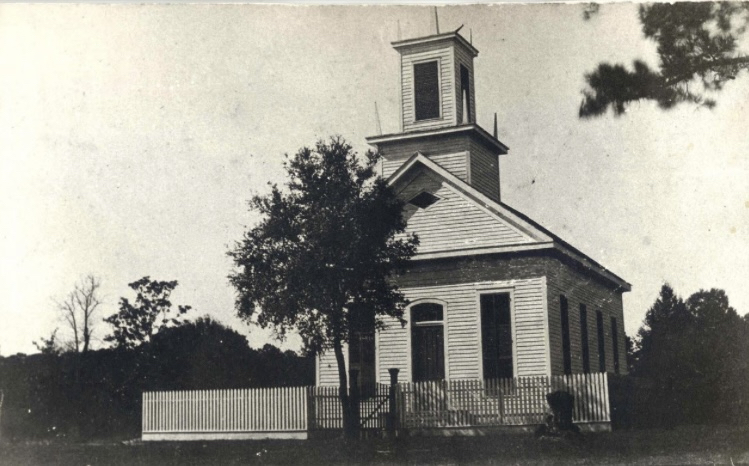
1876 First Baptist Church on Church Street
[Courtesy of Robert Endt and Bruce K. Mohler]
In 1874, the Tidewater Baptist Church became known as the Ocean Springs Baptist Church and moved in 1876, to a small rental house near the L&N depot. In 1878, a sanctuary was built on the northwest corner of Desoto and Church Street. The Baptists of the community worshiped here until the structure was severely damaged in the Hurricane of September 1906.
1896
The Reverend H.M. Crain came to Biloxi in February to be pastor of the 1st Baptist Church and also to minister to the Baptist faithful at Ocean Springs. He and Mrs. Crain were domiciled in one of the Cooper Cottages on Reynoir Stret near Front Street.(The Biloxi Herald, March 7, 1896, p. 8)
1909 First Baptist Church
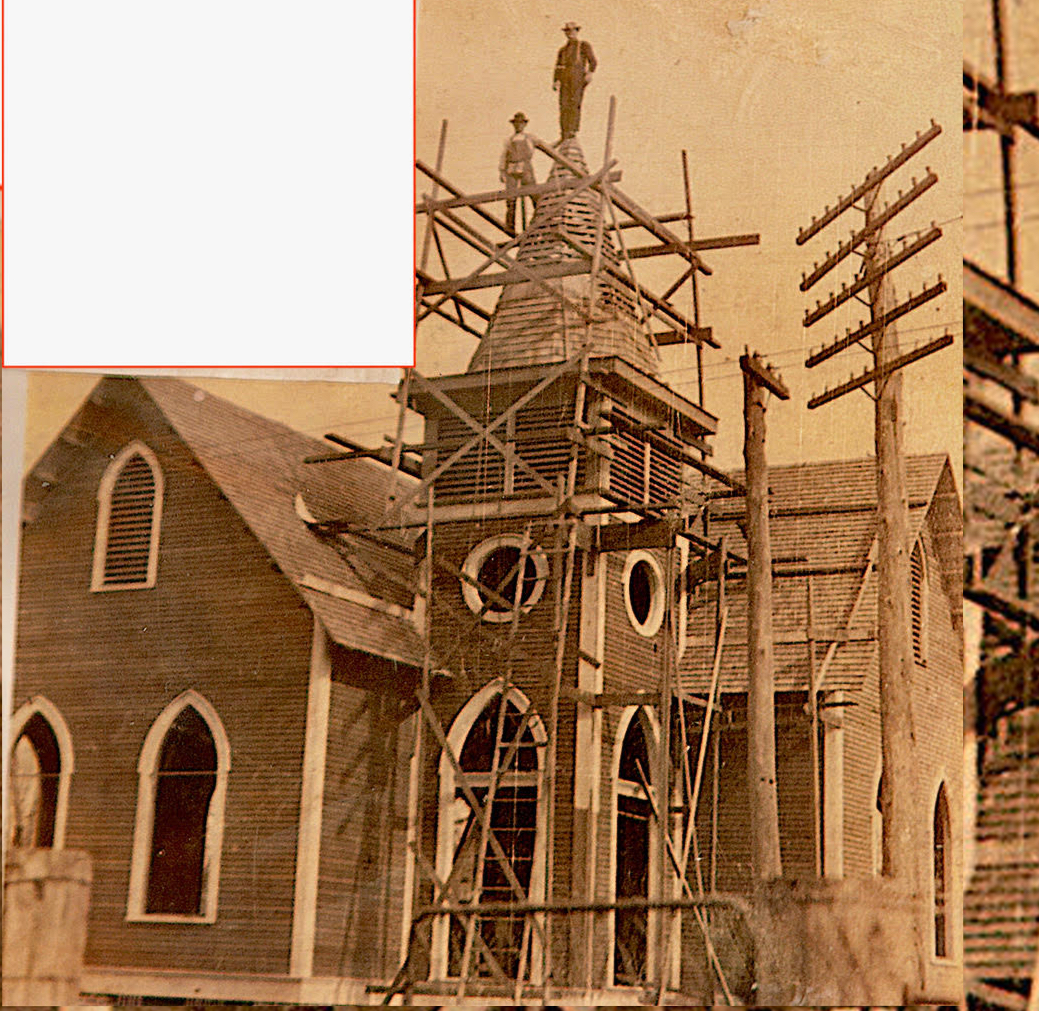
In the spring of 1909, Burr & Bradford erected a new sanctuary on land donated by George W. Davis (1842-1914), a descendant of the Davis family of the Tidewater Baptist Church on Davis Bayou. The building was situated on the northwest corner of Porter and Bellande. The church called its first full-time pastor, the Reverend John E. Barnes, in 1932. Sanborn insurance maps indicate that the Porter Avenue edifice was remodeled and enlarged before 1935. A post-1935 renovation occurred resulting in the present structure, which was used for storage before its demolition.
1928
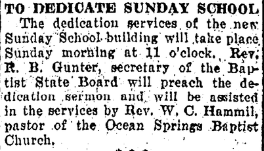
[from The Daily Herald, February 10, 1928, p. 16]
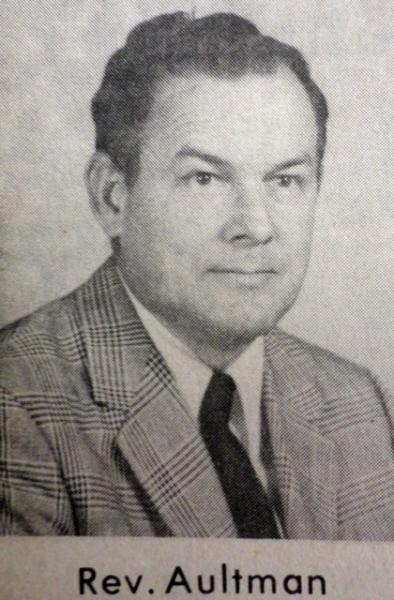
In 1958, the heirs of E.W. Illing (1980-1947) sold their property on the northeast corner of Washington Avenue and Porter to the First Baptist Church of Ocean Springs. This conveyance terminated the long history of the cinema entrepreneurship of the Illing family at this location. The Baptist under the leadership of the Reverend Paul D. Aultman erected a new sanctuary here. It was built to accommodate approximately twelve hundred persons and was dedicated on May 11, 1969.
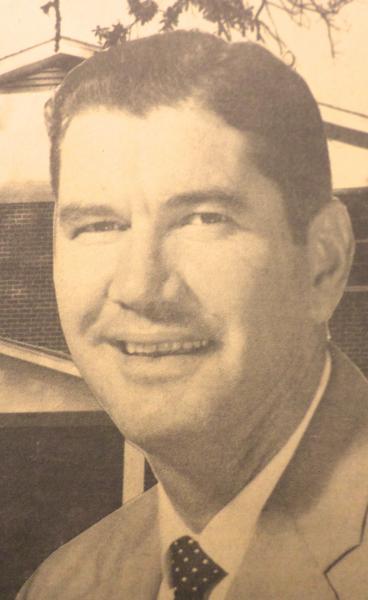
Dr. James G. Haggard Sr.
A graveside service for Dr. James G. Haggard Sr. (1921-2007), age 85 years, will be held at 10:00 a.m. Thursday, May 3, 2007, for family and friends at Crestlawn Memorial Park in Conway, Arkansas, with Bro. Stanley Young, pastor of Emmanuel Baptist Church, leading. This will be followed by a Praise and Worship Celebration at Conway's First Baptist Church at 11:00 a.m.
Dr. James G. Haggard Sr. was born on September 15, 1921 to James and Elnora Haggard in Louisville, Mississippi, Dr. Haggard was a WWII Navy veteran. He was a graduate of Mississippi College in Clinton, MS with a BA and of Southwestern Baptist Theological Seminary in Ft. Worth, Texas with a Master of Theology and Doctorate of Education. He served as Dean of Students at Ouachita Baptist University in Arkadelphia, Arkansas from 1968 - 1970 and taught Sociology at the University of Central Arkansas 1970 -1983. He was an ordained Southern Baptist minister who served at First Baptist Church, Phillip, Mississipppi; First Baptist Church, Dardanelle, Arkansas; First Baptist Church, Ocean Springs, Mississippi; Holland Baptist Church, Holland, Arkansas Emmanuel Baptist Church, Conway, Arkansas; Crystal Ridge Baptist Church, Louisville, Mississippi; and Second Baptist Church, Perryville, Arkansas. He served several churches as Interim Pastor. Dr. Haggard died Sunday, April 29, 2007 at Baptist Health Medical Center in Little Rock, Arkansas.
He is survived by his wife of sixty years, Sarah Haggard; son, John Haggard and wife Leta of Sherwood, Arkansas; daughters, Jenny Lind Allen and husband John Charles of Crossett, Arkansas; Nan Keathley and husband Ron of Conway, Arkansas; and Cynthia Haggard, of Harrison, Arkansas. His grandchildren are Rachel Haggard of Harrison, Arkansas; Shane and Teilena Keathley of Greenbrier, Arkansas; Matthew and Kathryn Allen of Bentonville, Arkansas; Erron and Beth Haggard of Corvallis, Oregon; Amanda and Jaret Gaither of Bristol, Tennessee; Melissa and David Clayton of Crossett, Arkansas; and Sam Haggard of Sherwood, Arkansas. He was blessed to have 5 great-grandchildren, Michael and JoAnn Clayton, Mariah and Colby Keathley, Daniel Allen and many loving nieces, nephews, and precious friends.
In lieu of flowers, Bro. Haggard requested that all memorials be made to the building fund of Emmanuel Baptist Church, 2 Daughtery Hill Rd., Conway, Arkansas 72032. Roller-McNutt Funeral Home of Conway, Arkansas, was in charge of arrangements.
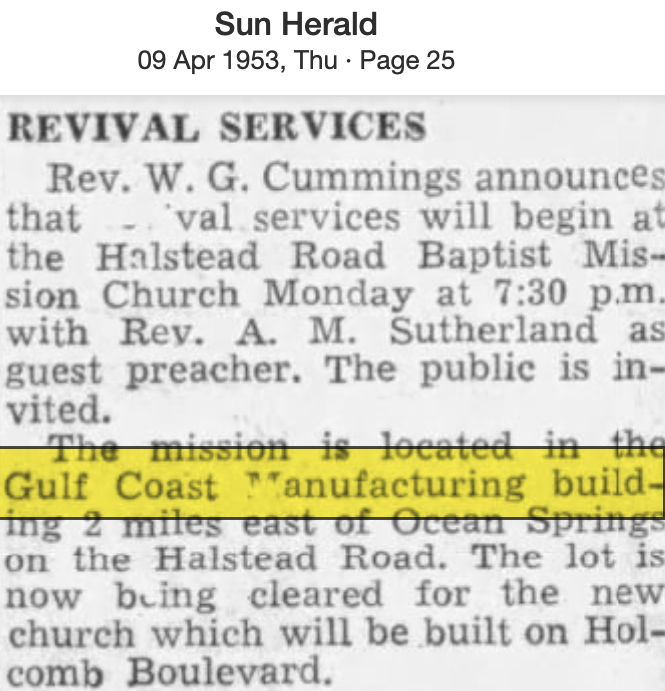
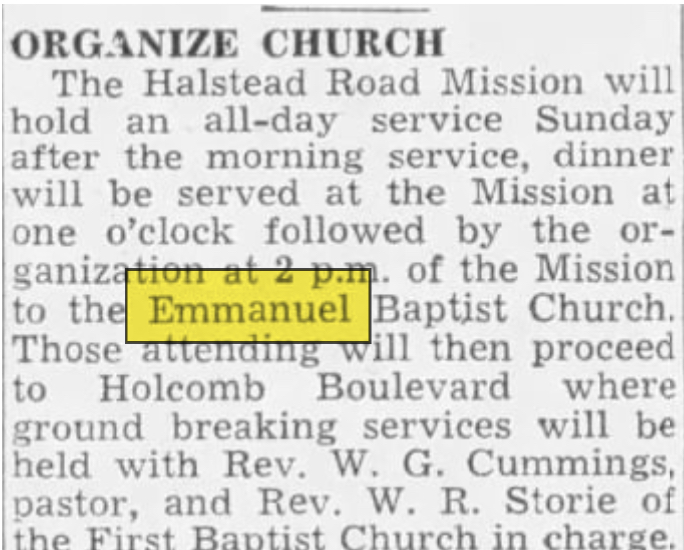
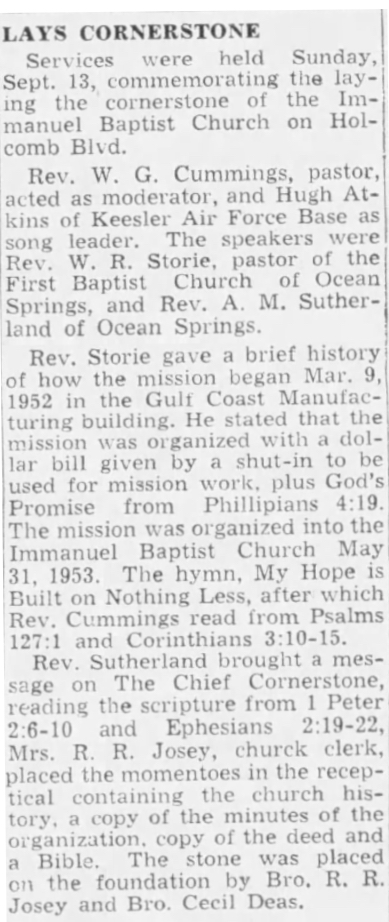
EMMANUEL BAPTIST CHURCH
Holcomb Boulevard
_______________________________________
METHODIST
The Methodist Church at Ocean Springs was organized in 1853, by the Reverend James Sampey. It wasn't until 1870 that a church building was erected on the north side of Porter near Washington. Elizabeth M. Stuart (1840-1925) who was a strong financial supporter of the Methodists' efforts here became the first registered member when the new building was dedicated in 1872. In April 1900, the Methodist Church was torn down and the materials sold to druggist, Herman Nill (1863-1904). The salvaged lumber was used by the Vahle family to erect a hotel, the Vahle House, on the northwest corner of Washington and Calhoun. In 1901, a new sanctuary was constructed on the southeast corner of Porter and Rayburn on a lot donated by Bishop Kenner. After the death of Mrs. Stuart in January 1925, a relative, W.C. Howcott of New Orleans, donated money for a memorial to the Stuarts and Bishop Keener. Three large stained glass windows and a group of Sunday school and social rooms were added to the church in their honor.
By 1950, the Ocean Springs church had become a station church. The Reverend William L. Elkin was the first full time pastor. The next decade saw a growing church population and the need for a larger sanctuary. In 1962, the congregation moved into a new brick structure at the same location as the 1901 structure. The Stuart memorial windows were integrated into the new church.
By 1998, St. Paul United Methodist Church had over one thousand members and had outgrown its present location on Porter Street. A committee investigated the purchase of land in the eastern part of town for a new complex of church buildings and sports fields. Seventeen acres of land were purchased in 1998 in Section 30, T7S-R7W, just west of the northwest corner of the intersection of US Highway 90 and Ms. Highway 57. Here in November 2001, ground was broken for the Christian Life Center, a 28,000 square-foot structure. The three million dollar facility was to house a family life center, fellowship hall, Sunday school classrooms, three nurseries, and a youth activity room. A soccer pitch and ball diamond were planned for outside activities.(The Mississippi Press, November 12, 2001, p. 6-A)
The new facility was built by Fletcher Construction Company of Pascagoula, Mississippi as the first phase of a Christian Life Center concept. The building was composed of: offices, classrooms, fellowship hall, and gymnasium, which will serve as the sanctuary, until Phase II, the actual sanctuary, is built.(The Mississippi Press, June 15, 2003, p. 8-A)
On May 11th, St. Paul’s United Methodist Church had its first church services in new its Christian Life Center on US 90. The old sanctuary on Porter continues for parishioners who want to remain at the downtown location. Bishop Kenneth L. Carder consecrated the new facility on June 15, 2003.Sanctuary dedicated on June 15, 2003.(The Ocean Springs Record, May 15, 2003, p. A-1 and The Mississippi Press, June 16, 2003, p. 1-A)
SOME EARLY METHODIST HISTORY at OCEAN SPRINGS, MISSISSIPPI
In the late 19th Century, the Ocean Springs and Pascagoula circuits were the strongholds of Methodism on the Mississippi Gulf Coast. As early as 1853, Methodist circuit riding ministers had come here from Alabama. In its early period, the faithful of Ocean Springs were under the jurisdiction of the Alabama Conference and a mission of the Pascagoula Circuit.( The Methodist Advocate, December 19, 1962, p. 4)
In February 1889, James G. Galloway, a young itinerant Methodist preacher who resided with Colonel William R. Stuart (1820-1894) at Ocean Springs, writing for The New Orleans Christian Advocate, described his ministry in this area: My work embraces Ocean Springs, Handsboro, Mississippi City, and Biloxi. Ocean Springs as the strongest membership, and half of my time goes to that place. At Handsboro our church is very weak, and we have no house of worship, but will make an effort to build one this year. We have no church at Mississippi City, but preach in the courthouse once a month. Biloxi is a town of about four thousand inhabitants, and is growing rapidly. Here, too, our church is very weak: Catholicism has the stronghold.( The New Orleans Christian Advocate, February 28, 1889, p. 1)
Roman Catholicism came to our shore in April 1699, with the expedition of French Canadian, soldier of fortune, Pierre Le Moyne, Sieur d'Iberville (1661-1706). Father Bordenave, the chaplain on the Badine, was assigned by d'Iberville to remain at Fort Maurepas (1699-1702). His duties were to minister to the spiritual needs of the French and Canadian soldiers, privateers, and Native Americans. The Recollect priest, Father Anastasius Douay, a seasoned veteran of North American expeditions, requested to return to his monastery in France. Admiral Le Moyne regretted that he did not have a Jesuit missionary who would learn the native languages swiftly. Father Douay had survived the disastrous Cavalier de La Salle Expedition of 1684-1687 which had failed to locate the Mississippi River's deltaic mouth.(McWilliams, 1981, p. 93 and Dufour, 1967, pp. 14-22)
It wasn't until after the Louisiana Purchase (1803) that Protestant Americans began to migrate into the southwest frontier, which in the early 19th Century comprised primarily the former colonies of strongly Catholic, France and Spain. After over a century of colonialism, the Roman Catholic Church was strongly rooted in this area, and the frustrations of Preacher Galloway in expanding the Methodist faith on the Mississippi coast, westward of Ocean Springs, are quite understandable.
In October 1889, Reverend Galloway wrote in the same journal, that the Mission Board of the Mississippi Conference was spending thousands of dollars in Mexico. He felt that more attention should be given to their missionary efforts on the Mississippi coast, especially Biloxi, which had a Catholic population of over 1200 souls, but less than fifty Methodists. Galloway felt the situation would not improve as long as the Methodist minister visited Biloxi only one Sunday each month.( The New Orleans Christian Advocate, October 31, 1889)
First sanctuary
It appears that the first Methodist house of worship at Ocean Springs was erected in the latter part of 1871. The one-story, wood, frame structure was located on the north side of Porter about one hundred feet west of Washington Avenue. The new church had an area of about 1400 square feet. (Sanborn Map Company (NY), "Ocean Springs, Ms.", Sheet 2, August 1893)
On March 17, 1872, Bishop John Christian Keener (1819-1906), the thirteenth bishop of the Methodist Episcopal Church of the South, dedicated the Methodist church building at Ocean Springs. At the time, this house of worship was the only Protestant church at Ocean Springs. The Methodist edifice was described as "a very handsome structure, neat and complete, outside and in, and costing altogether $1500". The church lot adjacent to Nill's Drugstore was donated by a "German brother", probably W.B. Schmidt (1823-1901). Another generous gift to the church was the communion service and baptismal bowl of Mrs. W.R. Stuart (1840-1925), then a resident of New Orleans. The Reverend E.J. Taylor was appointed the minister of the Ocean Springs church.(The New Orleans Christian Advocate, March 28, 1872)
By March 1875, the presiding elder of the district, Reverend C.F. Gillespie, reported in The New Orleans Christian Advocate, a journal for the Alabama, Mississippi and Louisiana Conferences of the Methodist Episcopal Church, "we were pleased to find the church so beautifully improved. It is not only neat and comfortable, but is now an ornament to the town". David Ayers (1793-1881), the patriarch of Galveston, Texas, was the benefactor who provided the finances for the improvements to the local church. His son, Frank H. Ayers (1827-1892), and Moses S. Park II (1845-1875+), his grandson, resided at Ocean Springs where they were the proprietors of AYERS & PARKS, which sold dry goods, groceries, tinware, hardware, etc. The aging Reverend Joseph Nicholson (1811-1886) had taken over the Ocean Springs church and the mission at Handsboro, as his predecessors had failed in their religious endeavors.(The New Orleans Christian Advocate, March 4, 1875, p. 1)
David Ayers was born at Morristown, New Jersey and veteran of the War of 1812. He brought his family to Texas in 1833. On behalf of the American Bible Society, they distributed bibles to new settlers. Settling first in San Patricio, David Ayers moved to Washington County where he became a friend to many leaders of the Texas Revolution. When William B. Travis went to the Alamo, he left his son, Charles, in Ayers' care. During the runaway scrape, Ayers led many families to safety. In 1847, he moved his family to Galveston, where he opened a mercantile business and served for a time as a United States deputy marshal. In 1857-58 he was publisher of the Texas Christian Advocate and wrote some of the earliest accounts of Methodism in Texas. He was a major contributor to the building of St. James Methodist Church in Galveston. Ayres died on October 25, 1881, and is buried in Galveston. (http://www.tsha.utexas.edu/handbook/online/articles/fay5.html)
Sunday school picnics
In May 1877, the Methodist Sunday school class held a picnic on the banks of Old Fort Bayou. Alvin Hoke was chosen to carry the silk banner, which read: In God We Trust”. He was assisted by Roberta Staples and Mattie Dunlap in the parade of children to the picnic grounds. Here the youngsters engaged in play until the dinner hour: swinging, boat-riding, singing, croquet. Three tables of food were prepared by Madames Park, Perin, Bartlett, Foster, Austin, Nicholson, and Clark. Superintendent M.S. Park was given a cake by Miss Olivia Clark, daughter of the sheriff. A May queen was selected after the mid-day meal. Miss Vergie Perin was selected for the honor. R.A. VanCleve was presented a bouquet by Superintendent Park.(The Star of Pascagoula, May 18, 1877, pp. 1 and 2)
The May 1878 picnic of the Ocean Springs Methodist Sunday School.(The Pascagoula Democrat-Star, May 24, 1878, p. 2)
Little City of Prophets
By August 1879, Ocean Springs had become "the little city of the prophets", as it was the home of the Methodist preachers on the Mississippi coast. Bishop J.C. Keener, Dr. Joseph Burch Walker (1817-1897), Brother Robert B. Downer (1837-1912), Brother Joseph Nicholson (1811-1886), and Dr. Dunlap all had good quality residences here. The circuit preacher lived with Colonel William R. Stuart.(New Orleans Christian Advocate, August 14, 1879)
Circa 1875, Bishop Keener and his wife, Mary Anna Keener (1821-1903), who resided at 1007 Dublin on the corner of Elm Street at Carrollton, then a suburb of New Orleans, had built a summer home on the Bay of Biloxi near Plummer's Point at Ocean Springs. The Keener lands were situated in Block 14, Lots 10, 11, and 13 (Culmseig Map) of Section 25, T7S-R9W, north of the L&N Railroad. Bishop Keener began acquiring real estate on Plummer's Point as early as July 1839. The Keener home was called "Cherry Wild".(JXCO, Ms. Land Deed Bk. 6, pp. 477-478 and New Orleans Christian Advocate, August 14, 1879)
Bishop Keener probably influenced the Reverend Joseph Burch Walker, also a Methodist minister, to erect a summer retreat here. Dr. Walker served at several parishes in New Orleans and Algiers as he ministered here for several decades. Walker established a summer home here on the Bay of Biloxi circa 1860, and owned the property until April 1891. His residence was also situated at Plummer's Point directly south of the Keener place. It is very possible that Dr. Walker also knew the Ayres family as he was stationed at St. John's in Galveston, Texas in 1871.(The Ocean Springs Record, January 2, 1997, p. 14 and The New Orleans Daily Picayune, February 27, 1897)
In February 1897, the Reverend Walker died at "Pecan Grove", his farm and dairy, north of Gulfport on the Gulf & Ship Island Railroad. His remains were transported by rail to Ocean Springs for internment in the Evergreen Cemetery. It is appropriate that his long time friend and fellow clergyman, Bishop J.C. Keener, conducted the burial services at the gravesite.(The Biloxi Daily Herald, March 6, 1897, p. 4)
In February 1912, Samuel Spencer Keener, a resident of Monroe, Louisiana and the executor of the estate of his father, Bishop J.C. Keener, sold "Cherry Wild" to Dr. William A. Porter (1850-1921), a retired physician from St. Louis for $3000.(JXCO, Ms. Land Deed Bk. 37, pp. 623-624)
His wife, Pearl Dickinson Porter (1862-1943), affectionately known as "Auntie Pearl", taught Sunday School at the First Presbyterian Church of Ocean Springs. The Porters called their home bay front home, "While-A-Way- Lodge". It was an often photographed structure and many postal cards survive today. Mrs. Porter sold her estate to the L&N Railroad in the 1930s.(Roberts and Bellande, 1996, p. 93)
Tidbits
Christian Keener, son of the Bishop, preached in the Methodist Church on Sunday.(The Pascagoula Democrat-Star, July 26, 1878, p. 3)
Reverend W.W. Hopper preached at the Methodist Church.(The Pascagoula Democrat-Star, June 21, 1878, p. 3)
In late 1879 or early January 1880, the Reverend Dr. T.S. West was assigned to the Ocean Springs Methodist church. He called for a quarterly meeting in late January.(The Pascagoula Democrat-Star, January 16, 1880, p. 3)
In a Sunday service in July 1880, the Reverend Dr. T.S. West failed to make it to the church on time. The Methodist congregation left as a body and went to the Baptist church service. Mr. Hall, the Baptist speaker, was very surprised but presented an excellent homily.(The Pascagoula Democrat-Star, July 9, 1880, p. 3)
In March 1881, a benefit for the local Methodist church was held at Illing House. The affair was characterized by charades, a tableaux, and supper.(The Pascagoula Democrat-Star, March 11, 1881, p. 3)
In late December 1889, J.W. Harmon was appointed pastor of the Ocean Springs congregation.[The Clarion-Ledger [Jackson ], December 26, 1889, p. 1]
In November 1891, entrepreneur, Albert Baldwin (1840-1911) of New Orleans, donated Lot, No. 14 in Block 1-Stuart Tract, on the northeast corner of Porter and Pecan Street (present day Ward Avenue) to be used as the site for the parsonage of the minister of the Ocean Springs Methodist Episcopal Church. The lot and improvements were sold to B.F. Beevers by the Church, in March 1902, for $550.(JXCO, Ms. Land Deed Bk. 13, pp. 134-135 and Bk. 24, pp. 394-395).
The Stuarts and Methodism
William R. Stuart (1820-1894) and Lizzie McCauley Stuart (1840-1925) supported the First Methodist Church at Ocean Springs, which was located on the north side of Porter near Washington Avenue and built in 1872. In the spring of 1891, a writer for The New Orleans Christian Advocate visited Ocean Springs and gave a glowing report of the Methodist Church at this time: The writer enjoyed a trip to Ocean Springs, on Saturday last, where he was elegantly entertained at the typical Methodist Southern home of Col. And Mrs. W.R. Stuart, both well known for their warm-heartedness and Christian hospitality. Sister Stuart, who was for over twenty-seven years bedridden, has for the past six years slowly recovering, so that she is able, accompanied by her faithful nurse, to walk about the house and grounds. Her patient, gentle submission to God’s will through all these years of trial have preached sermons to many. God be praised for his loving kindness to our church for giving us such Methodists as Brother and Sister Stuart!
The congregation at the M.E. Church, South, Sunday morning, while not large, was very attentive, which was also true of the Sunday-school, superintended by Brother Shannon, a faithful local preacher. The song service, conducted by Brother Wm. R. Stuart, was charming. Mrs. Webb presided at the organ; a lady friend adding much to the music by playing the violin.
Ocean Springs is improving very fast. Over ten new houses, mostly residences, are now being erected. It is a delightful place to live in. So thinks Bishop Keener, who selected this place for his summer home years ago.(The New Orleans Christian Advocate, April 23, 1891)
The corporal remains of Colonel W.R. Stuart, Elizabeth McCauley Stuart, and their faithful servant, Tempy Burton (1821-1925), are interred in the Evergreen Cemetery on Old Fort Bayou at Ocean Springs.
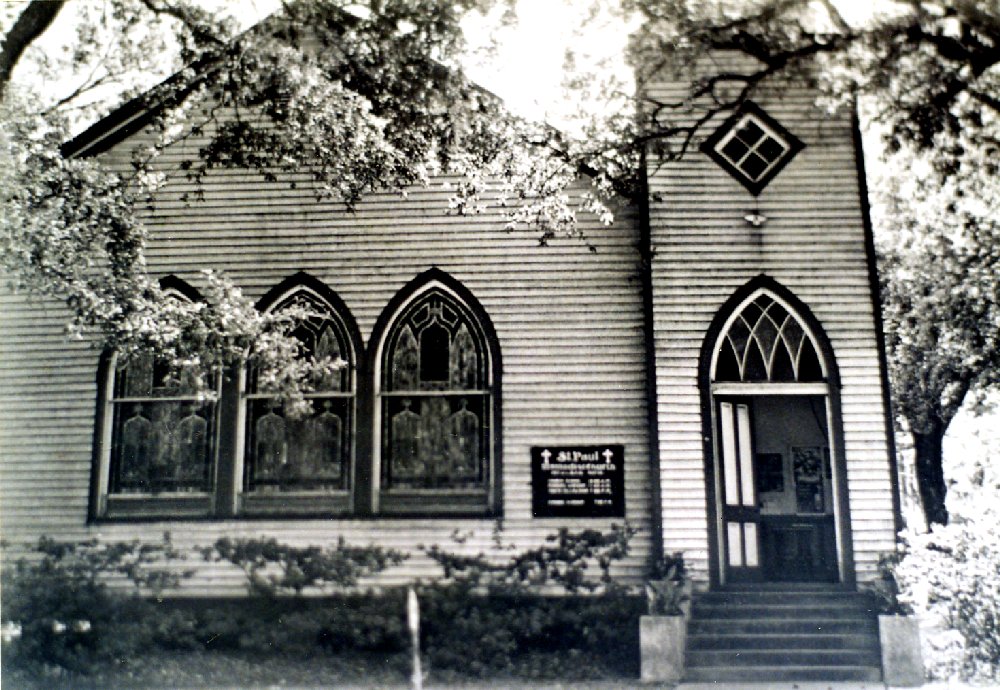
1899 Methodist Church
(southeast corner of Porter and Rayburn-image post 1934)
The 2nd Church
The second Methodist Church building to be constructed at Ocean Springs was erected in late 1899. The future building site was purchased from Jerry O' Keefe (1859-1911) by Bishop J.C. Keener on October 15, 1897, for $1100. The Keener lot, described as parts of Lot 1 and Lot 2 in Block 31 (Culmseig Map), was located on the southeast corner of Porter and Rayburn. The dimensions were 136 feet on the south side of Porter by 264 feet on the east side of Rayburn.( Jackson County, Ms. Land Deed Book 18, pp. 411-412).
Bishop Keener donated his lot to the Board of Trustees of the Methodist Episcopal Church South, in Ocean Springs. At the time of conveyance in August 1898, this board comprised the following persons: Oren Switzer, Thomas W. Grayson (1825-1904), William Toche (1862-1937), J.W. Clark, D.D. Cowan (1850-1929), O. Johnson, and Dr. A. Harry Shannon (1831-pre 1909).(JXCO, Ms. Land Deed Bk. 19, pp. 178-179)
Initial reaction to the Keener land donation was to move the existing 1872 church building near Washington Avenue to the Porter-Rayburn site. It appears that a house suitable for a parsonage was already here. This concept quickly dissipated and the decision to proceed with a new sanctuary was made.(The New Orleans Christian Advocate, April 6, 1899)
In order to erect a church edifice on the lot given by Bishop Keener, the Trustees of the Ocean Springs Methodist Church in April 1899, decided to sell their house of worship and lot, near Washington Avenue. The church was offered to the public for $700 while the Methodist parsonage and grounds were priced at $900.(The Pascagoula Democrat-Star", April 7, 1899, p. 3)
During the summer of 1899, enthusiasm in the Methodist Episcopal congregation on Porter for a new church building was high as members embarked enthusiastically to raise funds in the community. The proprietors of the lumber mills at Moss Point, the Dantzler Lumber Company, W. Denny & Company, the Moss Point Lumber Company, Bounds Mill, and Robinson & Company, made financial contributions amounting to three hundred dollars. The wholesale grocery firm, Schmidt & Ziegler of New Orleans, donated $50.(The Pascagoula Democrat-Star July 28, 1899, September 28, 1900, and November 17, 1899)
With these and other satisfactory accumulations of pecuniary gifts, The Pascagoula Democrat-Star announced on August 11, 1899, "the lumber is on the ground for the Methodist church building".
Additional funds to defray the building costs of the new Methodist Episcopal house of worship would come into the church treasury, after it was erected. The old sanctuary was sold to local pharmacist, Herman Nill (1863-1904), in April 1900.(The Pascagoula Democrat-Star, April 27, 1900)
Nill's Drug Store was on the northwest corner of Washington at Porter, just east of the old edifice. Nill utilized the lumber and materials from the Methodist church to erect a hotel for his mother-in-law, Katherine Vahle (1838-1914). The Vahle House was located on the northwest corner of Washington at Calhoun opposite the Shanahan House. It was destroyed in a conflagration, known as "The Big Fire", which occurred on the evening of November 15, 1916. As previously mentioned, the parsonage on Porter and Ward were sold in March 1902, for $550.(Bellande, 1994, pp. 108-111)
Rev. Howard Ware van Hook
In early January 1900, the new minister, Reverend Howard Ware Van Hook (1866-1947), with family arrived at Ocean Springs. They settled in the Bishop Keener donated parsonage on the east side of the sanctuary.(The Pascagoula Democrat-Star, January 5, 1900)
Reverend Van Hook was born at New Orleans. His wife, Eleanor Ormond (1871-1947+), was a native of Meridian, Mississippi. Her mother and sister, Mrs. Lowther, were residing at Jackson in 1900. They visited Ocean Springs remaining as long as one month at the parsonage.(The Pascagoula Democrat-Star, August 24, 1900)
The Van Hooks had six children: Eleanor Van Hook (1895-1912), Benjamin O. Van Hook (1899-1986+), Eugenia V. Redding (1902-1991), Mary V. McAllister (1903-1986), Julia V. Oberhausen (b. 1905), and Francis V. Graham (1910-1973).(Charlene Cole, July 1, 1997)
On January 6, 1900, Preacher Van Hook delivered his first sermons in the old church at both morning and evening Sunday services. The attendance of the congregation was large and attentive. His first service was held in the new Methodist church on May 19, 1900. Although not finished, the reporter for The Pascagoula Democrat-Star related that "it is comfortable and spacious, and an improvement on the location of the old church.(The Pascagoula Democrat-Star, January 12, 1900 and May 25, 1900)
The Methodist Episcopal Church building was dedicated on Sunday, September 16, 1900, by Bishop Keener and Reverend W.H. Lewis. The Pascagoula Democrat-Star on September 28, 1900, reporting on the memorable event said that: The building is located in one of the most desirable lots in Ocean Springs, which lot with adjoining patronage is a twentieth century offering of Bishop Keener and wife to the Methodist church.... The auditorium is large and possesses fine acoustic properties. The dedicatory services were peculiar in that there were no debts to be removed, hence no special collection was taken; a singular fact on such occasions. The membership of the church to show their appreciation for the years of friendship and helpfulness shown to them by Bishop Keener, have named their new place of worship KEENER CHAPEL.
The Reverend Samuel S. Keener of New Orleans, delivered the sermon at the dedication.(The Pascagoula Democrat-Star, September 7, 1900)
Reverend Van Hook and family departed Ocean Springs in December 1901. His forty-five year, peripatetic career, as a circuit riding preacher, church minister, school teacher, and recreation worker, would see Van Hook serve Methodist congregations at Lauderdale, Meridian, Rolling Fork, Ocean Springs, Biloxi, Woodville, Centreville, Silver City, Merryville, La., Sumrall, Vancleave, and Handsboro. Circa 1910, Reverend Van Hook became head master at the Methodist Sea Shore Camp Ground School at Biloxi. He resigned from this position in May 1925.(The Pascagoula Democrat-Star, January 26, 1900 and The Daily Herald, January 28, 1947, p. 1and p. 3 and October 3, 1976, B11 and B13)
REVEREND J.G. GALLOWAY
The Reverend J.G. Galloway was assigned to Ocean springs in January 1906.
Church Library
In January 1906, the nucleus of the church library was commenced when Mrs. Mattie L. Holcomb (1833-1906), the widow of Thomas A.E. Holcomb (1831-1897), donated books from her home library. Mrs. Holcomb's residence, "Hollywood", was located directly across the street from the Methodist sanctuary, on the north side of Porter. Mrs. Holcomb's gifts included Henry's Exposition and Clark's Commentaries, as well as several other historical and theological offerings.(The Pascagoula Democrat-Star, January 26, 1906)
Mrs. Stuart’s legacy
In October 1925, with the execution of the succession of the estate of Mrs. Elizabeth M. Stuart (1840-1925), by her cousin, William H. Howcutt (1847-1927) of New Orleans, the Methodist community of Ocean Springs was bestowed many valuable assets.( JXCO, Ms. Chancery Court Cause No. 4500-July 1925 and The Daily Herald, October 27, 1925, p. 1)
Included among the personal items donated by Mrs. Stuart were her valuable bookcase and pictures. Other Stuart gifts were: the three large, lancet, stain-glassed windows in memory of Bishop J.C. Keener, Colonel W.R. Stuart, and Mrs. Lizzie Stuart; a cash gift of $500 to secure a library for the Sunday school; a cash gift of $2000 to construct "The Lizzie McCauley Stuart Memorial Rooms", Sunday school class rooms.(The New Orleans Christian Advocate, November 19, 1925, p. 9)
Annex
In December 1926, Fred Bradford was rapidly completing construction of an annex to the sanctuary. It was anticipated to be ready soon.(The Jackson County Times, January 2, 1926)
St. Paul’s-a name change
The Methodist Quarterly Conference approved the change of the name of their Ocean Springs Methodist church to St. Paul’s in June 1934. New stewards appointed at this time were Frank C. Buehler (1909-1985) and H.P. Flateau (1888-1955). Mrs. Hilligoss was the choir leader while Walter Armstrong (1878-1945) was the General Superintendent. Sunday school teachers were: Mrs. R.L. Walton, adult; Eleanor Bradford, intermediates; Elizabeth Bradford, primary; and Virginia Thompson Lee (1901-1986), beginners.(The Jackson County Times, June 16, 1934, p. 3)
Church festivals
In late summers before World War II, the St. Paul's congregation held festivals to raise money. A common site for this event was the lot north of Bailey's Drug Store, now Lovelace Drugs, on Washington Avenue. Picnic style food was served: sandwiches, gumbo, salad, cakes, candy, ice cream, and cold drinks. A fortune teller and shooting gallery were utilized as part of the entertainment.(Jackson County, Times, August 19, 1939)

1962 St. Paul's United Methodist Church
(800 Porter-image made September 1993)
3rd Church
In 1961, plans were initiated for the construction of a new sanctuary at the site of the 1899 Methodist Episcopal Church. The cornerstone for St. Paul's United Methodist Church was set on May 27, 1962. M.G. Schuler, Mary G. Joachim (1902-1978), Horace Gladney (1894-1975), W.E. Wilson (1913-1985), Chester McPhearson Jr., H.A. Lowe, and V.B. Fox were Church Trustees at the time.(The Mississippi Methodist Advocate, June ? 1962, p. 4 and The Ocean Springs News, May 31, 1962, p. 1 and JXCO, Ms. Land Deed Bk. 216, p. 249)
The approximate 11,500 square-foot, church was of masonry construction and built by James F. Bates, a Pass Christian contractor, from a design by Claude Lindsley (1894-1969), local architect. Its sanctuary had laminated beams and had a seating capacity for 350 people. In addition, the new structure had a social hall, twelve Sunday School rooms, kitchen, church offices, and a choir room.(The Ocean Springs News, March 22, 1962, p. 1 and September 27, 1962)
The first service was held in the new church on October 21, 1962, with the Reverend J.H. Dillard present. It was dedicated on January 13, 1963.(The Mississippi Methodist Advocate, December 19, 1962 and The Ocean Springs News, January 17, 1963, p. 1)
The old sanctuary was relocated to the rear of the Church lot on Porter Avenue. It was planned to use the structure for Sunday school classes and Boy Scout meetings.(The Ocean Springs News, March 22, 1962, p. 1)
East Campus
In early November 1998, St. Paul’s United Methodist Church acquired from Robert J. Lucas Jr. et al for $867,000, 17-acres in Section 30, T7S-R7W, just west of the northwest corner of the intersection of US Highway 90 and Ms. Highway 57. The 17- acre tract was assembled from six parcels.(JXCO, Ms. Land Deed Bk. 1157, p. 169)
Here in November 2001, ground was broken for the Christian Life Center, a 28,000 square-foot structure. The three and one-half million dollar facility was to house a family life center, fellowship hall, Sunday school classrooms, three nurseries, and a youth activity room. A soccer pitch and ball diamond were planned for outside activities. The second project on the east campus of St. Paul’s will be a four million dollar sanctuary. The facility is served by the Reverend Kelly Pope, Senior Pastor, and Reverend Tom East.(The Mississippi Press, November 12, 2001, p. 6-A and The Ocean Springs Record, May 15, 2003, p. A1)
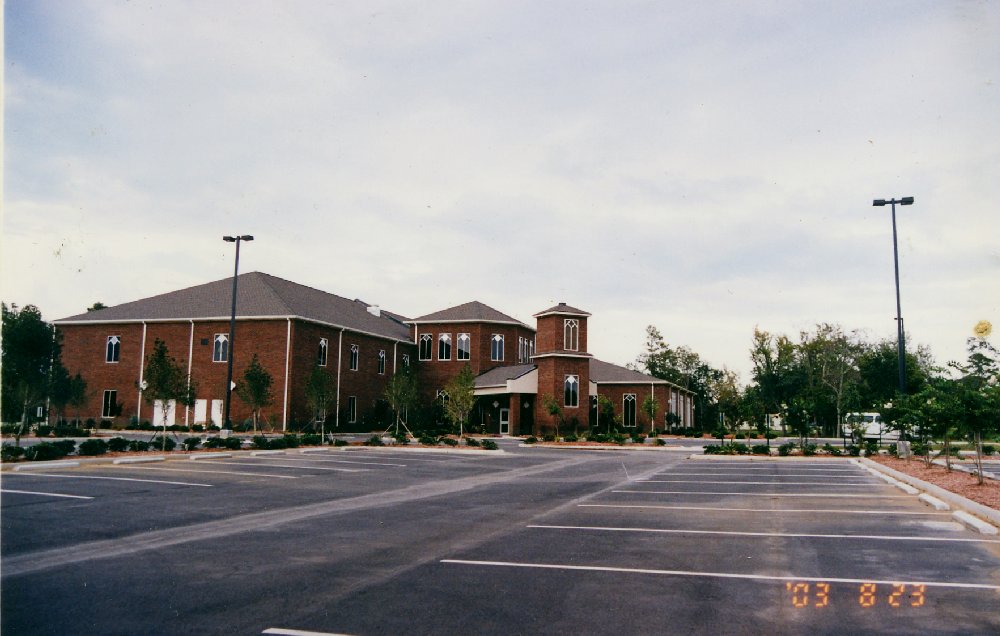
St. Paul's United Methodist Church-East Campus
(Bienville Boulevard-image made August 2003)
St. Paul’s Christian Life Center was built by Fletcher Construction Company of Pascagoula, Mississippi as the first phase of Christian Life Center concept. The large structure was composed of: offices, classrooms, fellowship hall, and gymnasium, which will serve as the sanctuary, until Phase II, the actual sanctuary, is built. On May 11th, St. Paul’s United Methodist Church held its first services in the new Christian Life Center on US 90. The former sanctuary on Porter Street continues for parishioners who desired to remain. The new facility was dedicated on June 15, 2003, by Bishop Kenneth L. Carder.(The Ocean Springs Record, May 15, 2003, p. A1 and
Fellowship Church
In July 2003, St. Paul’s United Methodist Church entered into a one-year contract with the Fellowship Church, a contemporary Christian worship group, to let their sanctuary and offices at 800 Porter Street. The group had two Sunday services, a 10:30 a.m. worship service and a 6:00 p.m. teenage service. Chris Erwin, associate pastor, related that the Fellowship Church possessed 12.5 acres of land on the Ocean Springs-Vancleave Road and aspired to build an eight hundred fifty seat multipurpose auditorium cum gymnasium and stage. The congregation members of St. Paul’s that didn’t want to worship at the new East Campus facility had an 8:15 a.m. worship service and Sunday School at 9:30 a.m. at the 800 Porter Street facility.(The Ocean Springs Record, July 17, 2003, p. A1)
REFERENCES:
Books
Ray L. Bellande, Ocean Springs Hotels and Tourist Homes, (Bellande: Ocean Springs, Mississippi-1994), pp. 108-111.
Charles L. Dufour, Ten Flag in the Wind: The Story of Louisiana, (Harper & Row: New York-1967), pp. 14-22.
Richebourg Gaillard McWilliams, Iberville's Gulf Journals, (The University of Alabama Press: University, Alabama-1981), p. 93.
Elizabeth Lemon Roberts and Ray L. Bellande, Ocean Springs-The Way We Were (1900-1950), (The Ocean Springs Rotary Club: Ocean Springs, Mississippi-1996), p. 93.
Chancery Court Causes
Jackson County, Miss. Chancery Court Cause No. 4500, "The Last Will and Testament of Elizabeth McCauley Stuart", July 1925.
Journals
The Biloxi Daily Herald, "Dr. Walker's Funeral", March 6, 1897, p. 4.
The Daily Herald, "Rev. Van Hook Dies After Short Illness at Biloxi", January 28, 1947, p. 1 and p. 3.
The Daily Herald, "Families had to comply with strict camp rules", October 3, 1976, p. B-11 and p. B-13.
The Gulf Coast Times, “WSCS Celebrated 10th Anniversary Tuesday Afternoon”, October 20,1950.
The Jackson County Times, “Local and Personal”, January 2, 1926.
The Jackson County Times, “St. Paul’s New Name of Local Church”, June 16, 1934.
The Jackson County Times, "Local and Personal", August 19, 1939.
The Mississippi Methodist Advocate, "Cornerstone Laid For St. Paul's Church", June ? 1962.
The Mississippi Methodist Advocate, "Official Opening St. Paul Church, Ocean Springs", December 19, 1962.
The Mississippi Press, “Church breaks ground on expanded facility”, November 12, 2001.
The Mississippi Press, “Holy Ground”, June 16, 2003, p. 1-A.
The New Orleans Christian Advocate, March 28, 1872.
The New Orleans Christian Advocate, March 4, 1875.
The New Orleans Christian Advocate, August 14, 1879.
The New Orleans Christian Advocate, February 28, 1889, p. 1.
The New Orleans Christian Advocate, October 31, 1889.
The New Orleans Christian Advocate, "Resolution of Thanks", April 6, 1899.
The New Orleans Christian Advocate, "Generous Gift To Church At Ocean Springs, Miss.”, November 19, 1925, p. 9.
The New Orleans Daily Picayune, "Rev. Dr. J.B. Walker Called Higher ", February 27, 1897.
The Ocean Springs News, “Foundation Laid At St. Paul’s”, March 22, 1962, p. 1.
The Ocean Springs News, “Cornerstone Laid At St. Paul’s, May 31, 1962, p. 1.
The Ocean Springs News, “New Methodist Church”, September 27, 1962.
The Ocean Springs News, “St. Paul’s Methodist Church Officially Opened”, January 17, 1963.
The Ocean Springs Record, "Sous Les Chenes", January 2, 1997, p. 14.
The Ocean Springs Record, "St. Paul rises in the east", May 15, 2003, p. A1.
The Ocean Springs Record, “Fellowship St. Paul to share facilities”, July 17, 2003, p. A1.
The Pascagoula Democrat-Star, “Ocean Springs Items”, May 24, 1878.
The Pascagoula Democrat-Star, “Ocean Springs Items”, June 21, 1878.
The Pascagoula Democrat-Star, “Ocean Springs Items”, July 26, 1878.
The Pascagoula Democrat-Star, “Ocean Springs Items”, January 16, 1880.
The Pascagoula Democrat-Star, “Ocean Springs Items”, July 9, 1880.
The Pascagoula Democrat-Star, “Ocean Springs Items”, March 11, 1881.
The Pascagoula Democrat-Star, "Ocean Springs Locals", April 7, 1899.
The Pascagoula Democrat-Star, "Ocean Springs Locals", July 28, 1899.
The Pascagoula Democrat-Star, "Ocean Springs Locals", November 17, 1899.
The Pascagoula Democrat-Star, "Ocean Springs Locals", September 28, 1900.
The Pascagoula Democrat-Star, "Ocean Springs Locals", January 5, 1900.
The Pascagoula Democrat-Star, "Ocean Springs Locals", January 12, 1900.
The Pascagoula Democrat-Star, "Ocean Springs Locals", April 27, 1900.
The Pascagoula Democrat-Star, "Ocean Springs Locals", My 25, 1900.
The Pascagoula Democrat-Star, "Ocean Springs Locals", August 24, 1900.
The Pascagoula Democrat-Star, "Ocean Springs Locals", September 7, 1900.
The Sun Herald, "St. Paul UMC strives to be a church home", August 21, 2010, p. A9.
Maps
Sanborn Map Company (NY), "Ocean Springs, Ms.", Sheet 2, August 1893.
Personal Communication
Charlene Cole, July 1, 1997.
__________________________________________________________________________________________________
PRESBYTERIAN
In July 1886, an organizational meeting was held with eight Ocean Springs families in the Washington Avenue home of Louisa Burling Bartlett (1823-1889), a New Orleans lady. Her husband, William A. Bartlett (1816-1882), a Connecticut native owned the Home Insurance Company at New Orleans. Their son-in-law was George Washington Cable (1844-1925), who gained national notoriety as a writer of Creole life and social reform. Cable's wife, Louisa S. Bartlett, owned the Bartlett Cottage from 1876 until 1890.
The local Presbyterians had been meeting on Sunday afternoons at the Baptist Church, and it was decided that they should have their own church building. As a result of the July 1886 organizational meeting, a sanctuary was erected on Ocean Avenue and dedicated in October 1886. The church lot was purchased from Mary Ann Wing in January 1887 for $1.00. In 1956, Mr. and Mrs. Gordon Walker donated a new belfry and steeple for the old sanctuary.
1896
Reverend N. Keff Smith, pastor of the Presbyterian church, has been honored with the degree of Doctor of Divinity by the Presbyterian college near Greenville, Tennessee.(The Pascagoula Democrat-Star, May 22, 1896, p. 3)
James Mulholland
1948-
The Reverend James Mulholland of Handsboro, Mississippi was installed as pastor of the First Presbyterian Church. At this time George Granitz was made an elder and Frank Snyder and Frank Cramer were made deacons.(The Daily Herald, October 15, 1948, p. 8)
Jack Wulff
The James H. Mitchell home in Cherokee Glen was purchased in April for incoming Pastor Wulff. Jack graduated on June 6, 1954 from the Presbyterian Seminary at Decatur, Georgia. Following his marriage and honeymoon. He and spouse will locate to Cherokee Glen and he will become a full time pastor.(The Daily Herald, April 16, 1954, p. 15)
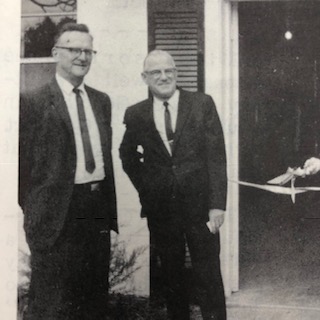
[L-R: Mayor Champ Gay and Reverend Merlin F. Usner]
Merlin F. Usner
1962
Merlin Frederick Usner (1902-1995) was one of two Usner descendants that later lived in Ocean Springs. Elizabeth ‘Betty’ Usner Armand (1909-1999) was the other. Merlin was born at NOLA on September 2, 1902. He attended Maryville College, Maryville, Tennessee and the Princeton Theological Seminary. Merlin came to the First Presbyterian Church at Ocean Springs, Mississippi in September 1962 and was installed by a commission chaired by the Reverend Robert T. Colt of the First Presbyterian Church of Long Beach, Mississippi, the Reverend Victor Augsburger of Biloxi and the Reverend Arthur M. Schneider of Pascagoula, Mississippi.
After 1930, Merlin F. Usner had married Ruby Elizabeth Getaz (1909-1986) of Maryville, Tennessee. They had Priscilla E. Usner (b. 1948), a daughter, who married Russell Lasseigne (b. 1945). Reverend Usner retired from his ministry at Ocean Springs, Mississippi in 1972. Ruby G. Usner expired at Ocean Springs, Mississippi on November 28, 1986. Merlin F. Usner relocated to Katy, Houston County, Texas and died there on August 20, 1995.
Robert R. Wilson
1971-
-Crestlawn.jpg)
The Reverend Robert R. Wilson (1921-2009) was installed in early November 1971 as the new pastor succeeding the Reverend Merlin Usner who retired earlier in 1971. The Reverend Wilson retired from the USAF on November 1, 1971 as Chaplain with the rank of Lt. Colonel. He had been stationed at Keesler AFB since January 1971. Reverend Wilson was a native of Pittsburg and graduated from Waynesboro College in Waynesboro, Pennsylvania and the Western Theological Seminary at Pittsburgh. He was ordained in 1951. Wilson retired from his pastoral duties at Ocean Springs circa 1987 and expired on January 8, 2009.(The Daily Herald, November 6, 1971, p. 2)
New Sanctuary
After nearly a century, the Presbyterians led by the Reverend Andy Wells built a large sanctuary just east of the old church. It was dedicated on August 20, 1995. The Reverend Wells was appointed pastor of the church on November 14, 1989.(The Ocean Springs Record, November 9, 1989, p. 7)
REFERENCES
The Daily Herald, "Rev. James Mulholland installed as minister", October 14, 1948.
The Daily Herald, "Purchase Manse', April 16, 1954.
The Daily Herald, "Presbyterians select new church pastor [Robert R. Wilson]", November 6, 1971.
The Pascagoula Democrat-Star, “Ocean Springs Locals”, May 1, 1896.
The Pascagoula Democrat-Star, “Ocean Springs Locals”, May 22, 1896.
The Ocean Springs Record, "Wells to become pastor of the Ocean Springs 1st Presbyterian”, November 9, 1989.
The Daily Herald, "Rev. James Mulholland installed as minister", October 14, 1948.
EPISCOPALIAN
The early history of the Episcopal Church at Ocean Springs has been lost but it is known that in June 1865 an organization of Episcopalians was formed. The first records of the church indicate that the "Fortnightly Guild" met in June 1891, at the home of Dr. Tebo. It was decided at this gathering to accept the offer of the Baptist congregation to use their church building on DeSoto Avenue. The St. John's Episcopal Church was erected in 1892, from plans drawn by Reverend Nelson Ayers from illustrations in the "Churchman". The lot was donated by William B. Schmidt, a wealthy merchant from New Orleans. The building committee was composed of Mrs. G.T. Helmuth, Mrs. F.V. Garrard, Mrs. Stansbury, and Dr. Tebo. It is very likely that Louis H. Sullivan, the renown Chicago architect, assisted in the design of the church. In 1903, George and Adele Arndt gave the bell in memory of their young daughter, Elsie Arndt. The parish house was erected in 1948. St. John's was a mission church served by rectors of the congregations at Pascagoula or Biloxi. In 1955, the Episcopalians at Ocean Springs got a full-time priest, the Reverend Howard B. Kishpaugh. In 1996, the church building was renovated. It was rewired, repainted, and a new copper shingle roof installed. In 2009, a new parish hall was erected. It was dedicated in January 2010.
ST. JOHN'S EPISCOPAL CHURCH
The Beginning
In February 1891, when the Episcopalians of Ocean Springs announced their intentions to erect a sanctuary on the northwest corner of Porter and Rayburn Avenue, opposite to “Hollywood”, the new cottage of T.A.E. Holcomb (1831-1897), there were four church buildings in Ocean Springs, for White religious Christian services. Two Black sanctuaries existed at this time, the African Methodist Episcopal Church (now St. James Methodist Church) and the Macedonia Missionary Baptist Church.
St. Alphonsus, the Roman Catholic Church, initially situated on Porter east of Washington, is now on the northeast corner of Jackson and Calhoun; the Baptist church which rested on the northwest corner of Desoto and Church Street, is now on the northeast corner of Washington and Porter; the early Methodist church was on Porter just west of Washington. Today it is still on Porter, but several blocks west on the southeast corner of Rayburn Avenue and Porter, diagonally across from the Protestant Episcopal sanctuary, as it was known at this time. Only the quaint Presbyterian structure on Ocean Avenue, like St. John’s Episcopal, is in near original condition and in situ.
Organizational meeting
The first official act of the Ocean Springs Episcopalian society occurred on June 19, 1891, when the “Fortnightly Guild”, was created at an assembly of potential parishioners at the domicile of Dr. Langdon Chevis Tebo (1846-pre-1925). The following officers were elected: Dr. L. Chevis Tebo, president; Mr. Guion, 1st vice-president; Ellen M. Sheldon (1834-1912), 2nd vice-president; Francesca V. Garrard (1839-1907), secretary; and Agnes Louise Cooke Hellmuth Earle (1862-1919), treasurer. A prospective minister, the Reverend Mr. Nelson Ayres, was chosen as honorary president.(St. John’s Episcopal Church History, p, 1)
The Church Lot
On August 6th, 1891, William B. Schmidt (1838-1900), the Merchant Prince of New Orleans who owned the Ocean Springs Hotel and a large estate on Front Beach between Martin Avenue and the present day Ocean Springs Yacht Club, conveyed, “in consideration of his desire to aid in the promotion of the cause of the Gospel and dissemination of the benefits of religion; and also for the better maintenance of the and support of the principles of the Protestant Episcopal Church”, to the Trustees of the Episcopal Fund and Church Property of the Protestant Episcopal Church of the Diocese of Mississippi, a parcel of land described in the corrected warranty deed of April 27th , 1893, as: Situated in Section 30 (sic) Township 7 South, of Range 8 West, in the Town of Ocean Springs, Jackson County, Mississippi bonded and described as follows: Commencing at the point where the line dividing Lots 6 and 7 of the Jerome Ryan Tract intersects Kendall Avenue (sic), and running from thence in a westerly direction along the line dividing Lots 6 and 7 to where said line intersects the north margin of Porter Avenue; thence running in an easterly direction and along the north margin of Porter Avenue to where said Porter Avenue intersects said Kendall Avenue (sic); thence north along the west margin of said Kendall Avenue (sic) 79 feet to the place of beginning. Being triangular in shape, and all of said Lot 6 of the Jerome Ryan Tract lying north of Porter Avenue.(JXCO, Ms. Land Deed Bk. 14, p. 533)
Mr. Schmidt had purchased this parcel from James Ryan in May 1888.(JXCO, Ms. Land Deed Bk. 10, p. 568)
It is interesting to note that in the original warranty deed of August 1891, from W.B. Schmidt to the Protestant Episcopal Church, that Rayburn Avenue is utilized in the parcel description, rather than Kendall Avenue of the corrected warranty deed description of April 1893.(JXCO, Ms. Land Deed Bk. 12, p. 576)
Rayburn Avenue was also depicted on a land plat of the Jerome Ryan Tract, which was surveyed by Enoch N. Ramsay (1832-1916) in February 1894.(JXCO, Ms. Surveyor’s Record Bk. 1, p. 22) It appears that the corrected warranty deed is also in need of correction! Regardless the triangular-shaped lot acquired by the Episcopalians from W.B. Schmidt was .41 acres in area.
Although the legal transfer of title to the church lot from W.B. Schmidt to the Episcopalians did not occur until August 1891, The Pascagoula Democrat-Star scooped the occasion in early June 1891, as it related: We are soon to have an Episcopal church in our town. Mr. W.B. Schmidt, with his usual liberality and public spirit, has donated a large and eligible site for it at the corner of Porter and Rayburn Avenues. There being considerable money and resources in hand for the purpose, it is only a question of a very short time till a handsome edifice will be erected…”
In another twist as to the acquisition of an Episcopalian church site, The Biloxi Herald related that the congregation possessed a lot, but it was not considered in an appropriate locale for their church. The Episcopalian’s bartered this parcel for the more desirable site on Porter and Rayburn.(The Biloxi Herald, February 16, 1891, p. 1)
Early meeting places
By mid-June 1891, the Episcopal leadership had made provisions to utilize the Knights of Pythias Hall on Washington Avenue, for bi-monthly meetings. Substantial donations for the new church were being received and it appeared that the building fund would soon reach sufficient amounts to warrant construction.(The Biloxi Herald, June 20, 1891, p. 4)
The fledgling Episcopalian community cancelled their proposal with the Knights of Pythias, as they accepted an ecumenical offering from theBaptists to utilized their Desoto Avenue sanctuary as a temporary assembly site. The Reverend Mr. Trader was an early minister to congregation when the Baptist sanctuary was being utilized.(St. John’s Episcopal Church History, p, 1)
At this time, it seems that it was common for the Christian churches of Ocean Springs to have joint outings. In May 1891, the children of the Sunday School classes of the Baptist, Methodist, and Presbyterian congregations had a picnic at the Leland Place on Old Fort Bayou.(The Pascagoula Democrat-Star, May 22, 1891, p. 3)
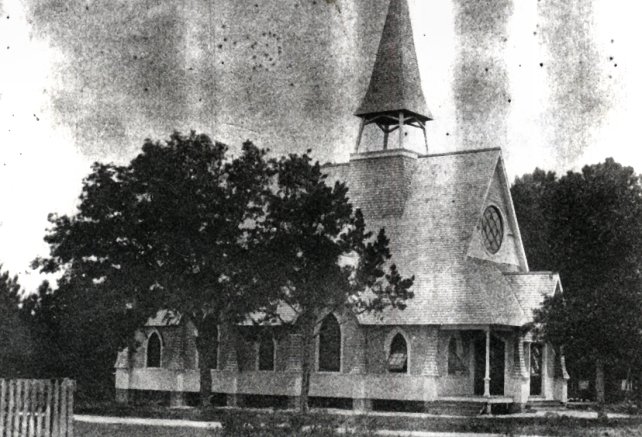
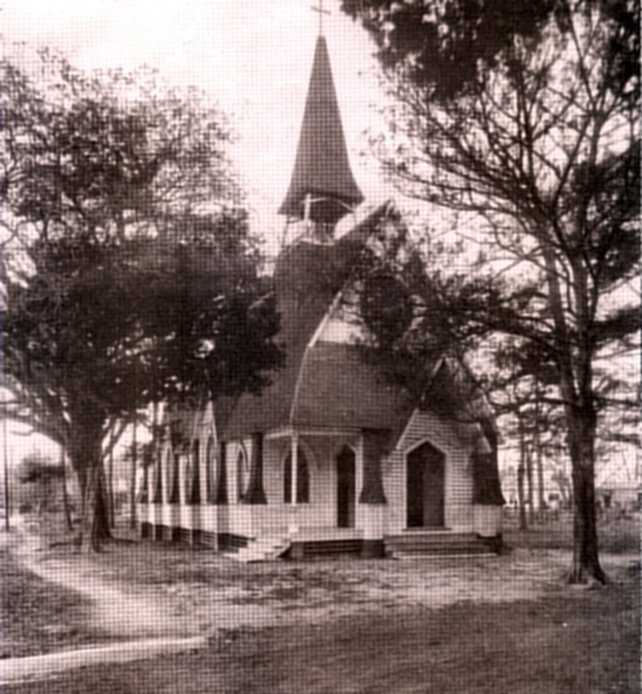
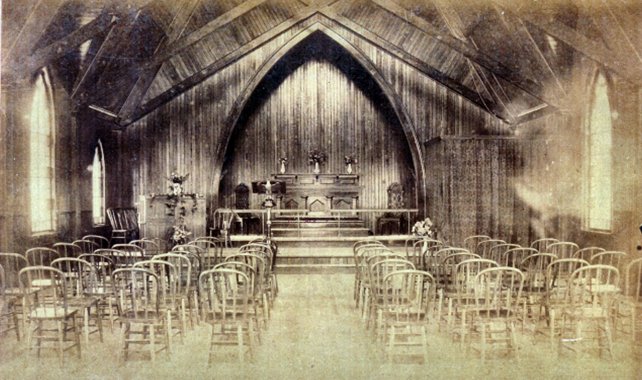
Original church building
[L-R: exterior views south and east elevation circa 1915 and 1925 and interior view circa 1895. Interior view shot by Dr. Ross Adams Switzer (1875-1945), a New York born photographer who later became a doctor and practiced medicine at McHenry, Stone County, Mississippi. Note the 48 chairs chairs in the sanctuary indicating that there were fifteen to twenty families in the congregation at this time.]
The Building
The architectural plan for the Protestant Episcopal Church on Rayburn Avenue, which was built in the interval from November 1891 to March 1892, was taken from the July 11, 1891, issue of The Churchman. Episcopal church records indicate that the High Victorian Gothic style used by the local congregation was a simplification of a plan for a Long Island, New York church designed by Manly Cutter of New York City.(The Ocean Springs Record, February 24, 1994, p. 21)
Rectangular in plan view, the wood-frame structure had an area of 2675 square-feet. Although the building contractor is not presently known, potential builders at this time were: Gregor Wieder & Sons, Lyman N. Bradford Jr. (1851-1894), George L. Friar (1870-1924), John D. Minor (1863-1920), and Thomas A. Friar (1871-1896).(Sanborn Insurance Map-Ocean Springs, Ms.-May 1935, Sheet No. 3)
In mid-November 1891, the ladies of the Ocean Springs Protestant Episcopal Church held a formal ceremony at the Rayburn Avenue site, to commence construction of the new Episcopal sanctuary. Each female solemnly placed a brick in the foundation of the future church.(The Biloxi Herald, November 21, 1891, p. 4)
By early December, construction was proceeding at a strong pace. It was speculated that this church building would be the most handsome at Ocean Springs.(The Biloxi Herald, December 5, 1891, p. 4)
By Christmas 1891, the architectural style of the rising, Episcopal edifice was quite discernible. Exceptionally fine fenestration had been designed and built for the structure.(The Biloxi Herald, December 26, 1891, p. 4)
Louis H. Sullivan’s Role
The great American architect, Louis H. Sullivan (1856-1926) may have been in winter residence at Ocean Springs, during the construction of the Protestant Episcopal Church, as his East Cottage had been commenced in late 1890 or early 1891. This fact is corroborated by a notice in a Pascagoula journal which related that in late January 1891, that Mr. Sullivan and his friend and neighbor, James Charnley, were domiciled at the Ocean Springs Hotel awaiting the imminent completion of their waterfront homes.(The Pascagoula Democrat-Star, January 30, 1891, p. 1)
It is the general consensus that if Sullivan’s had any participation in the building of the new Episcopalian sanctuary on Rayburn Avenue, it was in an advisory capacity only. Gustavus T. “Ted” Hellmuth (1884-1975), a member of St. John’s Episcopal Church, was interviewed in February 1973, and stated that he was a boy when the plan for the church was being developed. He alluded that Louis H. Sullivan had submitted an architectural rendering, but it was deemed undesirable by the congregation. They accepted the suggestion of Mr. Ayers [probably the Reverend Nelson Ayres] to use the plan in the Episcopal church magazine.(Steelman, 1973, p. 27)
On May 21, 1949, St. John’s Episcopal Church remembered Louis H. Sullivan with the emplacement of a memorial tablet in their sanctuary on Rayburn Avenue. At this time, there were approximately 500 architects attending the Southern Conference on Hospital Planning at the Buena Vista Hotel in Biloxi. A rose garden was planned on the church grounds.(The Gulf Coast Times, May 20, 1949, p. 1 )
Fund Raising
In early September 1891, James J. Garrard (1828-1902) in an effort to raise funds for the planned Protestant Episcopal Church, hosted a lawn party at his handsome residence on Iberville Drive. In the later years of the 19th Century, Mr. Garrard and his wife, Francesca Victoria Marks (1838-1907), moved into retirement at Ocean Springs from New Orleans. J.J. Garrard had been a partner in the Crescent City cotton firm of Garrard & Craig. He was a native of Paris, Kentucky. Here, one of his pastimes was gardening, from which he produced some fine white Niagara grapes. The Garrards’ soiree was a financial success for the church fund, as the more affluent crowd of Ocean Springs and surroundings were well represented.(The History of JXCO, Ms., 1989, p. 213, The Pascagoula Democrat-Star, September 11, 1891, p. 3, and The Biloxi Herald, July 11, 1891, p. 1)
During the 1891 Christmas season, Dr. Langdon Chevis Tebo (1846-pre 1925), an enthusiastic supporter of the Episcopalian fundraising efforts, allowed the church ladies to display Christmas toys in his drugstore. He sold the holiday gifts for the women.(The Biloxi Herald, December 19, 1891, p. 1)
On March 24, 1892, a fundraiser was held for the Episcopal Church at the Ocean Springs Hotel on Jackson Avenue. In spite of the rain, the affair was successful, both financially and socially.(The Pascagoula Democrat-Star, April 1, 1892, p. 2)
The Loan
By the end of 1891, the Fortnightly Guild of St. John’s had raised about $1100. To complete their church building which was under construction, James J. Garrard (1828-1902), Parker Earle (1831-1917), and W.B. Stansbury, members of the Protestant Episcopal Church of Ocean Springs, signed on January 10, 1892, a five-year, 6% interest, mortgage for $750, payable to the American Church Building Fund Commission. O.O. Eckford, Frederick Speed, and P.R. Saunders were the trustees of the Episcopal Fund and Church property of the Diocese of Mississippi. The mortgaged was cancelled on May 20, 1897.(JXCO, Ms. Land Deed Bk. 13, p. 273 and Bk. 15, p. 513 and St. John’s Episcopal Church History, p, 1)
The completed sanctuary was appraised for $3400. By December 4, 1896, the building fund debt had been reduced to $57.(The Biloxi Herald, December 12, 1896, p. 8)
First Services
In an ecumenical service held on April 24, 1892, religious services commenced in the sanctuary of the new Episcopal Church on Rayburn Avenue. The Reverend William C. West (1848-1915) of the Presbyterian Church assisted the Reverend Nelson Ayres (1848-1910+), the Episcopalian priest. The building swelled with alert parishioners who were awed with the sanctity of the service. Reverend Ayres delivered the first sermon and Jennie E. Carson, the spouse of Mr. John B. Carson (d. 1892), a railroad magnate from Chicago, donated an organ to the church.(The Biloxi Herald, April 30, 1892, p. 1, The Pascagoula Democrat-Star, May 3, 1892, p. 2 and Ellison 1991, p. 38)
Mrs. Jennie E. Carson and her husband were erecting a home at Belle Fontaine Beach, when he expired at Metropole Hotel in Chicago. She resided in her Belle Fontaine home until it was destroyed by a large conflagration on April 14, 1899. Mrs. Parker Earle and Mrs. Farmer were visiting her when the fire occurred. After the blaze, Mrs. Carson relocated to Ocean Springs where she was a houseguest of Mrs. Parker Hellmuth Earle (1862-1919), the future grandmother of Mrs. Peter Anderson (1906-1973) and Mrs. Walter I. Anderson (1909-1991).(The Pascagoula Democrat-Star, April 21, 1899)
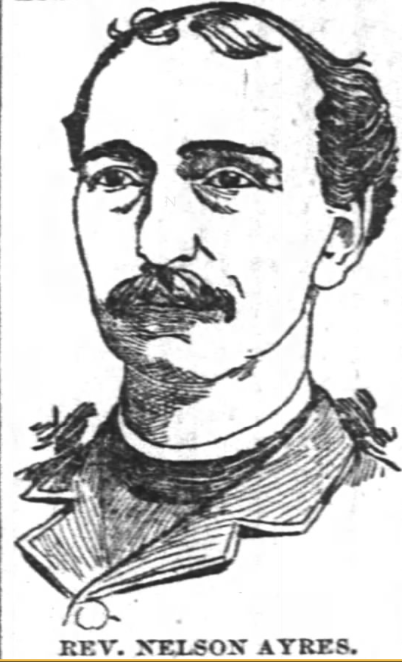
[The Daily Picayune, November 20, 1892, p. 22]
Reverend T. Nelson Ayers
T. [Thomas] Nelson Ayres Jr. (1848-1918) was a native of New York. He served the Episcopalian community of the Mississippi Coast for several years before his ordination as a Catholic priest in December 1896 at New Orleans. Reverend Ayres had married Martha Morrison (1850-1894), a Mississippi lady, who bore him two sons in Texas: John Morrison Ayres (1874-1897) and Nelson Ayres II (1877-1880+). In 1880, the Ayres family was domiciled on 15thStreet in Brownsville, Texas. Here he ministered to the Episcopalians in this Mexican border community. J. Morrison Ayres, his son, expired at San Antonio, Texas in March 1897.(1880 Cameron County, Texas Federal Census T9_1294, p. 104, ED 31 and The Biloxi Herald, March 2 , 1897, p. 1)
Rector Ayres appears to have been educated at Knox College at Galesburg, Illinois. He also served in the Union Army during the Civil War. Nelson Ayres was associated with the Episcopal Church in Springfield, Illinois as early as April 1886.(The Daily Picayune, March 4, 1910, p. 11 and The Churchman, April 10, 1886)
Martha Ayres died at Waveland, Hancock, Mississippi in the Ayres Cottage in July 1894. The Ayres Cottage was a five minute walk from the Nicholson Avenue rail station. It had eight rooms, kitchen, bathroom, seven closets, and stables.(The Daily Picayune, December 10, 1891, p. 1 and July 14, 1894, p. 4)
By December 1896, the Reverend Nelson Ayres had joined the Roman Catholic Church and studying to become a priest. After being a sub-deacon and deacon, he was ordained by Archbishop Francis Janssens (1843-1897), former Bishop of the Diocese of Natchez and the fourth Archbishop of New Orleans, in December 1896 at St. Theresa’s Church on Camp and Erato in New Orleans. Father Ayres expected to celebrate his first Mass on Christmas Day.(The Biloxi Herald, December 12, 1896, p. 8 and December 26, 1896, )
Father Ayres was assistant pastor at St. Peter’s and St. Paul’s in the Crescent City until the spring of 1898, when he was assigned as rector of Lady of the Lake Catholic Church at Mandeville, St. Tammany Parish, Louisiana. A salient mission while he worked for his parishioners on the north shore of Lake Pontchartrain was to raise funds to replace the derelict St. Genevieve Church on Bayou Bonfuca. By late summer 1899, two hundred of the twelve hundred dollars had been raised for the new sanctuary.(The Daily Picayune, May 10, 1898, p. 14 and August 5, 1899, p. 5)
Father Ayres served the Catholics in the St. Francisville, West Feliciana Parish, Louisiana region from 1899 until 1902. He relocated to St. Bernard Parish, Louisiana in 1903 and was rector of the St. Bernard Catholic Church until 1906.(The Daily Picayune July 18, 1901, p. 2 and June 13, 1903, p. 5)
More land
In May 1894, additional acreage was acquired by the Trustees of the Episcopal Fund and Church Property of the Protestant Episcopal Church of Mississippi, contiguous with and north of their August 1891 church lot, when Frederick M. Weed (1850-1926) and James I. Ford (1862-1915) conveyed to them a .34 acre parcel, having an 85-foot front on Rayburn Avenue for $50.(JXCO, Ms. Land Deed Bk. 15, p. 514)
1896
In early December 1896, the St. John’s guild convened for its annual meeting and election of officers. Dr. Dan Newcomb was re-elected sub-warden, his fifth term; Mrs. F.V. Garrard reelected secretary, her sixth term; and Mrs. E.M. Sheldon re-elected treasurer, her second term. There had been no services in the church for over a year with the departure of Rector Nelson Ayres to the Catholic Church. The Reverend Mr. Harris of Pass Christian was expected to relocate to Ocean Springs and to do mission work here and later at Scranton (Pascagoula), if his health permitted.(The Biloxi Herald, December 12, 1896, p. 8)
1904
In 1904, the Reverend Edwin D. Weed was pastor of the church. He departed Ocean Springs in September 1904, for a long vacation in the East. His itinerary included stops in New York and Connecticut. Church services would continue at the usual hour during the absence of Reverend Weed.(The Progress, September 8, 1904, p. 5)
1906 church bell
In 1906, George E. Arndt donated the bell for St. John’s Episcopal Church on Rayburn Avenue. Before its new sound pealed into the community, a bolt from the blue issued from a July thunderstorm, striking the church steeple. The resulting force rocked the sanctuary, broke windows, and damaged electrical light fixtures. The church sustained damages amounting to $400.(The Pascagoula Democrat-Star, July 13, 1906, p. 3 )
1910
Reverend John Chipman was the pastor of the church at this time.(The Ocean Springs News, January 7, 1911, p. 1)
1915 notes
In February 1915, twenty-six church members of the congregation attended services at the church. This marked the first time in the short history of the church that services were conducted by laymen. The rector, Mr. Griffin, was ill, but his health was improving.(The Ocean Springs News, February 25, 1915, p. 4)
1916 notes
Talk of building a rectory commenced.(The Ocean Springs News, March 9, 1916, p. 1)
1934
Edward A. DeMiller, rector.(The Daily Herald, October 13, 1934, p. 2)
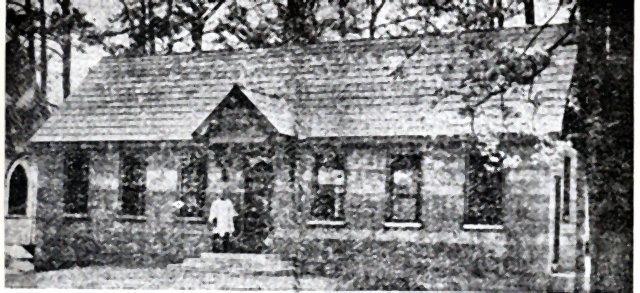
New parish house
[Father Edward A. DeMiller (1889-1948+), pastor, is standing in the doorway of the new parish house on Rayburn Avenue. Image from The Jackson County Times, May 14, 1948. p. 1]
1948-Parish House
In early May 1948, the new parish house for St. John's was dedicated by Bishop Duncan Montgomery Gray Sr. (1898-1966) assisted by Edward A. DeMiller, pastor. Louis Cosper, J.S. Bradford and John Cox of the church building committee were responsible for raising funds and getting the concrete structure built. It was designed by Wilfred Lockyer. Members of the St. John's and St. Ann's Guilds assisted with the post-dedication celebration held in the new parish house. Hostesses for the soiree were Mrs. James Friar and Mrs. Ellis Handy. Miss Janice Galle [Pepper] was chosen Miss Parish House and assisted as a hostess and greeter while Miss Bernadine Wulff sang.(The Jackson County Times, May 14, 1948. p. 1)
1955- Howard B. Kishpaugh, first full-time priest
St. John's was a mission church served by rectors of the congregations at Pascagoula or Biloxi. In 1955, the Episcopalians at Ocean Springs got a full-time priest, the Reverend Howard B. Kishpaugh (1926-2001). He later served the church in Meridian, Mississippi. In February 1963, Reverend Kishpaugh wrote a letter to Time magazine, which was published in the national weekly on February 22, 1963:
Homecoming
Sir: In a time when so many unkind (perhaps both deserved and undeserved) things are being said about Mississippi, I welcomed your coverage of Miss Leontyne Price's homecoming concert in Laurel [Feb. 8]. I wish you could have given it more space, because it was one of the finest examples of love and fellowship ever expressed among the races. We white people were only too glad to sit on the aisle floor to hear this gifted and great person return home and sing to us all. She not only received ovations; she brought tears to our eyes, and none of us, either colored or without color, could care less about Miss Price's color or her fame. (THE REV.) HOWARD B. KISHPAUGH)
Reverend Kishpaugh passed at Hershey, Pennsylvania on January 11, 2001. His obituary follows:
Rev. H. B. Kishpaugh, Episcopal traditionalist
by Judith Patton of the Patriot News
Hershey[Pennsylvania]is mourning a clergyman known for his roots in the community and his stand on church issues.
The Rev. Canon Howard B. Kishpaugh, 74, of 410 Hallmark South, died Thursday at home. Kishpaugh had returned to
Hershey in July 1973 to serve as rector at his childhood parish, All Saints Episcopal Church. He retired in November 1988.
"Father Kishpaugh was able to come back and be a pastor in his home parish, which is not an easy thing to do,"
said Monsignor Leo N. Bierster, senior pastor of St. Joan of Arc Roman Catholic Church, Hershey, and a friend for 23 years.
"I'll remember him as a man of great faith, a man who stood up for what he believed and as a faithful friend. He was
deeply interested in everything that happened in the Hershey community."
As a youngster, Kishpaugh had been an acolyte and choir boy. Before entering the priesthood at 29, he had aheating and air-conditioning business, served in the Marine Corps and was a bull rider on the rodeo circuit.Kishpaugh begin his ministry in Mississippi and served in Hawaii during the Vietnam War and in Tanzania,East Africa, where he designed and built churches, hosiptals, and water and electrical systems.Kishpaugh, who once described himself as a traditionalist, was unhappy with the modernization of the liturgy and othertraditions in his denomination. "We no longer preach a gospel of discipline," he said upon his retirement. "We want to grindup the faith into a kind of pabulum that makes it digestible, palatable for everybody."His fight to have the Episcopal Church reaffirm its historic teachings against sexual cohabitation by homosexuals and byheterosexuals outside of marriage cost him an election as a deputy to the national General Convention. Kishpaugh, however,served in leadership positions in Mississippi, Hawaii and central Pennsylvania. In 1986, he was elected president of the standingcommittee of the Central Pennsylvania Diocese. He also served as chairman of its Diocesan Board of Examining Chaplains andCommission on Ministry as a dean of the Harrisburg Convocation.He received commendations from the Boy Scouts of America and U.S. Marines, as well as the Bishops Merit Cross from theDiocese of Hawaii and the Army's Certificate of Honor for Civilian Service for his ministry to widows and children of servicemenkilled in Vietnam. He was a member of the Cities in Schools of Harrisburg and of the Pearl Harbor and Hershey Rotary clubs,and a member and past president of the Wahiawa and Hershey ministeriums.After his retirement, he served as interim rector at parishes in Honolulu and Meridian, Miss. He also served St. Stephen's Churchin Whitehall, St. James Church in Lancaster and St. Luke's Church in Lebanon.Kishpaugh wrote a number of publication, a novel, "Shake off the Dust," and was moderator of religious TV programs. He wasa graduate of Hershey High School, Indiana and Pennsylvania State universities, State University of New York, Daniel Baker Collegeand St. Luke's Seminary.Surviving are his wife, Carolyn L. Marzen Kishpaugh; a son, Scott, and a daughter, Patricia, both of Harrisburg; two sisters, Dr. Marjorie Poolof Lower Allen Twp. and Dorothy Baum of Los Angeles; a brother, William of Phoenix; and five grandchildren.Services will be held at 10 a.m. Jan. 20 in All Saints Church, Burial will be in Hershey Cemetery at the convenience of the family.There will be no viewing. Hoover Funeral Homes & Crematory, Hershey, is handling arrangements. Memorial contributions may bemade to All Saints Church, P.O. Box 324, Hershey 17033.(Harrisburg Patriot News. Harrisburg PA, January 13, 2001, p. B-2)
1956-new parish house
1968-Women allowed in Vestry
Marie Setze and Shirley Mohler Grafaglione were the first women accepted into the vestry at St. John's.
Rector David E. Holt
David E. Holt (1896-1970) married Renabel Boney (d. 1970)
Reverend Thomas J. Lundy
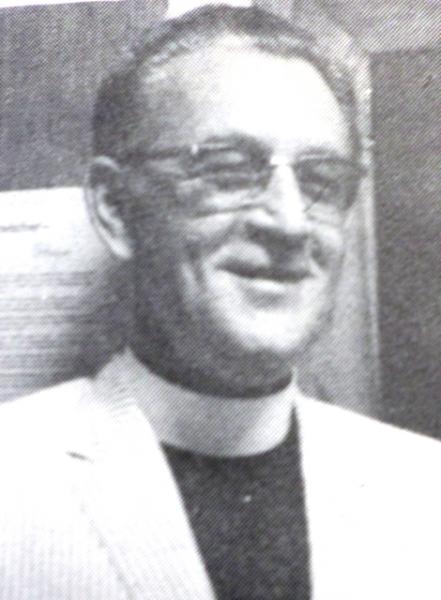
Reverend Thomas J. Lundy
Thomas J. Lundy built his house on Rayburn in 1960s-1970s.
Al Mead
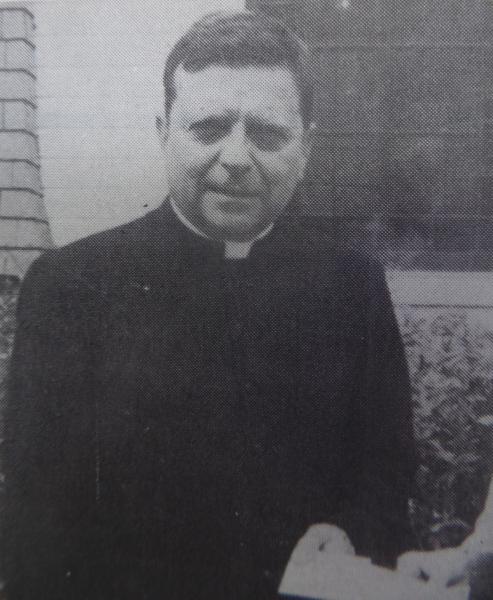
1986
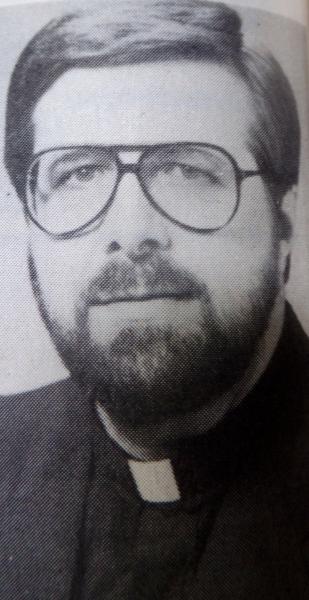
On June 7th, Mike Dobrosky was ordained a Deacon. He was the first seminarian since the church was erected to have been ordained in this sanctuary. Mike attended the Seabury-Western Theological Seminary at Evanston, Illinois.(The Ocean Springs Record, June 5, 1985, p. 2.
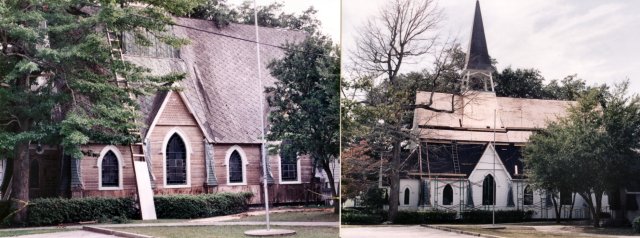
1995 renovations
Renovations 1995
In 1995, the church sanctuary was renovated at a cost of about $125,000. It was rewired, repainted for $30,000, and a new copper, shingle roof installed to replace the asbestos shingles. Richard McPhearson, local engineer, was the general contractor and Bruce Tolar, local architect, was also involved. While the old paint was being removed with scrappers and a blow torch, the wood caught fire and the OSFD called to the scene. There was no damage to the structure. The $88,000 copper, shingle roof was installed by Jim Wallis Roofing of Biloxi, Mississippi. The new roof did not fair well during Hurricane Georges of October 1998 and was later replace with an architectural shingle roof.
New Church Hall 2009
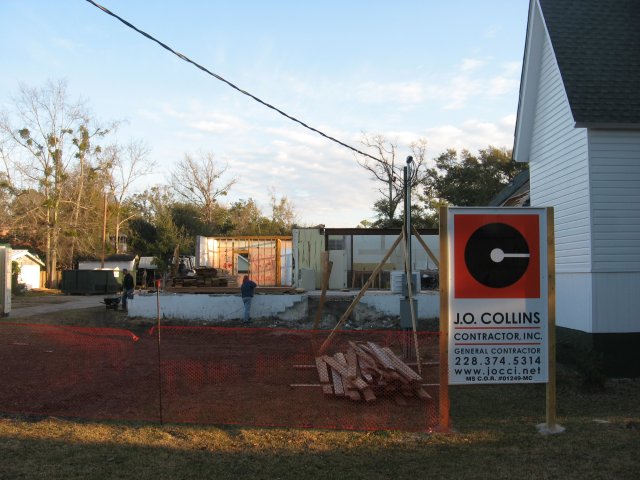
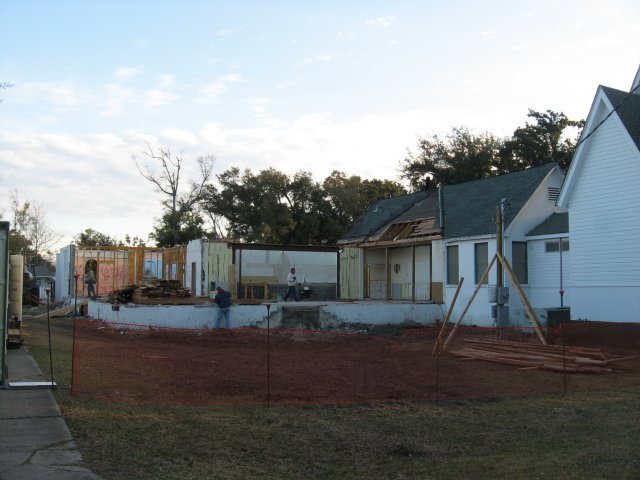
[L-R: rear south elevation March 2009]
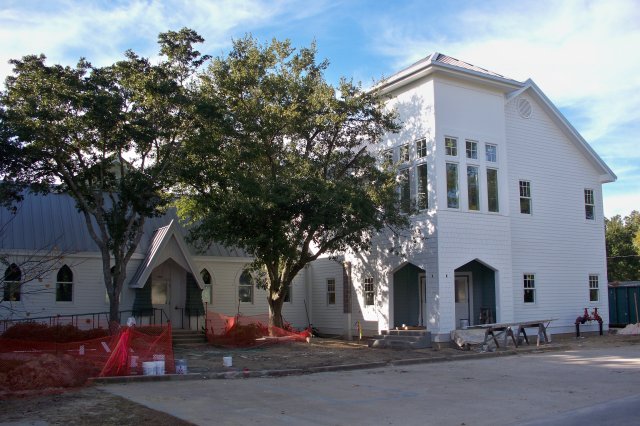
2008-2009 addition
Caption: St. John’s Episcopal Church circa 1900. This turn of the 20th Century image was composed by Miss Winifred Alma Norwood (1870-1937), the daughter of Fred W. Norwood (1840-1920) and Elizabeth Winne (1839-1912). At this time, the Episcopal sanctuary was only about eight years old. Remarkably, the exterior and interior of this 19th Century Gothic structure, which will be one-hundred ten years old in March 2002, has remained virtually unchanged. Past and present parishioners of St. John’s should be lauded for their untiring efforts at preserving this historic landmark. Hopefully this legacy will continue.
REFERENCES
Betty Clark Rodgers, Miscellaneous Records of Jackson County, Mississippi, Volume I, (Jackson County Genealogical Society: Pascagoula, Mississippi-1990).
St. John’s Episcopal Church History, Ocean Springs, Mississippi, (St. John’s Episcopal Church: Ocean Springs, Mississippi-19 ?)
Margaret Steelman, “An Historical Research On The Louis Sullivan Cottages In Ocean Springs, Mississippi”,(Steelman: USM Course, Housing 460, Hattiesburg, Mississippi-1973)
Journals
The Biloxi Herald, "Ocean Springs", November 8, 1890.
The Biloxi Herald, “Ocean Springs”, February 16, 1891.
The Biloxi Herald, “Ocean Springs”, June 20, 1891.
The Biloxi Herald, “Ocean Springs”, July 11, 1891.
The Biloxi Herald, “Ocean Springs”, November 21, 1891.
The Biloxi Herald, “Ocean Springs”, December 5, 1891.
The Biloxi Herald, “Ocean Springs”, December 19, 1891.
The Biloxi Herald, “Ocean Springs”, December 26, 1891.
The Biloxi Herald, “Ocean Springs”, January 9, 1892.
The Biloxi Herald, “Ocean Springs”, January 23, 1892.
The Biloxi Herald, “Opening a New Church”, April 30, 1892.
The Biloxi Herald, “Coast Items”, December 12, 1896.
The Biloxi Herald, “Father Ayres”, December 26, 1896.
The Biloxi Herald, “John Morrison Ayres [obituary]”, March 22, 1897.
The Churchman, “Personals”, April 10, 1886.
The Daily Herald, “Honor Rev. DeMiller for 25 years of service to Biloxi church”, October 13, 1934.
The Daily Herald, “Ocean Springs”, July 8, 1946.
The Daily Picayune, “To Rent”, December 10, 1891.
The Daily Picayune, “Death of a Christian woman [Mrs. Nelson Ayres]”, July 14, 1894.
The Daily Picayune, “Catholic News”, May 10, 1898.
The Daily Picayune, “A Bonfuca Church”, August 5, 1899.
The Daily Picayune, “Hotel arrivals”, July 18, 1901.
The Daily Picayune, “Personal Points”, June 13, 1903.
The Daily Picayune, “Personal and General Notes”, February 5, 1904.
The Daily Picayune, “St. Bartholomew in Kenner”, August 23, 1906.
The Daily Picayune, “GAR head visits the men in Gray”, March 4, 1910.
The Gulf Coast Times, “ , May 20, 1949.
The Jackson County Times, “Parish House ceremony set”, May 7, 1948.
The Jackson County Times, “New Parish House open”, May 14, 1948.
The Ocean Springs News, “Lewis-Davis”, January 7, 1911.
The Ocean Springs News, "Death of Mrs. Ada M. Switzer", November 21, 1914.
The Ocean Springs News, “Episcopal Church Breaks Record”, February 25, 1915.
The Ocean Springs News, “Rectory?”, March 9, 1916.
The Ocean Springs News, “Church group told of new building plans”, March 9, 1916.
The Ocean Springs Record, “Rectory of St. John’s”, February 23, 1967, p. 1.
The Ocean Springs Record, “Rector [Rev. Thomas J. Lundy] returns home”, November 8, 1956.
The Ocean Springs Record, “Reverend David E. Holt”, November 12, 1970, p. 1.
The Ocean Springs Record, “Renabel Boney Holt”, July 14???, 1970.
The Ocean Springs Record, “St. John’s Has Long History”, December 3, 1970.
The Ocean Springs Record, "Barry L. Cotter ordained", April 16, 1987, p. 2)
The Ocean Springs Record, “St. John’s Episcopal Church”, February 24, 1994.
The Pascagoula Democrat-Star, “Booming Ocean Springs”, January 30, 1891.
The Pascagoula Democrat-Star, “Ocean Springs News”, March 18, 1892.
The Pascagoula Democrat-Star, “Ocean Springs News”, April 1, 1892.
The Pascagoula Democrat-Star, “Ocean Springs News”, May 3, 1892.
The Pascagoula Democrat-Star, “Ocean Springs Locals”, October 15, 1897.
The Pascagoula Democrat-Star, “Ocean Springs Locals”, January 21, 1898.
The Pascagoula Democrat-Star, “Ocean Springs Locals”, April 21, 1899.
The Pascagoula Democrat-Star, “Ocean Springs Locals”, July 13, 1906.
The Progress, “Local News Items”, September 8, 1904.
The Sun Herald, “Church’s new old look draws interest”, October 28, 2001.
Photographs
Emilie Lancaster-435-7433
Gulf Photo Service, Gulfport, Mississippi. No. 1755
Lutheran
The organized Lutheran religion at Ocean Springs is relatively new. Services commenced in September 1963, and the congregation was officially organized as Christus Victor Lutheran Church on February 23, 1964. It is part of the Southeastern Synod of the Lutheran Church in America. The Reverend Richard Dahlke was the first pastor. Parishioners met in a building at 703 Washington Avenue until a sanctuary was built at 2755 Bienville Boulevard in 1967. The land, 2 1/4 acres was purchased in April 1964 from the Fort Bayou Development Corporation for $22,500.(The Ocean Springs News, April 30, 1964, p. 1)
On August 6, 1967, the first services were held in the new church with the Reverend B.F. Rutrough in charge.
REFERENCES:
The Ocea Springs News, "Lutheran purchase ground here", April 30, 1964.